
|
E - My Newspapers&Magazines related to JFK & KENNEDY Family |
| Items 51 - 100 | ||
|
1940, May 31 - Corriere della Sera |
||
|
|
|
Copy
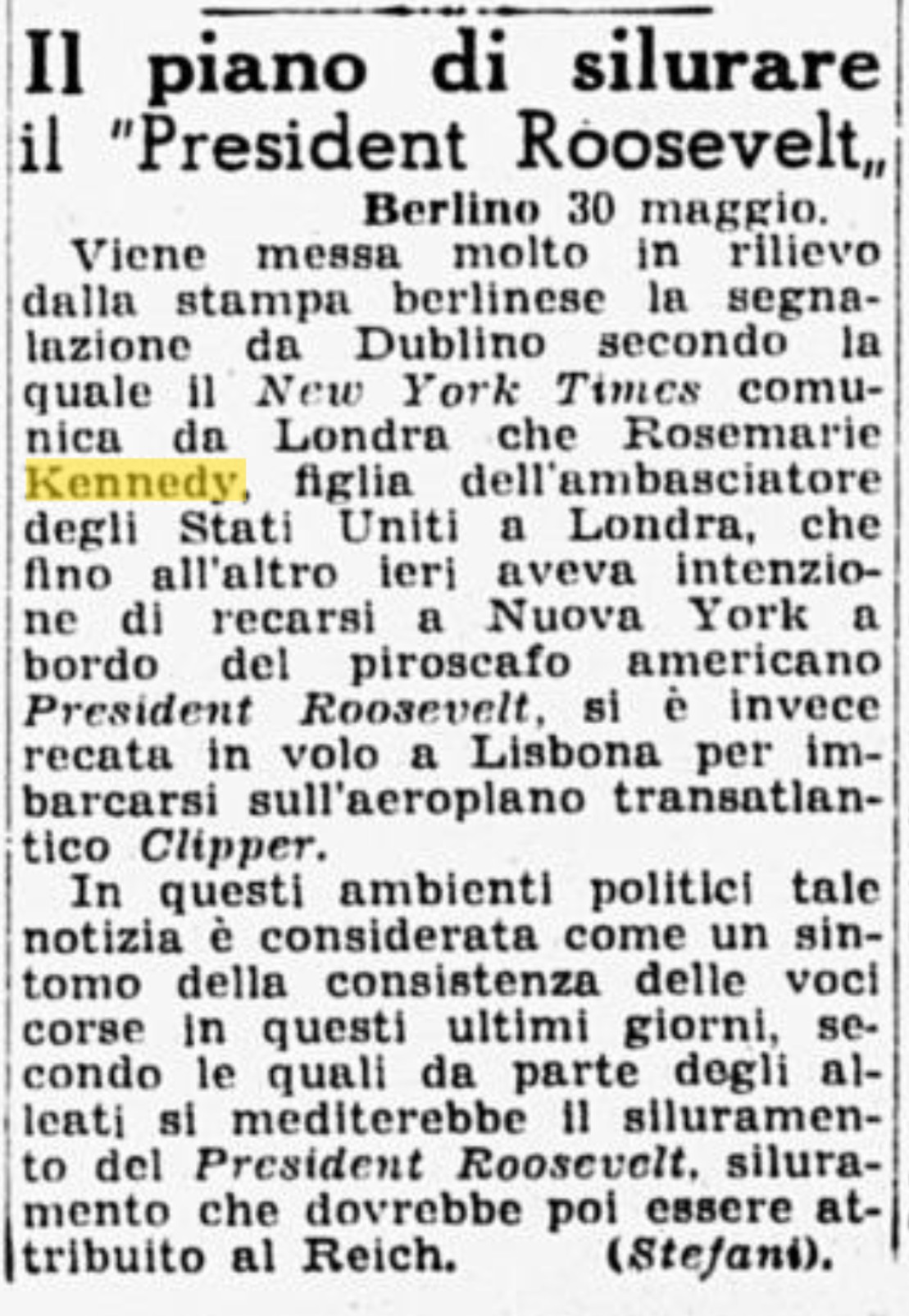
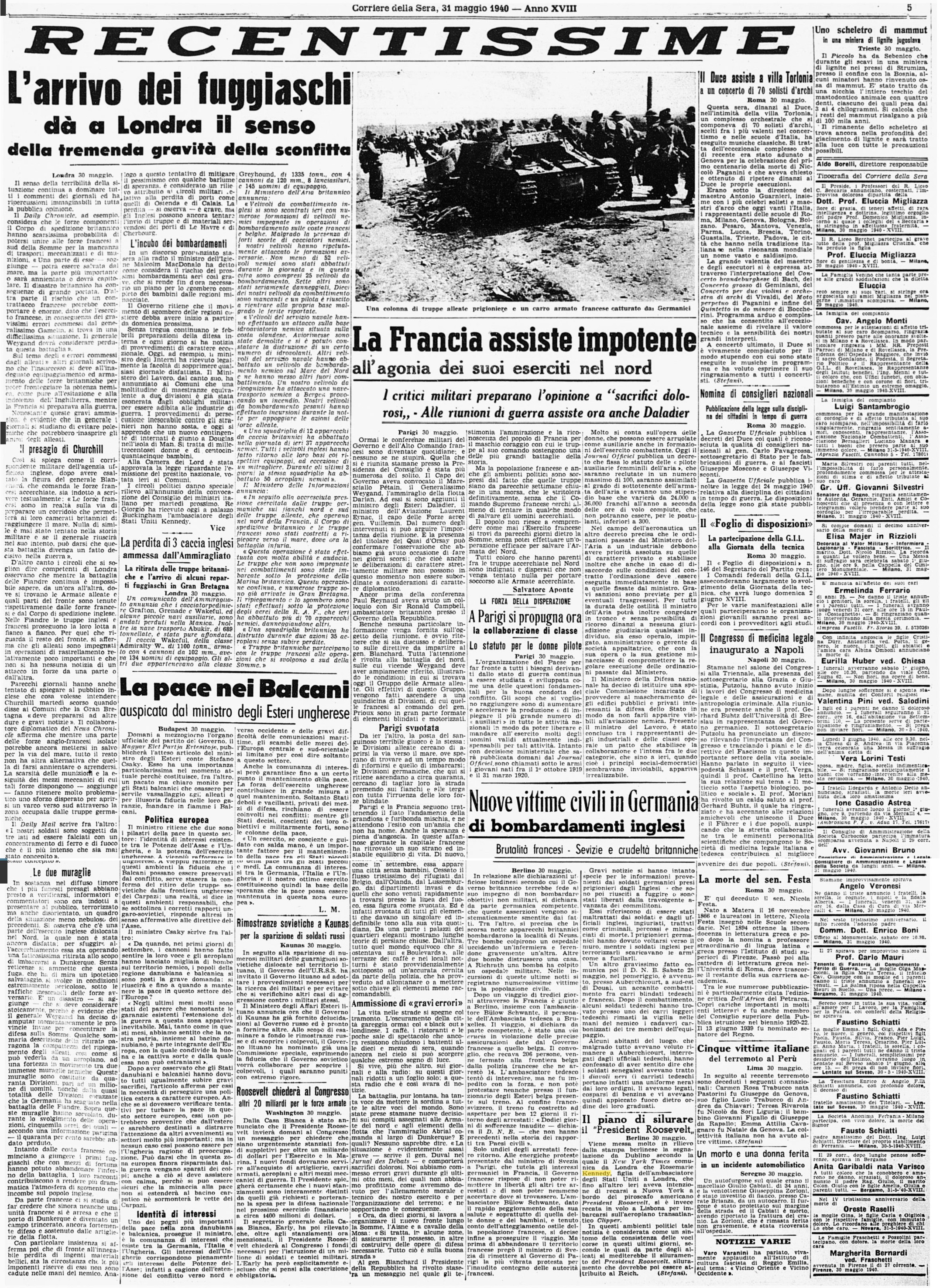
of an article from the Italian daily newspaper *Corriere della Sera*,
dated Friday, May 31, 1940. A short piece (a dispatch from the Stefani news agency, datelined Berlin, May 30) titled: "The Plot to Torpedo the 'President Roosevelt'" Summary of the article: ° Berlin’s propaganda ploy: The German press is giving significant prominence to a report originating from Dublin, which itself is based on a dispatch from London by *The New York Times*. In Berlin political circles, this news is being interpreted as confirmation of rumors that had been circulating in the preceding days regarding an alleged Allied plot to torpedo the American steamship *President Roosevelt* and subsequently pin the blame on Germany. ° A change of plans for his daughter, Rosemary: The dispatch makes indirect reference to the U.S. Ambassador in London through the travel arrangements of his family. The story centers on Rosemary Kennedy, identified as the daughter of the United States Ambassador to London, Joseph Kennedy. It is noted that, although she had intended—as recently as two days prior—to return to New York by sea aboard the *President Roosevelt*, she suddenly altered her plans, traveling by air to Lisbon to board a transatlantic "Clipper" seaplane instead. |
|
1940, June 6 - Corriere della Sera |
||
|
|
|
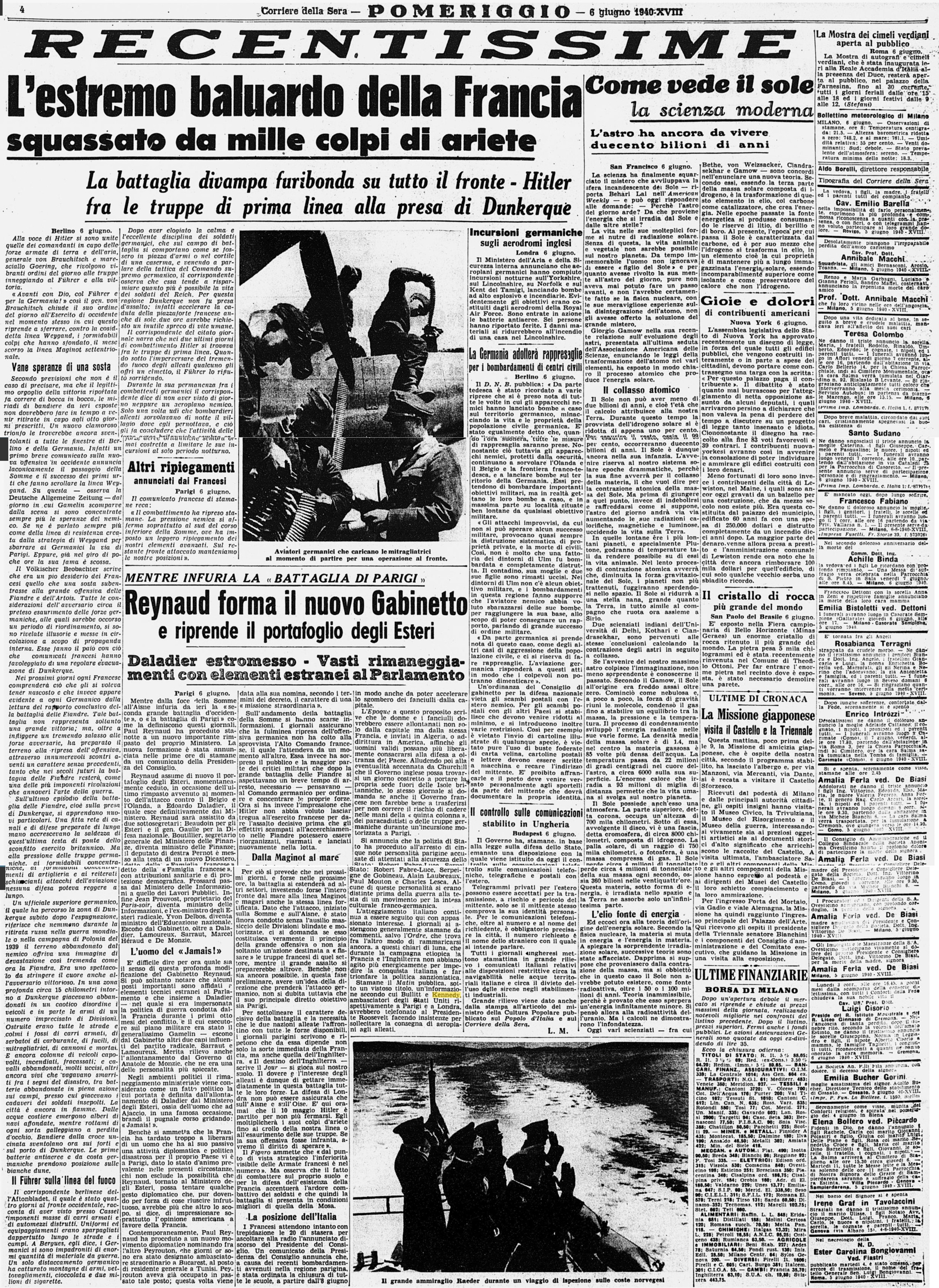
Copy
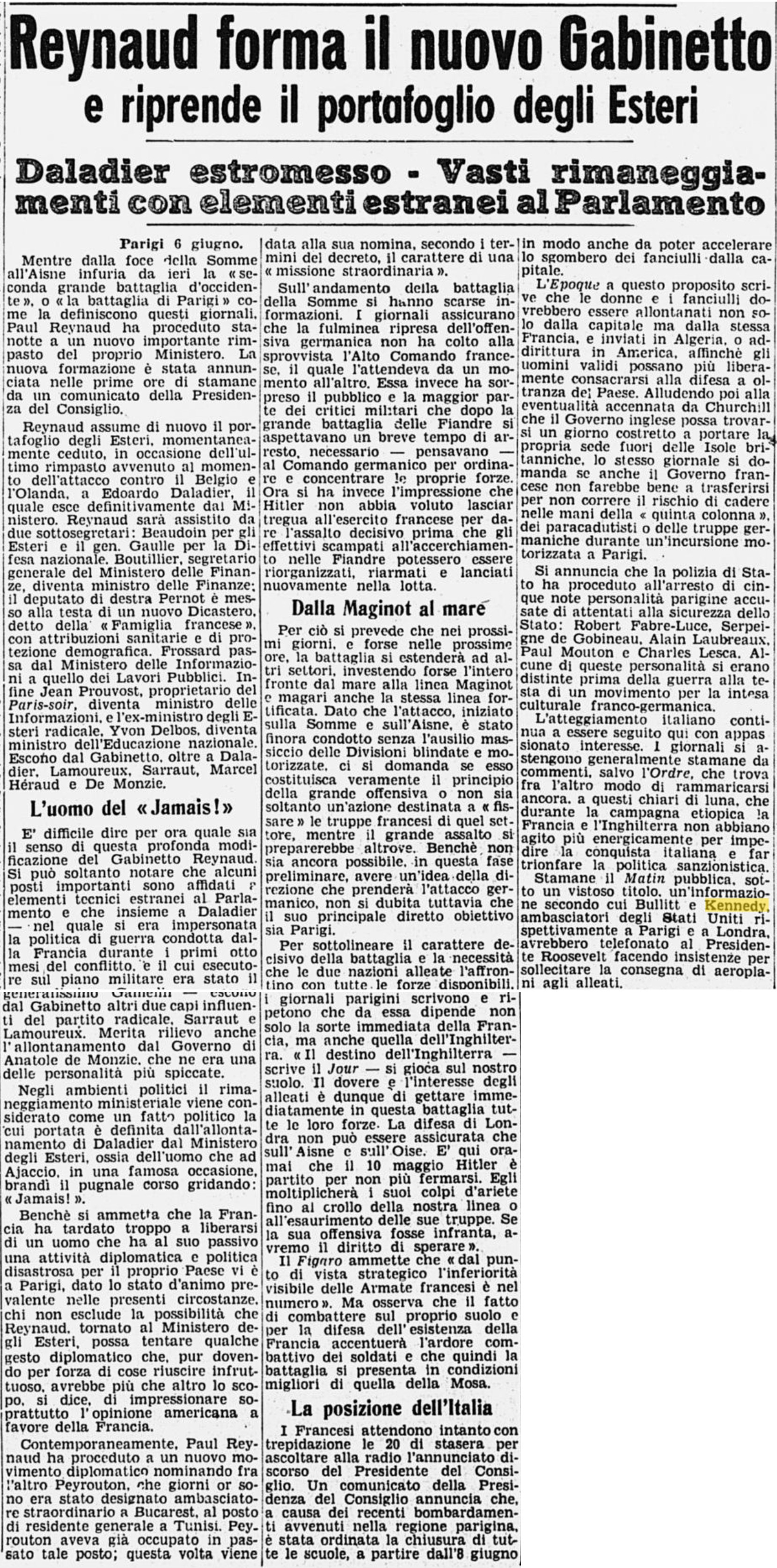
of an article from the Italian daily newspaper CORRIERE DELLA SERA, dated
Thursday, June 6, 1940. Article (from Paris) titled "Reynaud forms the new Cabinet and takes over the Foreign Affairs portfolio." Summary of the article: ° The French government reshuffle: As the new German offensive rages along the Somme and the Aisne ("the Battle for Paris"), Prime Minister Paul Reynaud is carrying out a major reorganization of the Cabinet. Reynaud has personally assumed the Foreign Affairs portfolio, definitively ousting Édouard Daladier. ° Focus on Joseph Kennedy – Pressure on Roosevelt to send aircraft: The final part of the article mentions a significant piece of inside information, prominently featured in the Parisian newspaper *Le Matin*. According to these reports, U.S. Ambassador to London Joseph Kennedy and his counterpart in Paris, William Bullitt, placed direct phone calls to President Roosevelt. The two diplomats reportedly exerted strong pressure on the White House, urging the urgent dispatch of aircraft to the Allies, who were struggling to cope with the critical military situation on the Western Front. |
|
1940, September 29 - Corriere della Sera |
||
|
|
|
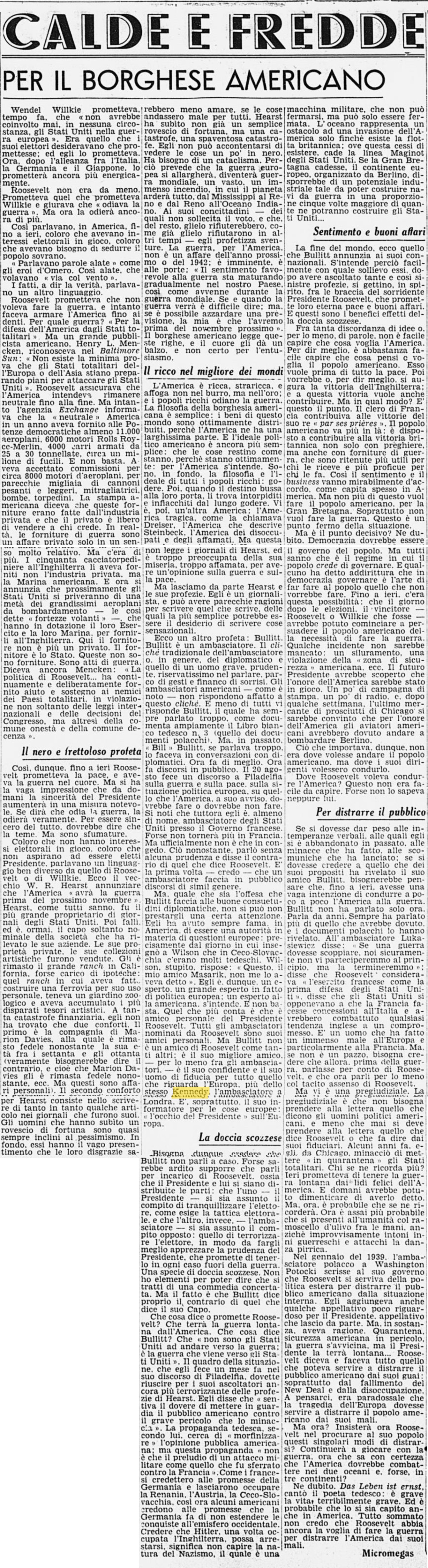
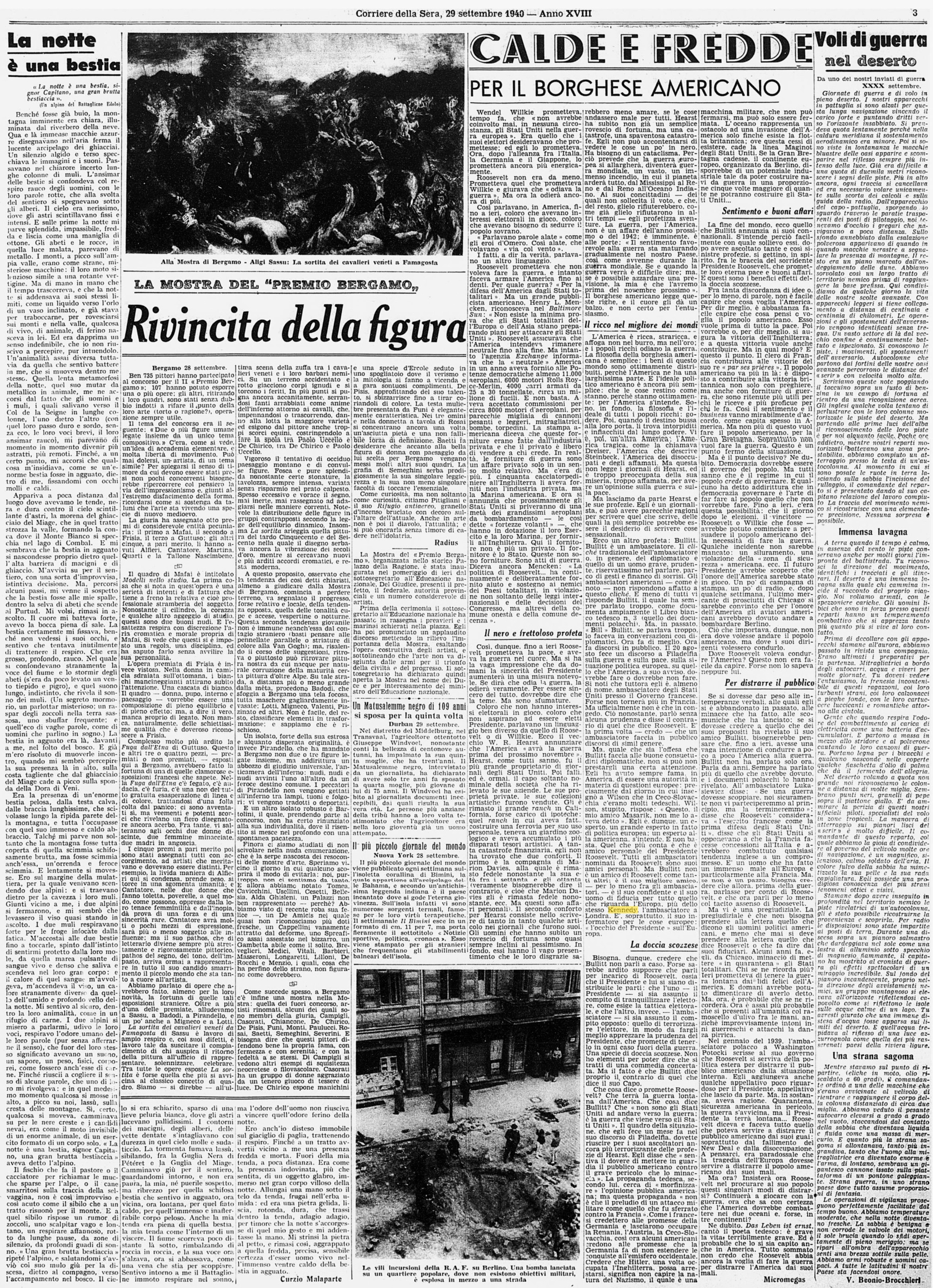
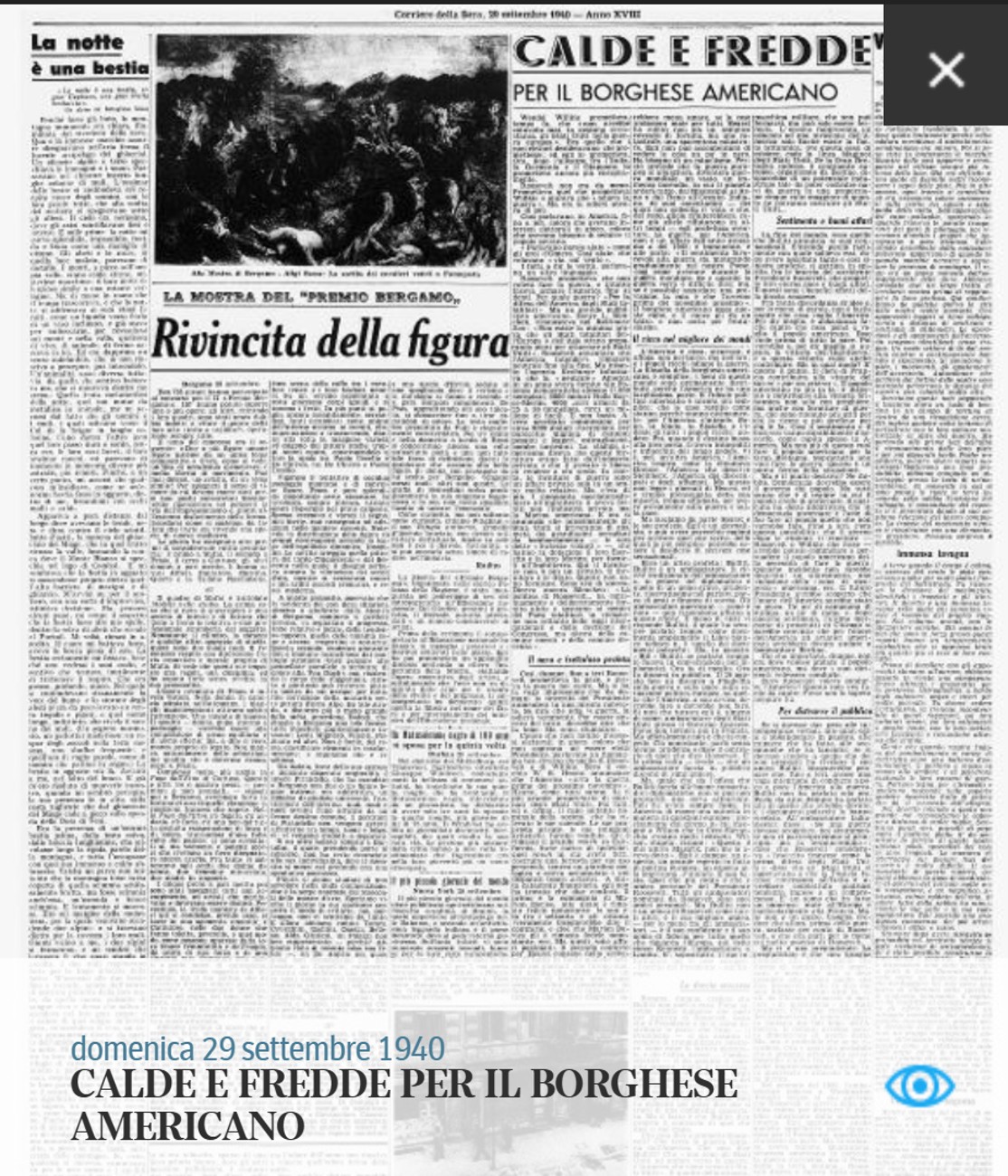
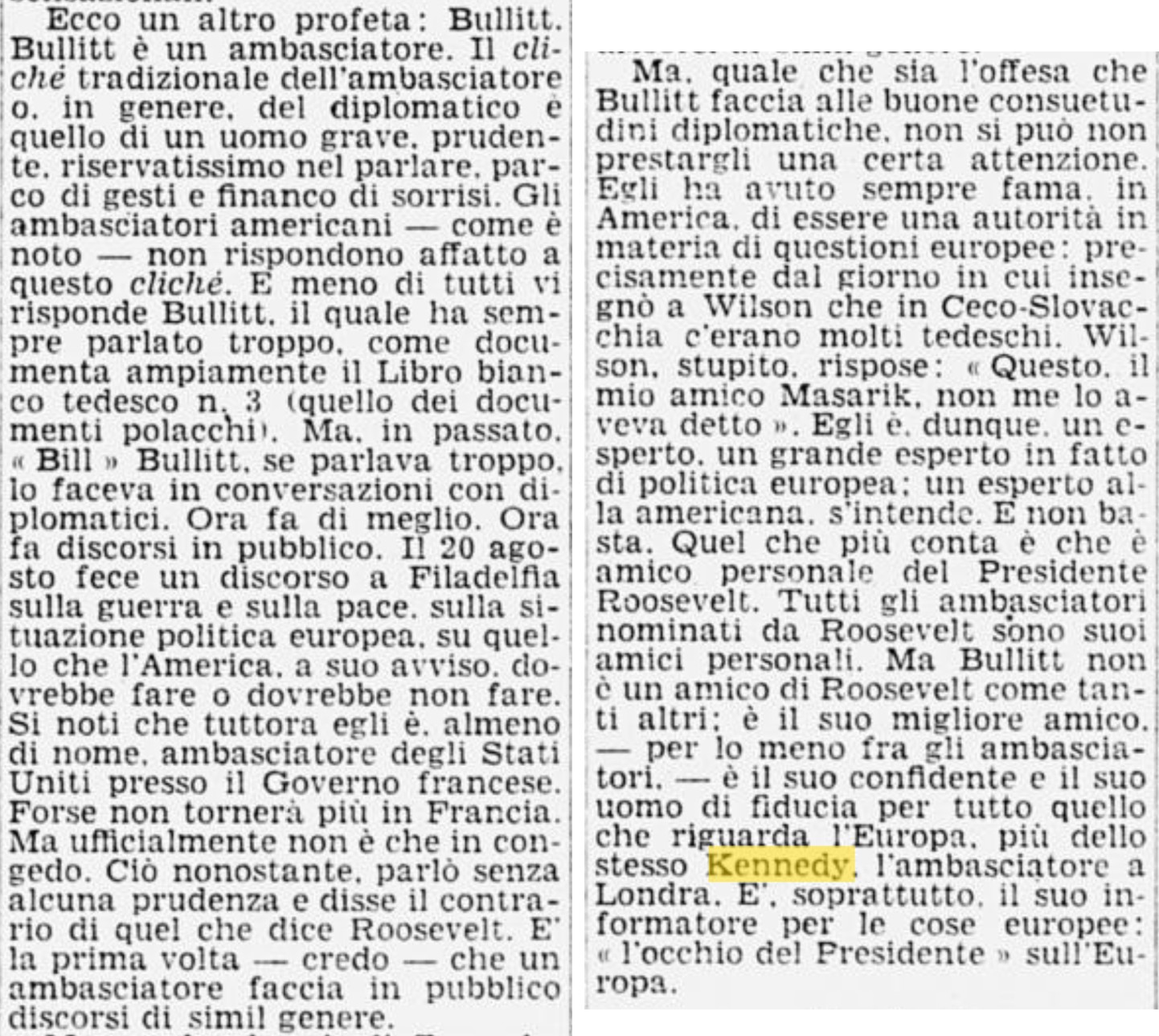
Copy
of an article from the Italian daily newspaper *Corriere della Sera*,
dated Sunday, September 29, 1940. Article titled "Hot and Cold for the American Bourgeois" (signed by Micromegas). Summary of the article: ° The contradictions of American politics and the election campaign: The columnist offers a polemical analysis of the pacifist promises made by U.S. presidential candidates Franklin D. Roosevelt and Republican Wendell Willkie, contrasting them with the massive rearmament efforts and military supplies—including airplanes, destroyers, and weaponry—sent to Great Britain, which constituted a substantial violation of American neutrality. The piece also cites publisher W. R. Hearst’s grim predictions that the United States would enter the war by the following November, alongside Roosevelt’s speeches, which sought to alarm the electorate regarding the threat of aggression by totalitarian powers. ° The role of William Bullitt and his confrontation with Joseph Kennedy: In examining the influence of Roosevelt’s advisors on foreign policy, the article focuses on the U.S. Ambassador to Paris, William Bullitt—described as the President’s "best friend" and primary confidant on European affairs. Bullitt is accused of having helped fuel the war in Europe through his public statements and diplomatic maneuvers (as evidenced by Polish documents). ° Focus on Joseph Kennedy – His subordinate role relative to Bullitt: In assessing the hierarchy of influence within the White House, the author draws a sharp contrast between the ambassador to France and the U.S. ambassador to London. It is specified that Roosevelt’s true confidant and trusted advisor on European affairs is William Bullitt—not Joseph Kennedy, the ambassador in London. According to the author, Bullitt carries significantly more political weight than Kennedy, as he is regarded as the President’s primary source of information on European developments and his direct "eyes" on Europe. |
|
1940, October 19 - Corriere della Sera |
||
|
|
|
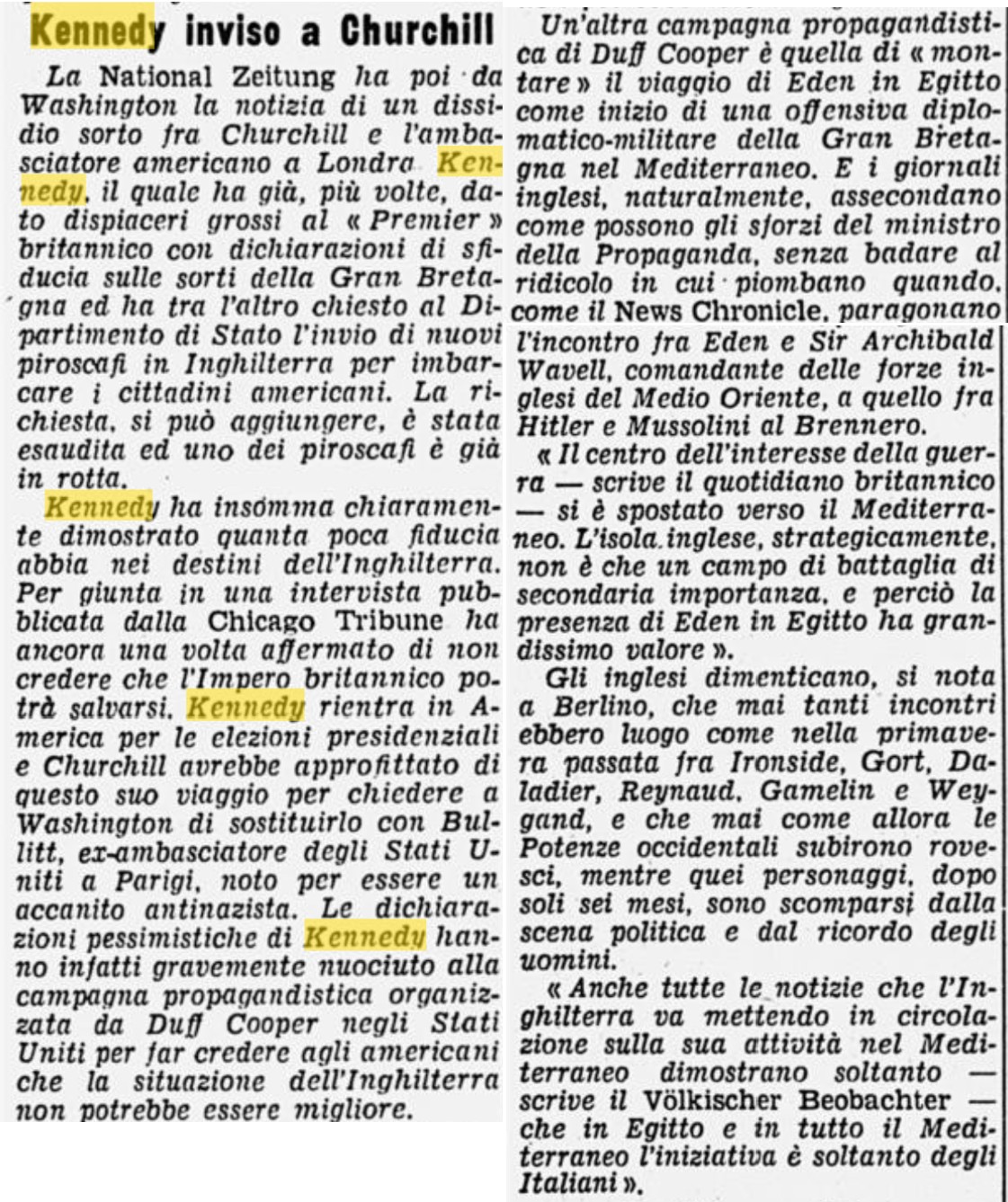
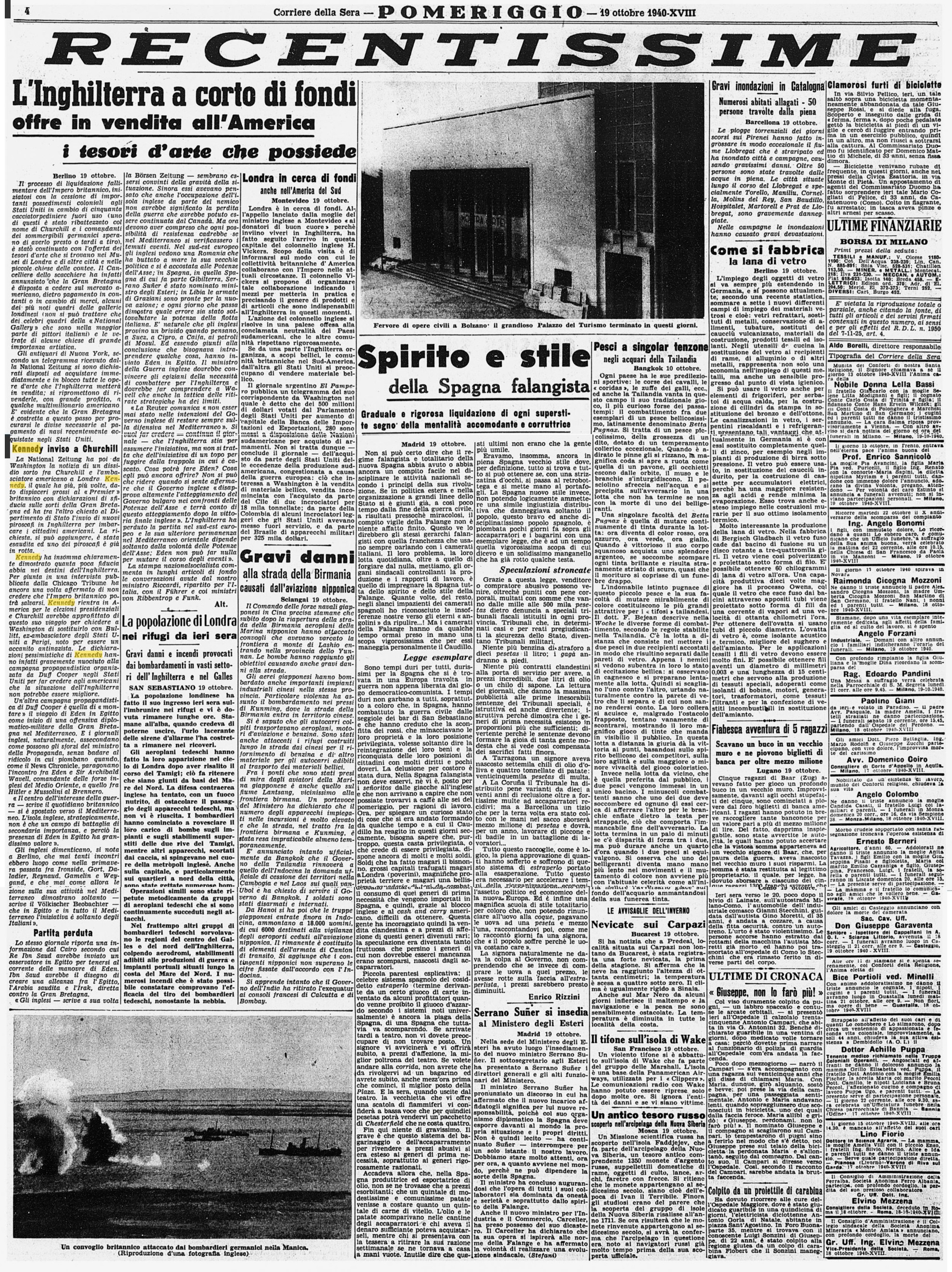
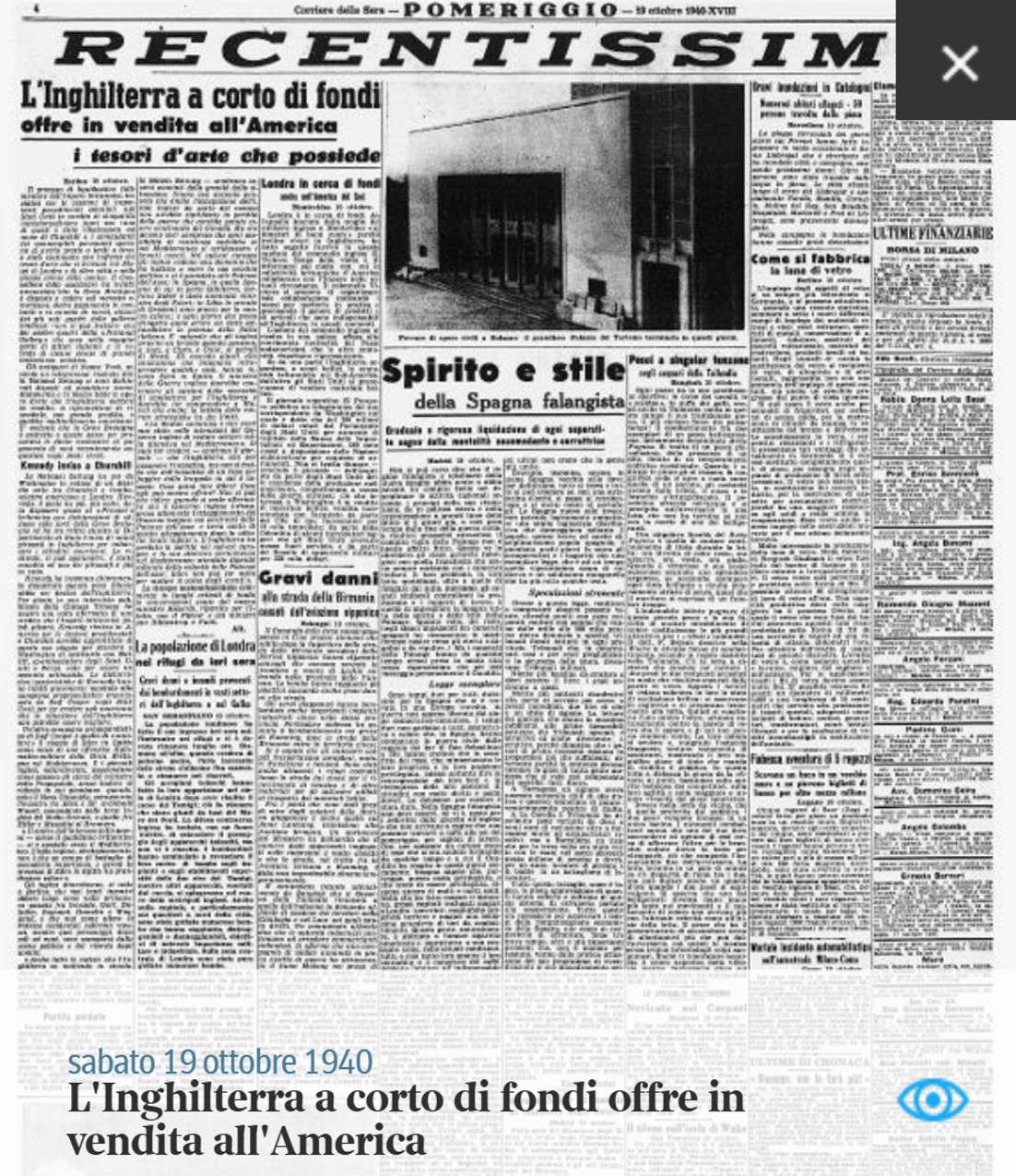
Copy
of an article from the Italian newspaper CORRIERE DELLA SERA, dated
Saturday, October 19, 1940. Article titled "Kennedy in Churchill’s bad graces." Summary of the article: Here is the summary: ° Focus on Joseph Kennedy – The clash with Churchill and his lack of faith in London: According to a report from Washington in the *National Zeitung*, an open rift has emerged between British Prime Minister Winston Churchill and the U.S. Ambassador to London, Joseph Kennedy. Kennedy has deeply irritated Churchill with repeated expressions of doubt regarding Great Britain’s future—going so far as to tell the *Chicago Tribune* that he did not believe the British Empire could be saved—and has also requested that the State Department send additional steamships to evacuate American citizens from the United Kingdom. ° The request for his replacement by Bullitt: Taking advantage of Kennedy’s return to the United States for the presidential election, Churchill reportedly asked Washington to replace him with William Bullitt (formerly ambassador to Paris and known for his fervent anti-Nazism), as the ambassador’s pessimism was undermining the British propaganda effort in the U.S., which was being orchestrated by Minister Duff Cooper. |
|
1940, October 22 - Corriere della Sera |
||
|
|
|
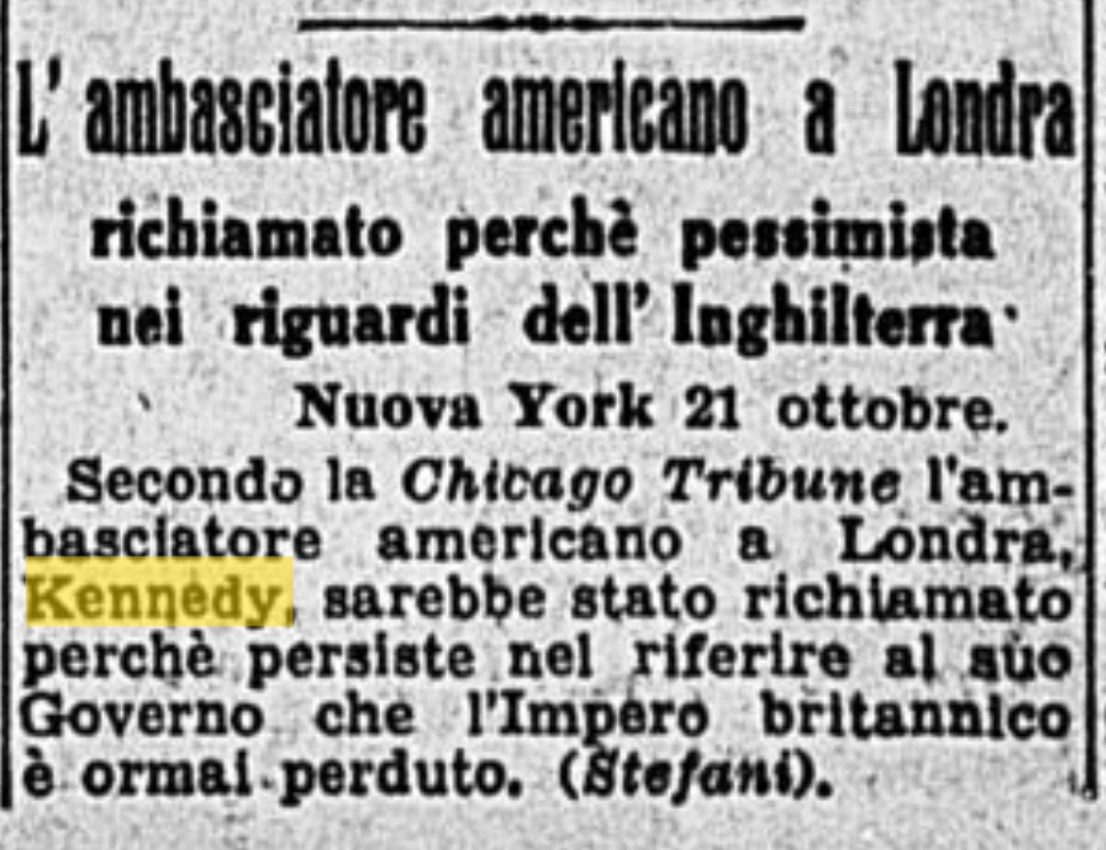
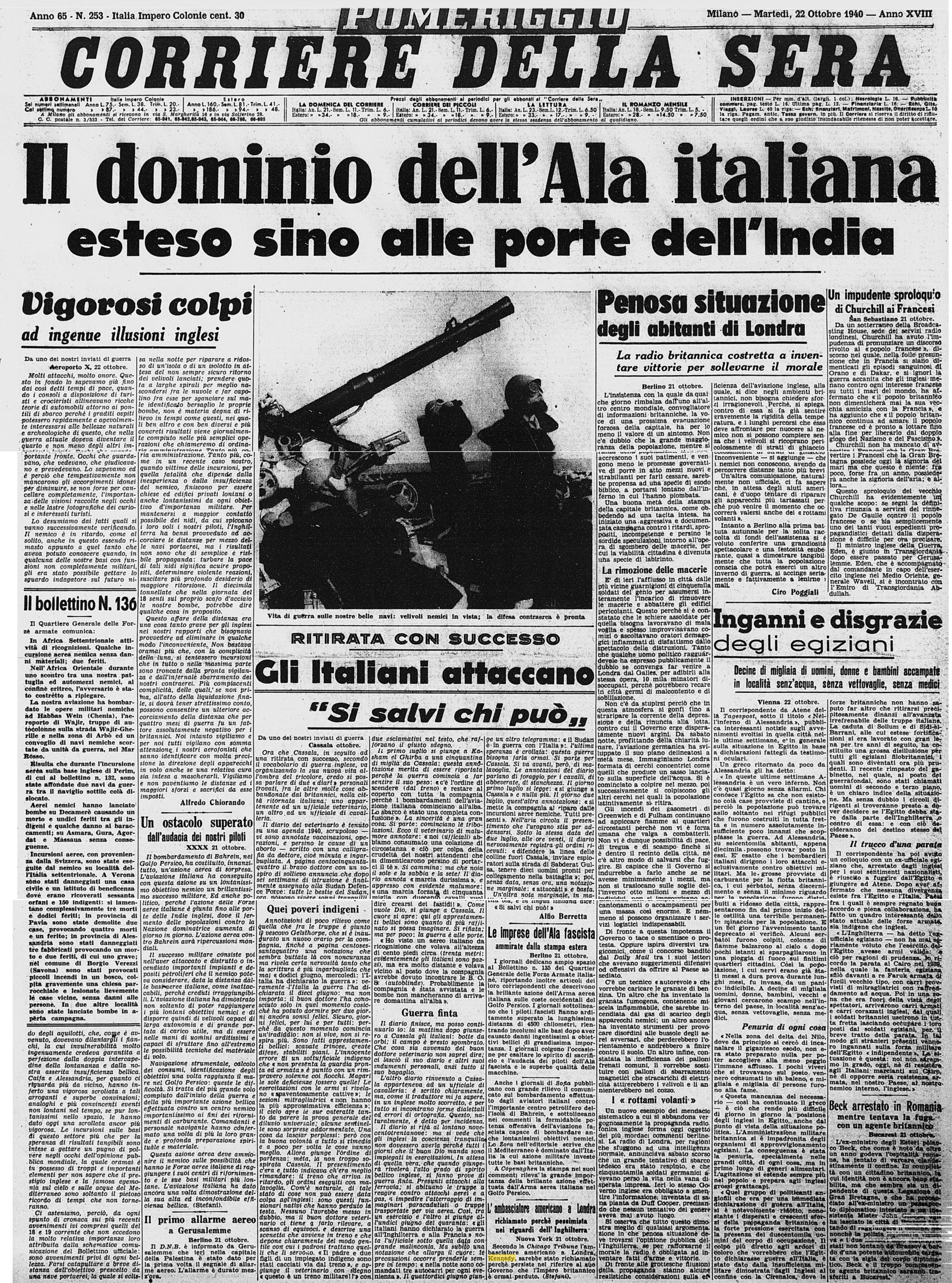
Copy of an
article from the Italian daily newspaper CORRIERE DELLA SERA, dated
Tuesday, October 22, 1940. The following is a summary of a short piece from the Corriere della Sera, titled "American Ambassador to London recalled for being pessimistic regarding England" (a dispatch from the Stefani news agency, New York, October 21): Citing the Chicago Tribune as its source, the dispatch reports that the United States Ambassador to London, Joseph Kennedy, has allegedly been recalled home by the Washington government. This decision is reportedly due to the fact that Kennedy persists in sending highly pessimistic reports to his government, maintaining that the British Empire is, by now, lost. |
|
1940, October 23 - Corriere della Sera |
||
|
|
|
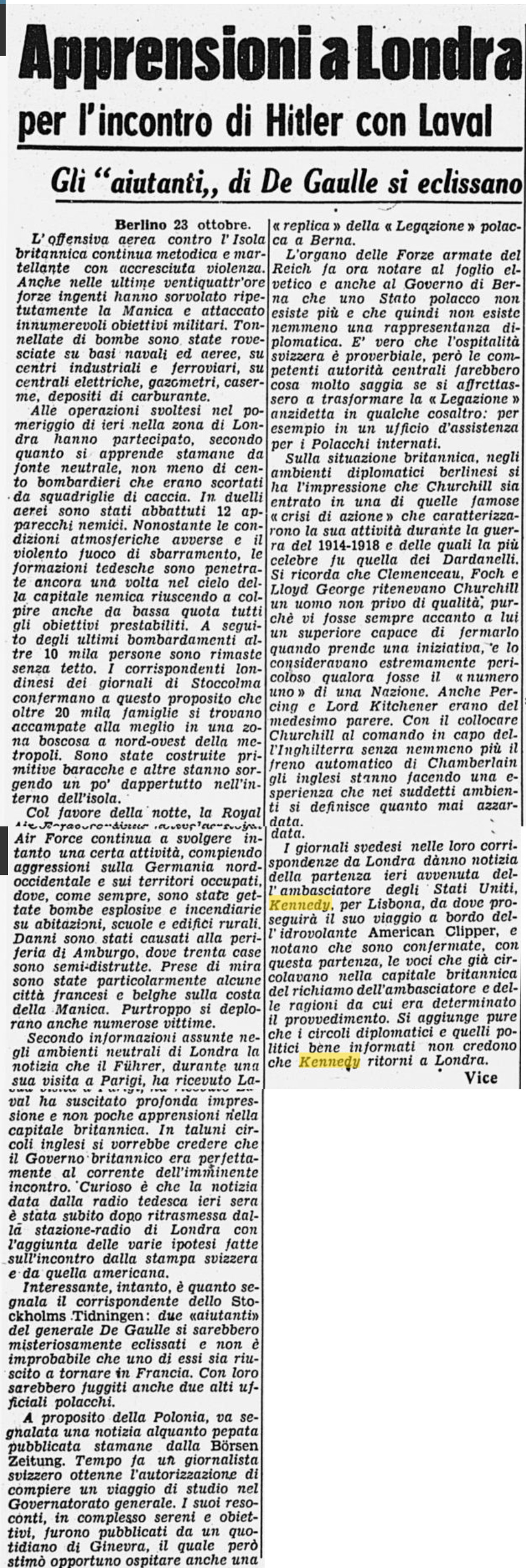
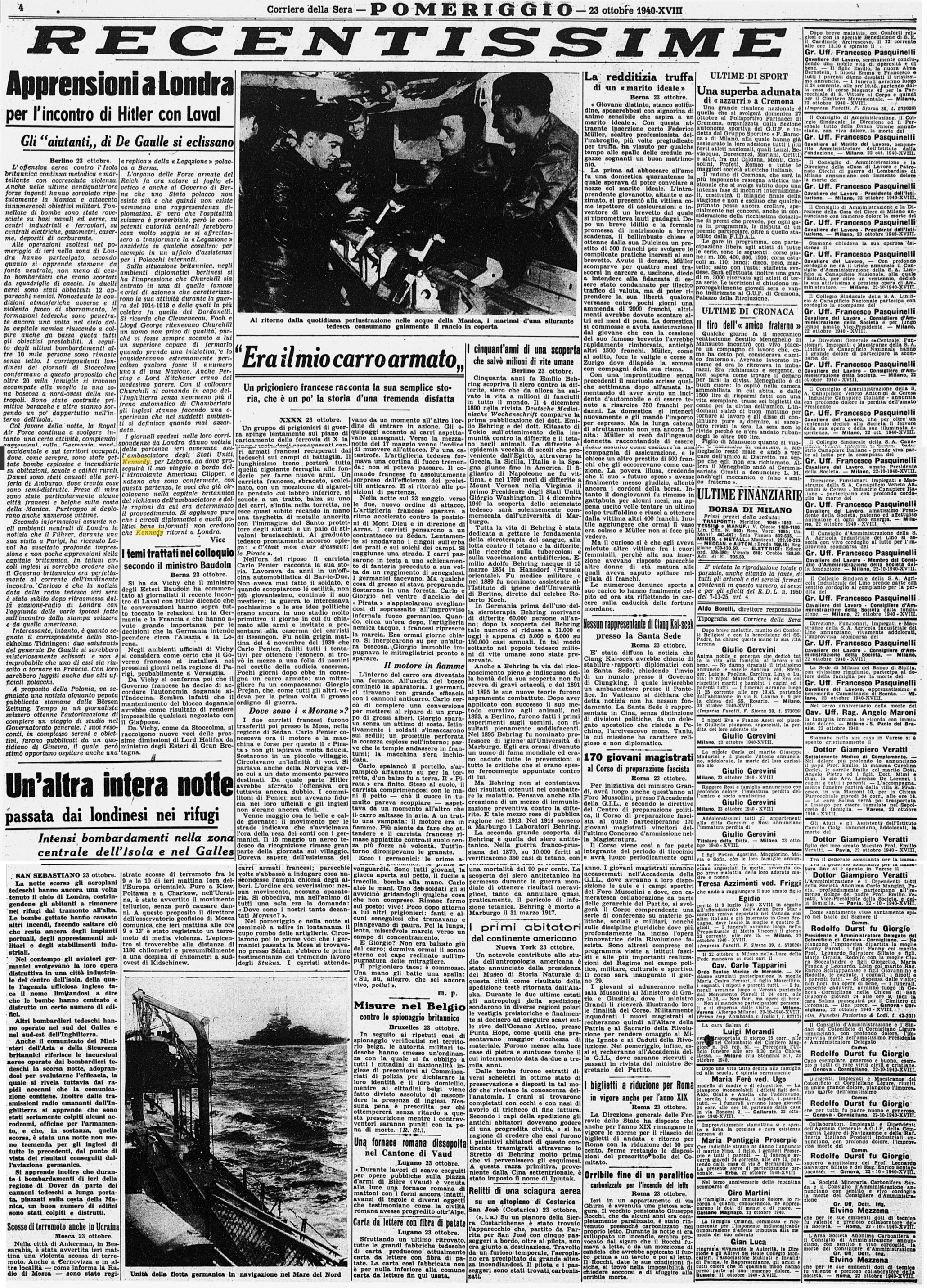
A copy of
an article from the Italian daily newspaper *Corriere della Sera*, dated
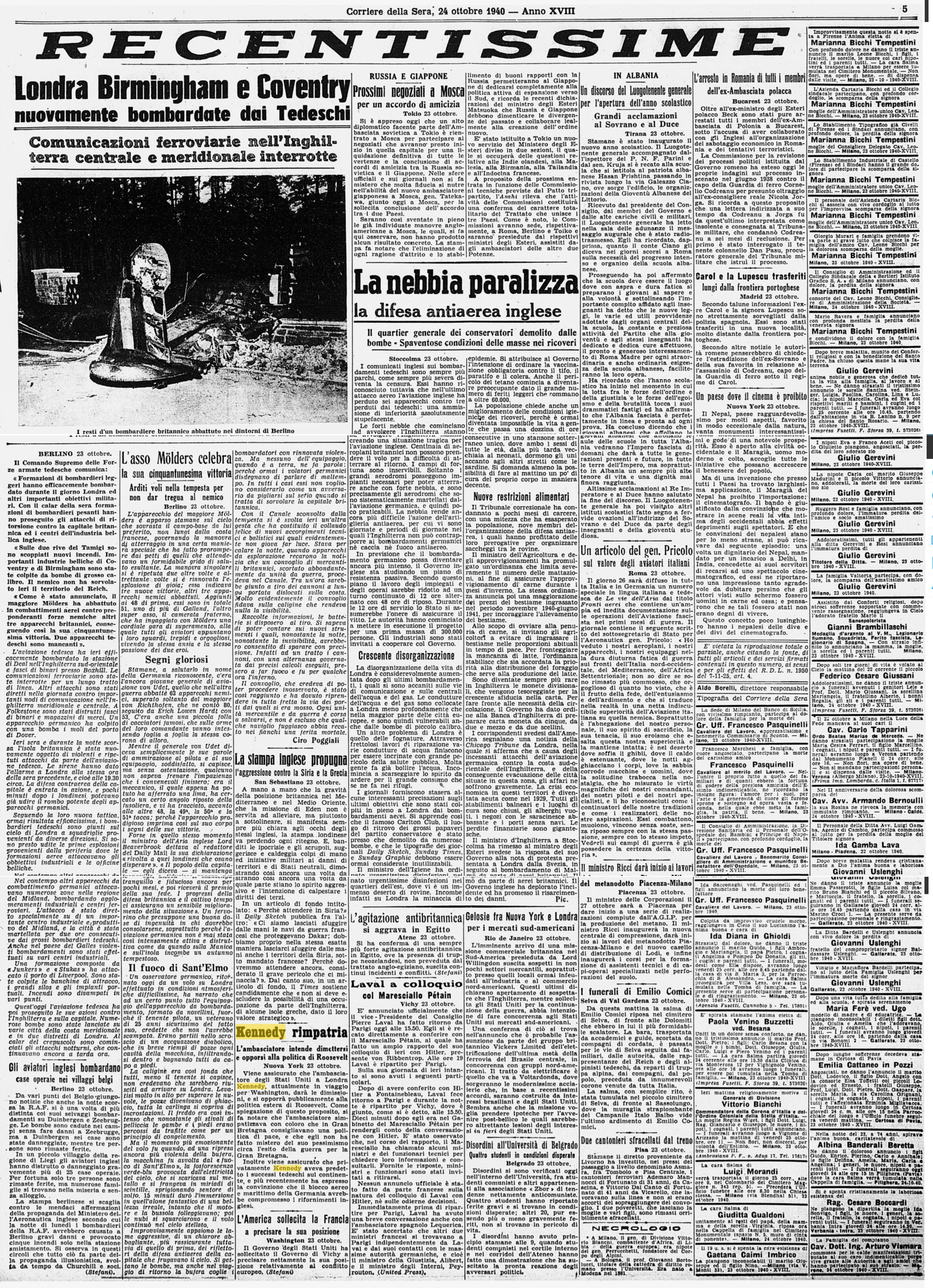
Wednesday, October 23, 1940. The article is titled "Apprehension in London over Hitler’s meeting with Laval – De Gaulle’s 'aides' vanish" (signed "Vice," reporting from Berlin). Summary: ° The bombing of England and the Hitler-Laval meeting: The report covers the ongoing German air offensive against military and civilian targets in Great Britain—noting thousands of displaced persons in London—as well as British nighttime raids on Hamburg and the occupied coasts. It also highlights the deep concern in London regarding the meeting in Paris between Hitler and Pierre Laval, alongside the mysterious disappearance of two of General de Gaulle’s associates. ° Focus on Joseph Kennedy – His departure from London and permanent return to the USA: In the final part of the article, citing reports from Swedish newspapers in London, the conclusion of the U.S. Ambassador’s diplomatic mission is confirmed. It is reported that Ambassador Joseph Kennedy left London the previous day, bound for Lisbon, from where he will continue his journey to the United States aboard the *American Clipper* seaplane. According to these journalistic sources, his departure confirms rumors that had been circulating in the British capital regarding Kennedy’s official recall and the reasons behind it. Finally, it is noted that, within well-informed diplomatic and political circles, it is now considered certain that Kennedy will not return to London. |
|
1940, October 24 - Corriere della Sera |
||
|
|
|
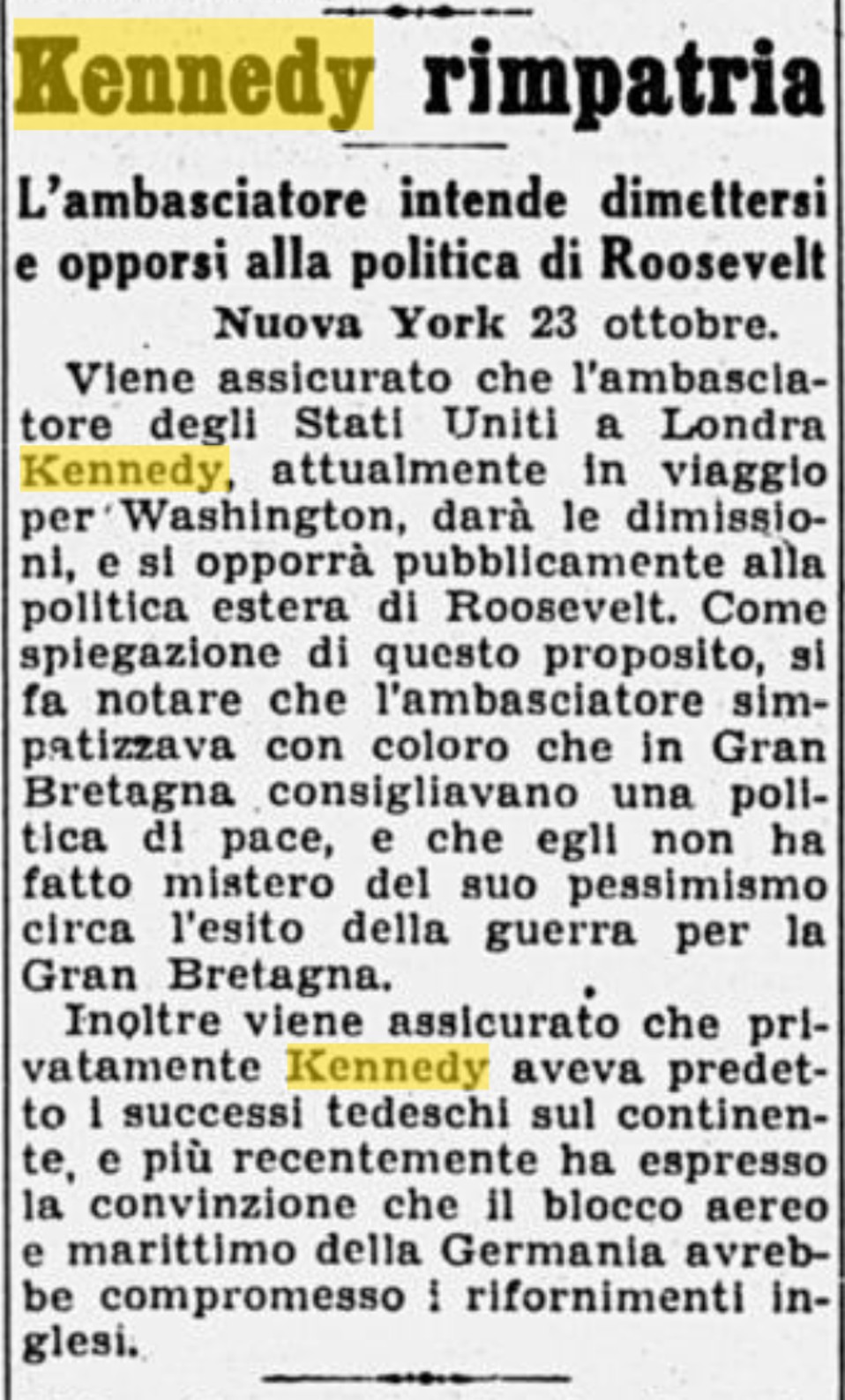
A copy of
an article from the Italian daily newspaper *Corriere della Sera*, dated
Thursday, October 24, 1940. A short piece (datelined New York, October 23) titled "Kennedy Returns Home – Ambassador Intends to Resign and Oppose Roosevelt’s Policy." Here is a summary: ° Focus on Joseph Kennedy – Resignation and a Break with Roosevelt: As he travels back to Washington, it is considered certain that the U.S. Ambassador to London, Joseph Kennedy, will submit his resignation. Kennedy reportedly intends to publicly oppose President Roosevelt’s foreign policy. ° Reasons for Dissent and Military Forecasts: The article explains this decision by highlighting the profound divergence in views that developed between the diplomat and the White House’s interventionist stance. Kennedy held sympathies for British circles that favored a policy of peace, and he had never concealed his pessimism regarding the outcome of the war for Great Britain. Privately, Kennedy had already foreseen German military successes on the European continent. More recently, he had expressed the conviction that the air and naval blockade imposed by Germany would compromise British supply lines. |
|
1940, October 25 - Corriere della Sera |
||
|
|
|
A
copy of an article from the Italian daily newspaper *Corriere della Sera*,
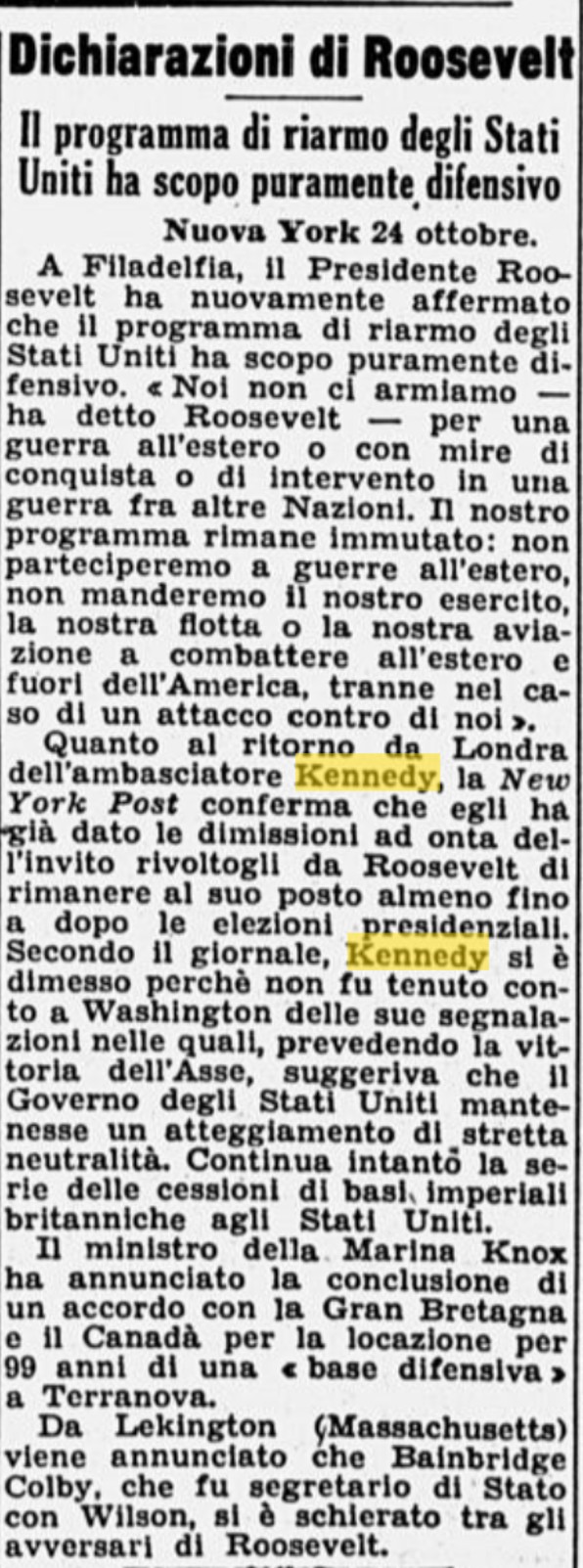
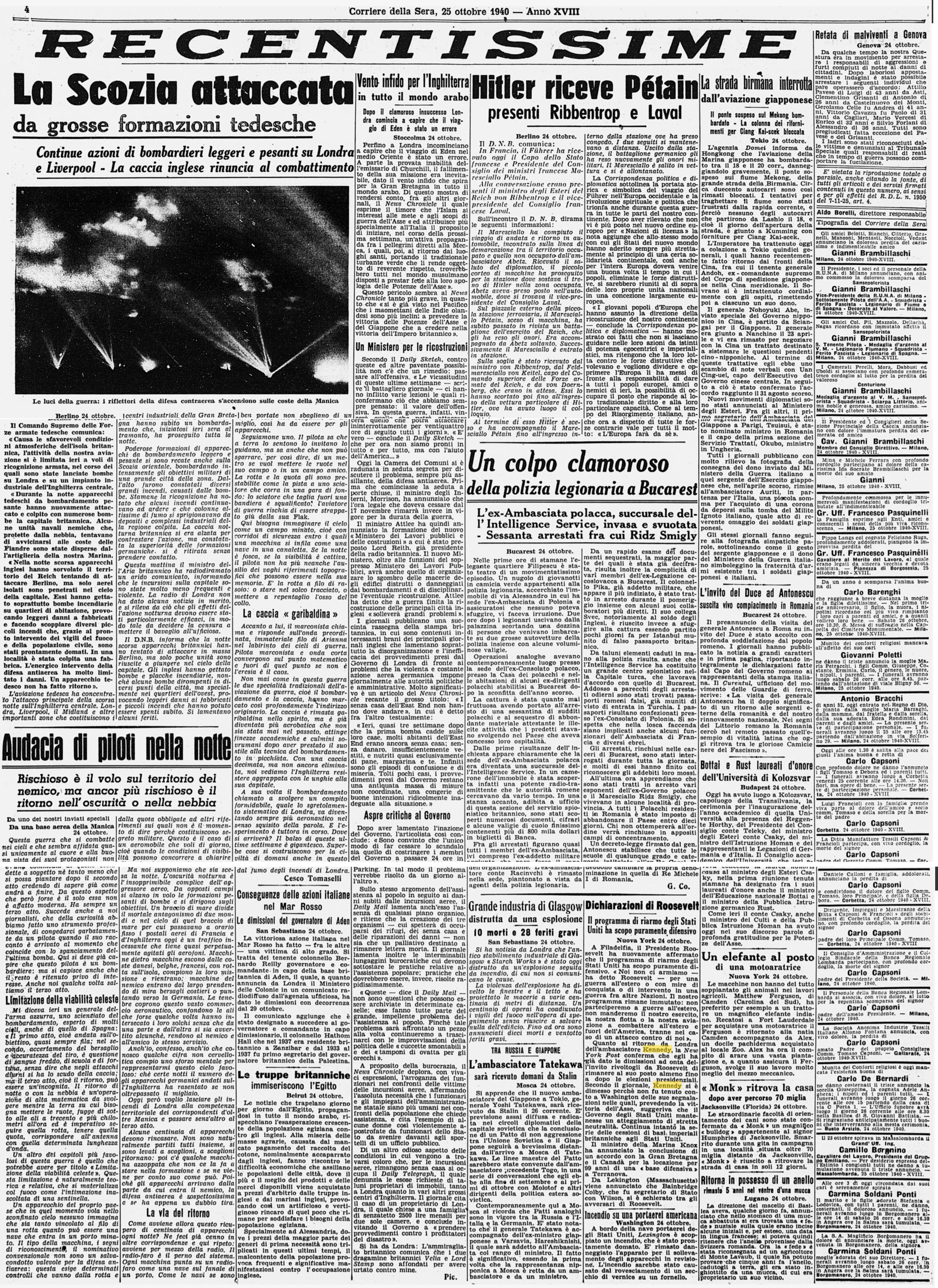
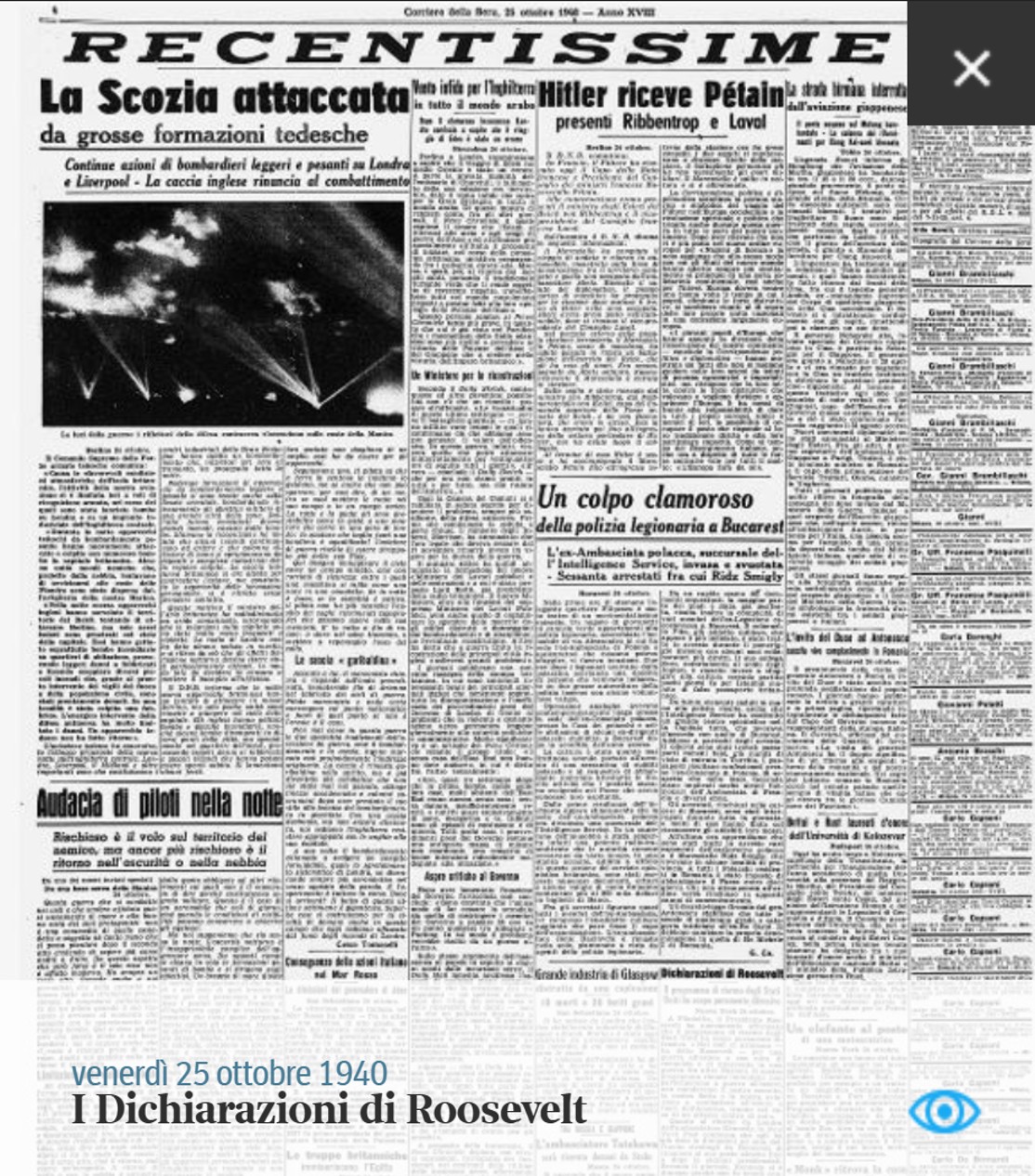
dated Friday, October 25, 1940. A short piece (datelined New York, October 24) titled "Statements by Roosevelt – The United States' rearmament program is purely defensive in nature." The following is a summary of the piece: ° Roosevelt’s peace-oriented reassurances: In a speech delivered in Philadelphia, President Roosevelt reiterated that the U.S. rearmament plan has exclusively defensive objectives. He gave assurances that the United States would not enter into foreign wars, nor would it send its army, navy, or air force outside the American continent, except in the event of a direct attack. ° Focus on Joseph Kennedy – Resignation confirmed despite Roosevelt’s request: On the diplomatic front, the article cites a report from the *New York Post* regarding the return of the U.S. Ambassador from London: Joseph Kennedy has already submitted his resignation, disregarding President Roosevelt’s request that he remain in his post at least until the conclusion of the presidential election. According to the American newspaper, Kennedy chose to resign because Washington had ignored his reports—in which he predicted a victory for the Axis powers and recommended that the U.S. government maintain a policy of strict neutrality. |
|
1940, October 26 - Corriere della Sera |
||
|
|
|
A
copy of an article from the Italian newspaper CORRIERE DELLA SERA, dated
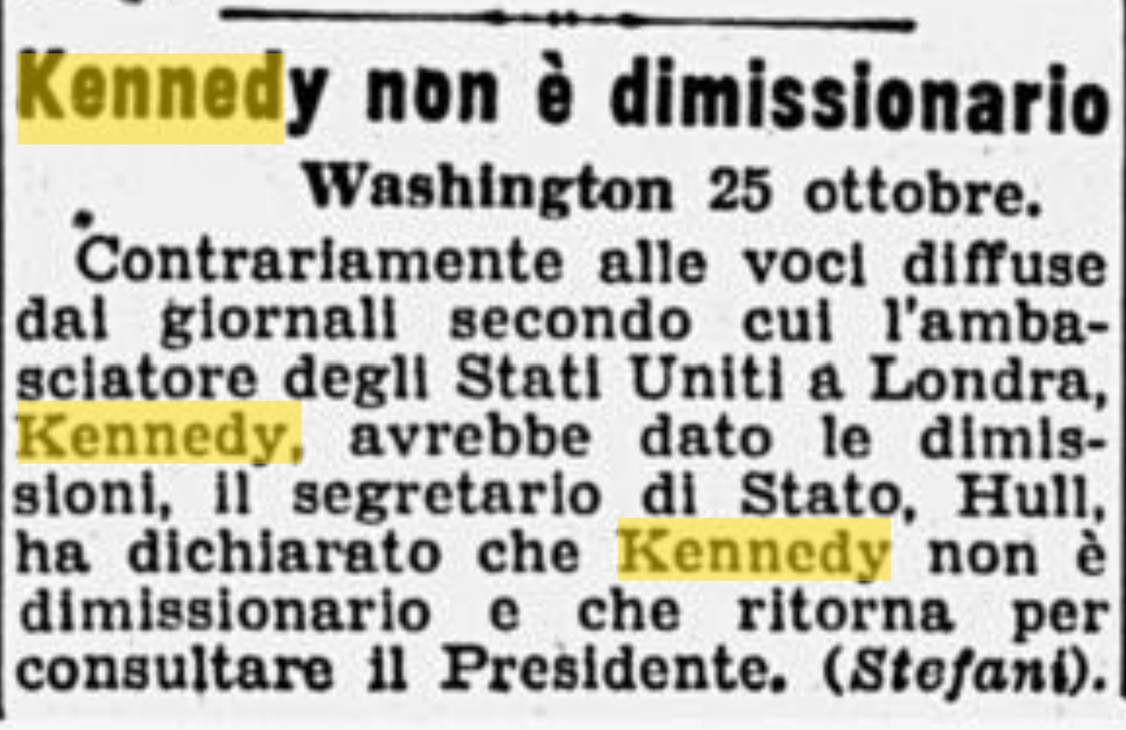
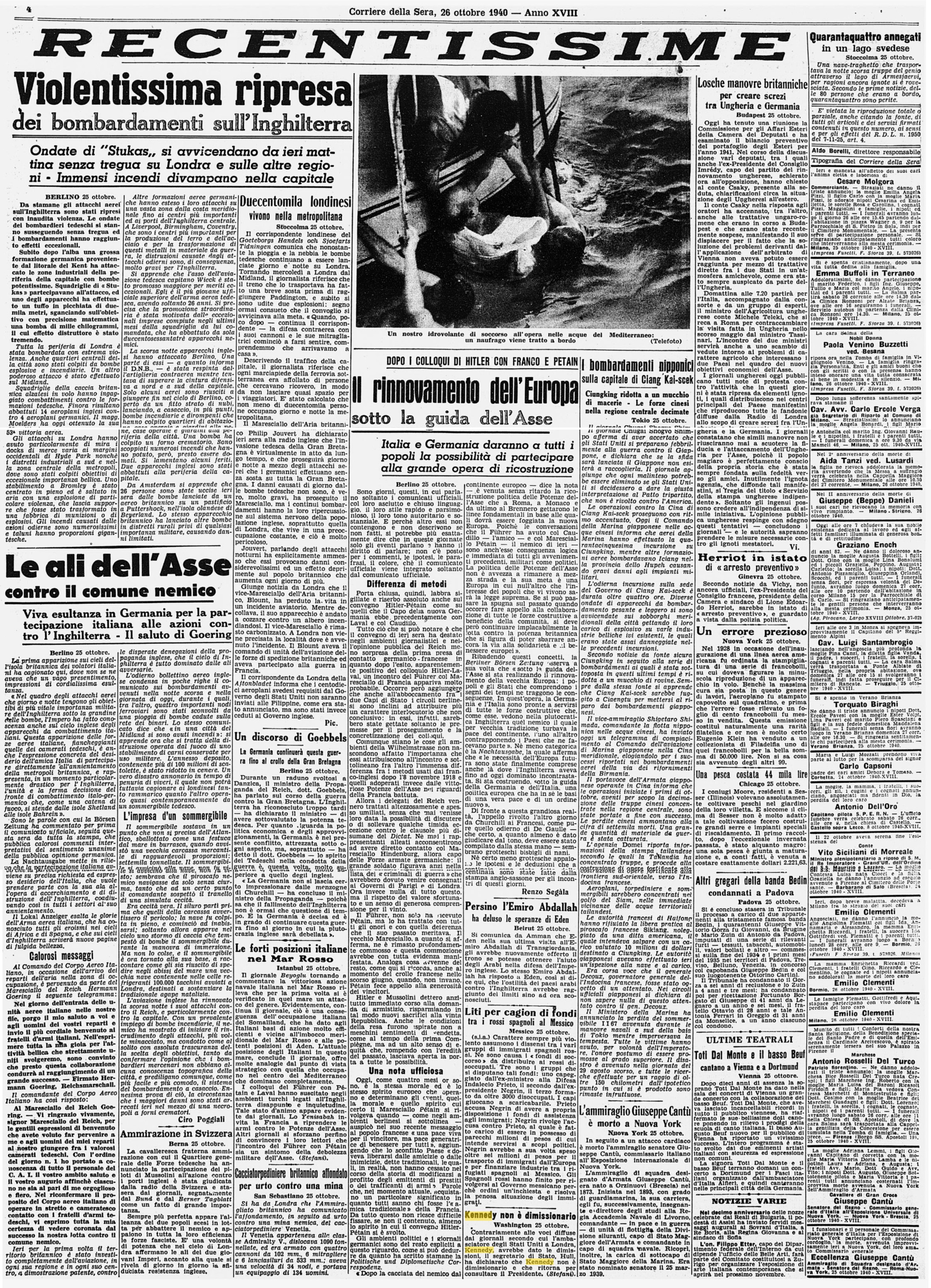
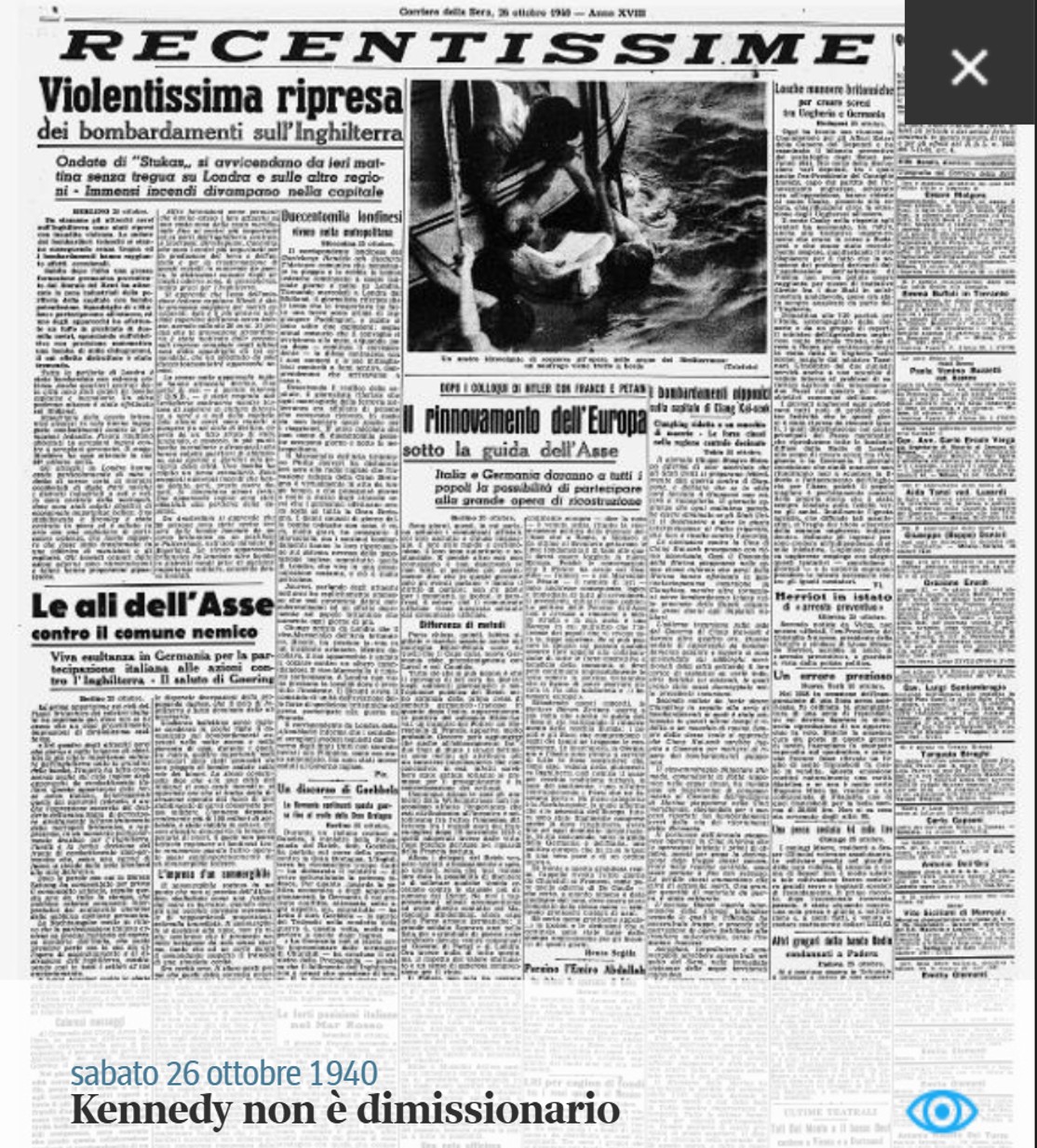
Saturday, October 26, 1940. A short item (a dispatch from the Stefani news agency, Washington, October 25) titled "Kennedy Has Not Resigned." Here is a summary of the item: ° Official denial from the State Department: Secretary of State Cordell Hull has formally denied rumors circulating in the press regarding the alleged resignation of the U.S. Ambassador to London, Joseph Kennedy. ° The actual reason for his return: Hull stated that Joseph Kennedy has not resigned, clarifying that his return to the United States is solely for the purpose of consulting with President Roosevelt. |
|
1940, October 28 - Corriere della Sera |
||
|
|
|
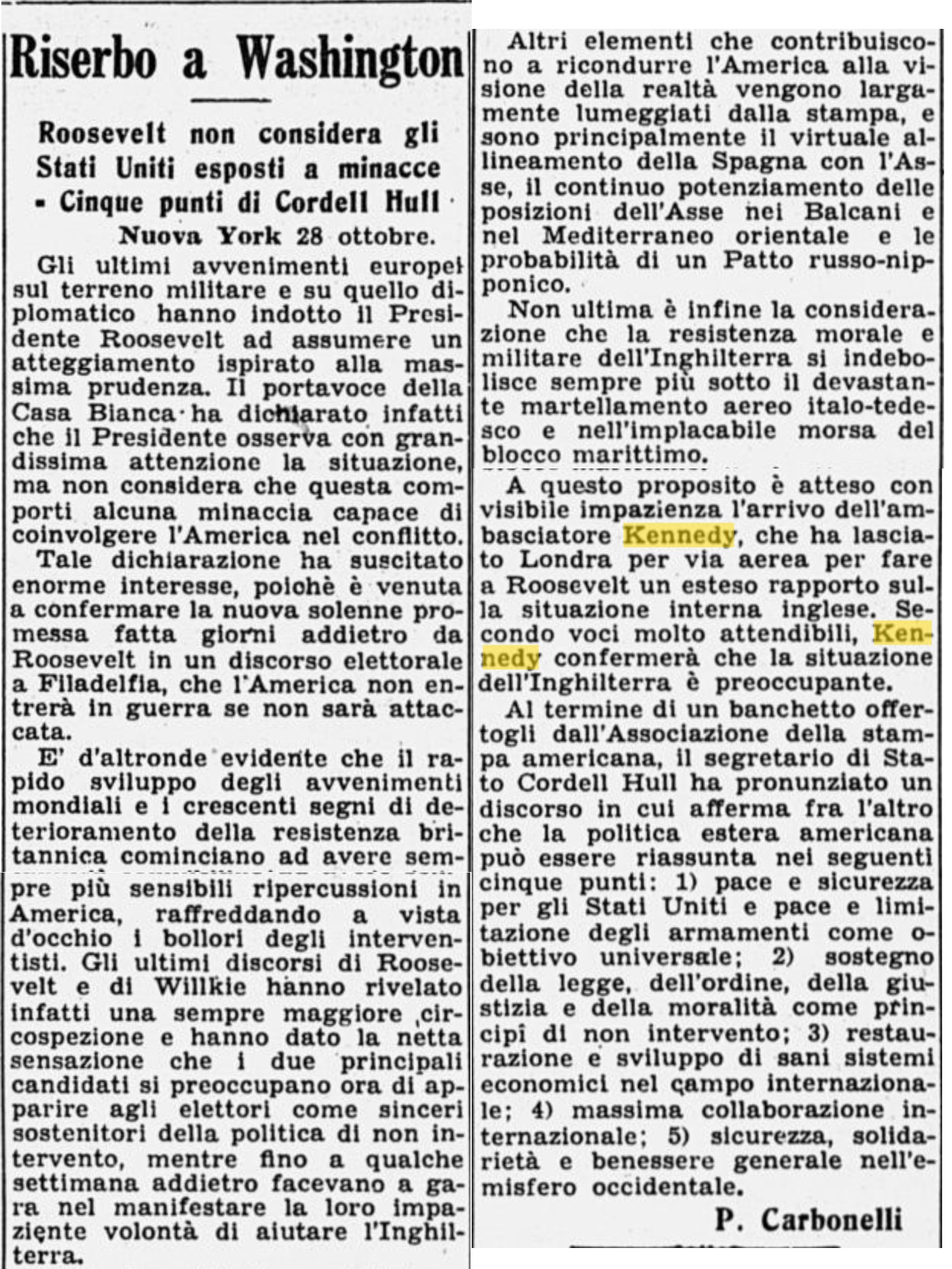
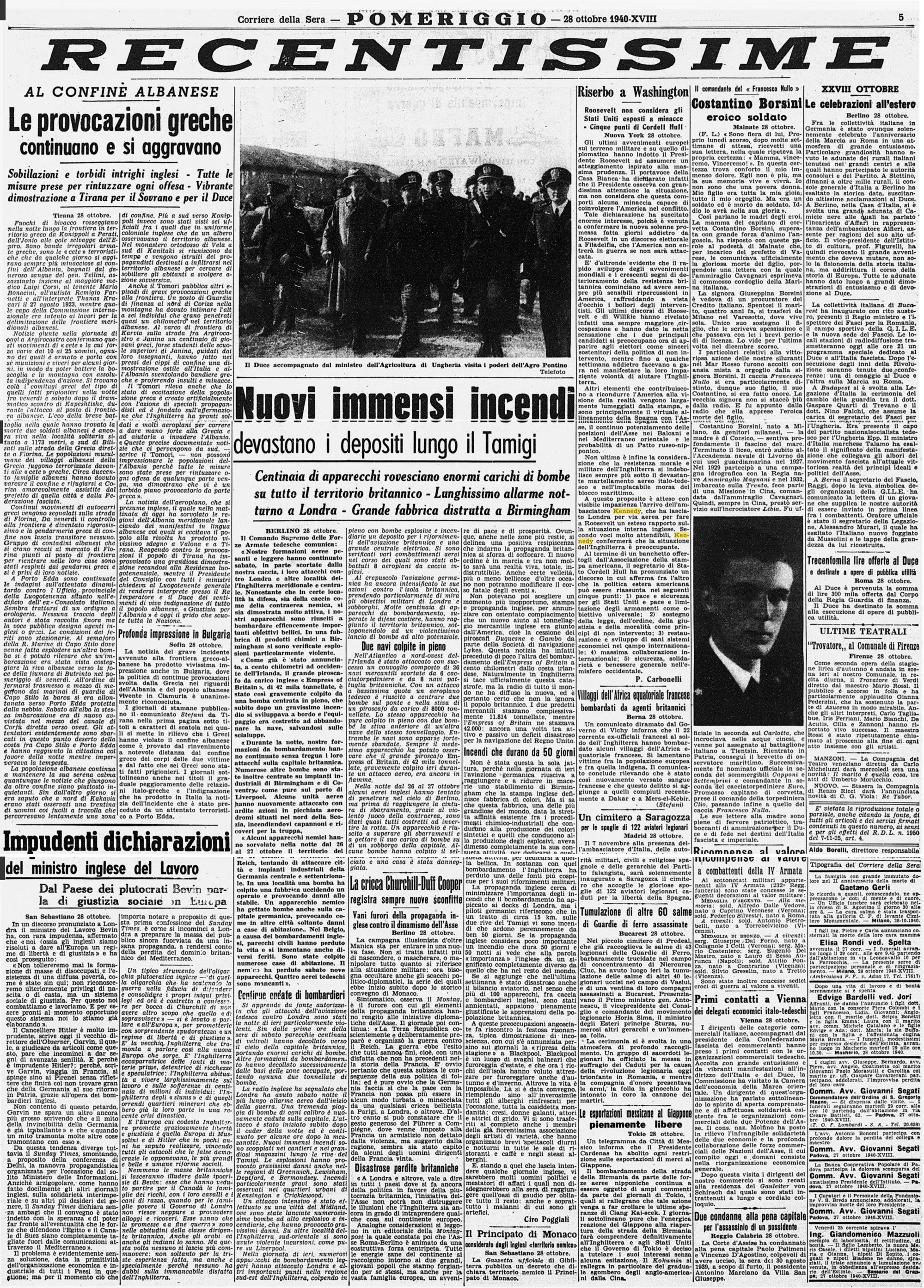
A
copy of an article from the Italian daily newspaper *Corriere della Sera*,
dated Monday, October 28, 1940. The article—a dispatch from New York by P. Carbonelli—is titled "Reserve in Washington – Awaiting Ambassador Kennedy." A summary of the piece follows: ° Electoral caution and non-intervention in Washington: Military developments in Europe and the progressive weakening of Great Britain—subjected to Axis bombing and a naval blockade—have dampened interventionist enthusiasm in the United States. In the heat of the election campaign, both President Roosevelt (speaking through a White House spokesperson and in a recent address in Philadelphia) and his challenger, Willkie, are adopting a very cautious tone, reiterating that America will not enter the war unless it is directly attacked. ° Focus on Joseph Kennedy – Anticipation of a report on the British crisis: Amid the international factors pushing Washington toward a more realistic outlook, the return of the U.S. Ambassador holds central importance. There is palpable impatience for the arrival of Joseph Kennedy, who has departed London by plane to personally present President Roosevelt with a detailed report on the internal situation in Britain. According to highly reliable sources, Kennedy will confirm to the President that conditions in Great Britain are concerning. |
|
1940, October 29 - Corriere della Sera |
||
|
|
|
A
copy of an article from the Italian newspaper *Corriere della Sera*, dated
Tuesday, October 29, 1940. The article—a dispatch from New York by P. Carbonelli—is titled "Great Stir in the United States." A summary of the piece follows: ° The repercussions of the Italian attack on Greece: Italy’s military initiative against Greece has caused a great stir in the United States, where it is viewed as a move to undermine British positions in the Mediterranean and the Near East. ° The gravity of the situation for the British: In the concluding paragraph, the article cites initial statements from the U.S. ambassador, who had just returned from London. Joseph Kennedy, having arrived back from the British capital the previous day, acknowledged the extreme gravity of the conditions in which England finds itself. His remarks conveyed the distinct impression that he believes Great Britain is incapable of resisting the mounting pressure exerted by the Axis powers for much longer. |
|
1940, October 30 - Corriere della Sera |
||
|
|
|
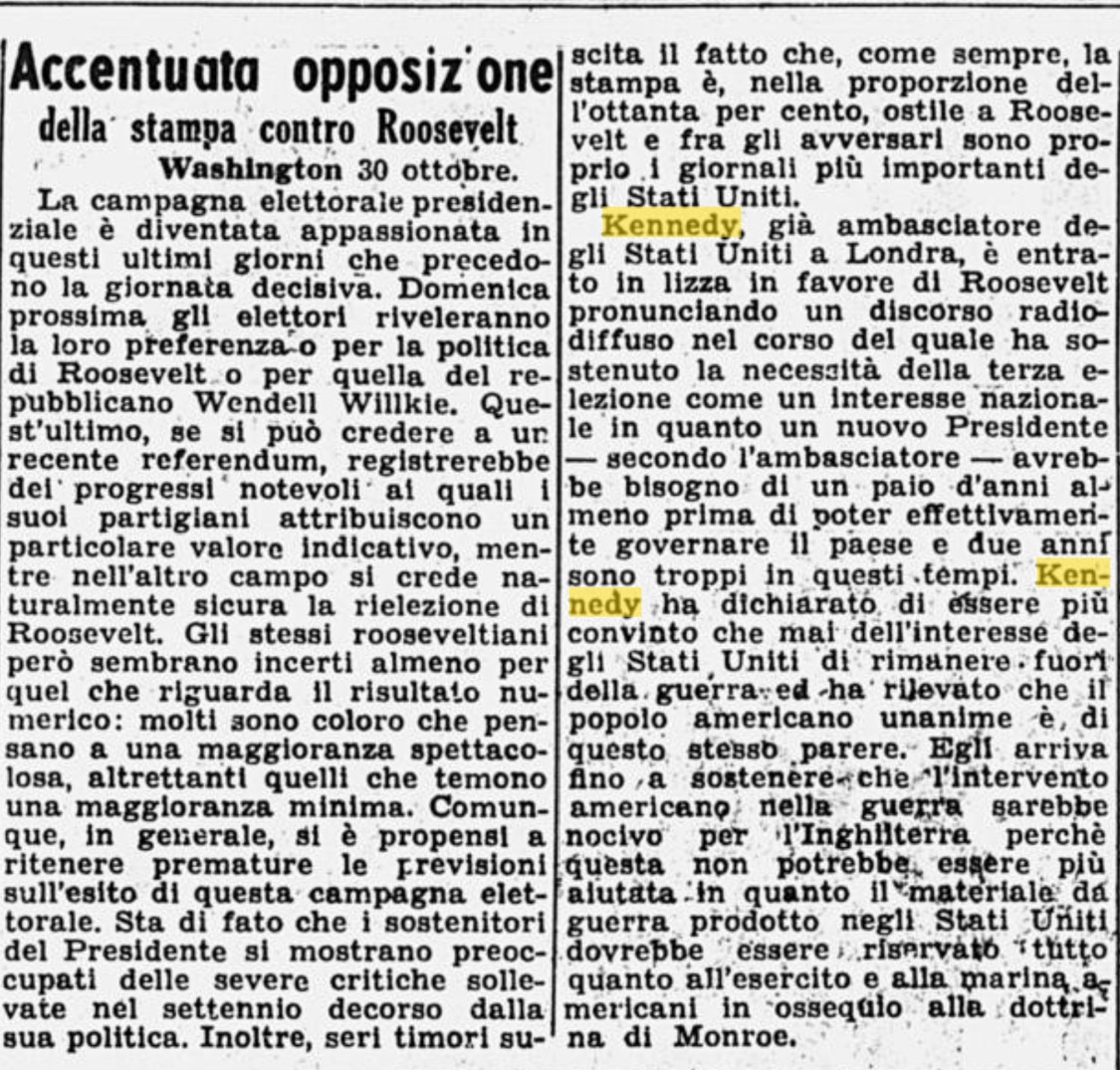
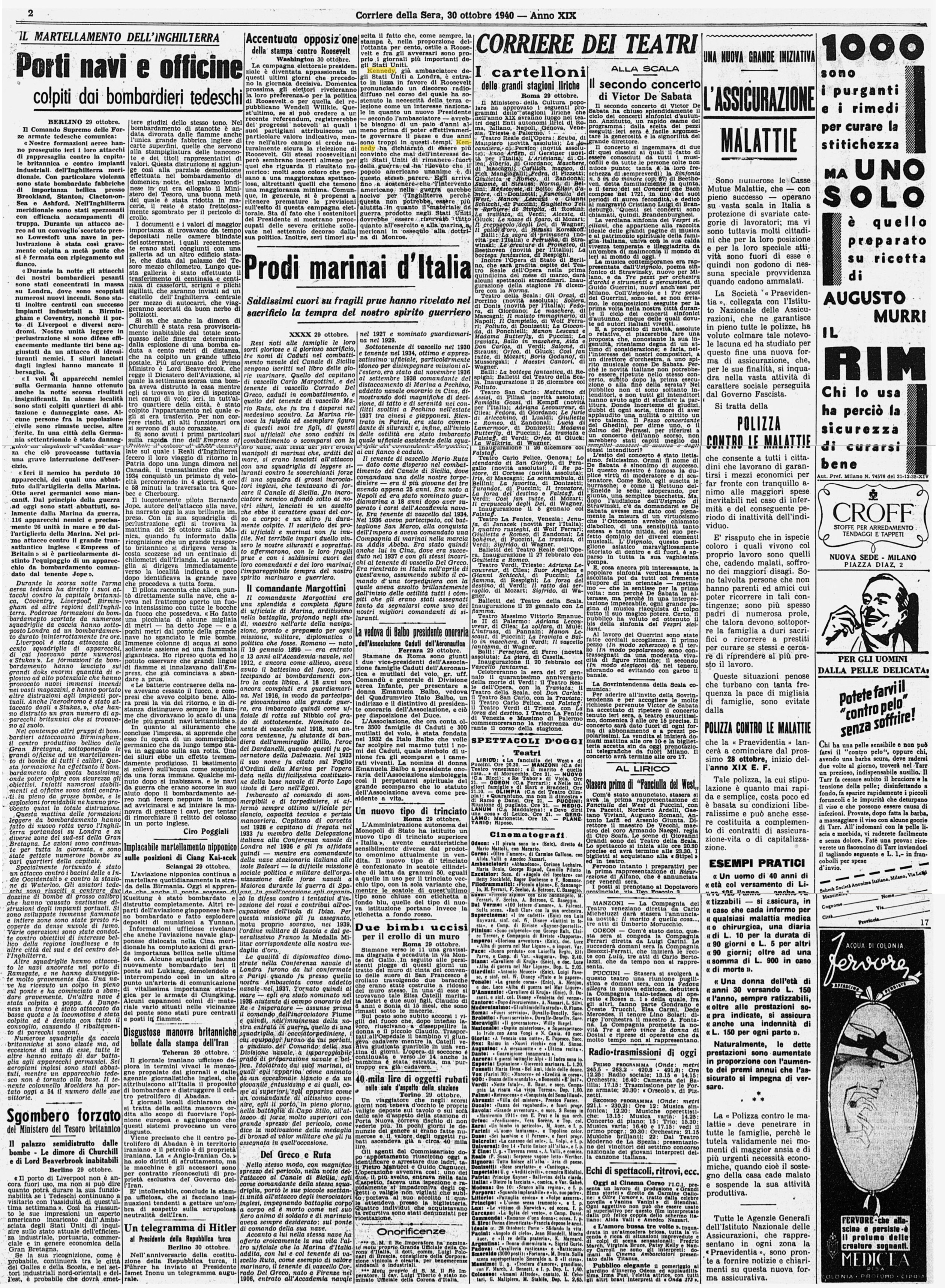
A
copy of an article from the Italian daily newspaper *Corriere della Sera*,
dated Wednesday, October 30, 1940. The article (a dispatch from Washington, October 30) is titled "Intensified Press Opposition to Roosevelt." A summary of the article follows: ° The uncertainty of the election campaign and the hostility of the press: With the presidential election—pitting Franklin D. Roosevelt against Republican candidate Wendell Willkie—only days away, the political clash has become particularly heated. Although Roosevelt’s supporters remain confident in his reelection, there is uncertainty regarding the margin of victory, given the harsh criticism leveled at his seven-year tenure and the open hostility of 80% of the U.S. press, including the country’s major newspapers. ° Focus on Joseph Kennedy – A radio address in support of a third term: In the second column, the article covers the intervention of the former U.S. Ambassador to London on behalf of the incumbent President. Joseph Kennedy (identified as the former U.S. Ambassador to London) delivered a radio address arguing that a third term for Roosevelt was in the national interest. He asserted that a new president would require at least two years to learn how to govern effectively—a duration that would be far too long given the critical international situation at the time. Kennedy further reiterated his firm conviction that the United States must remain outside the conflict (a view shared by the American public at large). He went so far as to argue that U.S. military intervention would actually be detrimental to England itself: in the event of war, all war materiel produced in the United States would be entirely absorbed by the American army and navy—in accordance with the Monroe Doctrine—thereby making it impossible to continue supplying the British. |
|
1940, October 31 - Corriere della Sera |
||
|
|
|
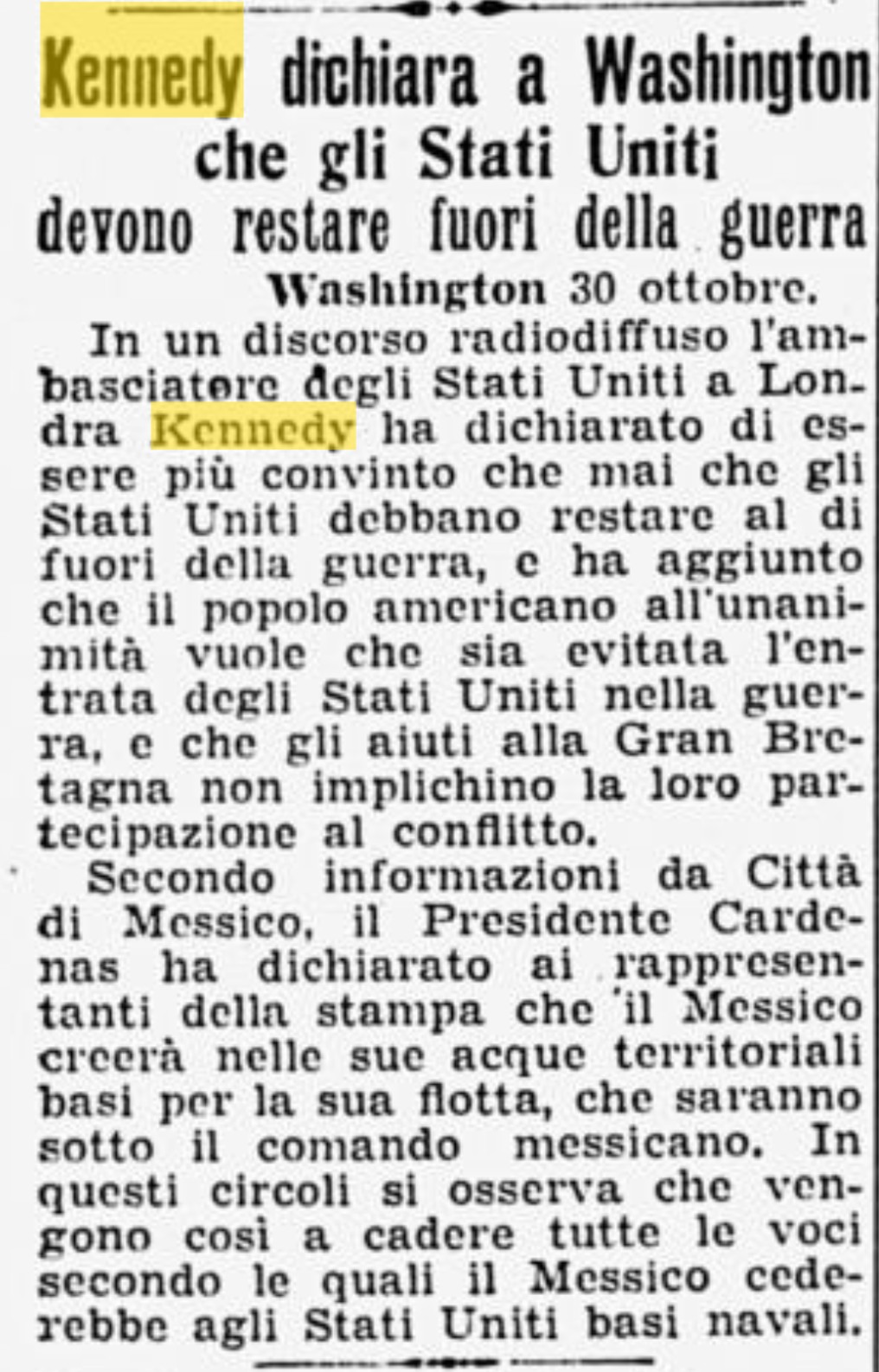
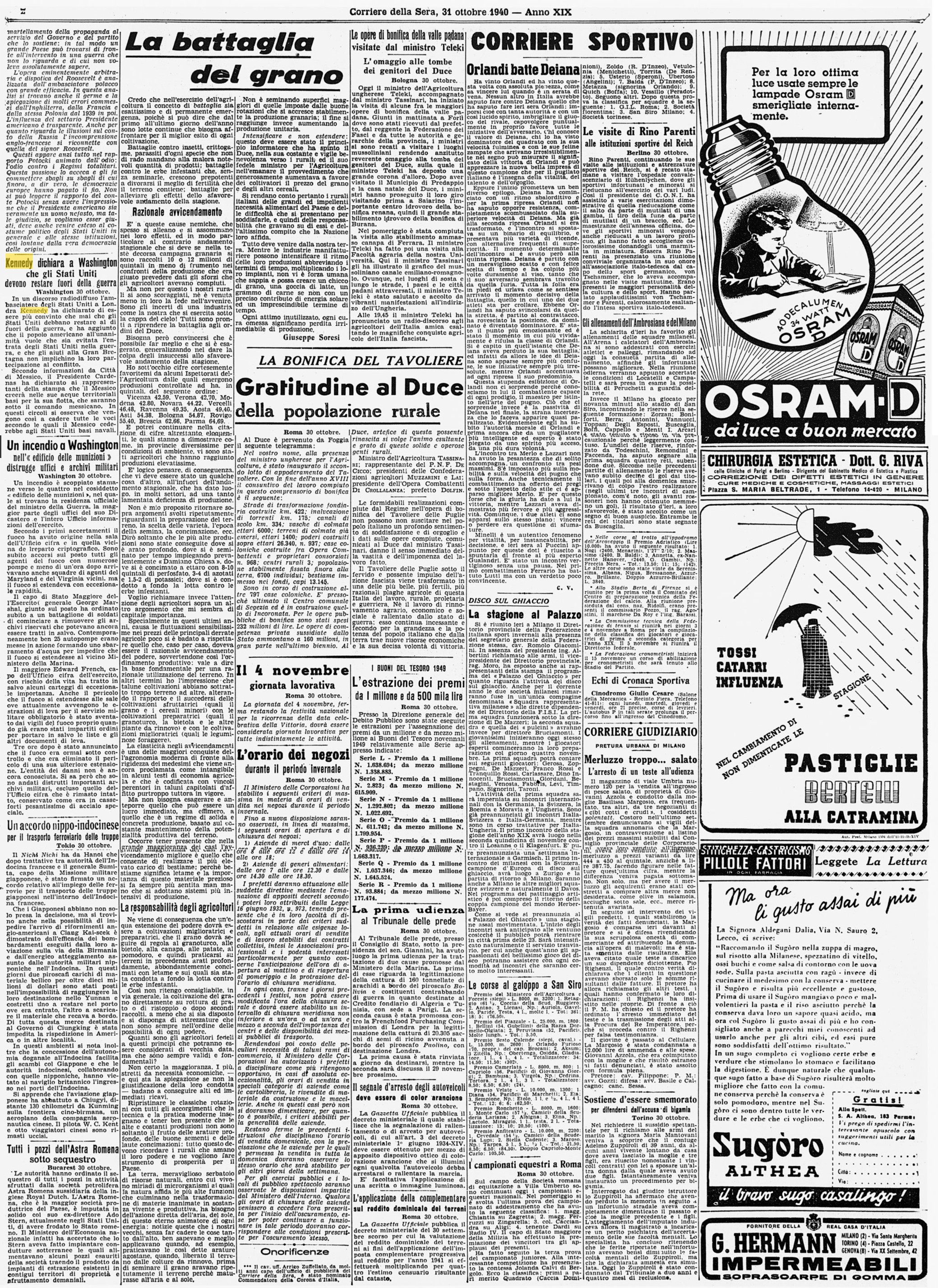
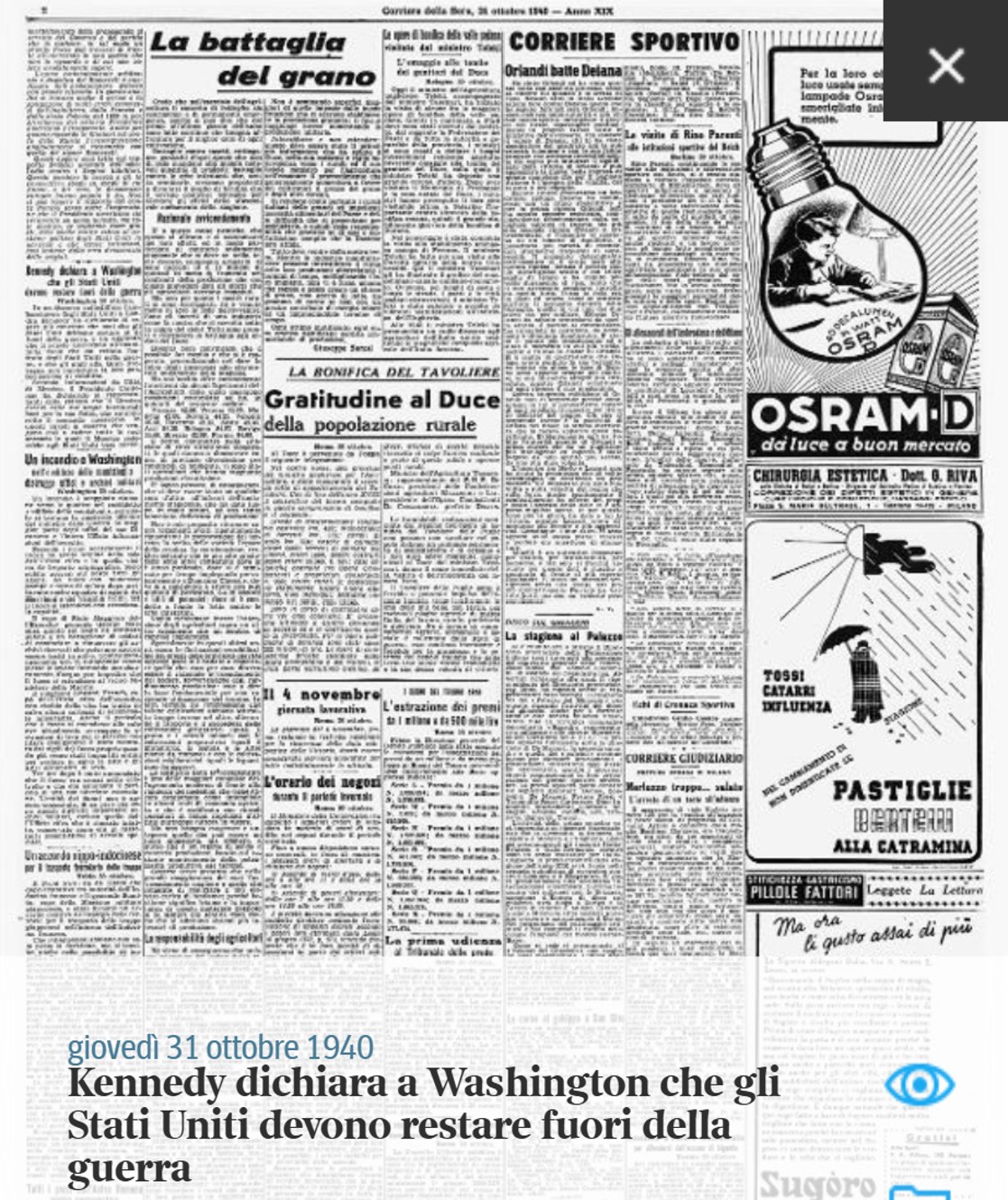
A
copy of an article from the Italian daily newspaper CORRIERE DELLA SERA,
dated Thursday, October 31, 1940. The article (a dispatch from Washington, October 30) is titled "Kennedy declares in Washington that the United States must stay out of the war." Here is a summary of the piece: ° Focus on Joseph Kennedy – A radio address against military intervention: In a radio broadcast, the U.S. Ambassador to London, Joseph Kennedy, firmly reiterated his conviction that the United States should remain uninvolved in the European conflict. Kennedy further emphasized that the American people are unanimous in their desire to avoid entering the war, specifying that the support offered to Great Britain must not entail direct military participation by the United States. |
|
1940, November 8 - Corriere della Sera |
||
|
|
|
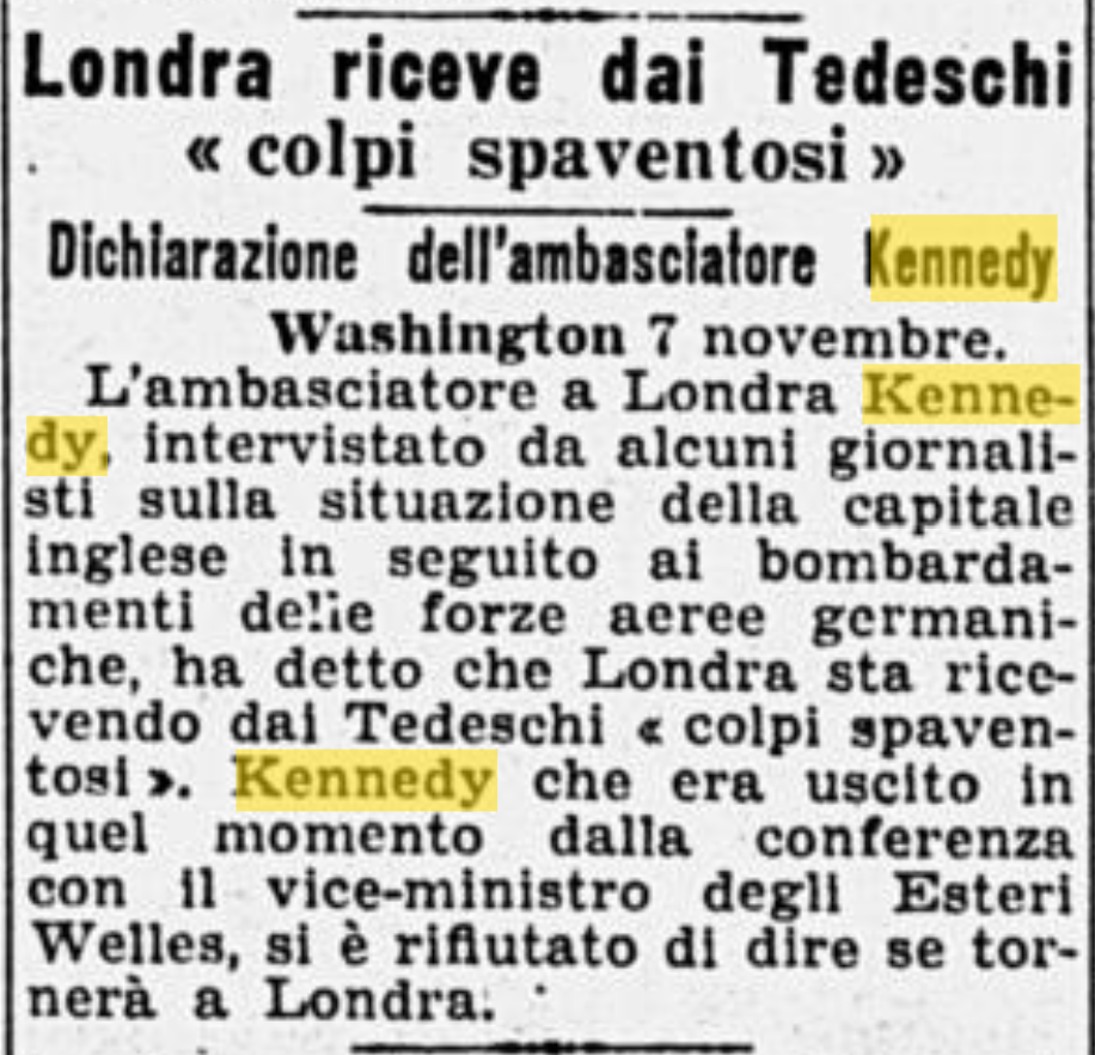
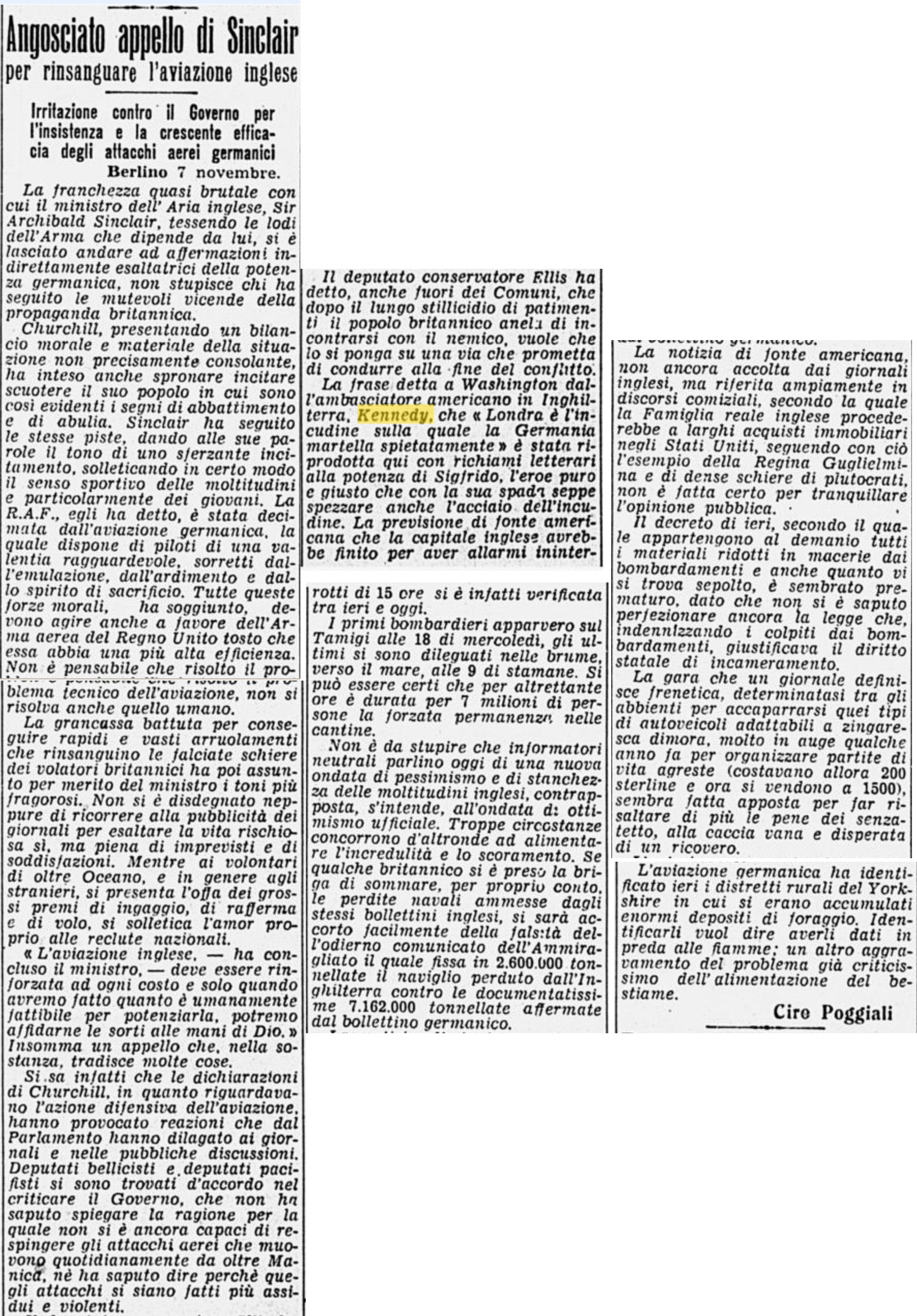
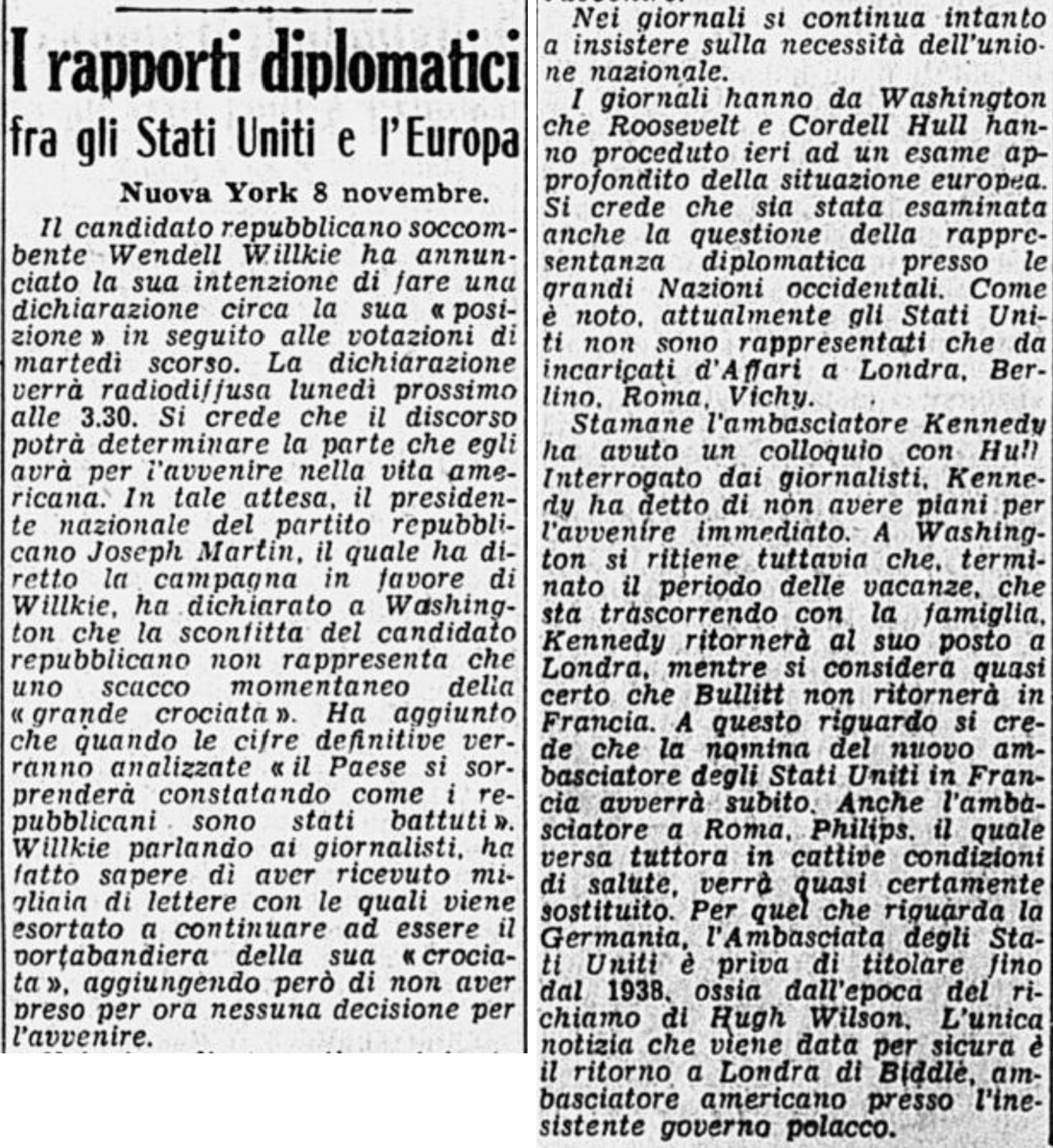
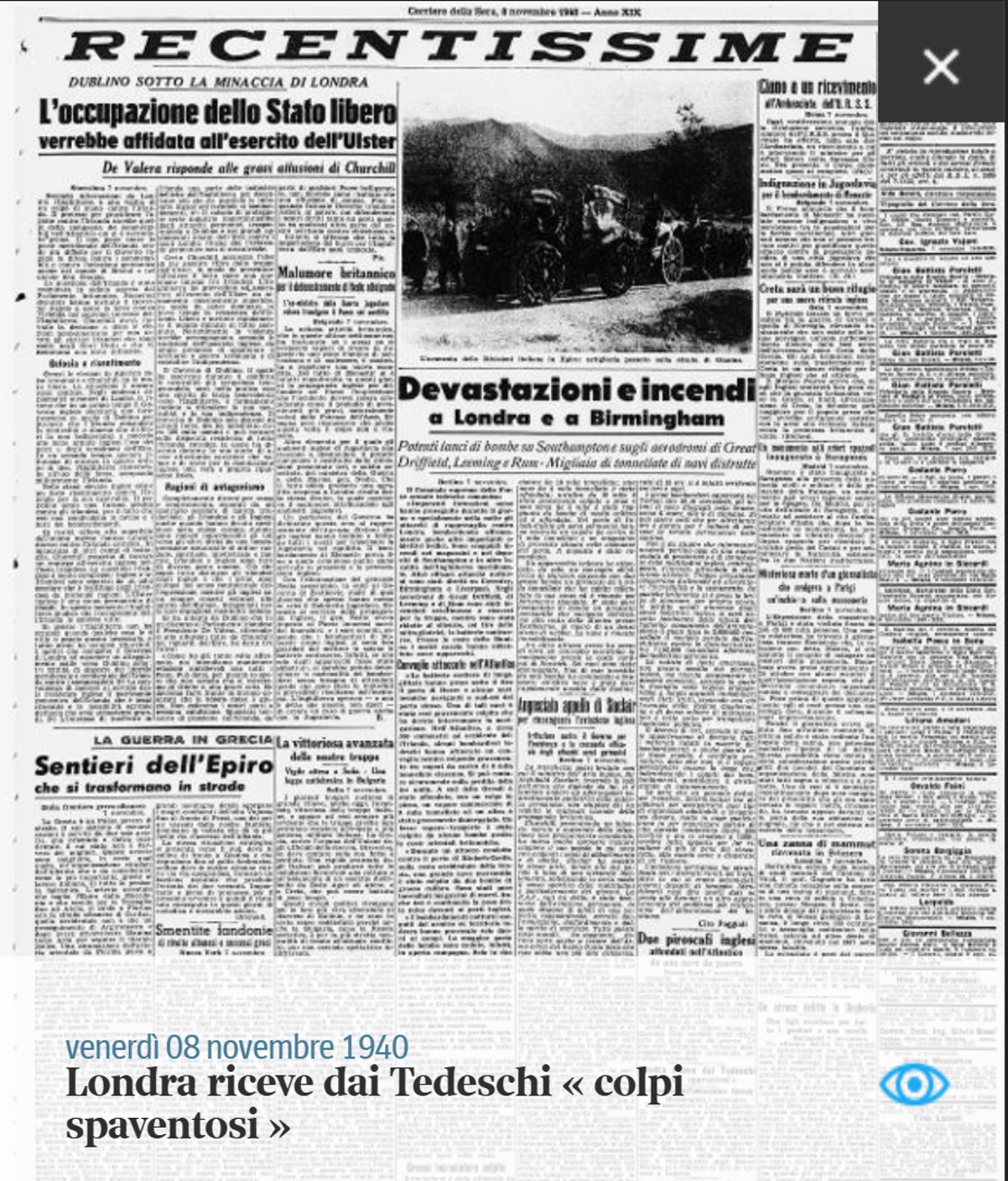
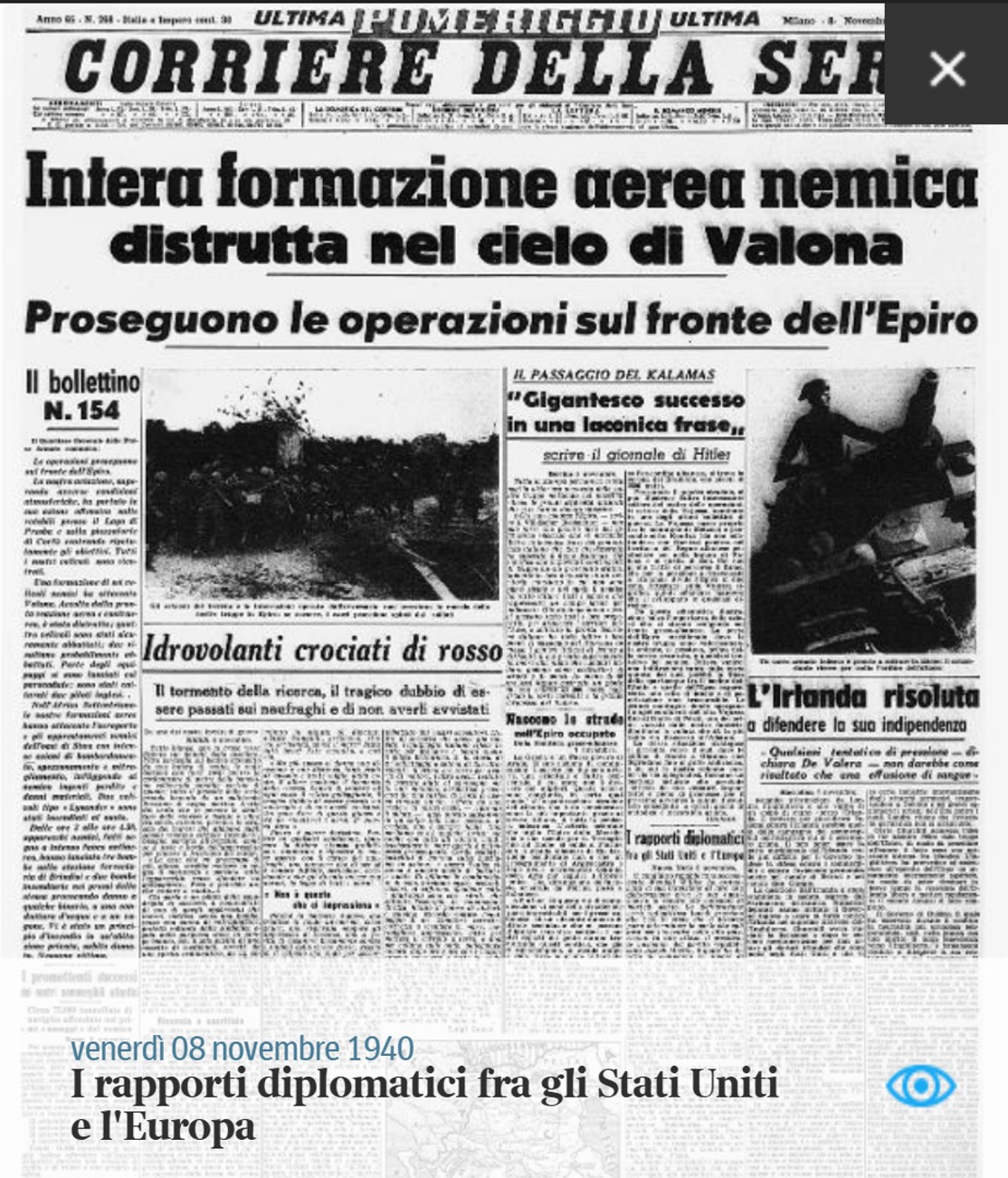
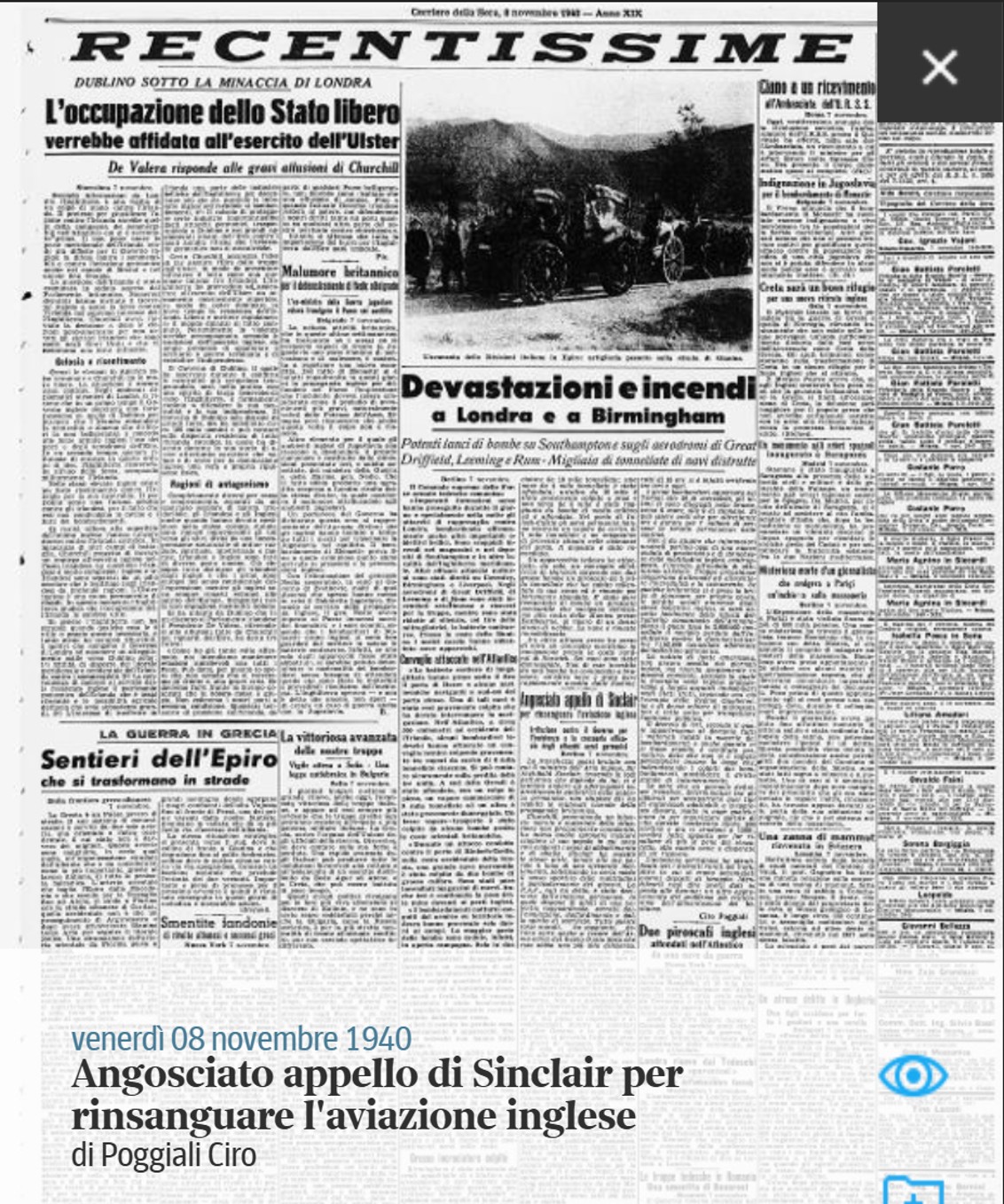
Copies
of three articles from the Italian daily newspaper *Corriere della Sera*,
dated Friday, November 8, 1940. Below is a summary of the references to Ambassador Joseph Kennedy found in these three *Corriere della Sera* articles from November 8, 1940: 1. "London Receives 'Terrifying Blows' from the Germans – Statement by Ambassador Kennedy" (from Washington, November 7) ° Statements regarding the bombings: Immediately after a meeting with Under Secretary of State Sumner Welles, Kennedy gave an interview to journalists in which he described the dramatic situation in the British capital under German air attacks, stating that London is receiving "terrifying blows" from Germany. ° Uncertainty regarding his return: When asked about his diplomatic future, Kennedy declined to say whether or not he would return to London. 2. "Sinclair’s
Distressed Appeal to Replenish the British Air Force" (correspondence from
Berlin by Ciro Poggiali) 3. "Diplomatic
Relations Between the United States and Europe" (from New York, November
8) |
|
1940, November 9 - Corriere della Sera |
||
|
|
|
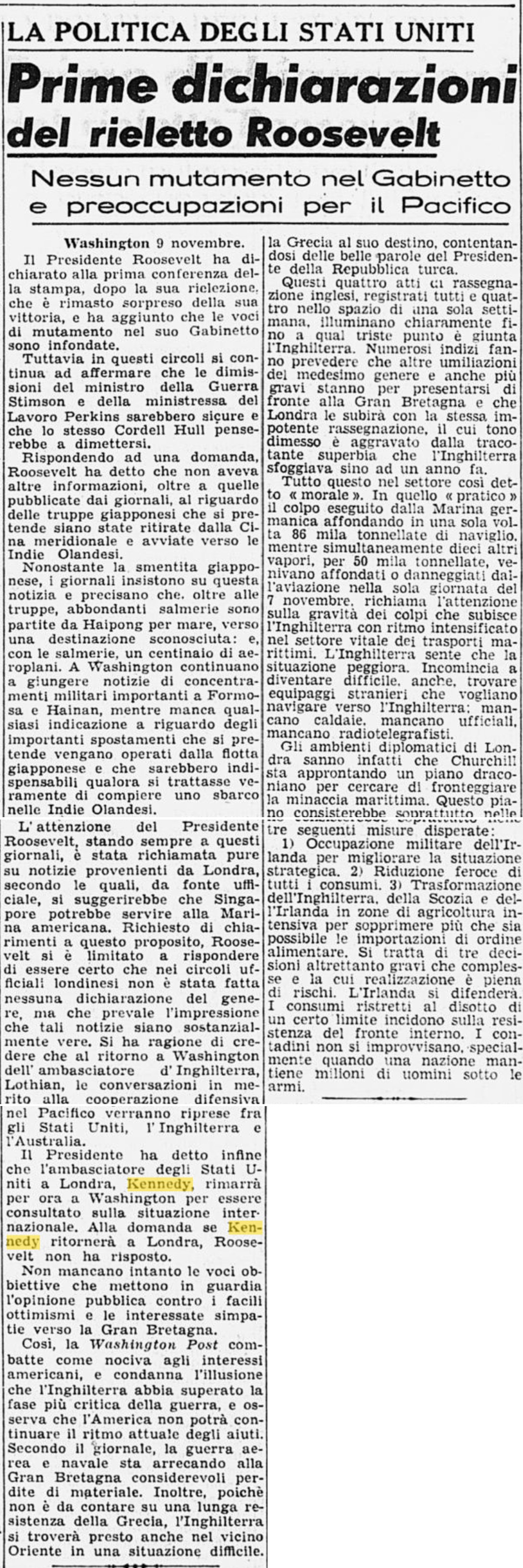
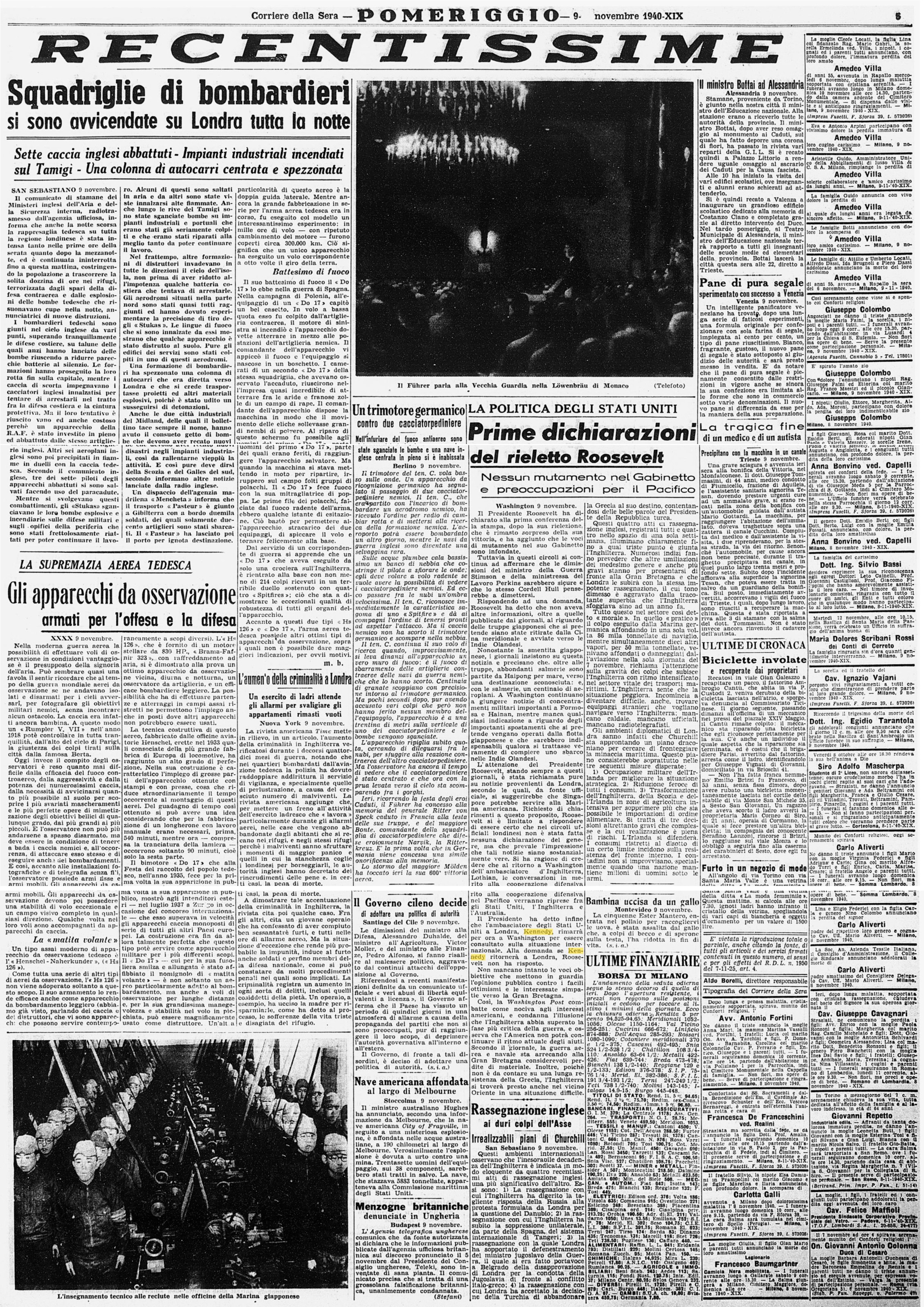
A
copy of an article from the Italian newspaper *Corriere della Sera*, dated
Saturday, November 9, 1940. Below is a summary of the reference to Ambassador Joseph Kennedy found in the *Corriere della Sera* article from November 9, 1940, titled "UNITED STATES POLICY – Initial statements by the re-elected Roosevelt" (from Washington, November 9): ° Remaining in Washington for consultations: During his first press conference following his re-election, President Roosevelt announced that the U.S. Ambassador to London, Joseph Kennedy, would remain in Washington for the time being to be consulted regarding the international situation. ° Silence regarding a return to London: When asked by journalists whether or not Kennedy would return to the British capital, Roosevelt chose not to respond. |
|
1940, November 13 - Corriere della Sera |
||
|
|
|
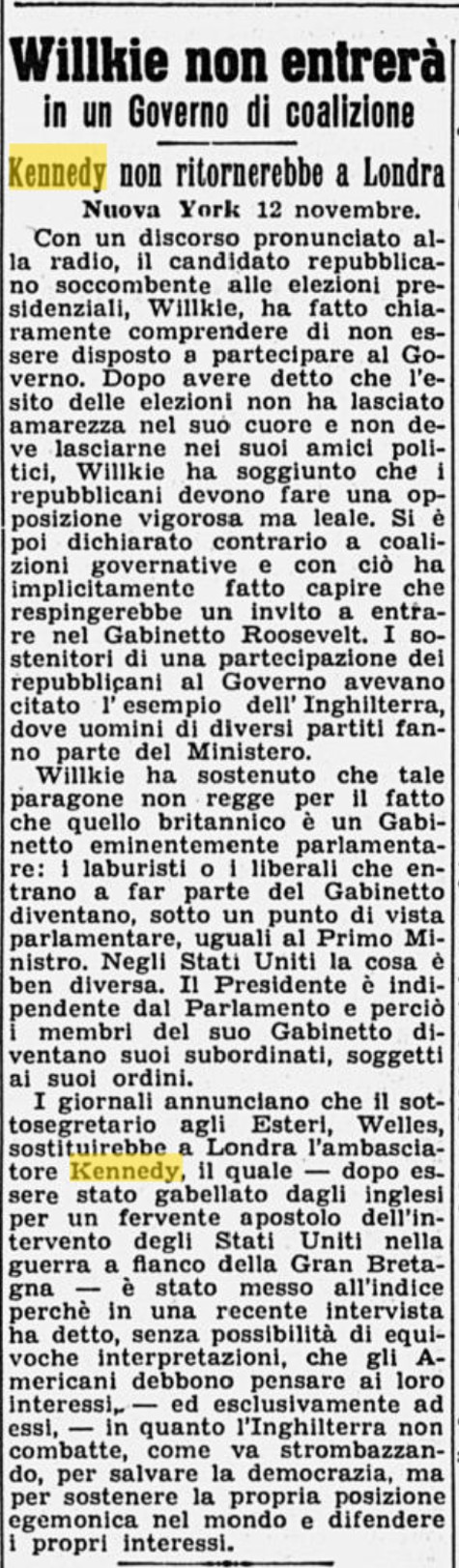
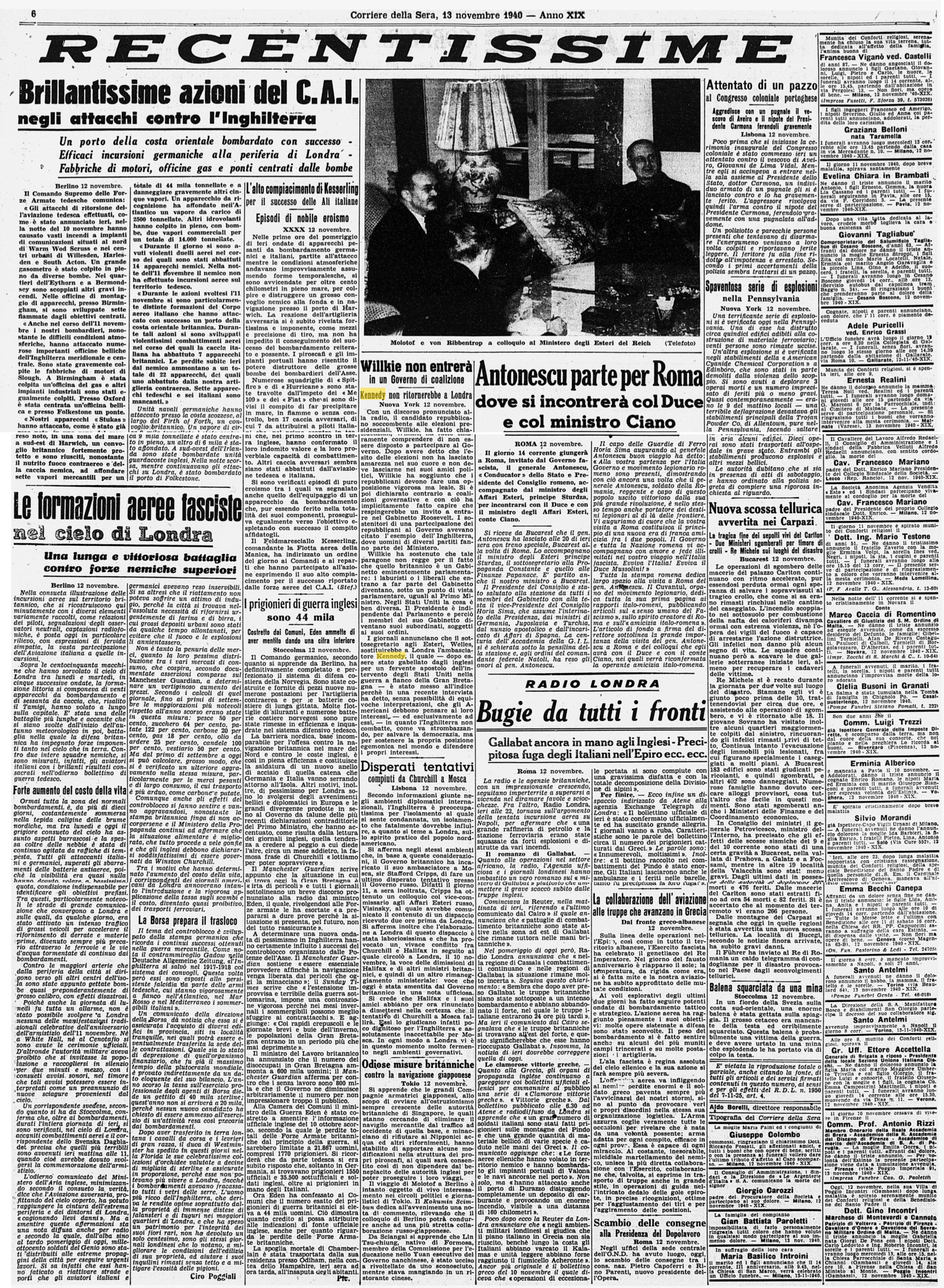
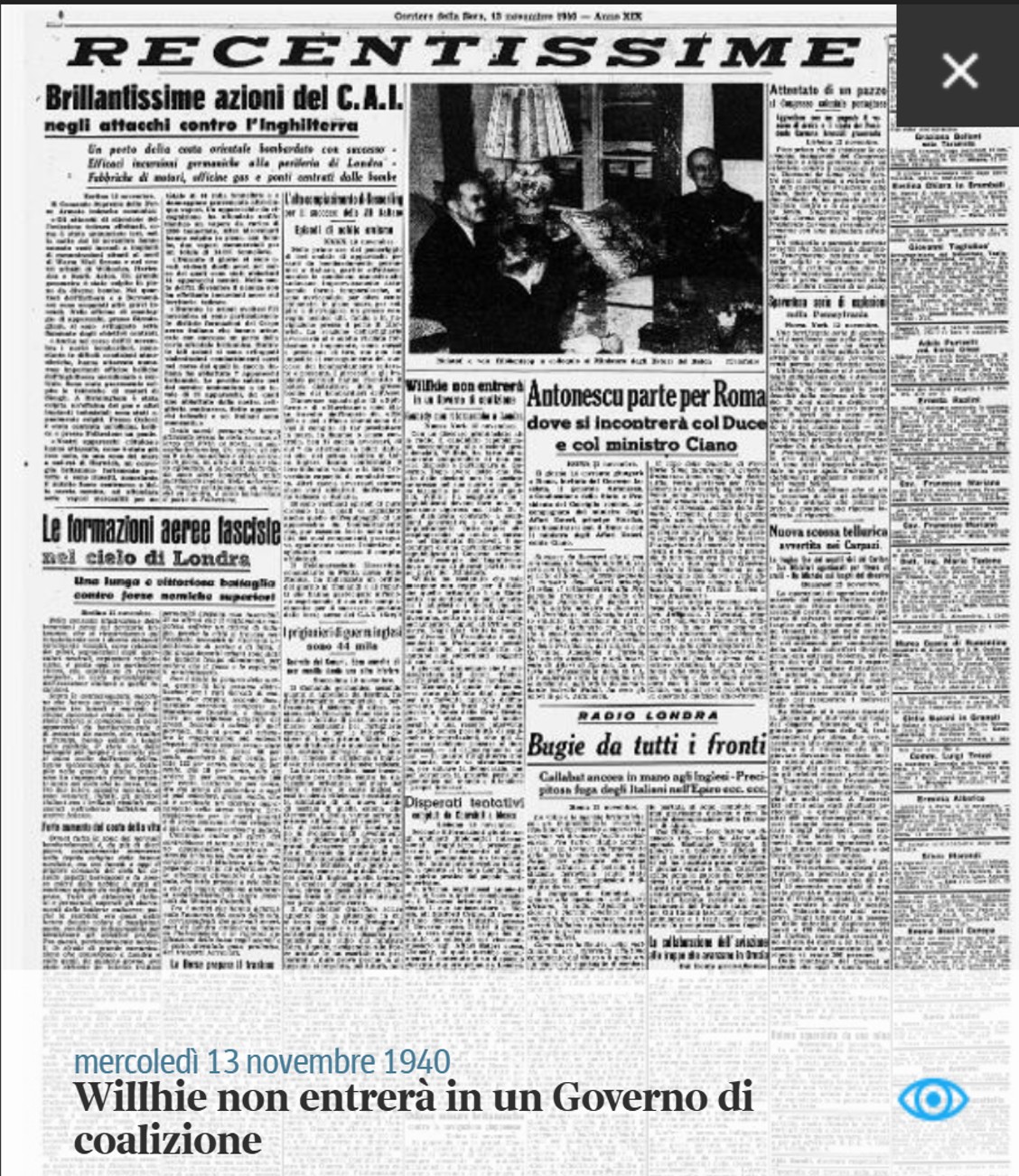
A
copy of an article from the Italian daily newspaper *Corriere della Sera*,
dated Wednesday, November 13, 1940. The following is a summary of the reference to Ambassador Joseph Kennedy in an article titled "Willkie Will Not Join a Coalition Government – Kennedy Will Not Return to London" (from New York, November 12): ° Potential replacement by Sumner Welles: According to press reports, Undersecretary of State Sumner Welles is set to replace Ambassador Kennedy at the diplomatic post in London. ° Reasons for the rift with British circles: The article explains that Kennedy—who was initially portrayed by the British as a fervent advocate for American intervention on their side—has been "ostracized" due to his recent statements to the press. In an unambiguous interview, Kennedy asserted that the United States should focus exclusively on its own interests, arguing that England is not fighting to save democracy—as its propaganda claims—but rather to defend its own interests and maintain its global hegemony. |
|
1940, November 15 - Corriere della Sera |
||
|
|
|
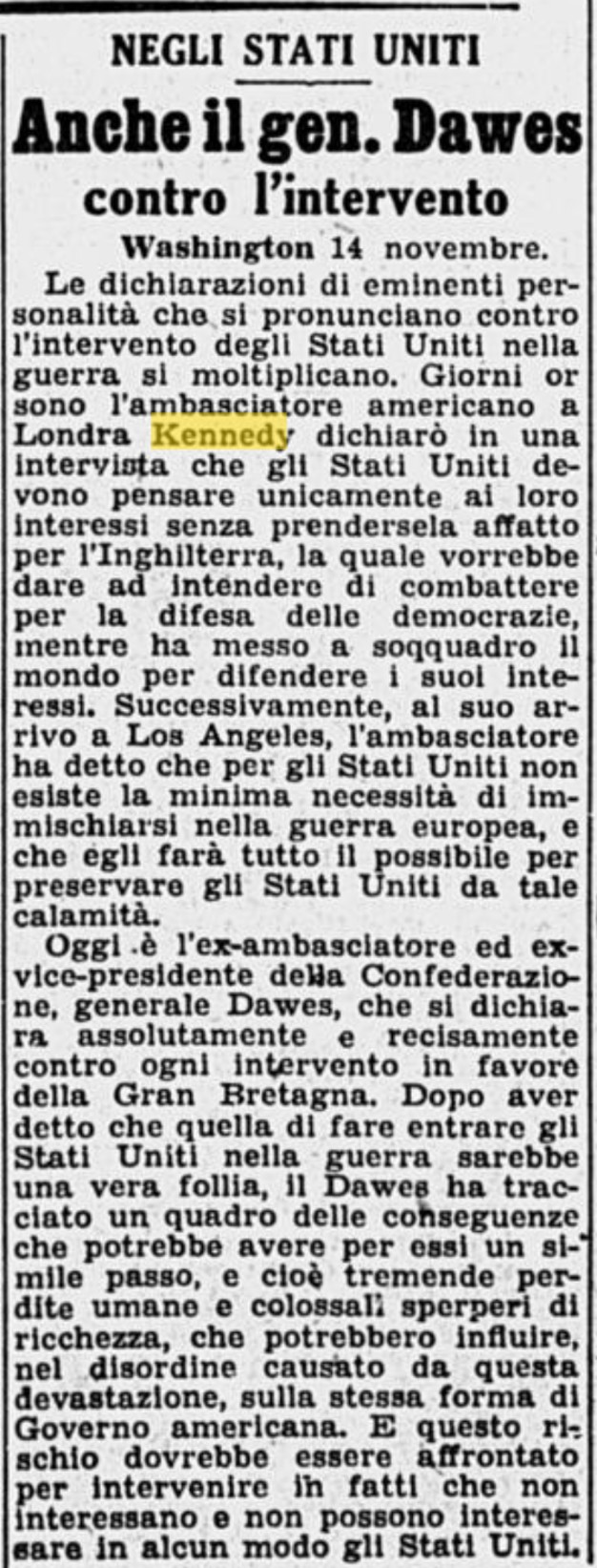
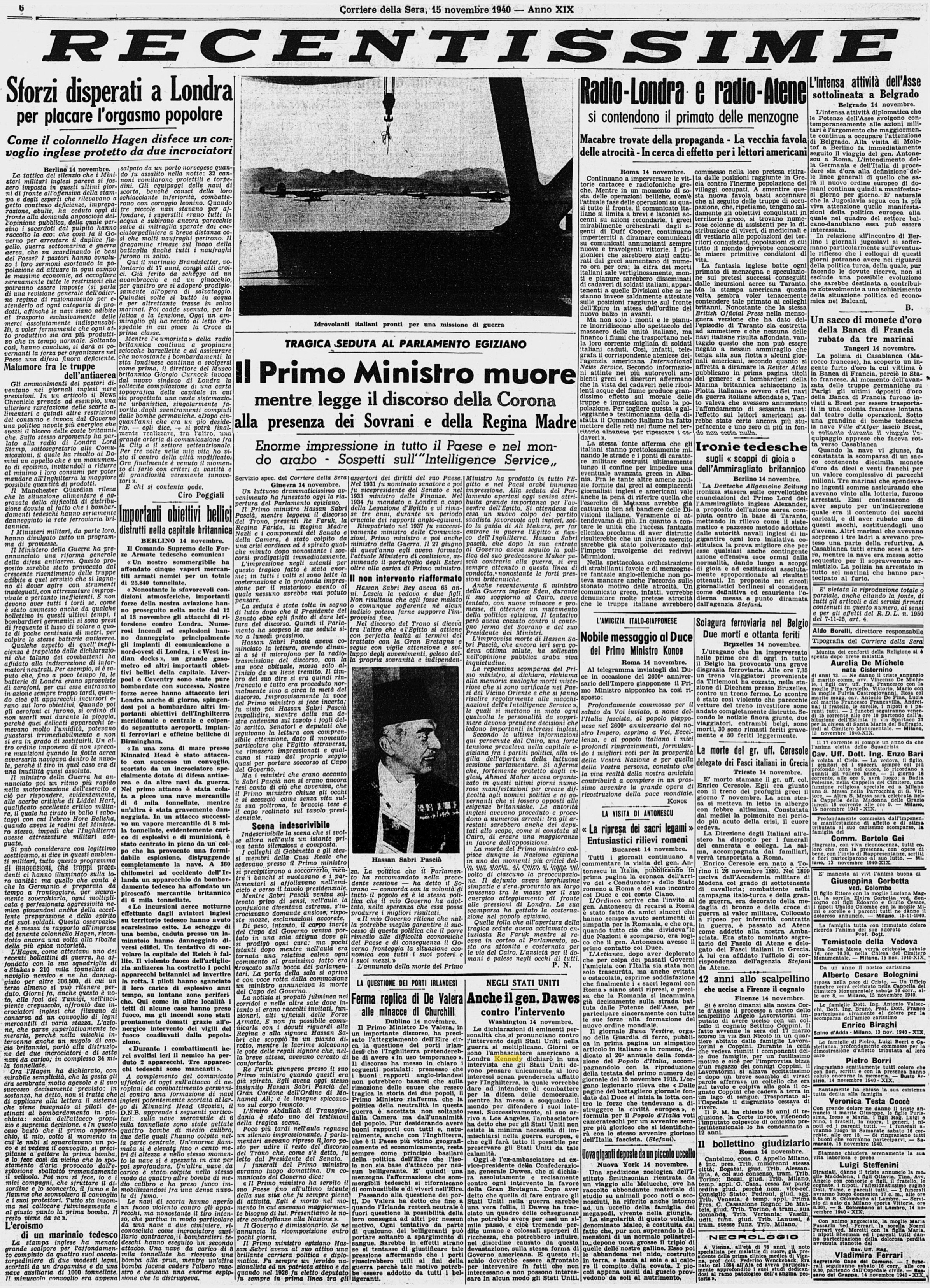
A
copy of an article from the Italian daily newspaper *Corriere della Sera*,
dated Friday, November 15, 1940. The following is a summary of the reference to Ambassador Joseph Kennedy, found in an article titled "IN THE UNITED STATES – Gen. Dawes also opposes intervention" (from Washington, November 14): ° Criticism of British war aims: Amidst growing isolationist sentiment in the United States, the article cites a recent interview in which the American Ambassador to London, Kennedy, stated that the United States should focus exclusively on its own interests, without concern for England. According to Kennedy, Great Britain seeks to portray its struggle as a defense of democracies, when in reality it has thrown the world into turmoil solely to protect its own interests. ° Opposition to entering the war: It is further reported that, upon his arrival in Los Angeles, Kennedy reiterated that there is absolutely no need for the United States to become involved in the European conflict, pledging to do everything in his power to spare the country from such a calamity. |
|
1940, November 27 - Corriere della Sera |
||
|
|
|
Copies
of two articles from the Italian daily newspaper *Corriere della Sera*,
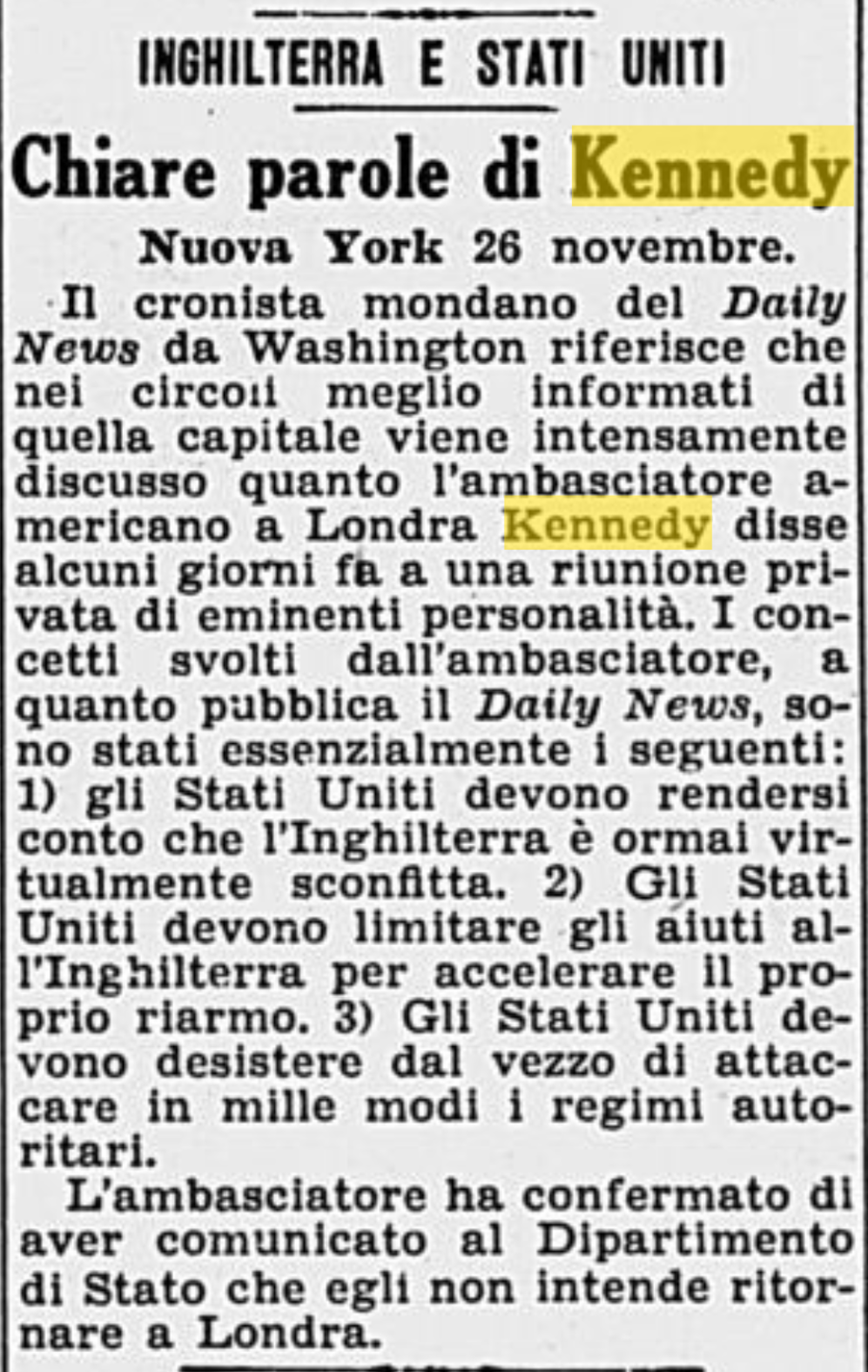
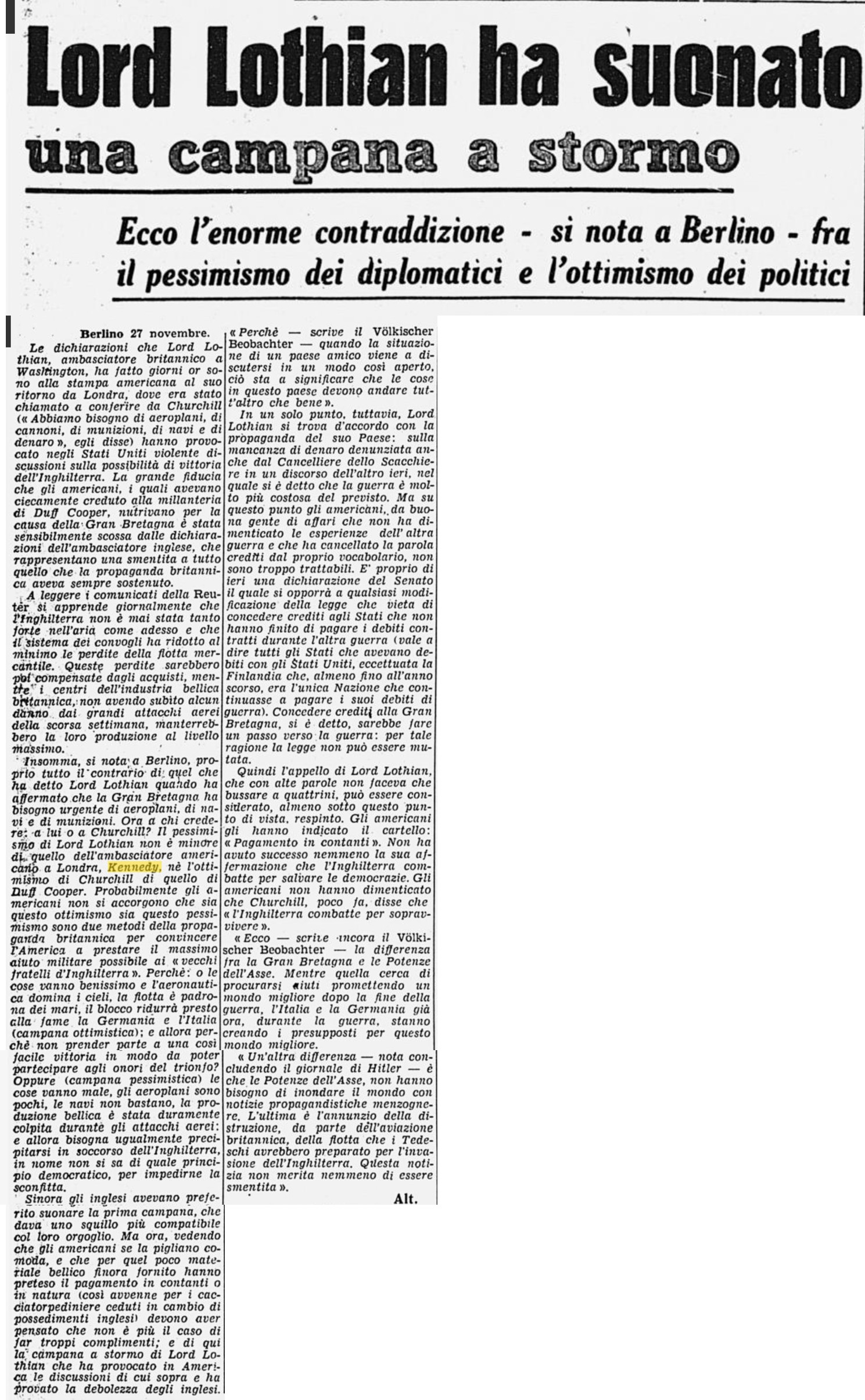
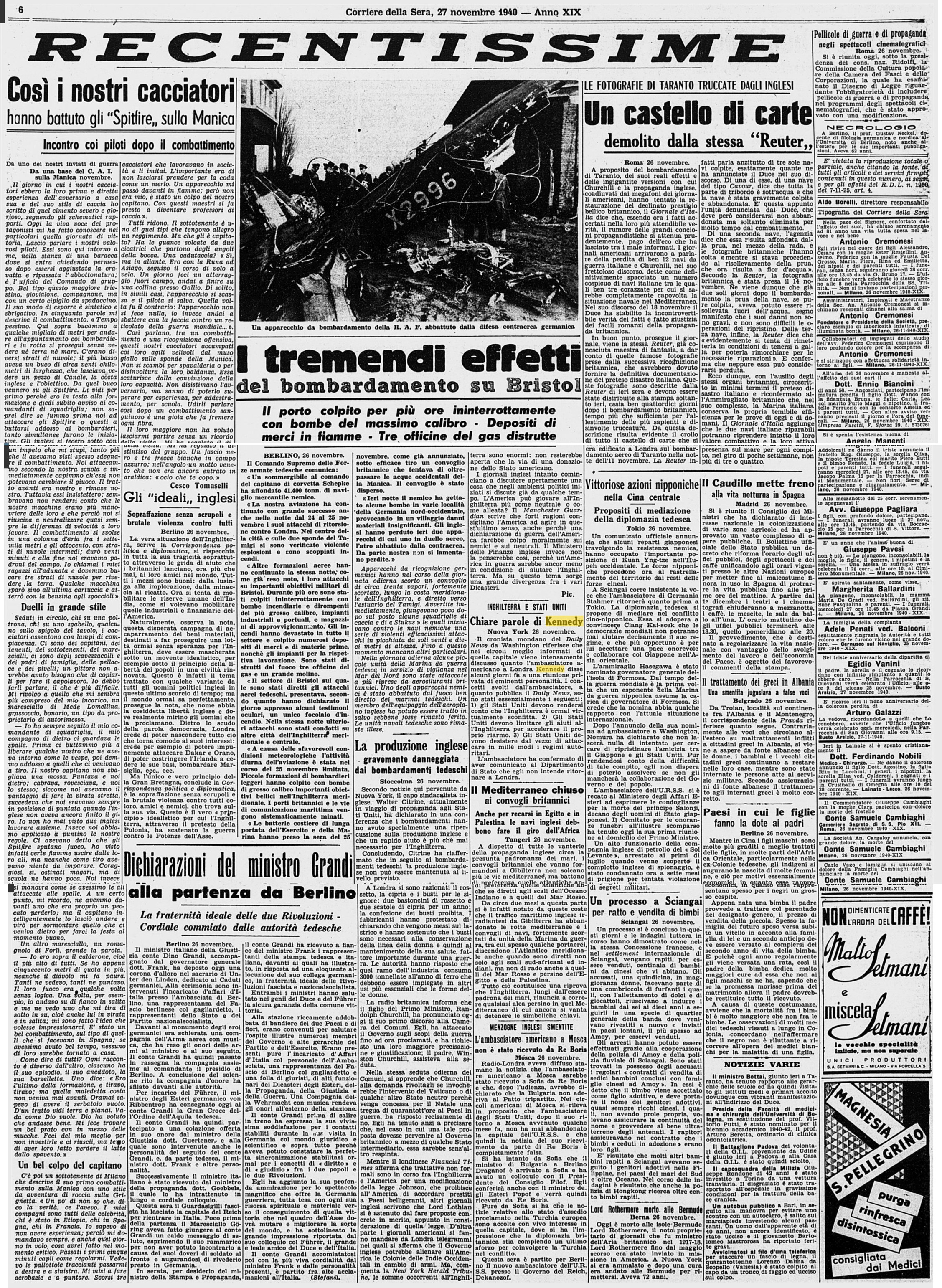
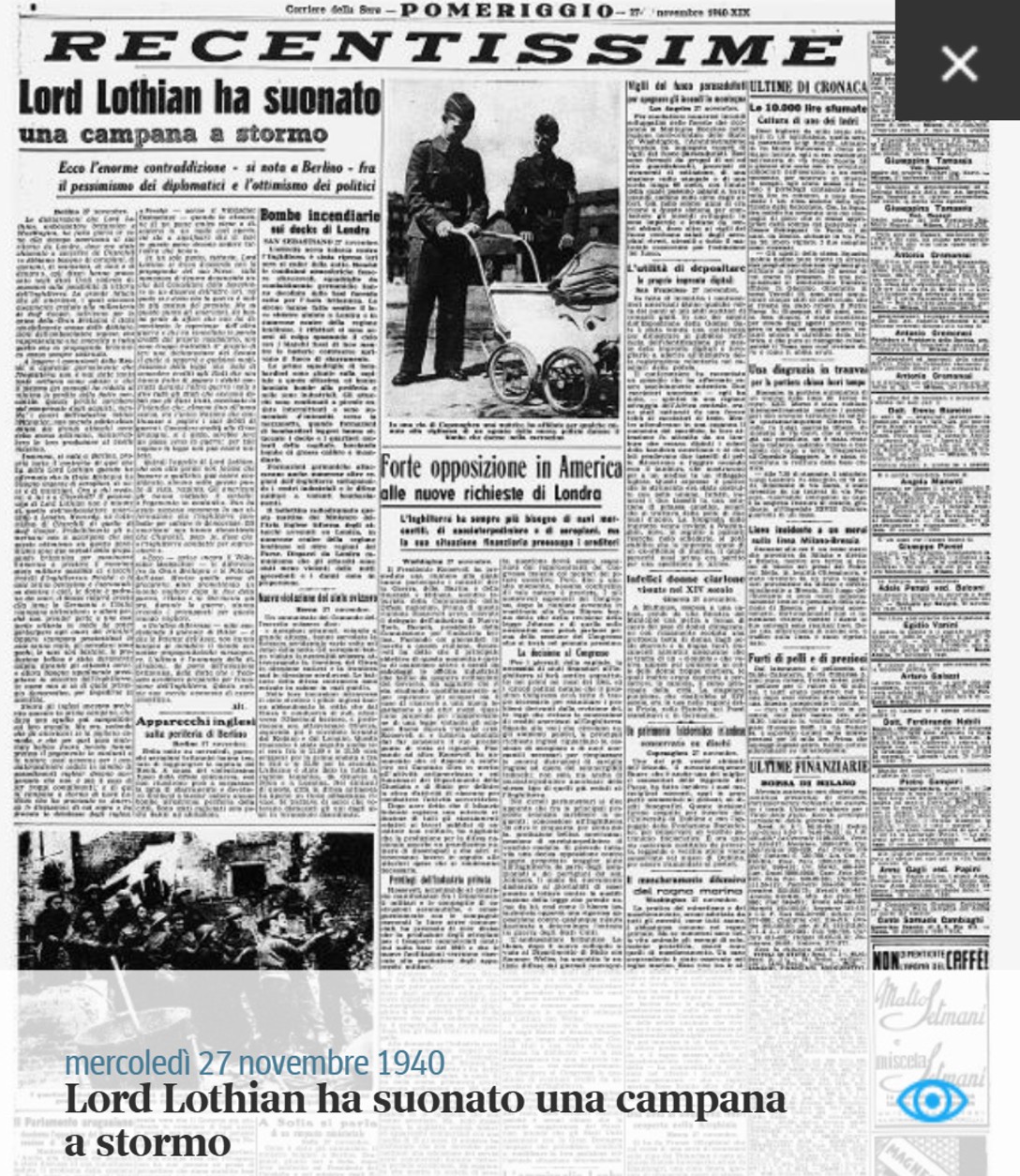
dated Wednesday, November 27, 1940. Below is a summary of the references to Ambassador Joseph Kennedy found in these two articles: 1. "ENGLAND AND THE UNITED STATES – Clear words from Kennedy" (from New York, November 26) ° Statements made in Washington: Citing a society columnist from the *Daily News*, the article reports that well-informed circles in Washington are discussing, at length, remarks made a few days earlier by the U.S. Ambassador to London, Joseph Kennedy, during a private meeting with prominent figures. ° The three points put forward by the Ambassador: According to the *Daily News* account, Kennedy expressed three fundamental ideas: - The United States must acknowledge that England is, for all practical purposes, already defeated; - The United States should reduce military aid to Great Britain in order to accelerate its own national rearmament; - The United States must cease its constant attacks on authoritarian regimes. ° A definitive departure from London: In closing, it is reported that Kennedy confirmed he has already informed the State Department of his intention not to return to London. 2. "Lord Lothian has
sounded an alarm – There is a glaring contradiction, it is noted in
Berlin, between the pessimism of the diplomats and the optimism of the
politicians" (correspondence from Berlin signed 'Alt.') |
|
1940, December 3 - Corriere della Sera |
||
|
|
|
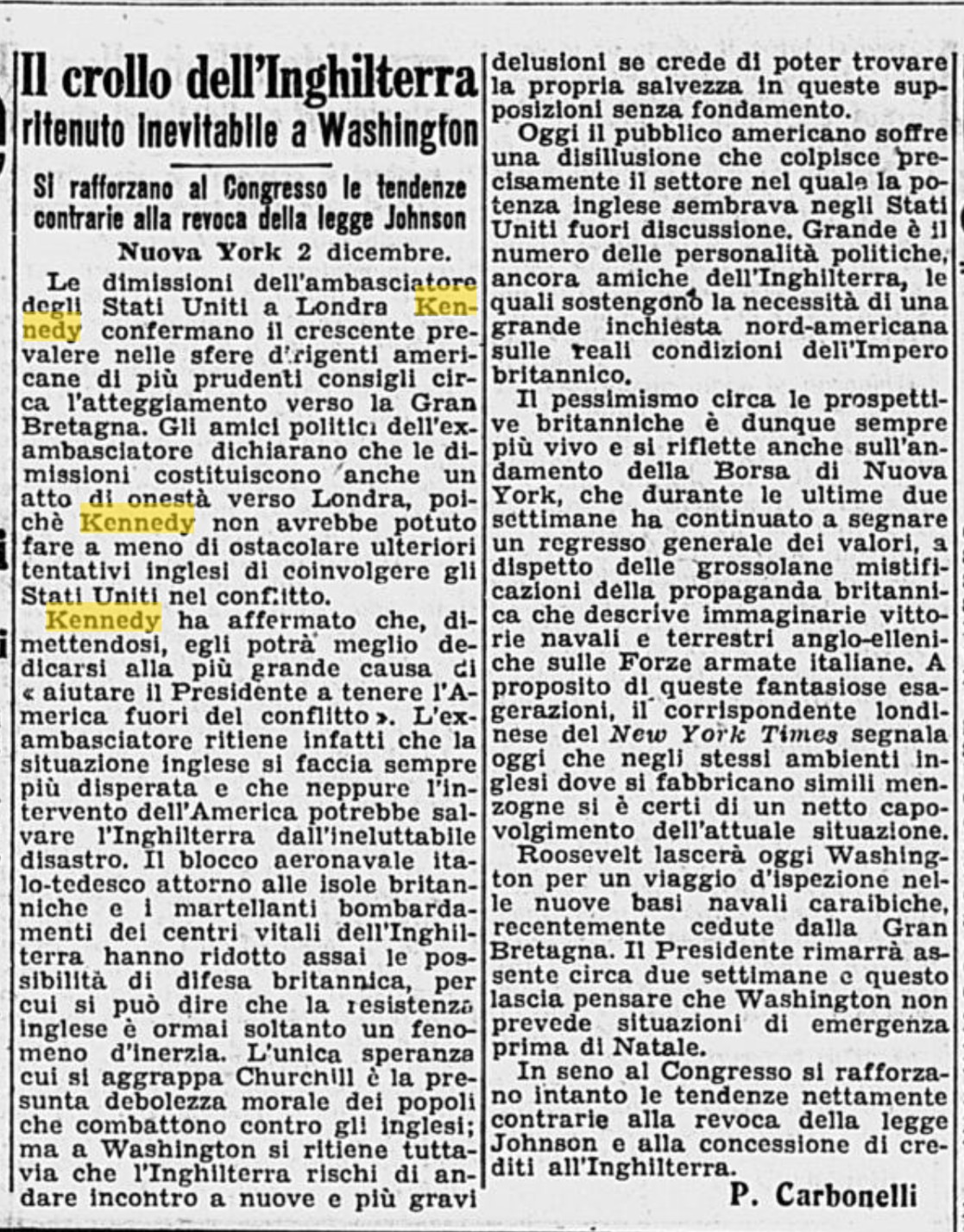
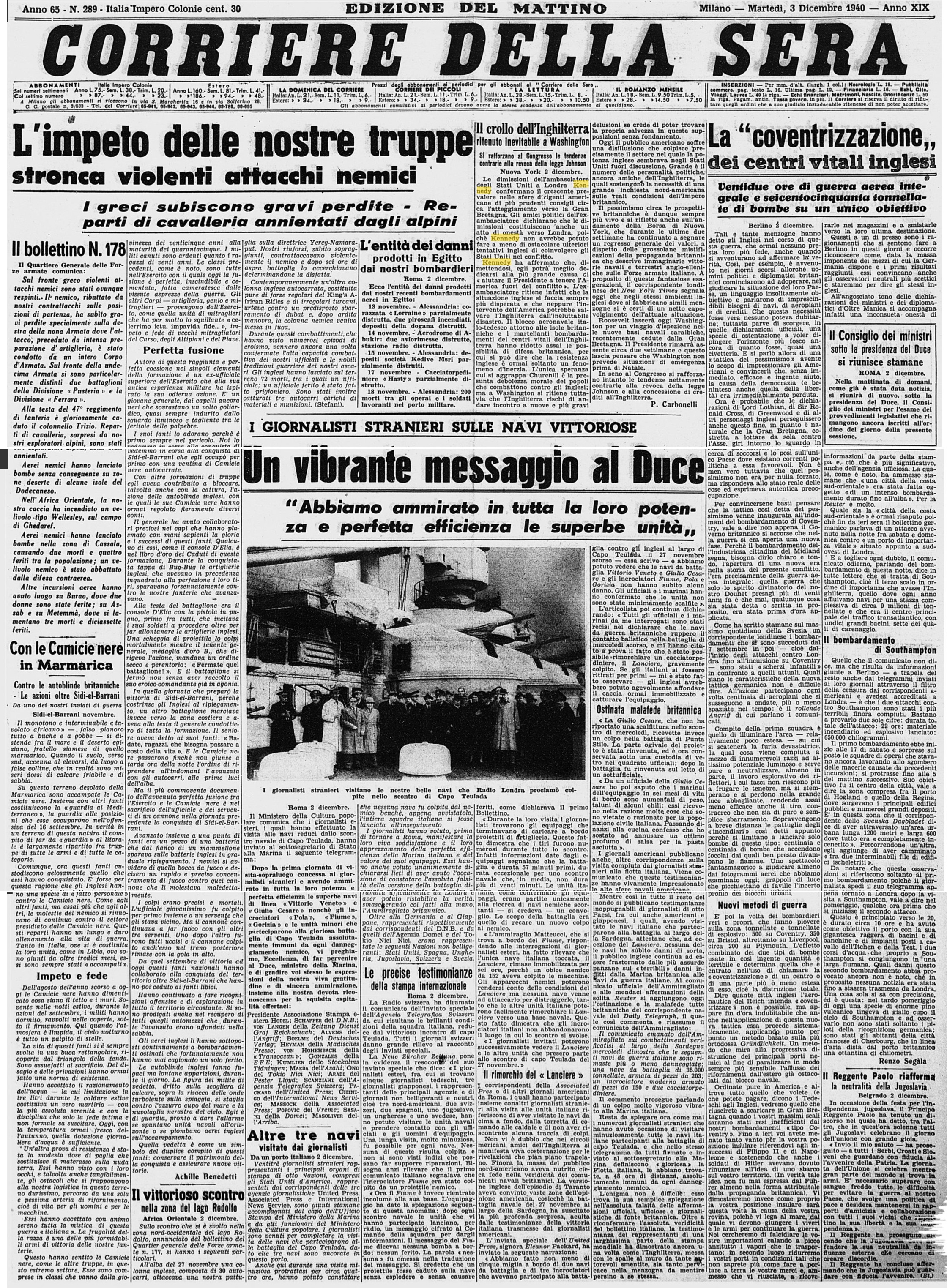
A
copy of an article from the Italian daily newspaper *Corriere della Sera*,
dated Tuesday, December 3, 1940. The following is a summary of the reference to Ambassador Joseph Kennedy in an article titled "England’s Collapse Deemed Inevitable in Washington – Opposition to Repealing the Johnson Act Gains Ground in Congress" (dispatched from New York on December 2, signed by P. Carbonelli): ° Resignation and a climate of caution in Washington: The article begins by noting that the resignation of the U.S. Ambassador to London, Joseph Kennedy, confirms that more cautious stances toward Great Britain are increasingly prevailing within American leadership circles. ° Honesty toward London and opposition to intervention: According to the former ambassador’s political allies, his stepping down also represents an act of honesty toward London, as Kennedy would have inevitably found himself obstructing further British attempts to draw the United States into the war. ° The goal of keeping America out of the conflict: Kennedy stated that, by resigning, he would be able to work more effectively toward the greater cause of "helping the President keep America out of the conflict." ° The conviction that a British disaster is inevitable: The former ambassador believes that England’s situation has become increasingly desperate and that even U.S. intervention would be unable to save the country from an unavoidable disaster. In his view, the Italian-German naval and air blockade around the British Isles and the persistent bombing of vital centers have so diminished British defensive capabilities that British resistance has become «merely a phenomenon of inertia»; meanwhile, Churchill’s hope—that the opposing peoples might suffer from a lack of moral resolve—is regarded in Washington as groundless and destined to lead to further disappointment. |
|
1940, December 4 - Corriere della Sera |
||
|
|
|
A
copy of an article from the Italian daily newspaper *Corriere della Sera*,
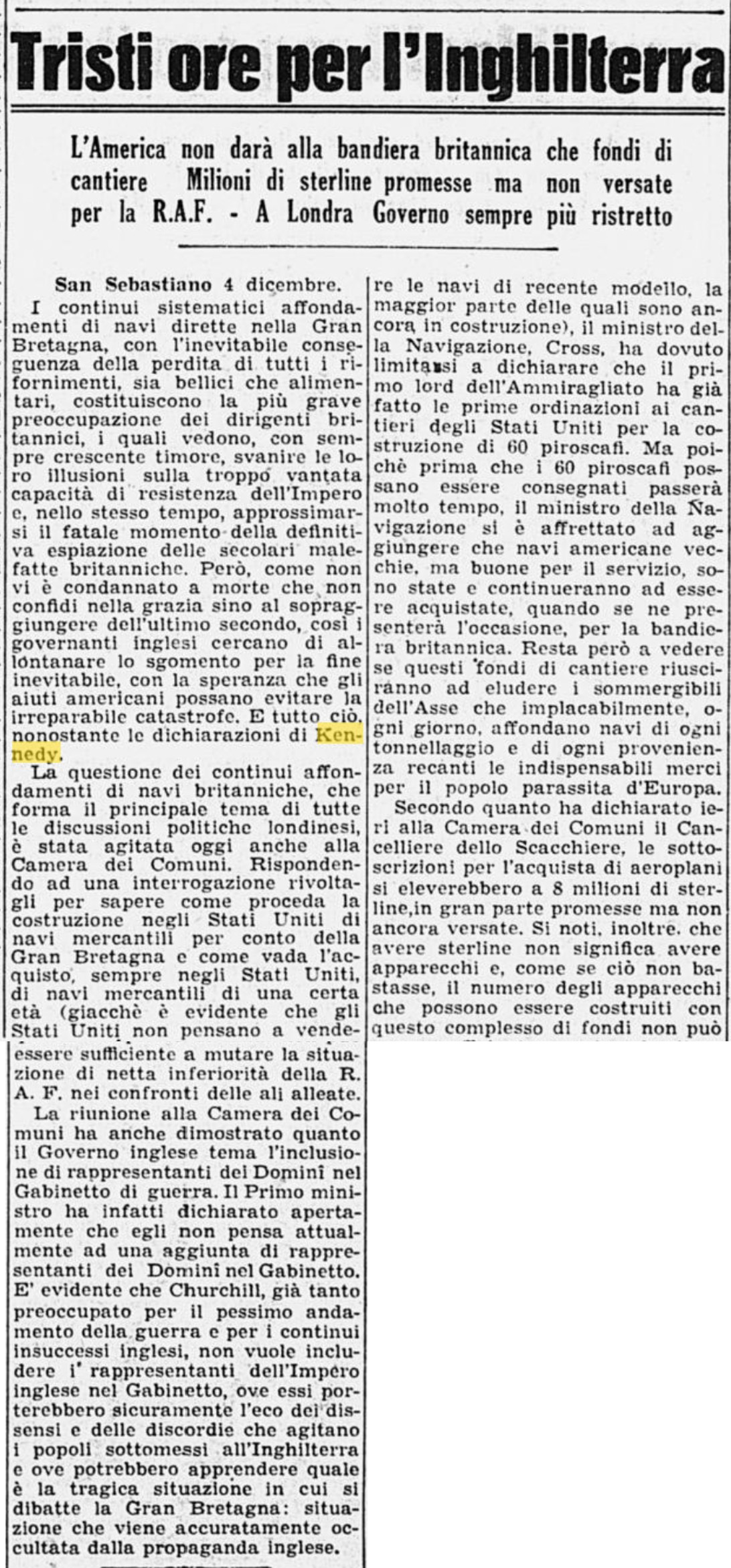
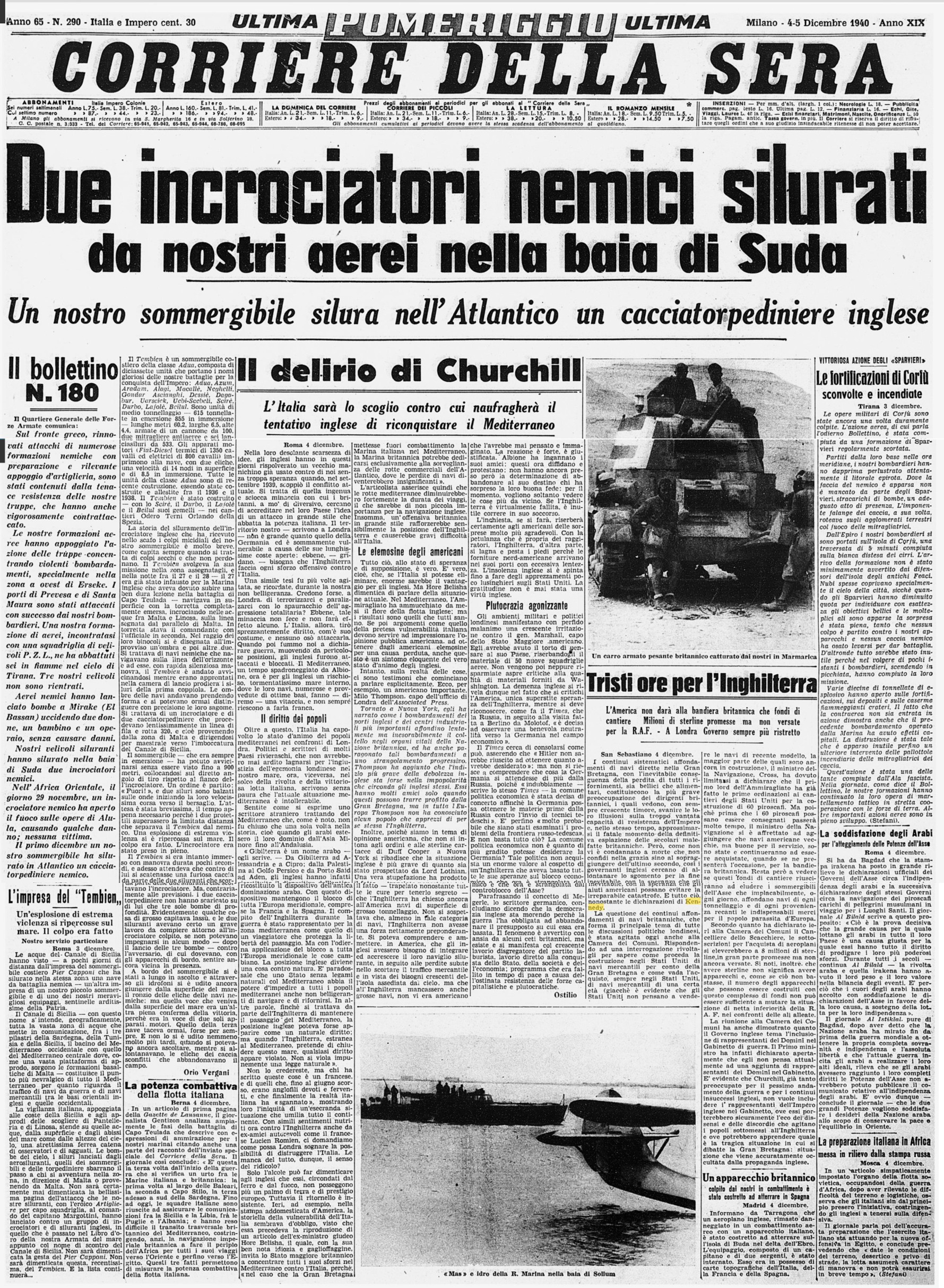
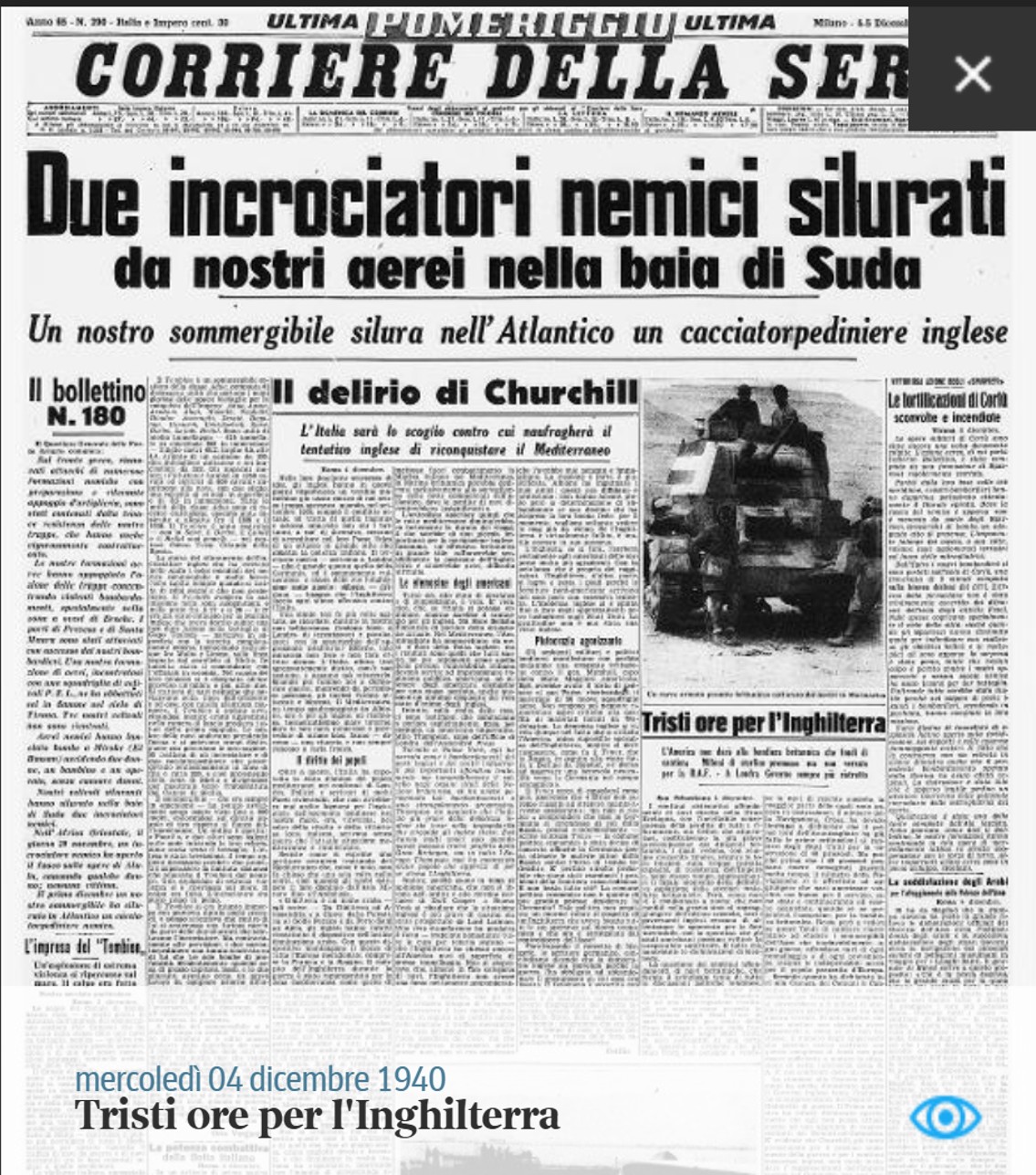
dated Wednesday, December 4, 1940. Below is a summary of the reference to Ambassador Joseph Kennedy found in the article titled "Grim Hours for England" (datelined San Sebastián, December 4): ° British hopes for U.S. aid, despite Kennedy’s words: In the opening paragraph, the article highlights how the ongoing sinking of ships bound for Great Britain—resulting in the loss of both war materiel and food supplies—has fueled fears among British leaders that defeat is imminent. Faced with this prospect, the British government attempts to stave off despair by clinging, until the very end, to the hope that American aid might avert catastrophe—"despite the statements of Kennedy" (who, in the preceding days, had reiterated that American intervention would be futile and that a British collapse was inevitable). ° The context of limited supplies: The remainder of the article indirectly reinforces Kennedy’s pessimism by pointing out the limitations of U.S. support for the British merchant fleet—which has been confined to ordering 60 steamships yet to be built and purchasing only aging merchant vessels ("leftovers from the shipyards"), as Washington is unwilling to part with any recently constructed ships—alongside the financial difficulties facing the R.A.F. and political tensions within Churchill’s government. |
|
1940, December 20 - Corriere della Sera |
||
|
|
|
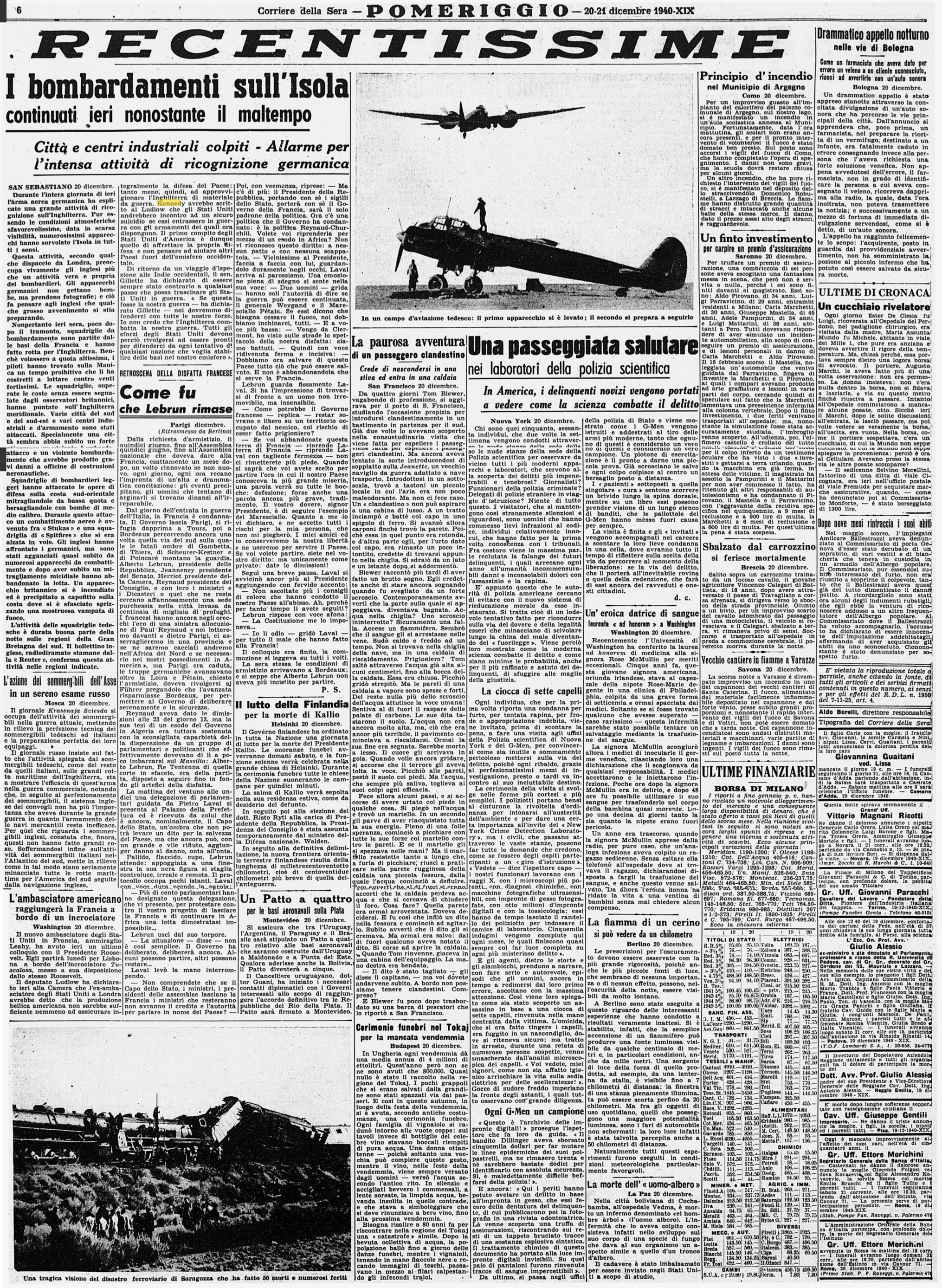
A copy of
an article from the Italian daily newspaper *Corriere della Sera*, dated
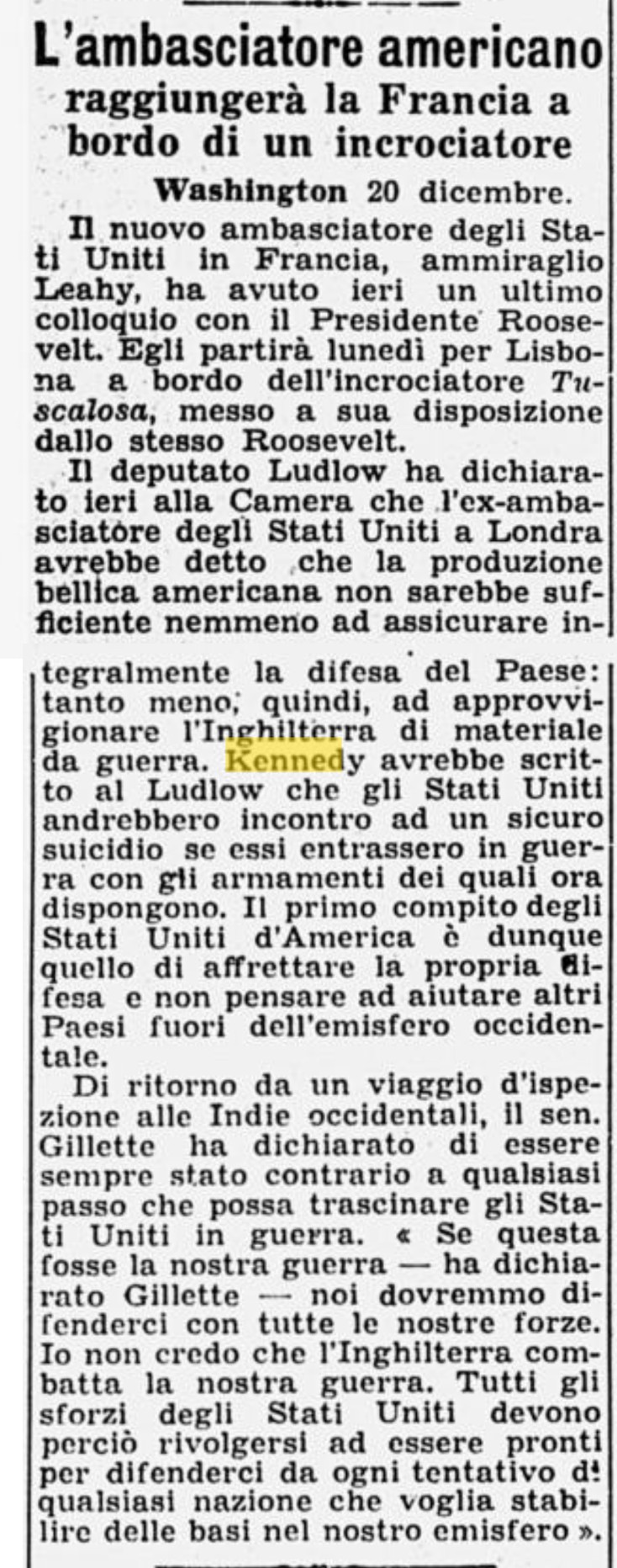
Friday, December 20, 1940. Below is a summary of the reference to Joseph Kennedy in the article—titled "American Ambassador to Reach France Aboard a Cruiser" (from Washington, December 20)—which notes the following: ° Insufficiency of U.S. war production: Speaking in the House of Representatives, Congressman Ludlow reported that former U.S. Ambassador to London Joseph Kennedy had stated that American war production is not even sufficient to fully guarantee the defense of the United States, let alone to supply England with war materiel. ° A warning of "certain suicide": Kennedy reportedly wrote to Ludlow that the United States would be heading toward "certain suicide" if it were to enter the war with the armaments currently at its disposal. ° Priority on domestic defense: According to the report, the former ambassador believes that the primary duty of the United States is to accelerate its own national defense, without concerning itself with assisting other countries outside the Western Hemisphere. |
|
1940, December 21 - Corriere della Sera |
||
|
|
|
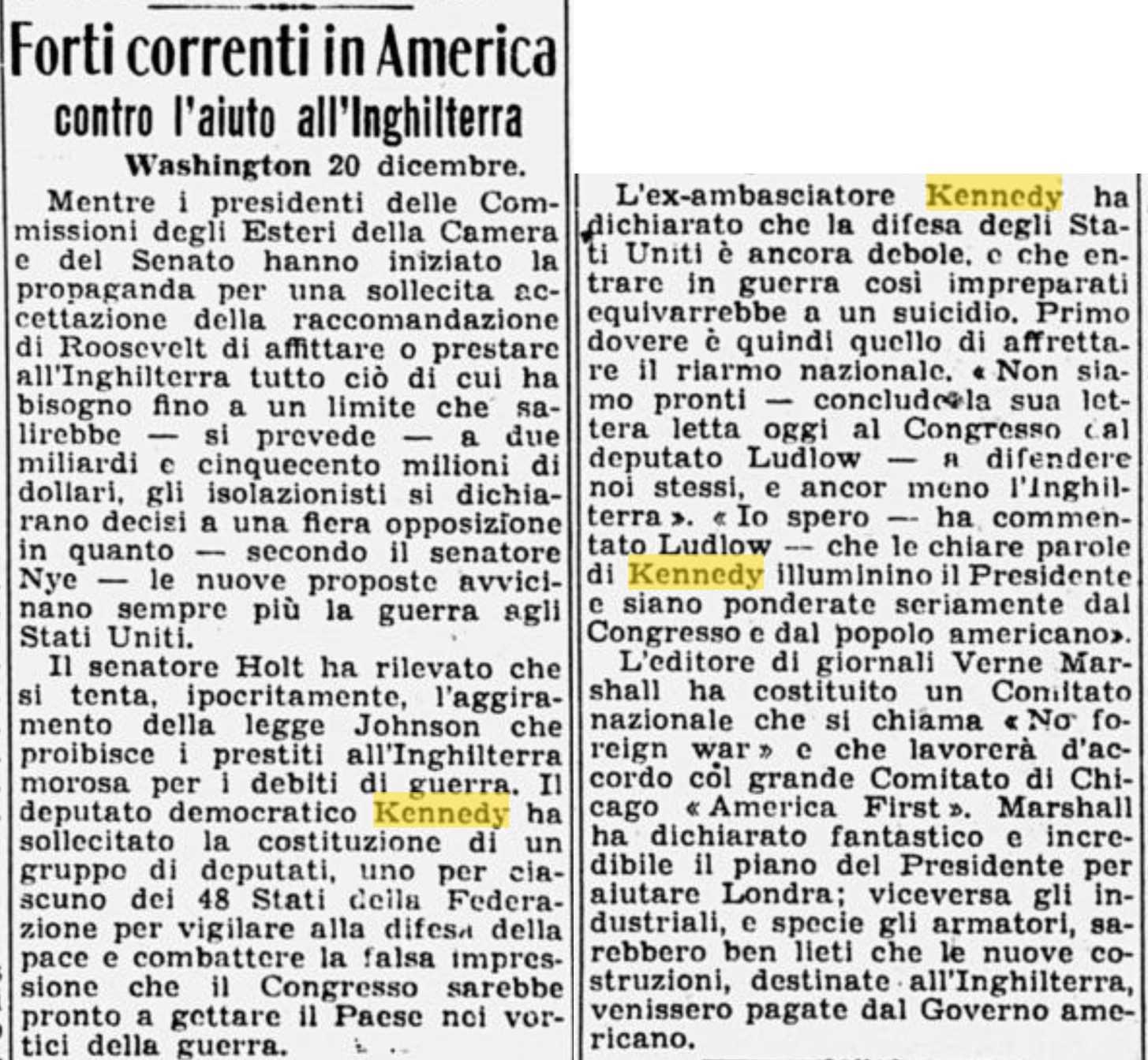
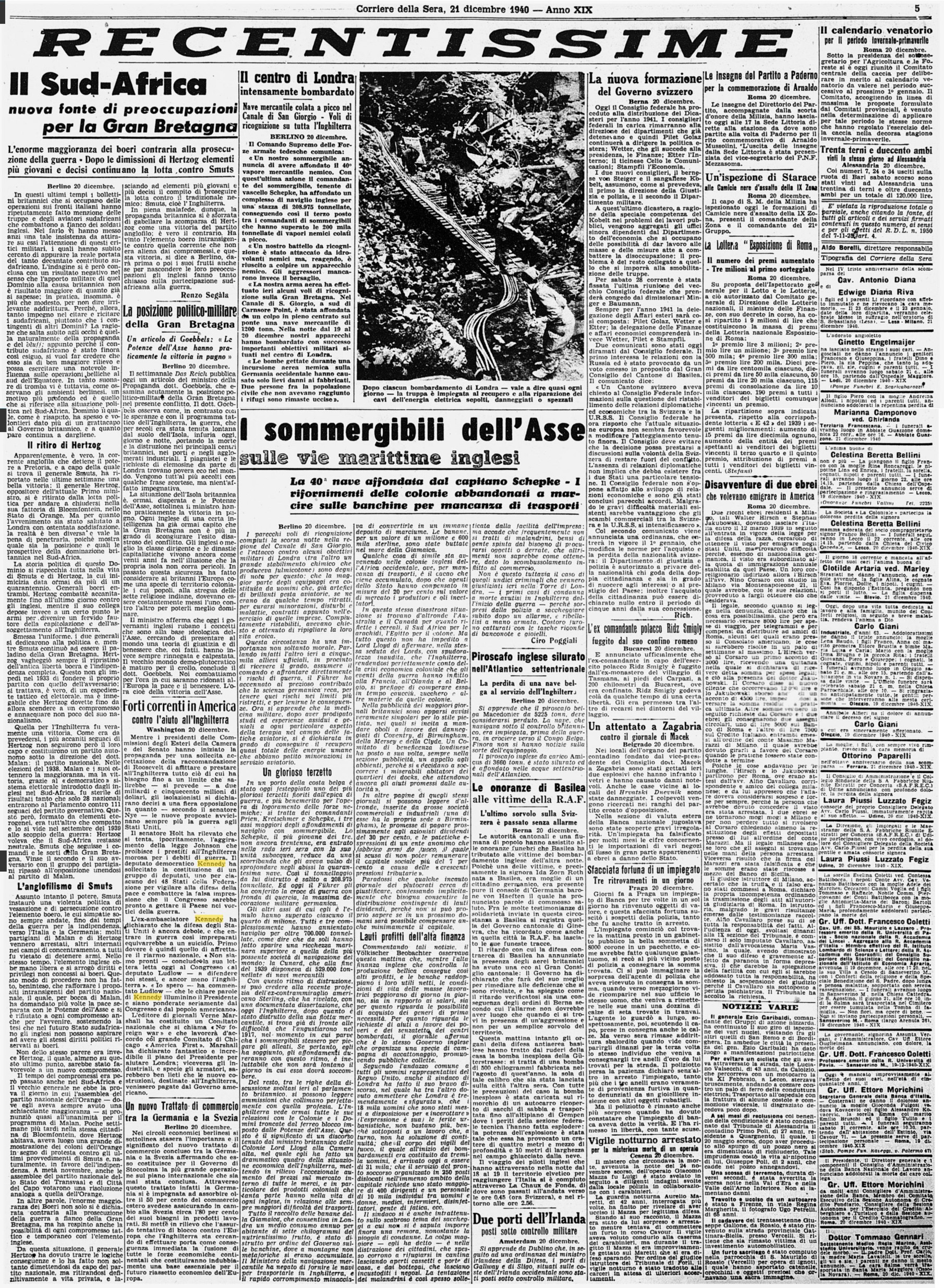
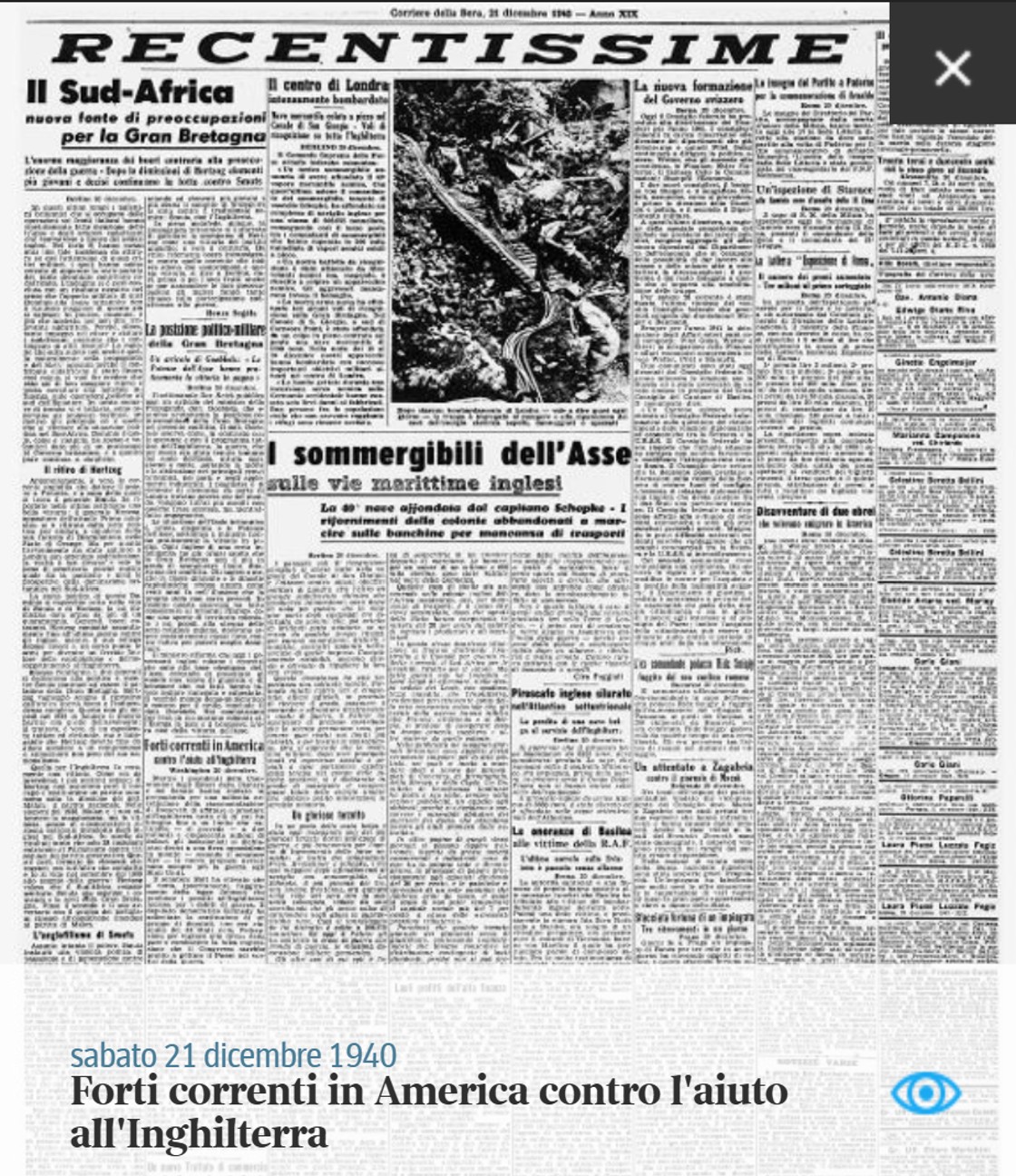
A copy of
an article from the Italian daily newspaper *Corriere della Sera*, dated
Saturday, December 21, 1940. Below is a summary of the reference to former Ambassador Joseph Kennedy, found in an article titled "Strong Currents in America Against Aid to England" (from Washington, December 20): ° Military unpreparedness and the danger of "suicide": Within the context of the isolationist opposition to Roosevelt’s proposals to lend or lease war materiel to Great Britain, the article cites the position of former Ambassador Kennedy, who argues that the United States' defenses remain weak and that entering the war in such a state of unpreparedness would be tantamount to suicide. ° Priority given to national rearmament: Kennedy reiterates that the primary duty of the United States is to accelerate national rearmament. ° A letter read in Congress by Representative Ludlow: The article quotes the conclusion of a letter from Kennedy, which was read in Congress by Representative Ludlow: "We are not prepared to defend ourselves, let alone England." Ludlow commented by expressing the hope that Kennedy’s clear words might enlighten the President and be given serious consideration by Congress and the American people. (Note: The first column of the article also mentions—highlighted—an individual with the same surname, Democratic Representative Martin J. Kennedy, who calls for the formation of a group of lawmakers to safeguard peace.) |
|
1940, December 28 - Corriere della Sera |
||
|
|
|
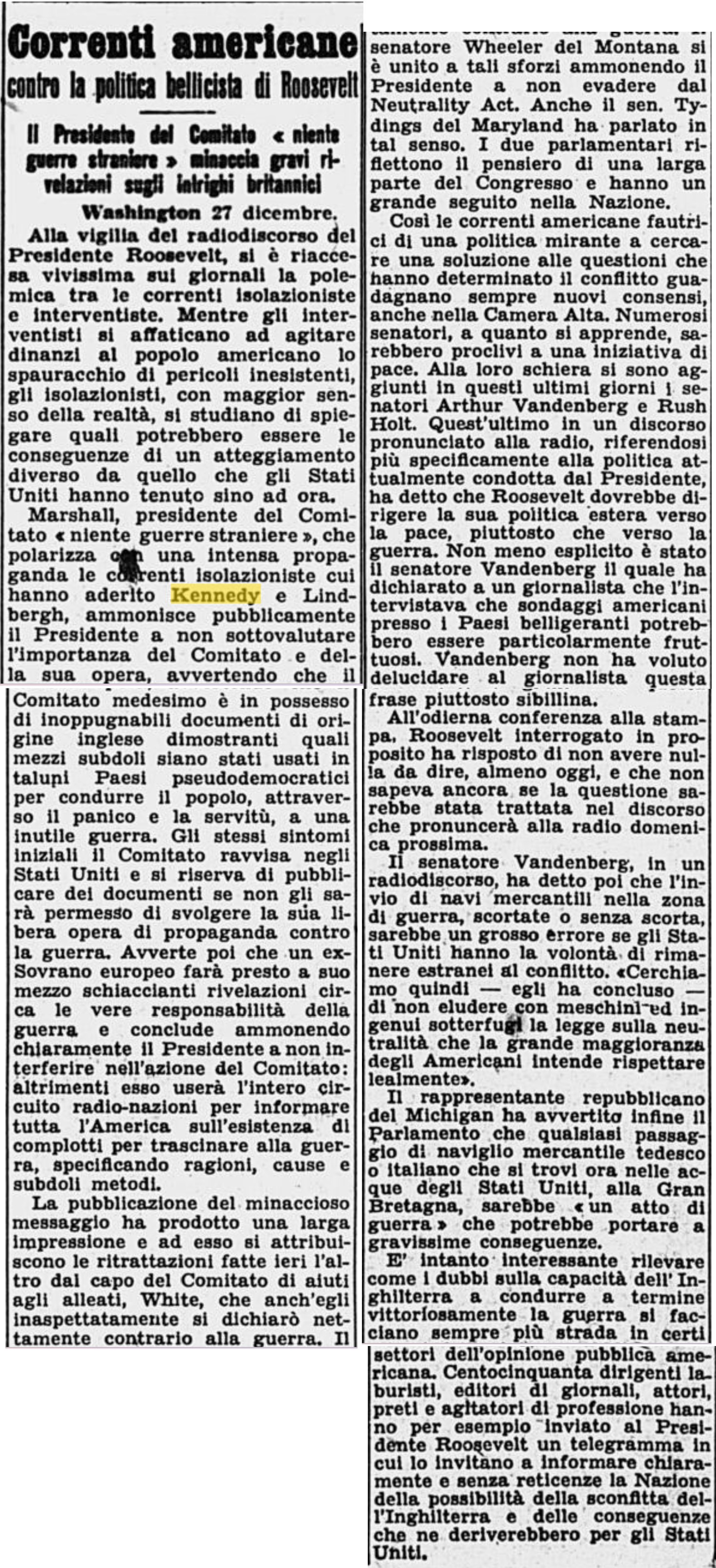
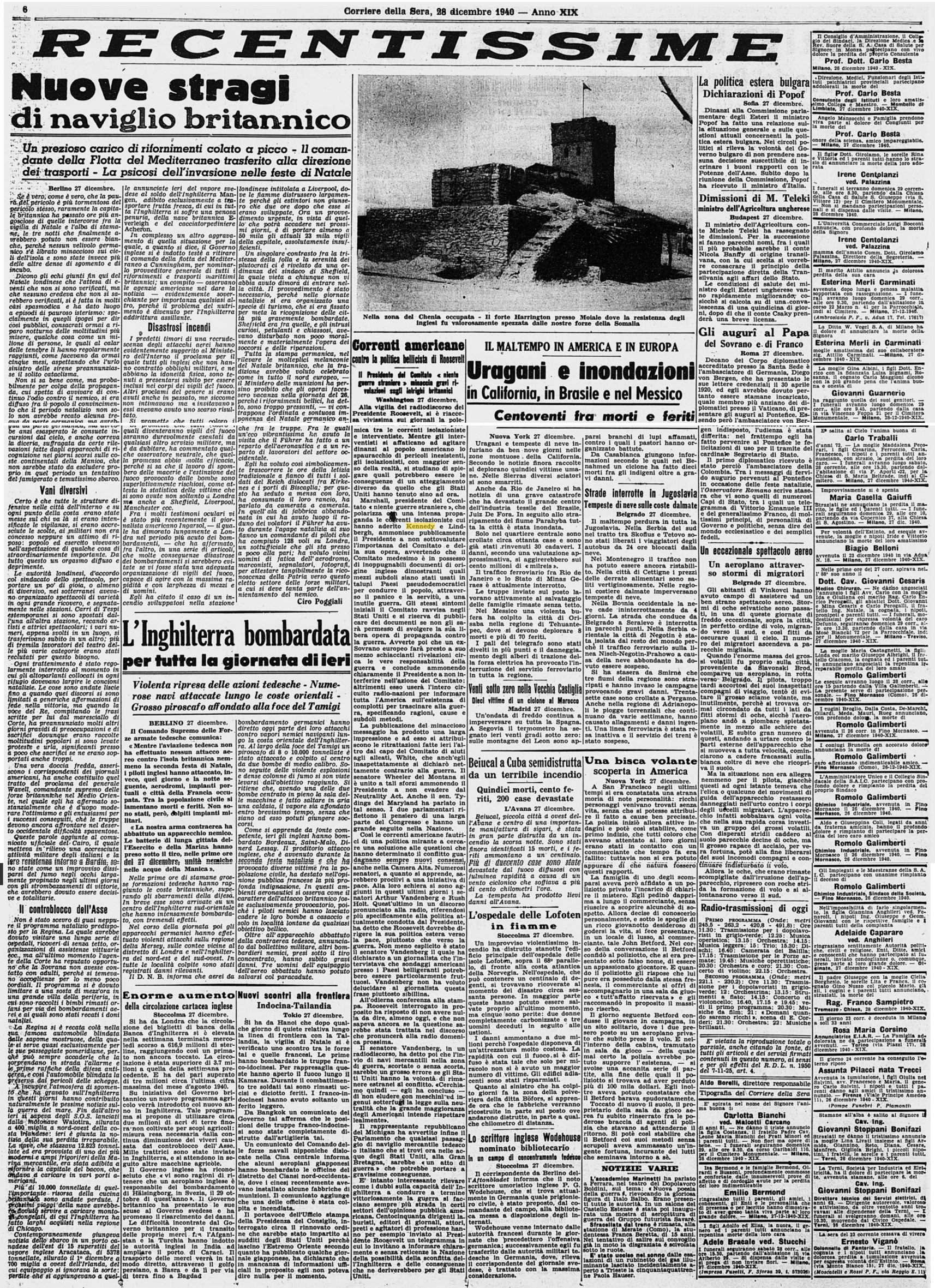
A copy of
an article from the Italian daily newspaper *Corriere della Sera*, dated
Saturday, December 28, 1940. Below is a summary of the reference to Joseph Kennedy in an article titled "American Currents Oppose Roosevelt’s Warmongering Policy – Chairman of the 'No Foreign War' Committee Threatens Major Revelations Regarding British Intrigues" (from Washington, December 27): ° Alignment with isolationist currents: Amidst the heated debate in the U.S. press between interventionists and isolationists—on the eve of a radio address by Roosevelt—the article cites a statement by Verne Marshall, chairman of the "No Foreign War" Committee. The piece explicitly notes that this Committee, through intense propaganda, serves as a focal point for isolationist factions—factions "to which Kennedy and Lindbergh have lent their support." ° The context of the warning to Roosevelt: Bolstered by the weight of such endorsements, Marshall and his Committee publicly caution the President not to underestimate their efforts or hinder their anti-war propaganda; they threaten that, should he do so, they will broadcast documents of British origin detailing the methods used to drag nations into the conflict. |
|
1941, January 7 - Corriere della Sera |
||
|
|
|
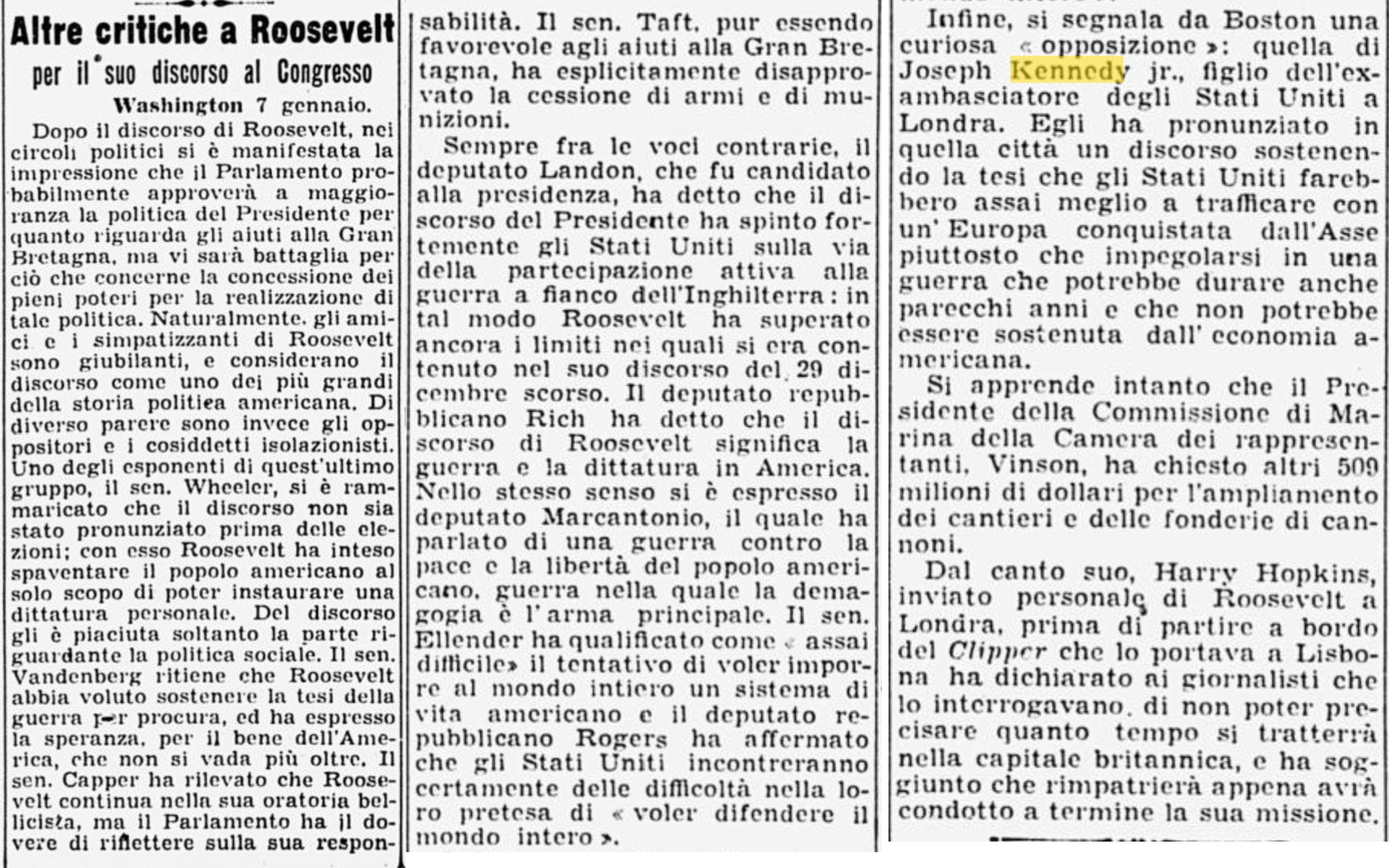
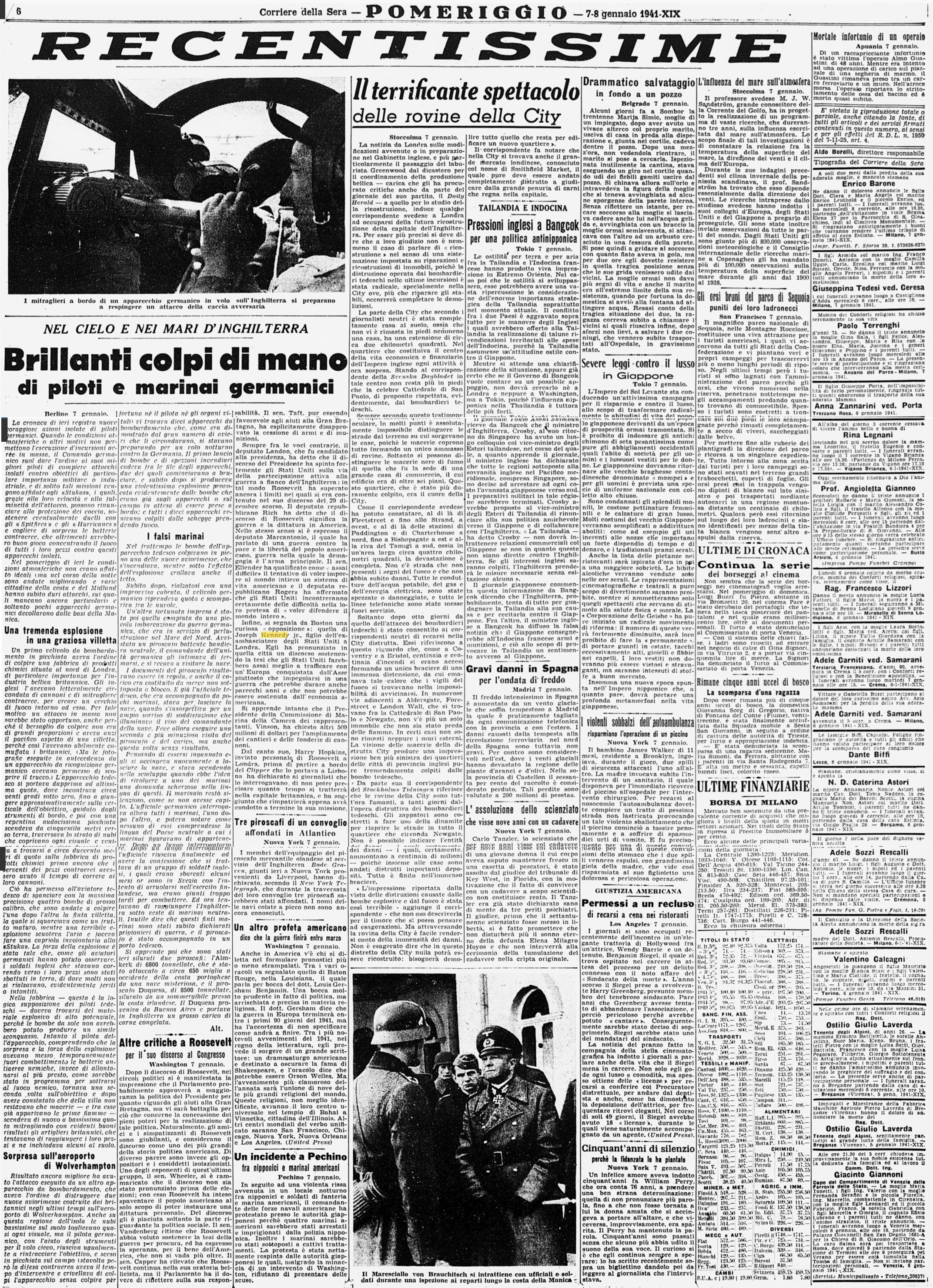
A copy of
an article from the Italian daily newspaper *Corriere della Sera*, dated
Tuesday, January 7, 1941. In the article titled "Further Criticism of Roosevelt Regarding His Address to Congress" (from Washington, January 7), Ambassador Joseph P. Kennedy is not quoted directly; rather, he is mentioned in his capacity as the father of his eldest son, Joseph Kennedy Jr.: ° The stance taken by his son, Joseph Kennedy Jr.: In the third paragraph of the final column, the article reports from Boston on a "curious opposition" to Roosevelt’s interventionist policy—an opposition coming from none other than Joseph Kennedy Jr., who is explicitly identified as the "son of the former United States Ambassador to London." ° The speech in Boston against military intervention: In a speech delivered in Boston, Joseph Kennedy Jr. argued that it would be far more advantageous for the United States to trade with a Europe conquered by the Axis powers than to become embroiled in a conflict that could drag on for several years—a conflict that the American economy would be unable to sustain. |
|
1941, January 10 - Corriere della Sera |
||
|
|
|
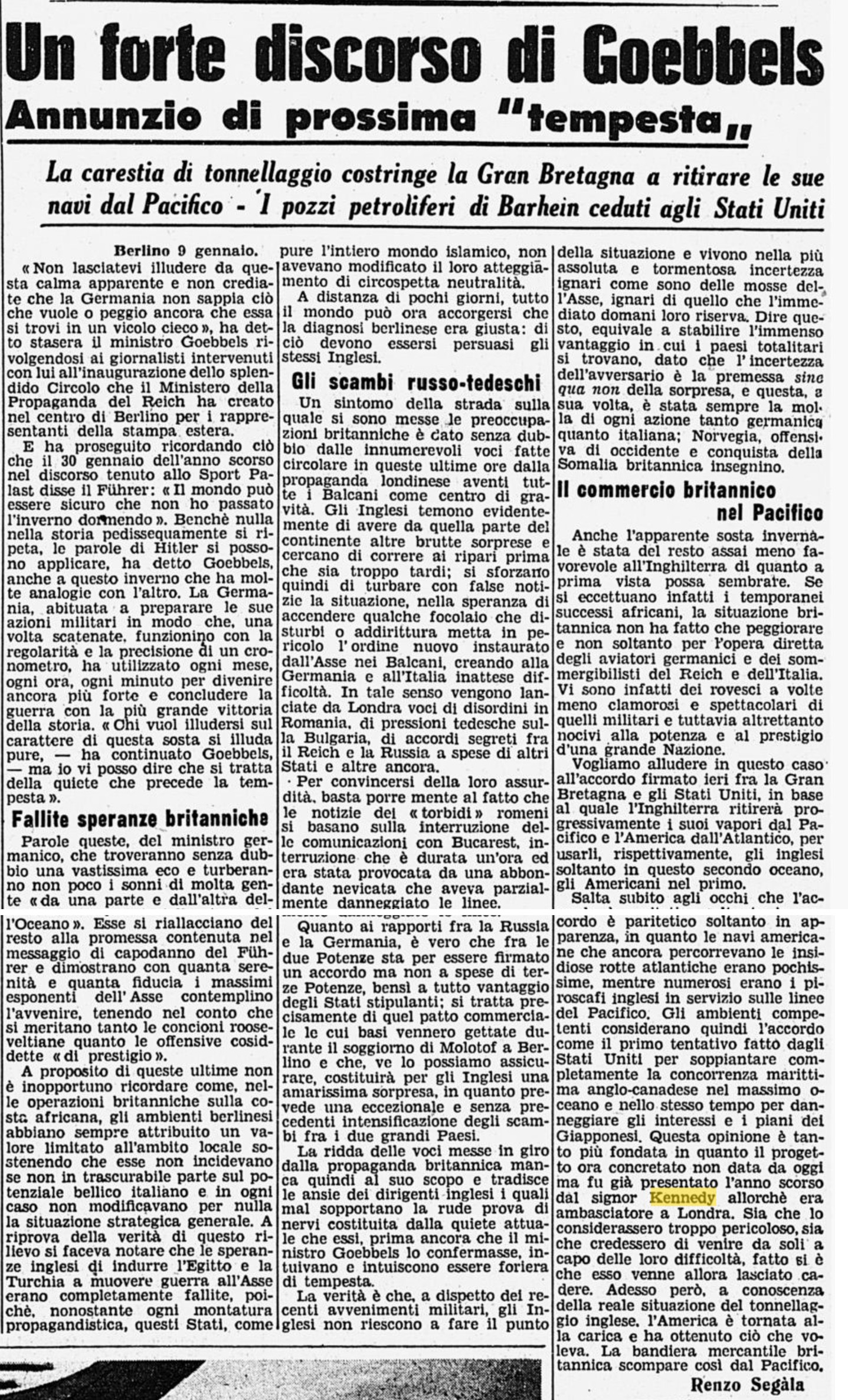
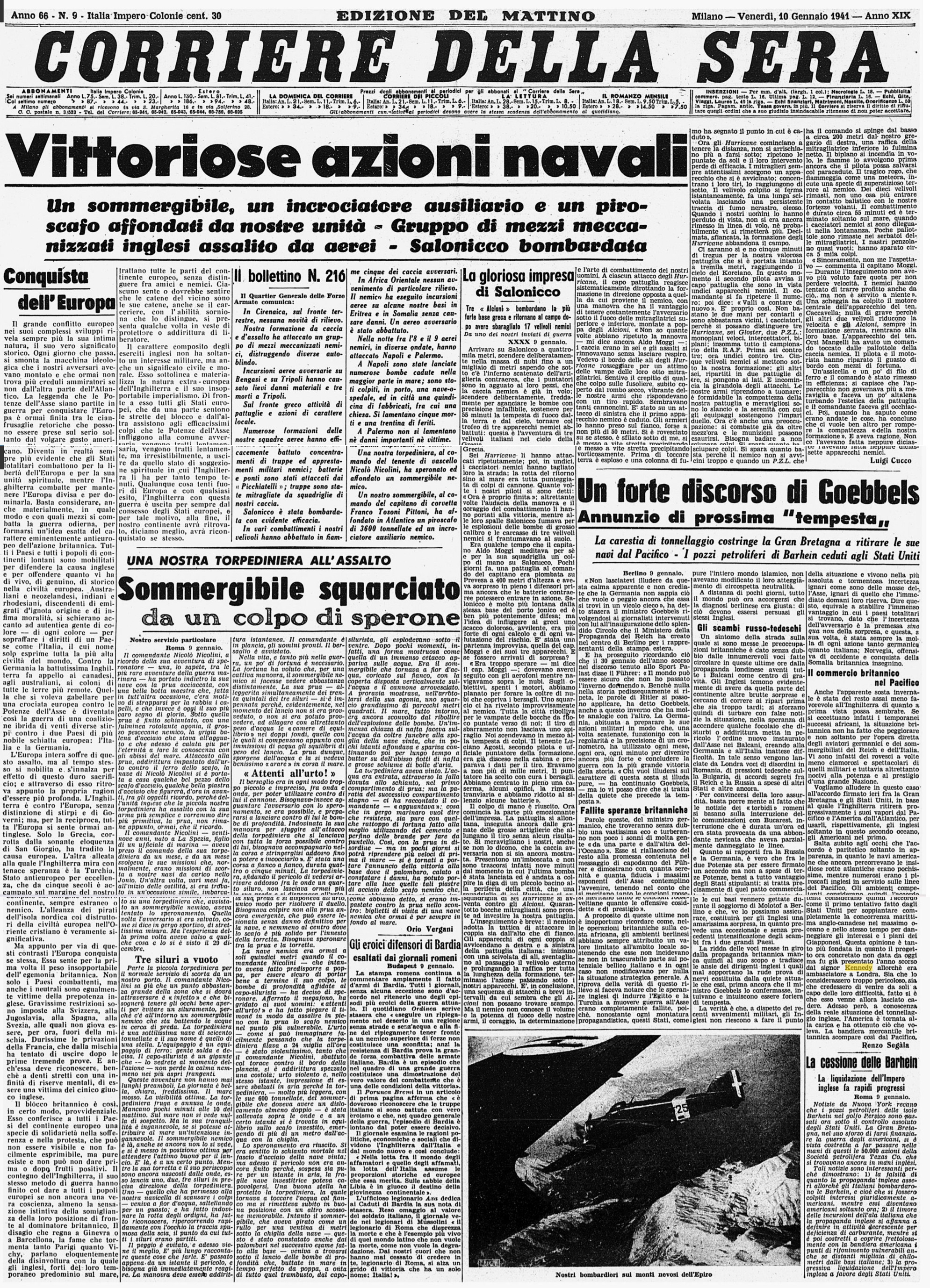
A copy of
an article from the Italian daily newspaper *Corriere della Sera*, dated
Friday, January 10, 1941. In the article titled "A Strong Speech by Goebbels – Announcement of an Impending 'Storm' – Tonnage Shortage Forces Great Britain to Withdraw Its Ships from the Pacific – Bahrain Oil Wells Ceded to the United States" (a dispatch from Berlin dated January 9, signed by Renzo Segàla), a reference to former Ambassador Joseph Kennedy appears in the third column, within a section titled "British Trade in the Pacific." The Anglo-American maritime agreement in the Pacific: The article discusses an accord recently signed between Great Britain and the United States, under which the British will progressively withdraw their merchant vessels from the Pacific to concentrate them in the Atlantic, while the Americans will do the reverse. According to the correspondent, the agreement is only ostensibly equitable and represents the first step by the United States to supplant Anglo-Canadian maritime competition in the Pacific. The earlier proposal presented by Kennedy: In support of this argument, it is noted that this plan is not new; it had already been put forward the previous year by Mr. Kennedy himself, during his tenure as United States Ambassador to London. From initial rejection to forced acceptance: At the time, the British dismissed Kennedy’s proposal—either because they deemed it too dangerous or because they were confident they could overcome their difficulties on their own. However, faced with a severe worsening of the shortage of British shipping, Washington pressed the issue again, ultimately succeeding in securing what Kennedy had previously proposed—thereby bringing about the disappearance of the British merchant flag from the Pacific. |
|
1941, January 14 - Corriere della Sera |
||
|
|
|
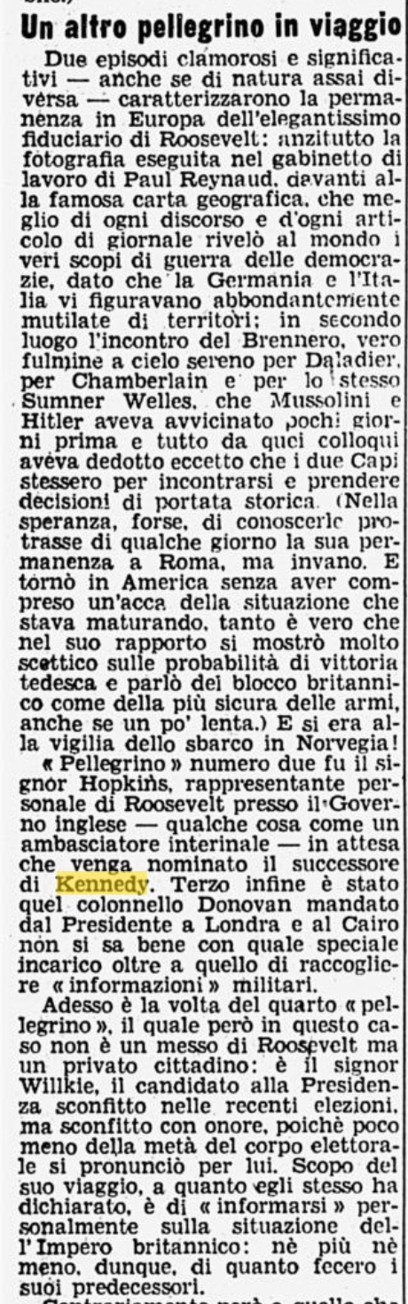
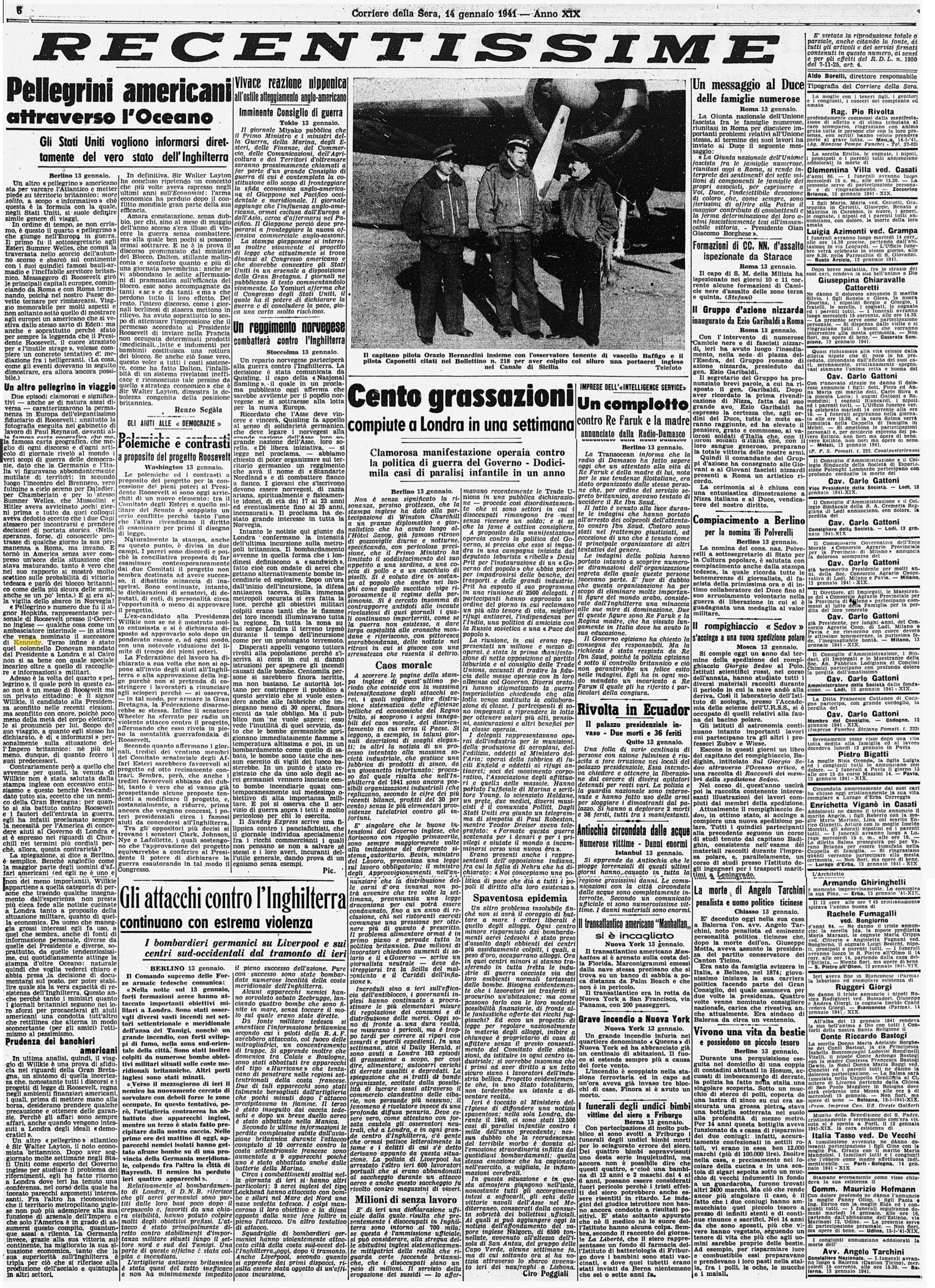
A copy of
an article from the Italian daily newspaper *Corriere della Sera*, dated
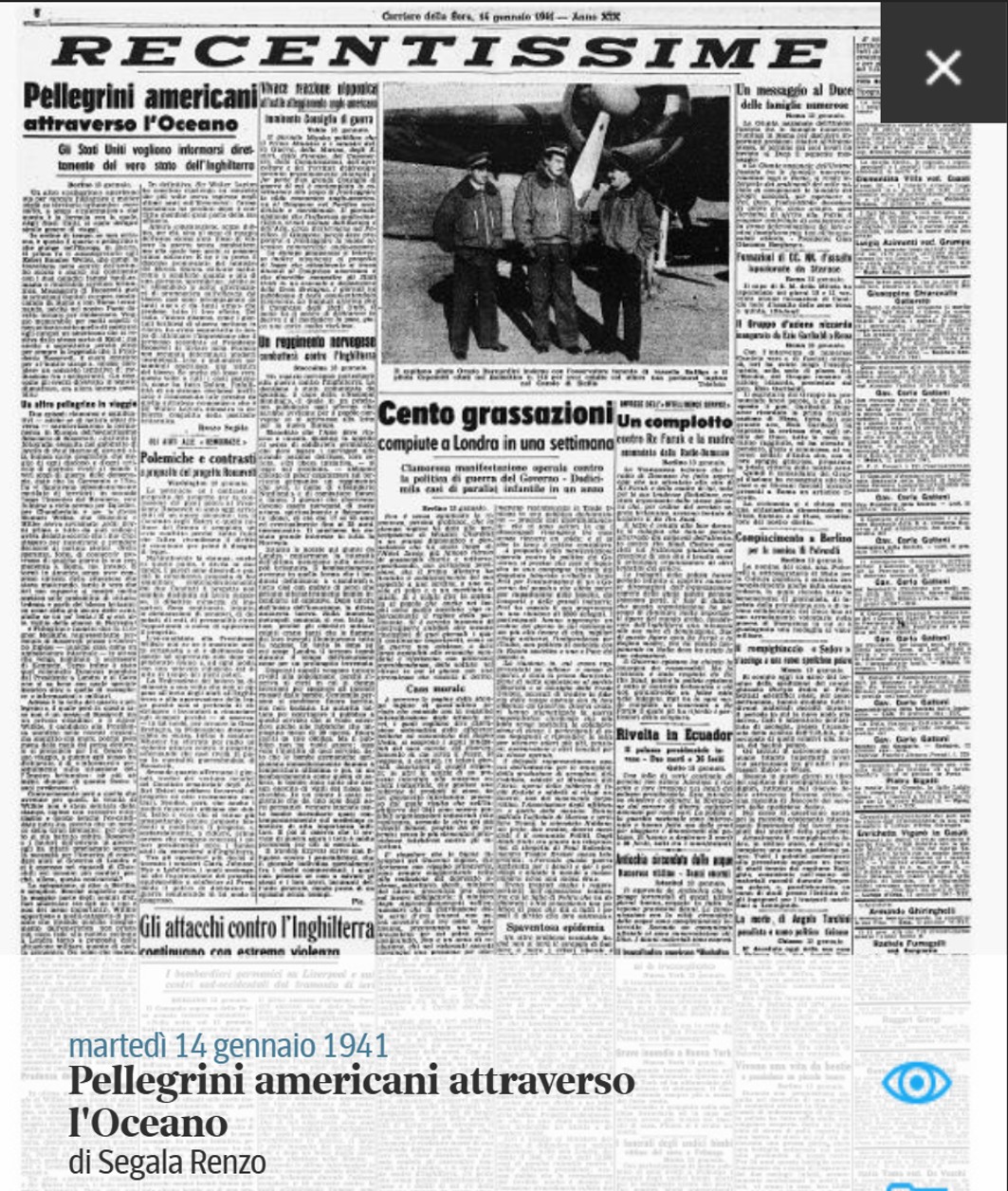
Tuesday, January 14, 1941. In the article, titled "Another Pilgrim on a Journey," a reference to former ambassador Joseph Kennedy appears in the second paragraph, within an overview of the American envoys sent to Europe by Roosevelt (following Sumner Welles, the first "pilgrim"): ° The vacancy at the London diplomatic mission: In introducing Harry Hopkins as the second "pilgrim"—that is, a personal representative sent by President Roosevelt to the British government—the article describes him as a sort of *ad interim* ambassador, pending the official appointment of a successor to Kennedy at the helm of the United States Embassy in London. ° The context of the mission of Hopkins and the other envoys: The text highlights the diplomatic void left by Kennedy’s resignation, which was temporarily filled by informal and confidential missions—such as those of Hopkins himself, Colonel Donovan (sent to London and Cairo), and, finally, the former Republican presidential candidate Wendell Willkie (the fourth "pilgrim," traveling as a private citizen to personally assess the state of the British Empire). |
|
1941, January 15 - Corriere della Sera |
||
|
|
|
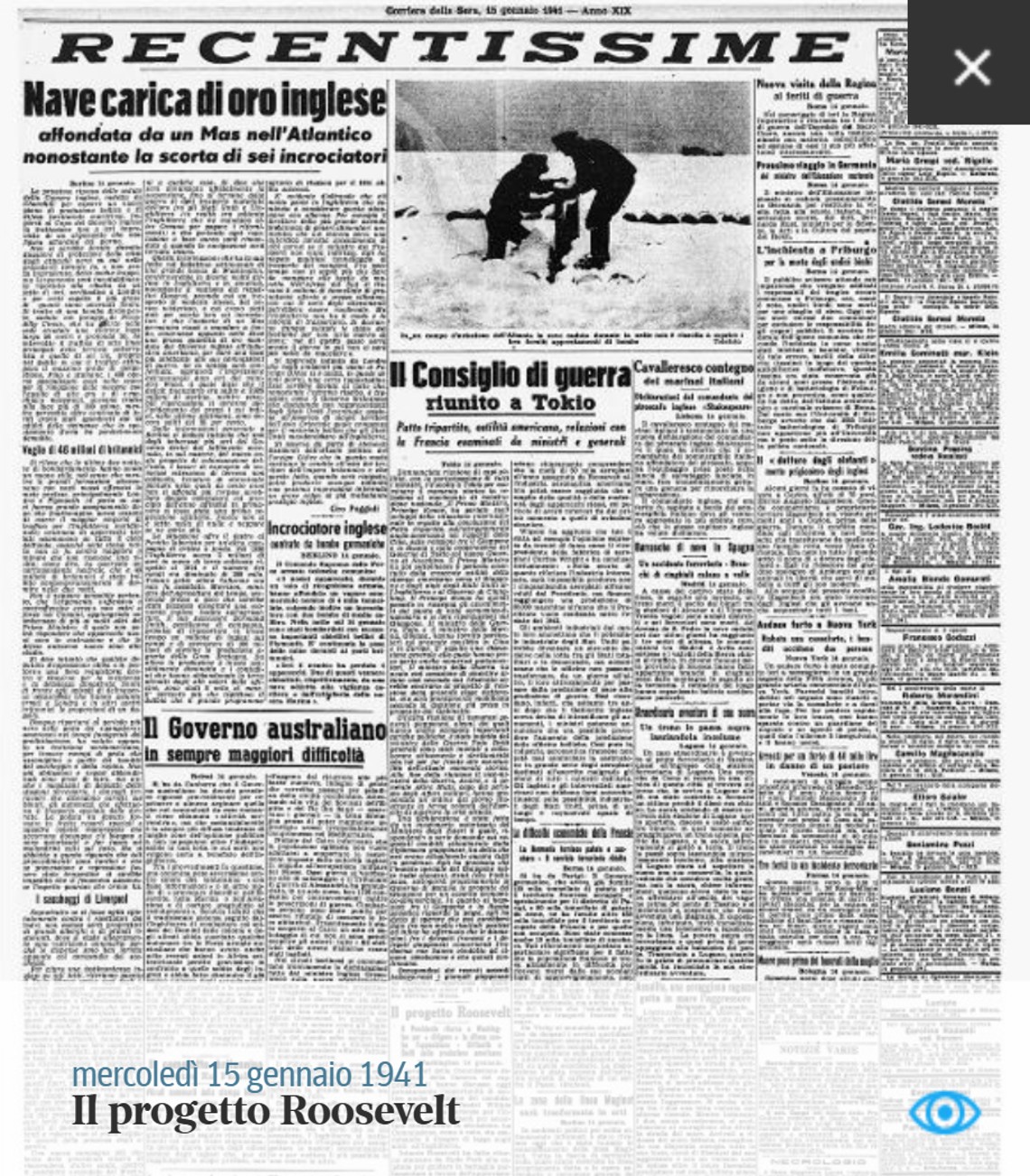
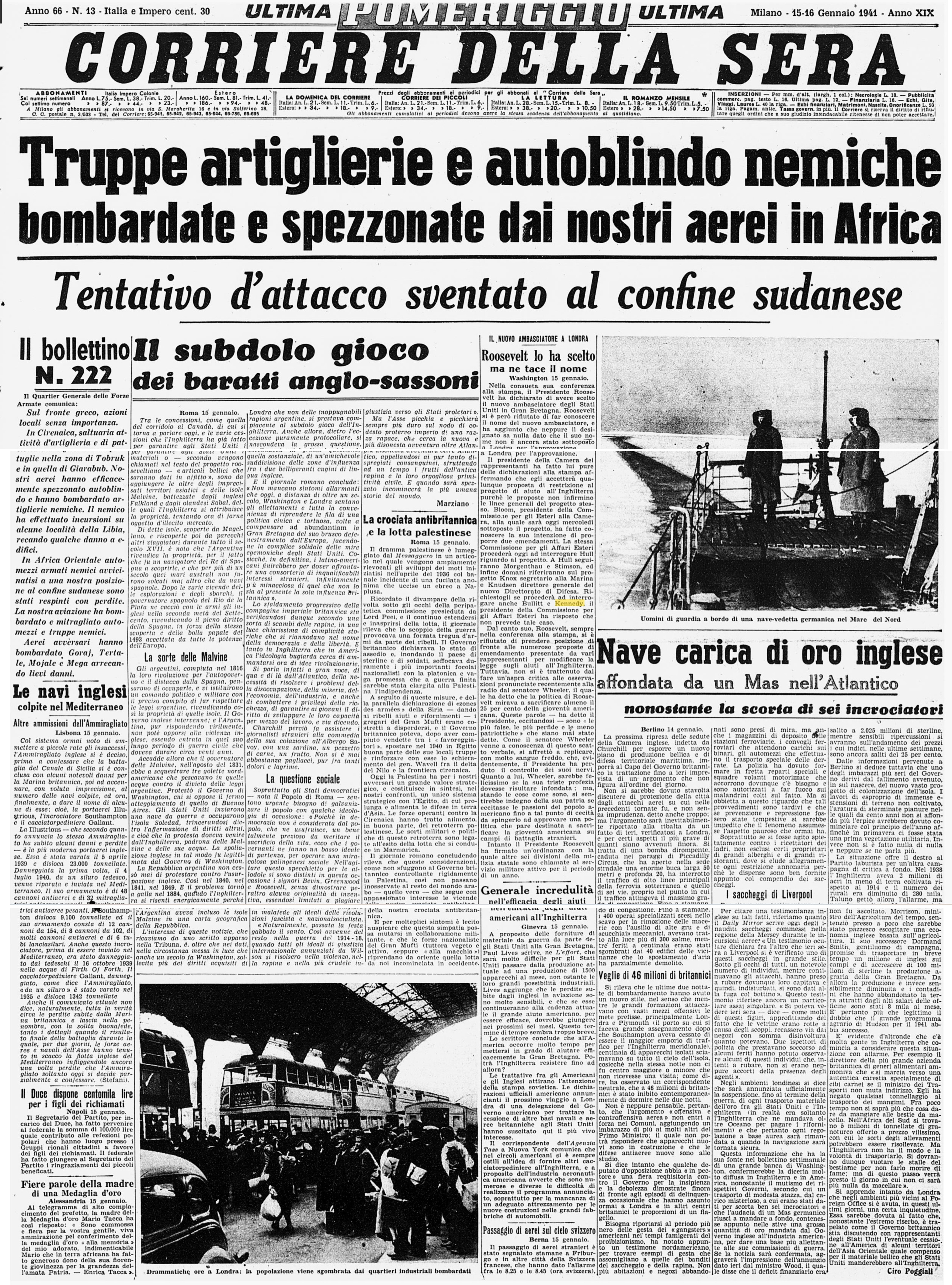
Copies of
two articles from the Italian daily newspaper *Corriere della Sera*, dated
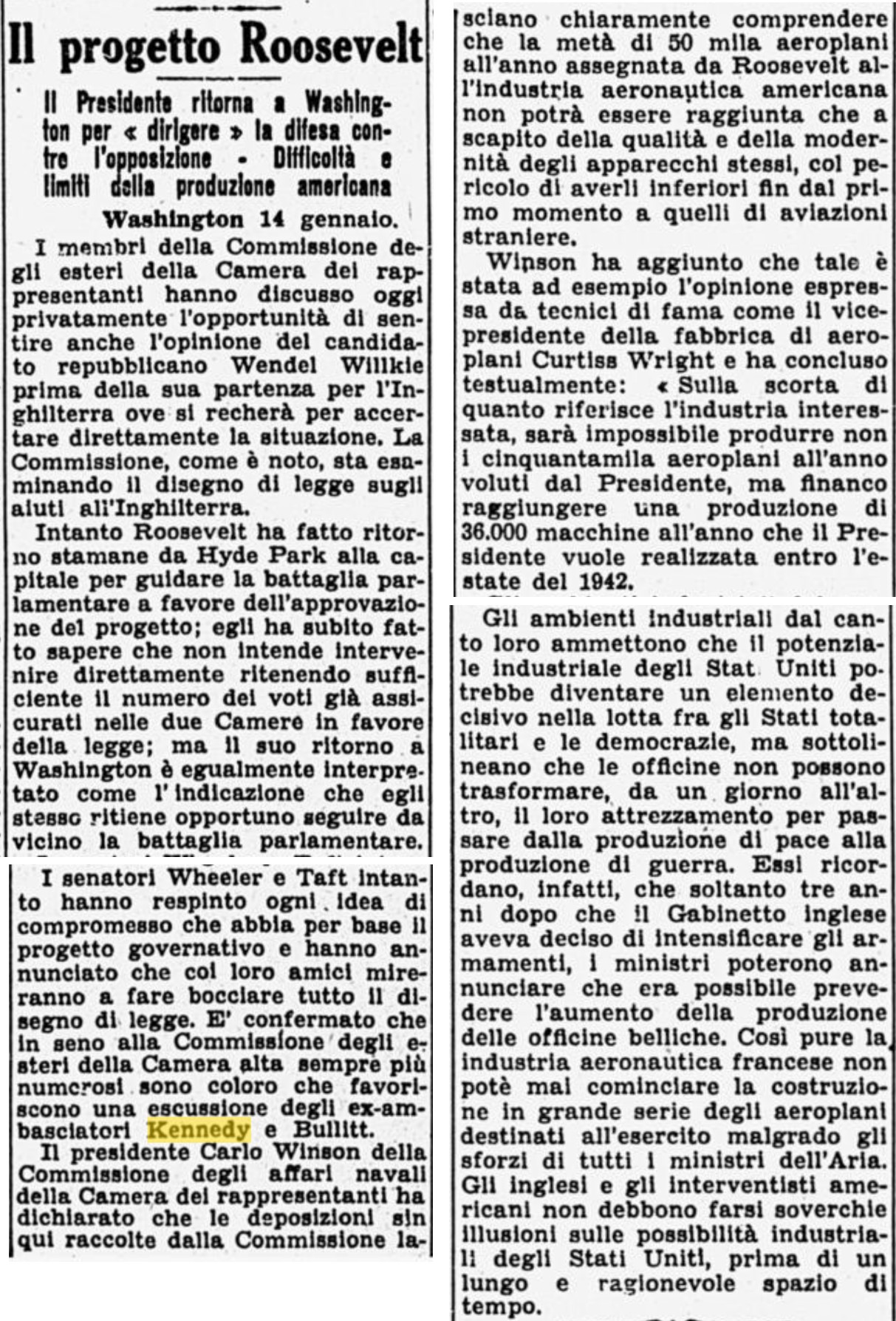
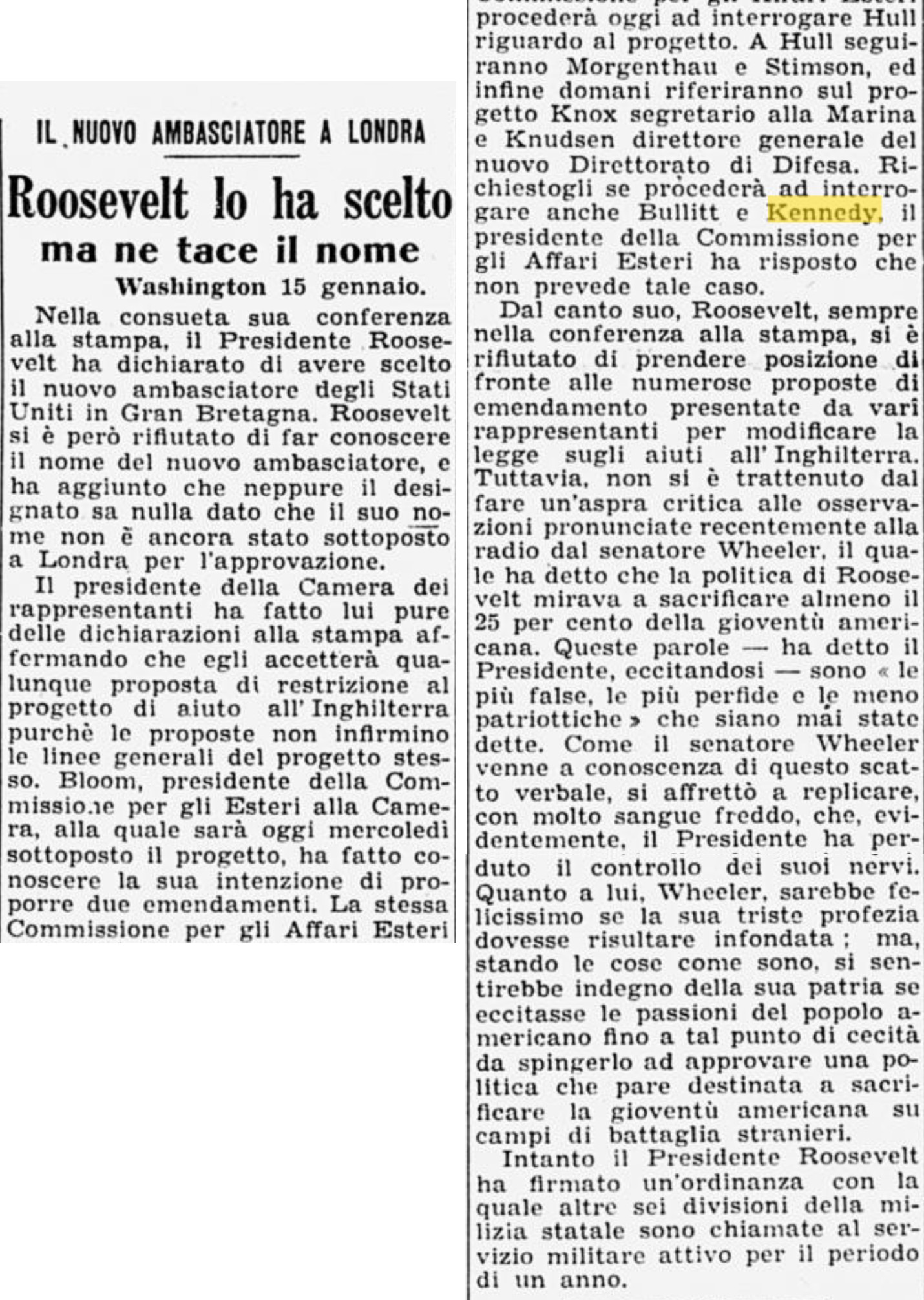
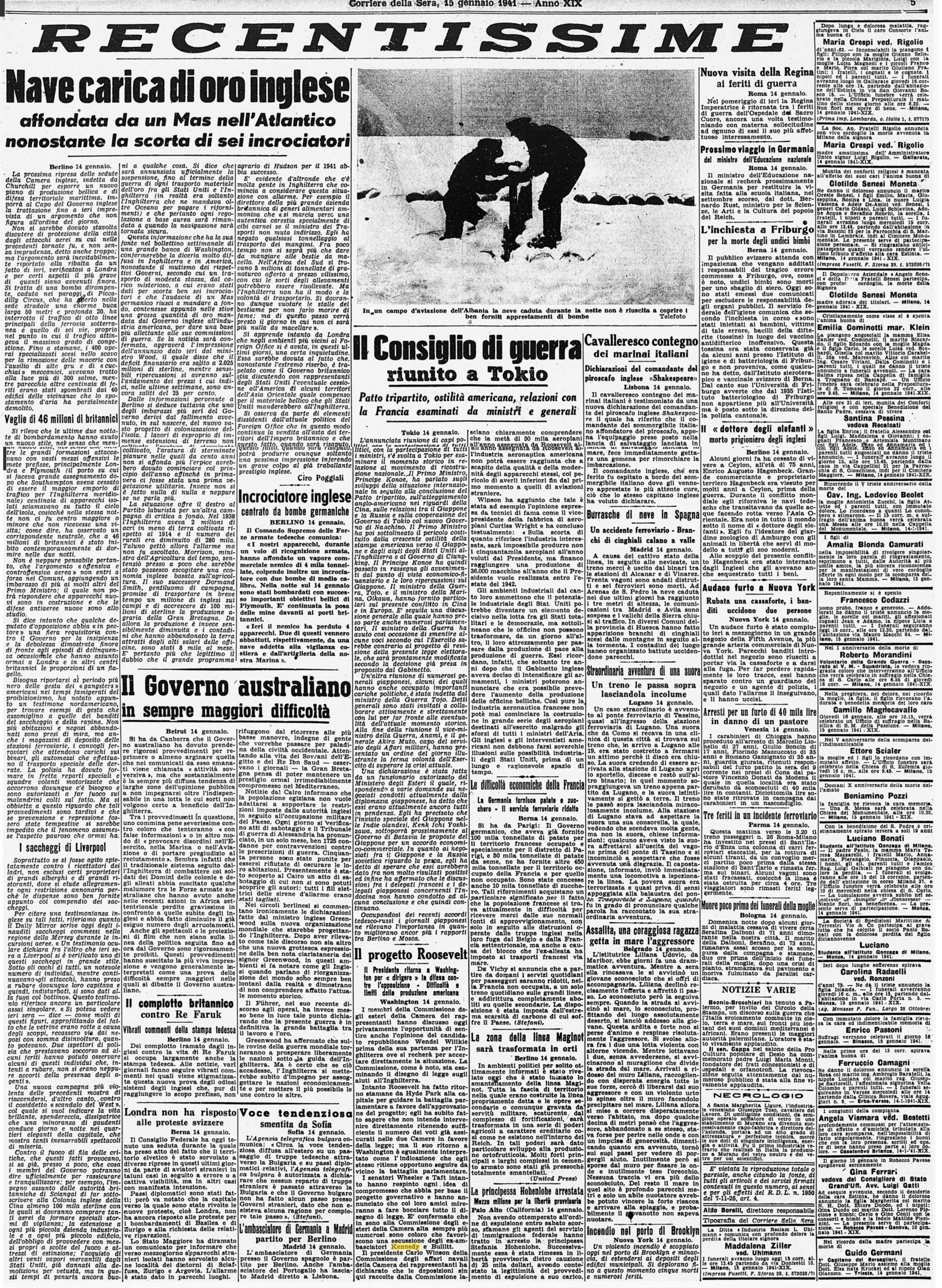
Wednesday, January 15, 1941. Below is a summary of the references to former Ambassador Joseph Kennedy found in these two articles, which highlight contrasting positions between the Senate and the House of Representatives regarding his potential testimony concerning the bill for aid to Great Britain (Lend-Lease): 1. "The Roosevelt Plan – The President returns to Washington to 'direct' the defense against the opposition – Difficulties and limitations of American production" (from Washington, January 14) ° Request to hear from Kennedy in the Senate: While Senators Wheeler and Taft declare their intention to reject any compromise and defeat the government’s bill for aid to England, the article notes that within the Senate Foreign Relations Committee ("Upper House"), there is growing support for calling upon former Ambassadors Kennedy and Bullitt to provide testimony. 2. "THE NEW AMBASSADOR TO LONDON – Roosevelt has chosen him but keeps his name under wraps" (from Washington, January 15) ° Exclusion of a hearing in the House of Representatives: The report on the proceedings of the House Committee on Foreign Affairs (chaired by Sol Bloom) lists the government officials summoned to testify on the bill (Hull, Morgenthau, Stimson, Knox, and Knudsen). When asked about the possibility of summoning and questioning former Ambassadors Bullitt and Kennedy as well, the Committee chairman explicitly states that no such action is planned. ° The successor in London: Furthermore, at the beginning of the article, Roosevelt announces to the press that he has already chosen the new United States ambassador to Great Britain (who is set to succeed Kennedy), while declining to reveal the name before receiving official approval from London. |
|
1953, January 10 - Corriere della Sera |
||
|
|
|
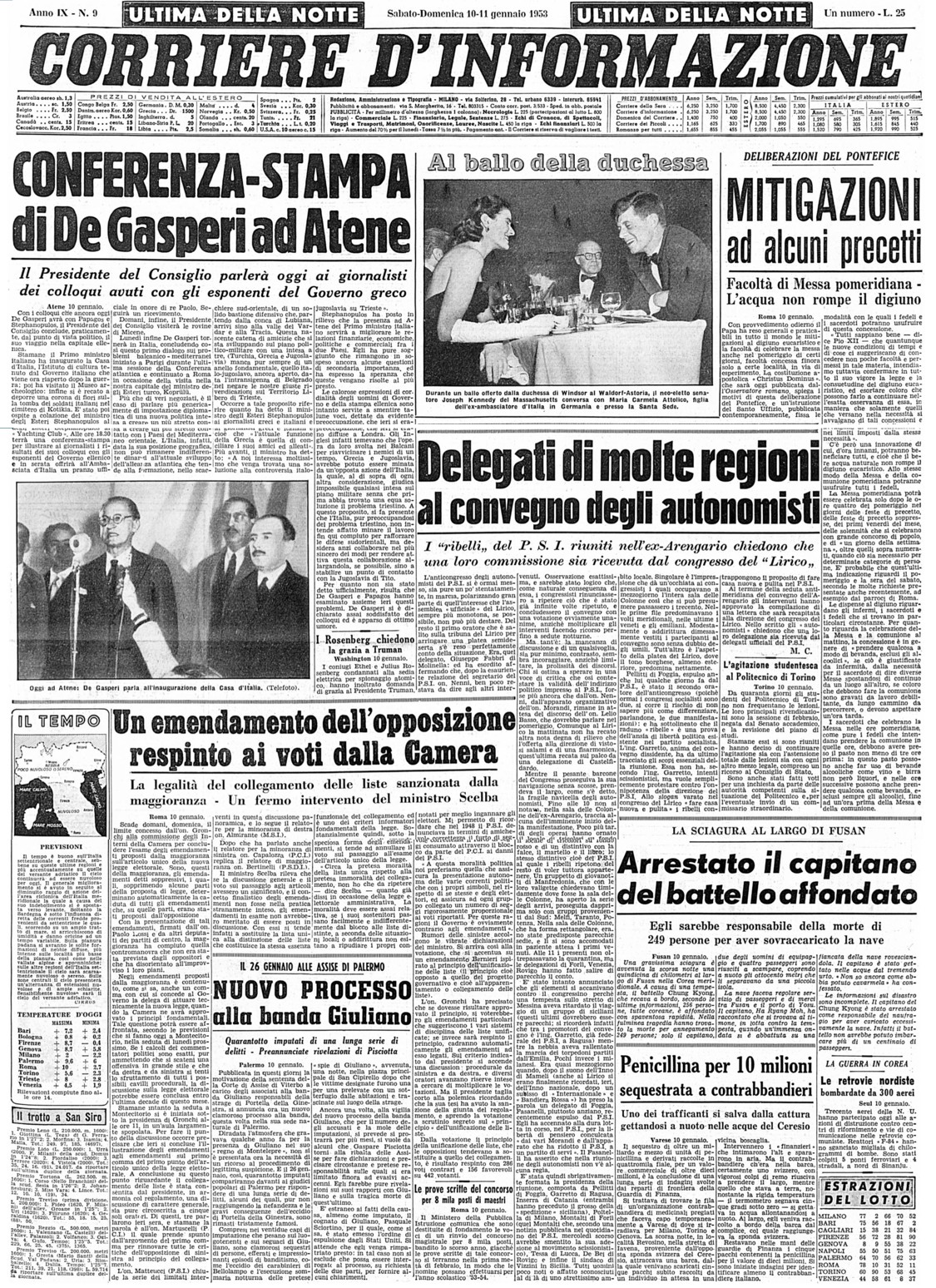
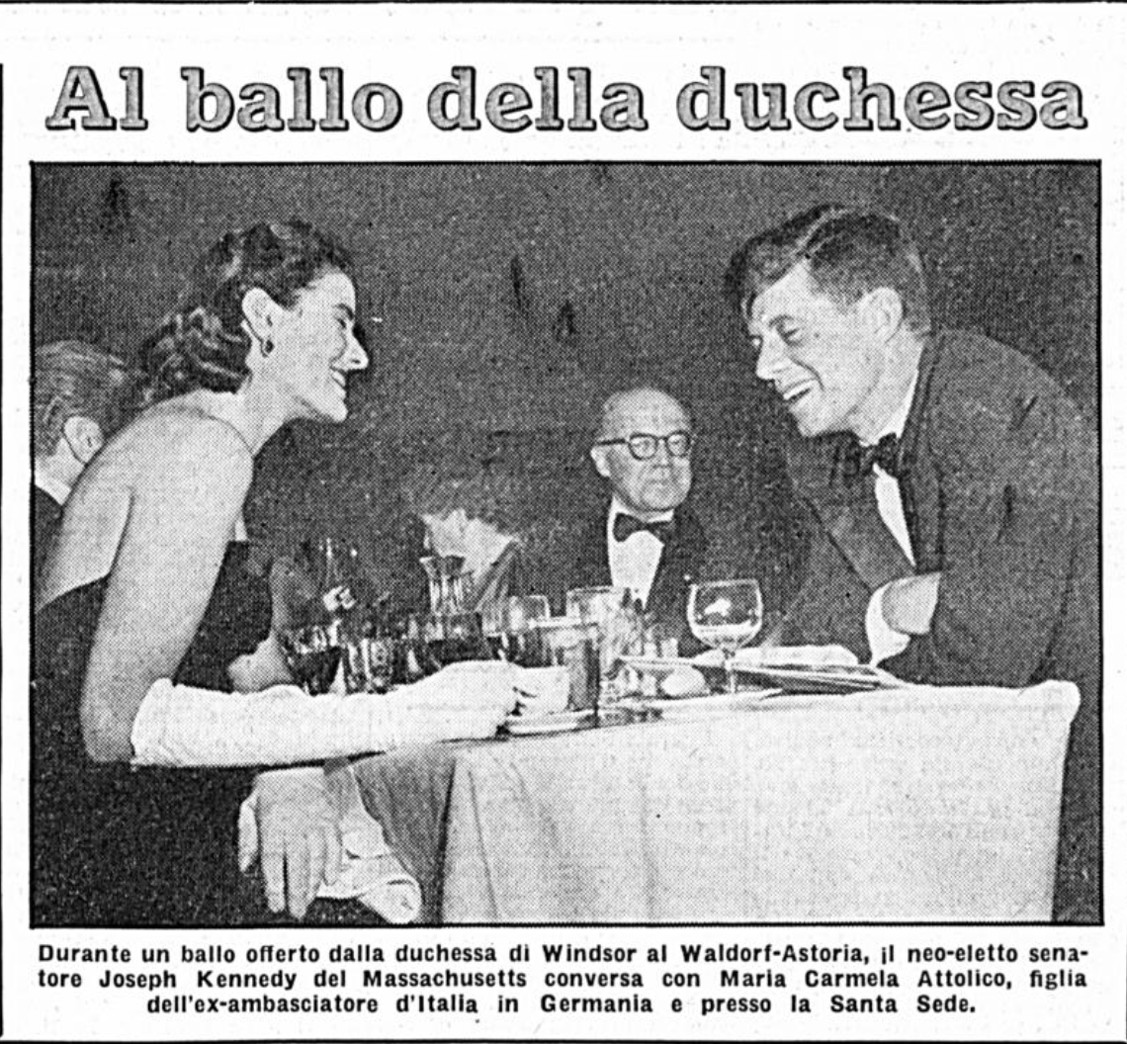
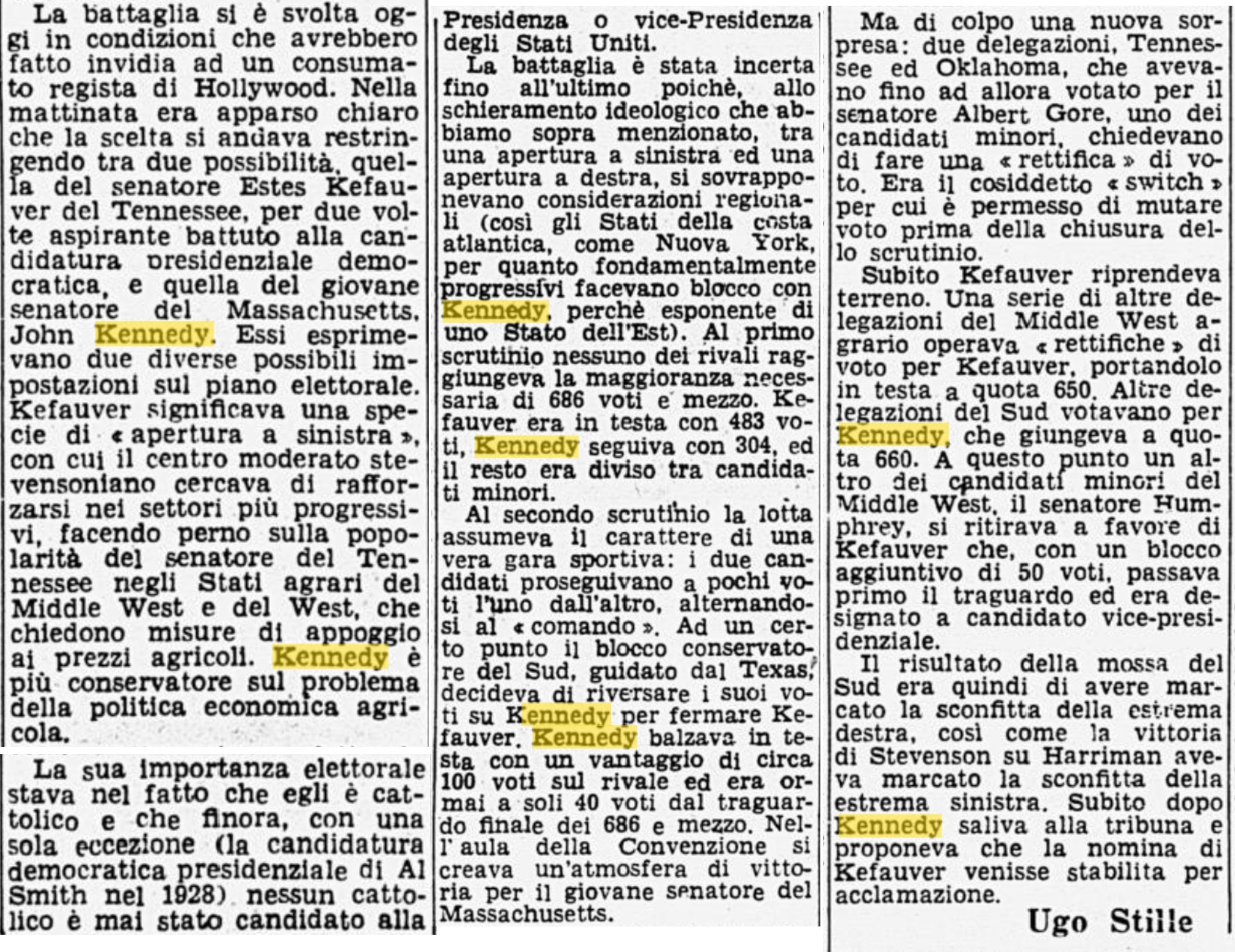
A copy of a page from the *Corriere
della Sera* dated January 10, 1953. |
|
1956, August 17 - Corriere della Sera |
||
|
|
|
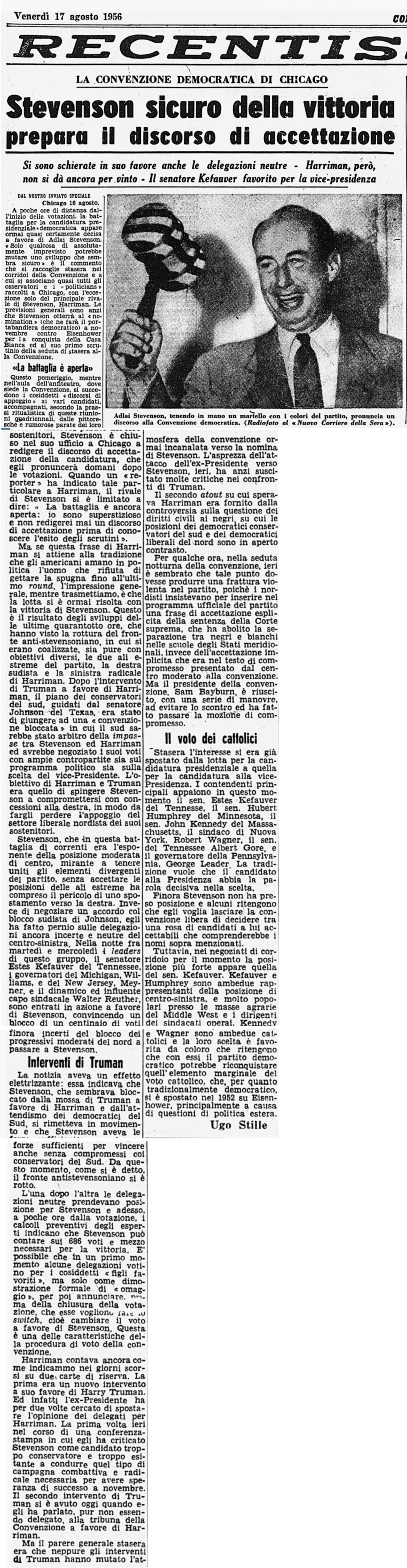
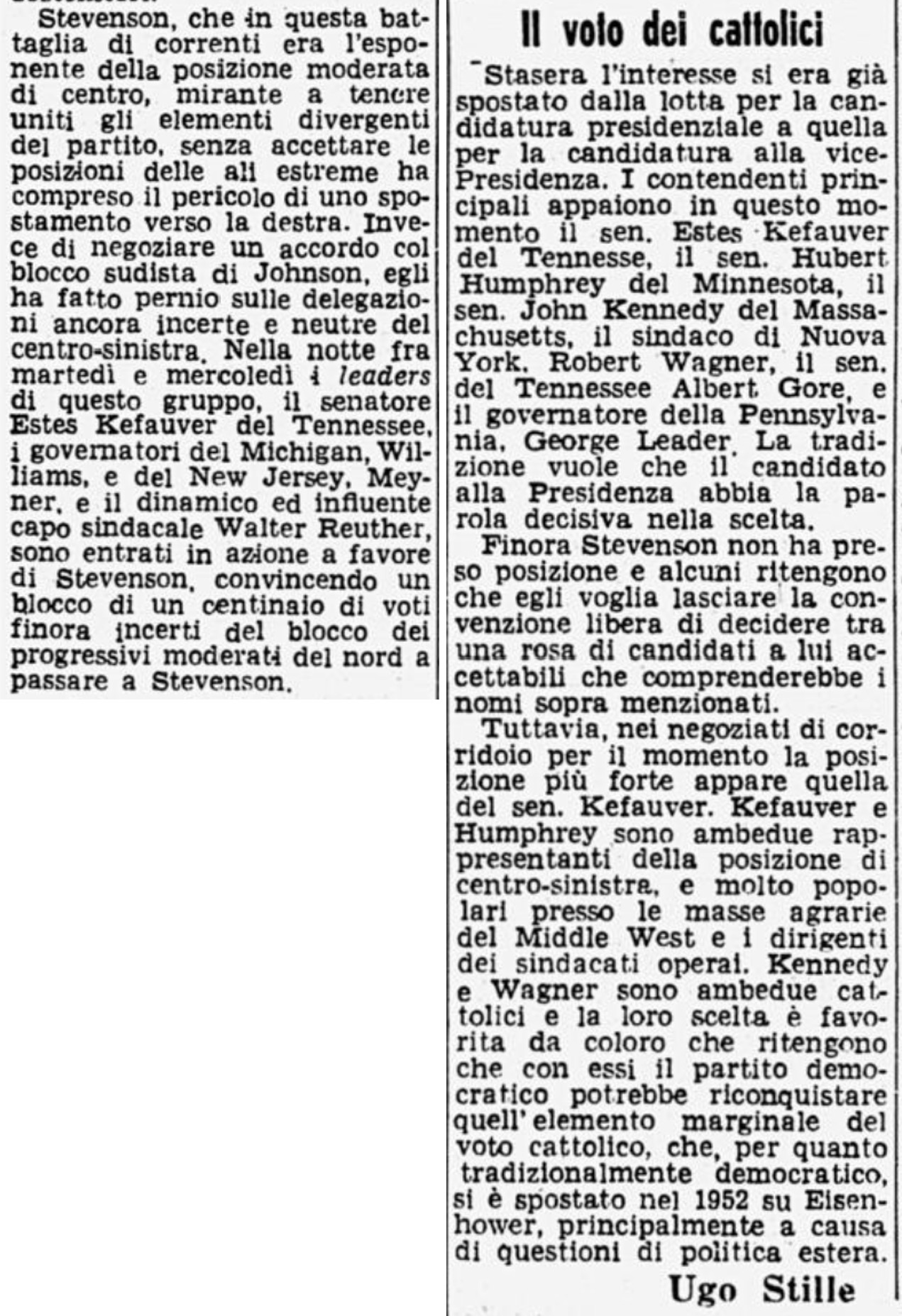
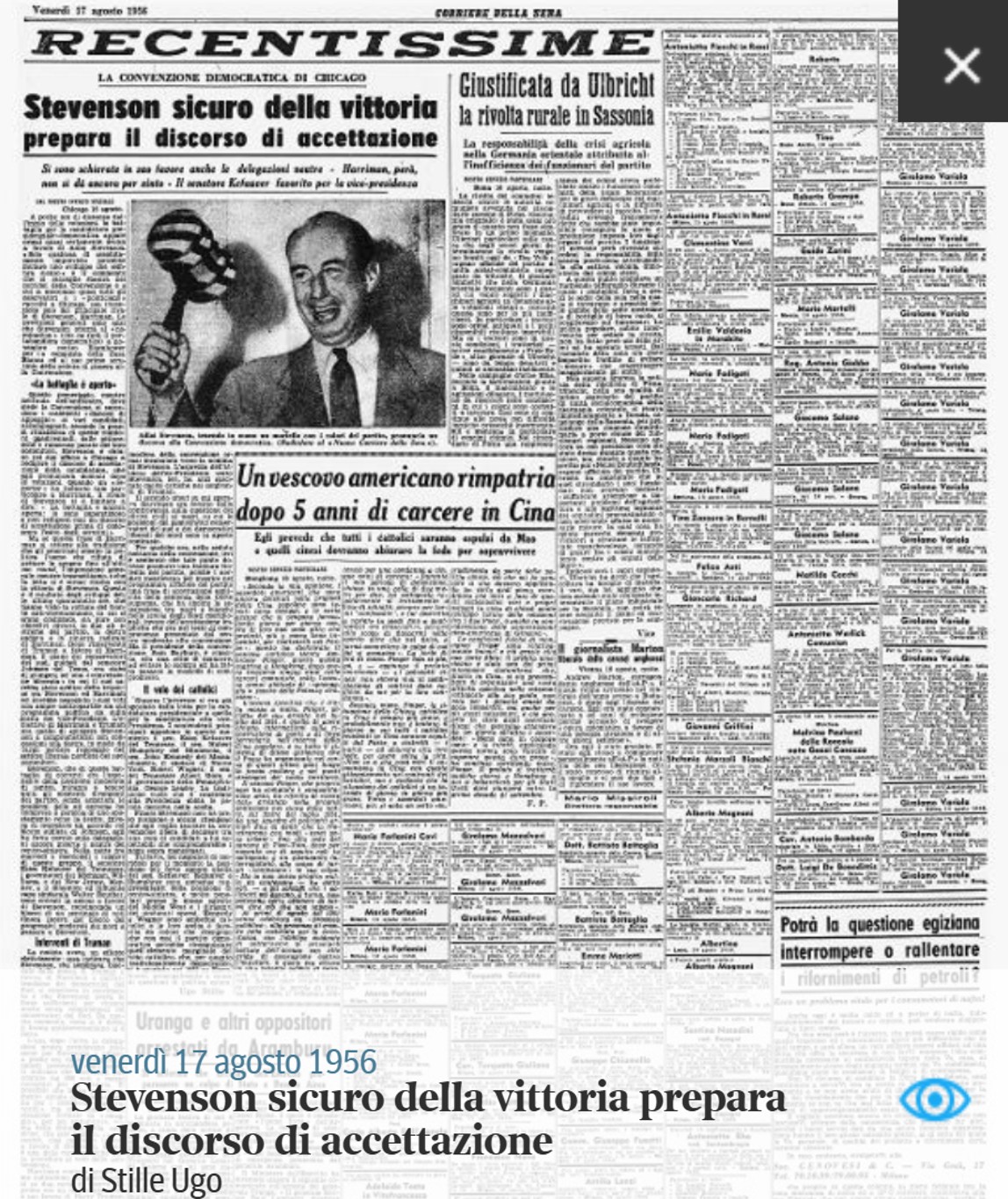
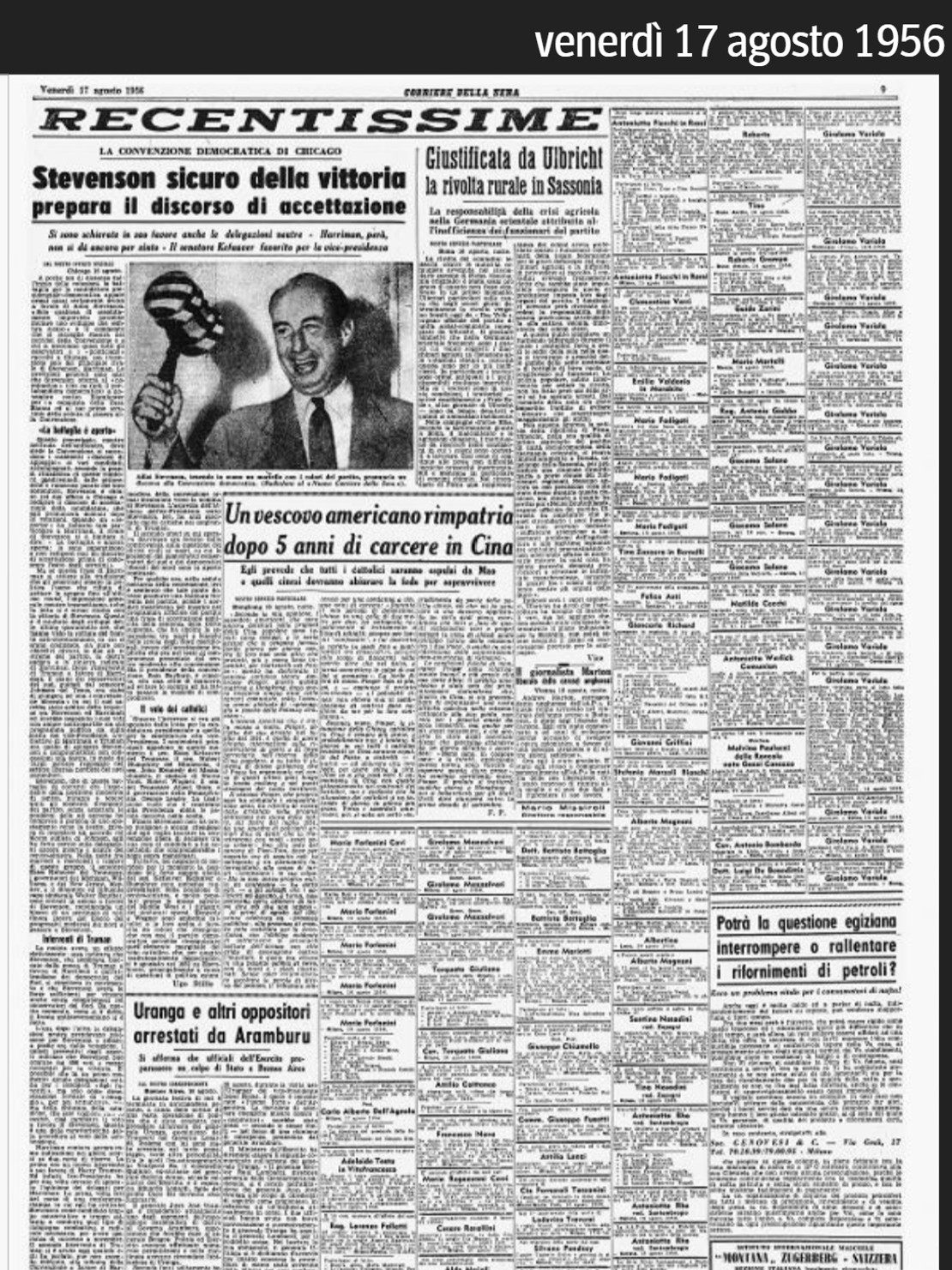
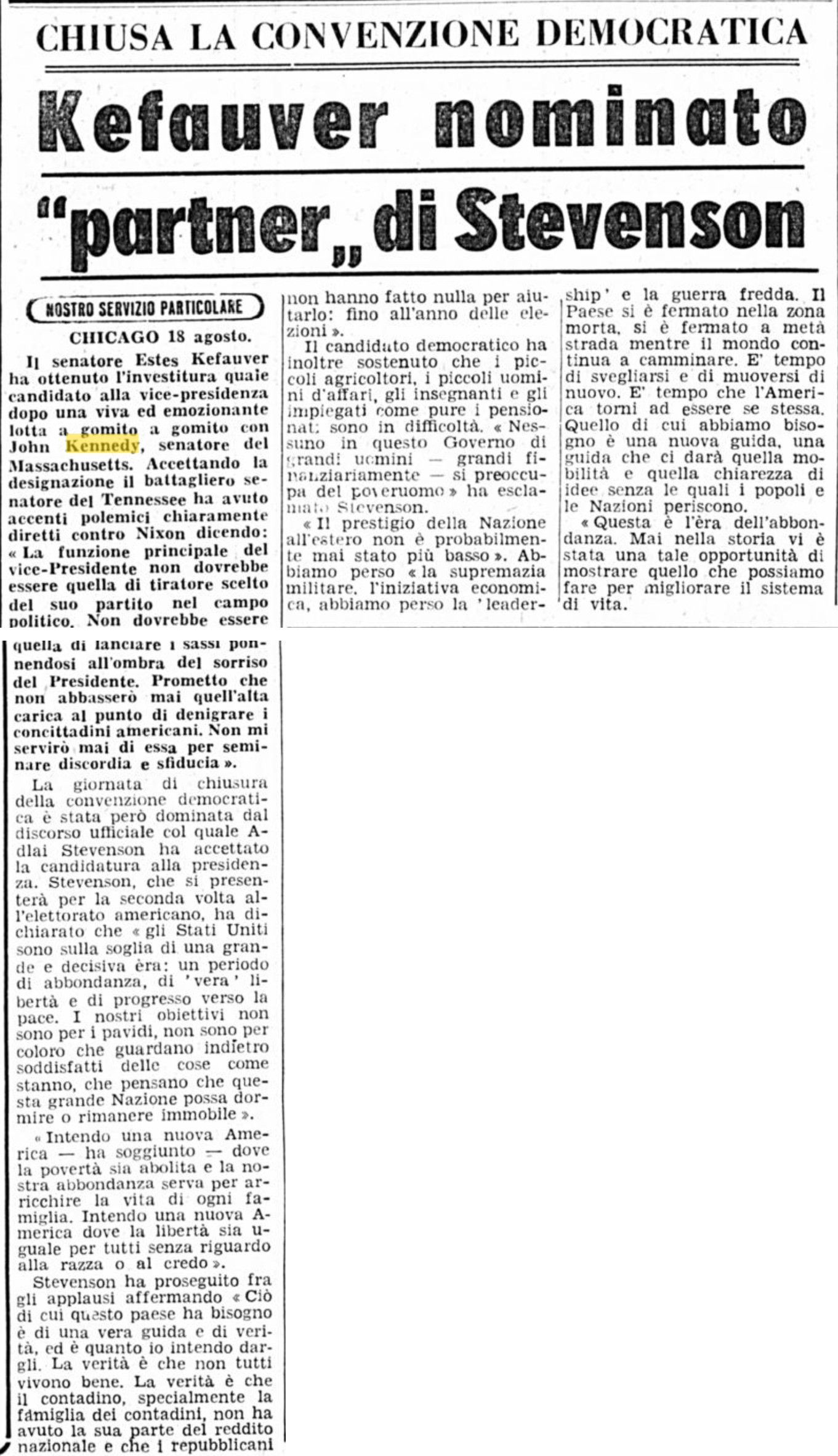
A copy of a page from the
Italian daily newspaper *Corriere della Sera*, dated Friday, August 17,
1956. |
|
1956, August 18 - Corriere della Sera |
||
|
|
|
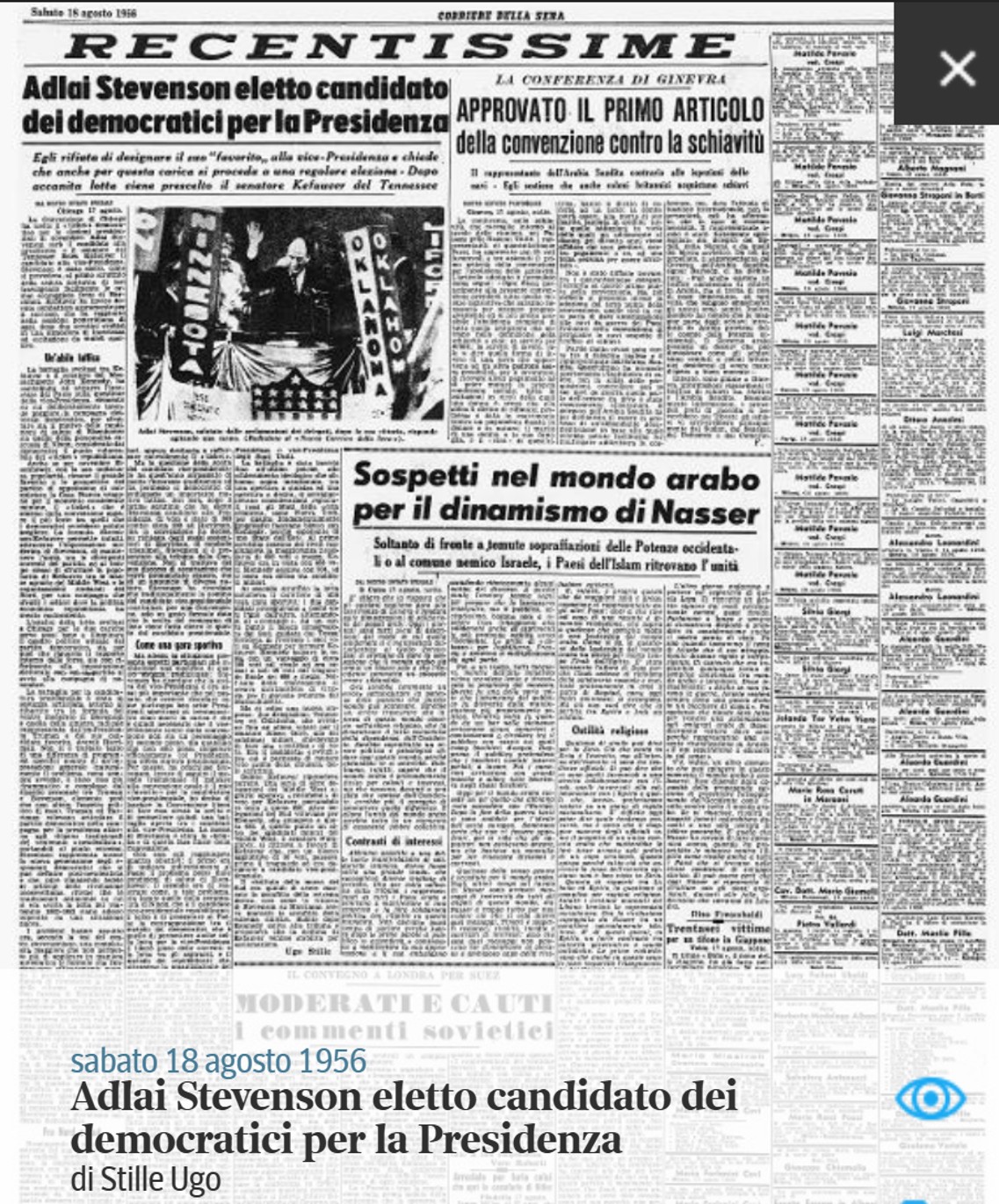
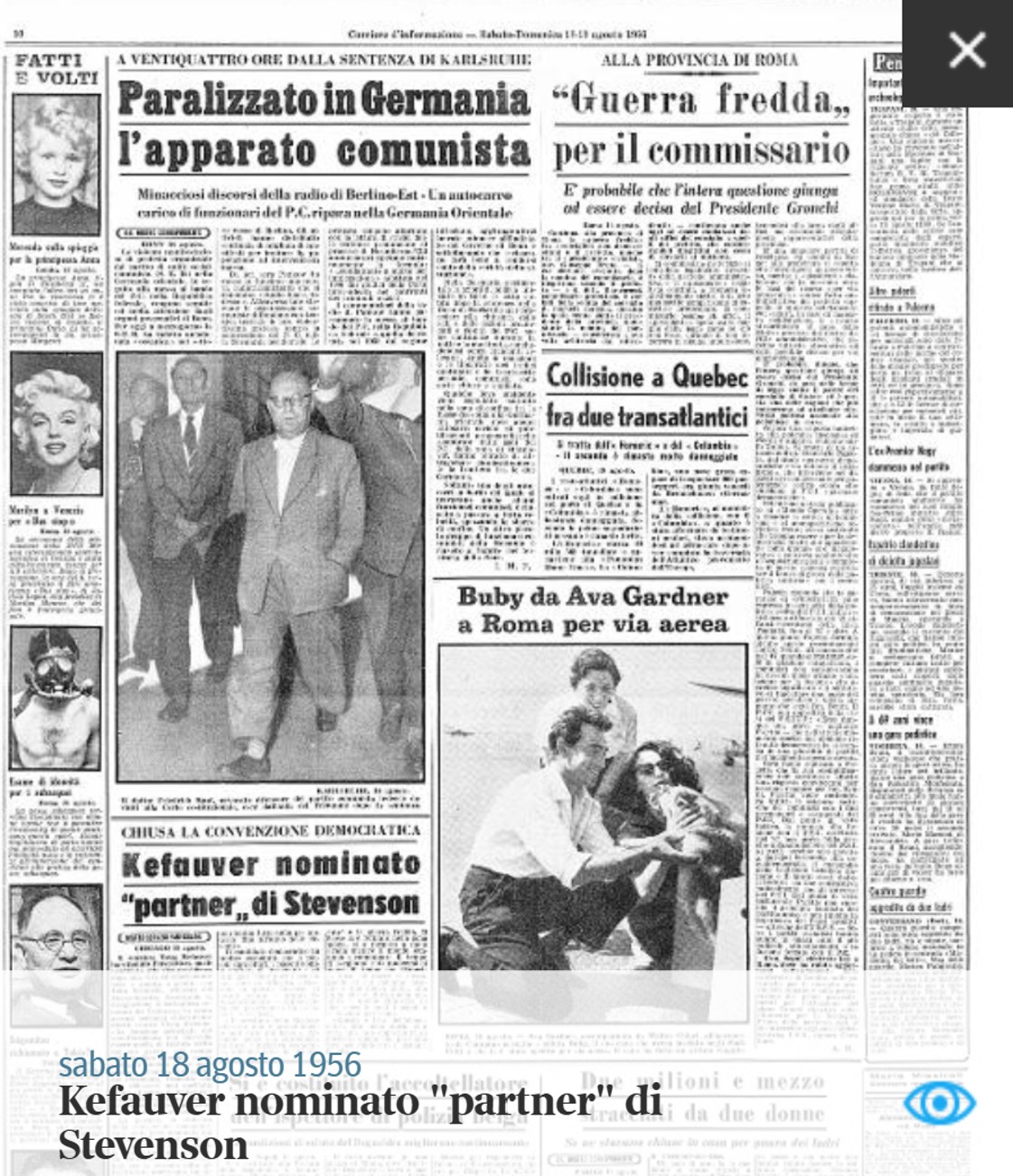
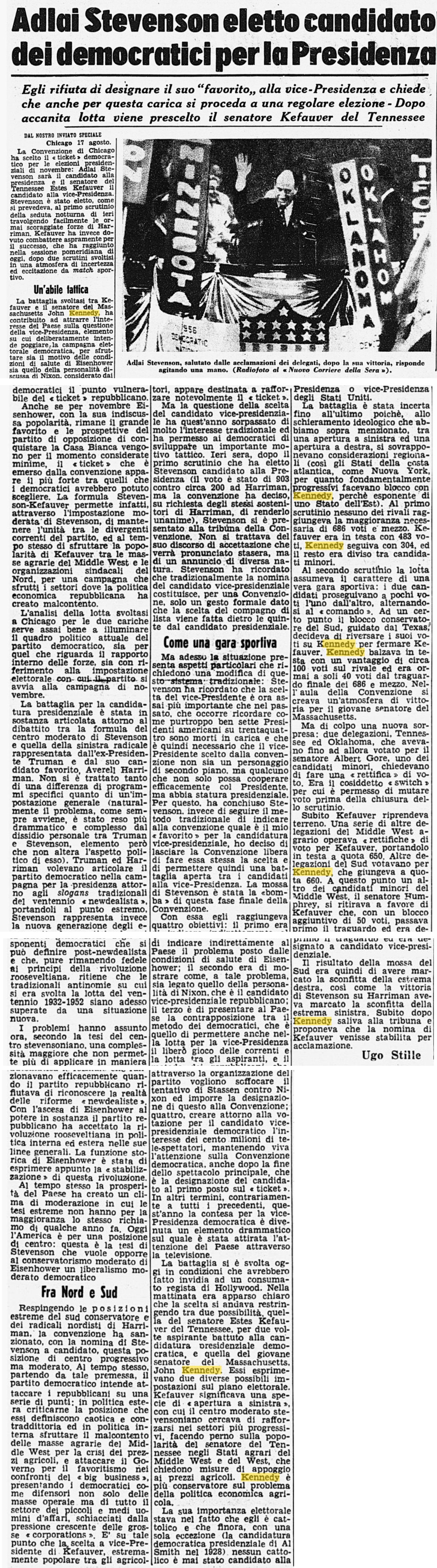
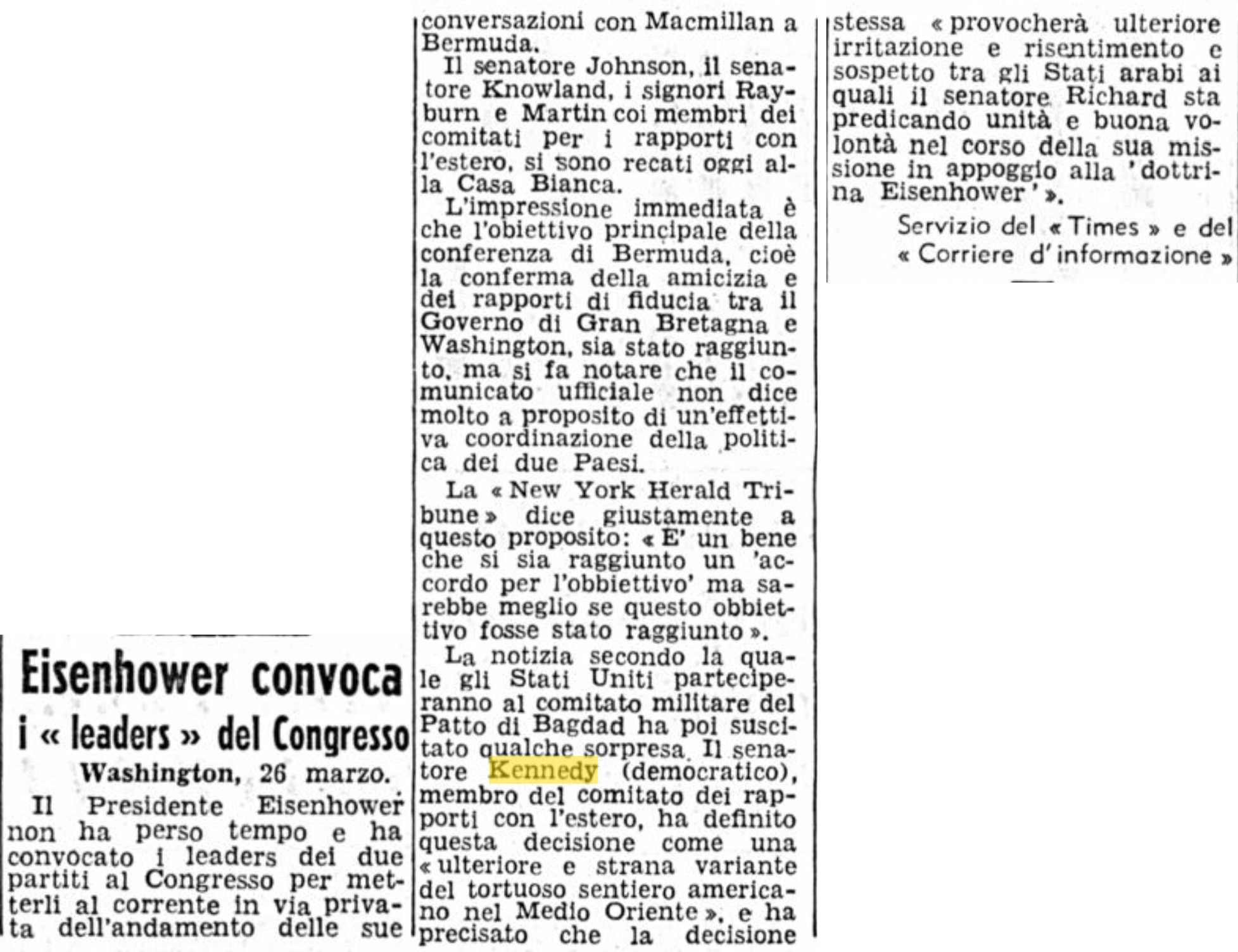
Copies of two pages from
the Italian daily newspaper *Corriere della Sera*, dated Saturday, August
18, 1956. |
|
1957, March 11 - Life |
||
|
|
|
Original. |
|
1957, March 26 - Corriere della Sera |
||
|
|
|
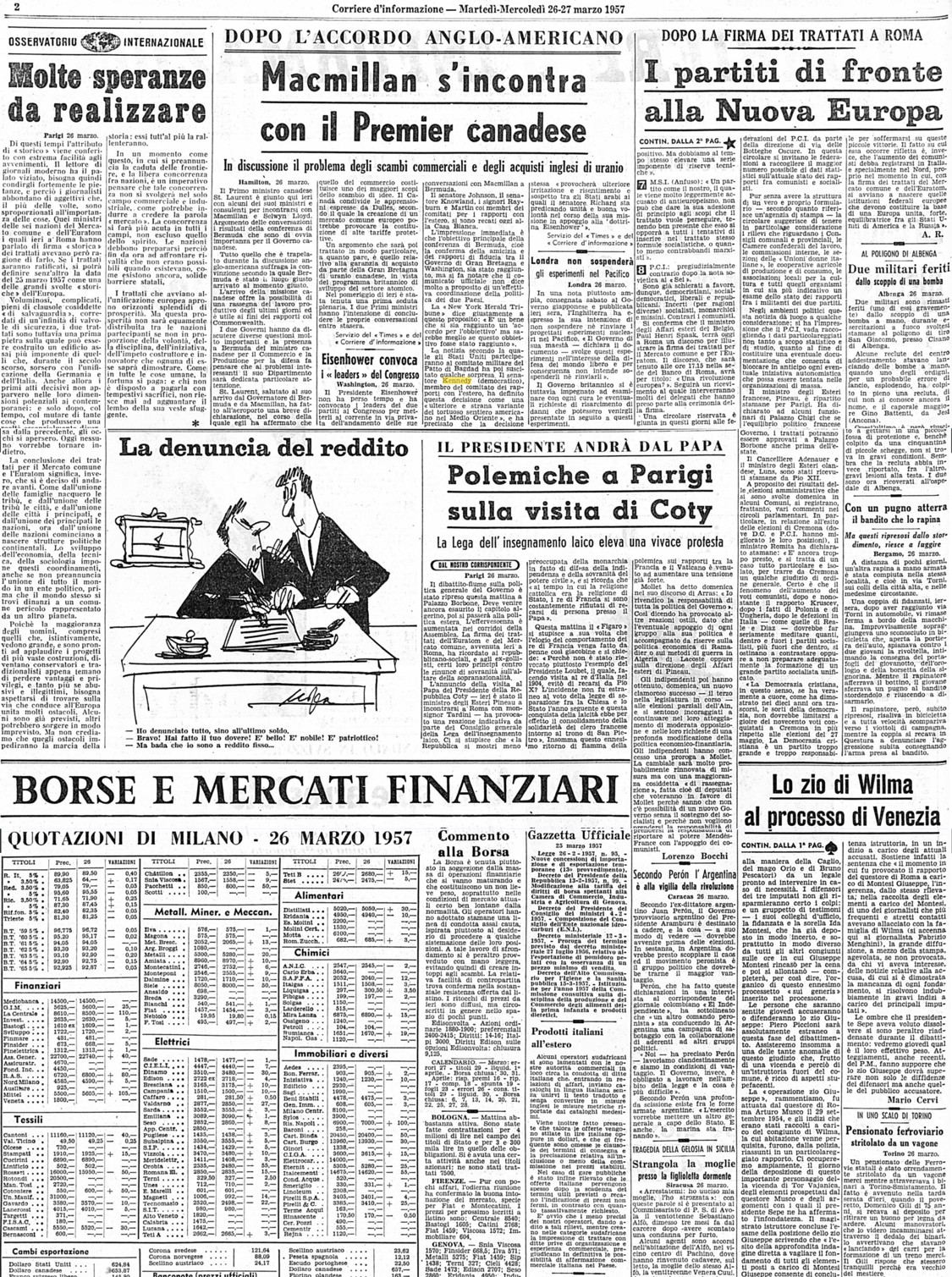
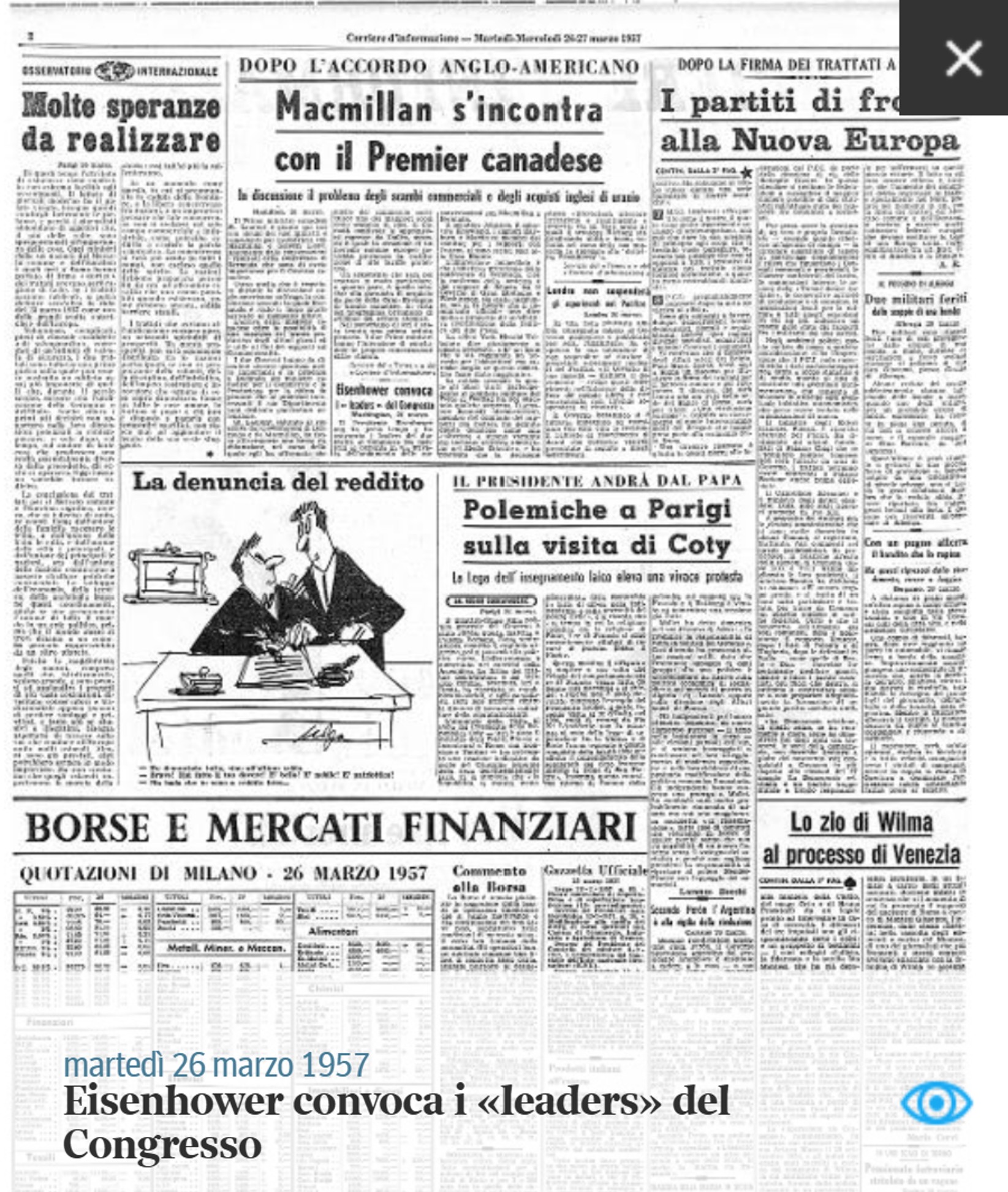
Copy of an article
from the Italian daily newspaper *Corriere della Sera*, dated Tuesday,
March 26, 1957. |
|
1957, July 3 - Corriere della Sera |
||
|
|
|
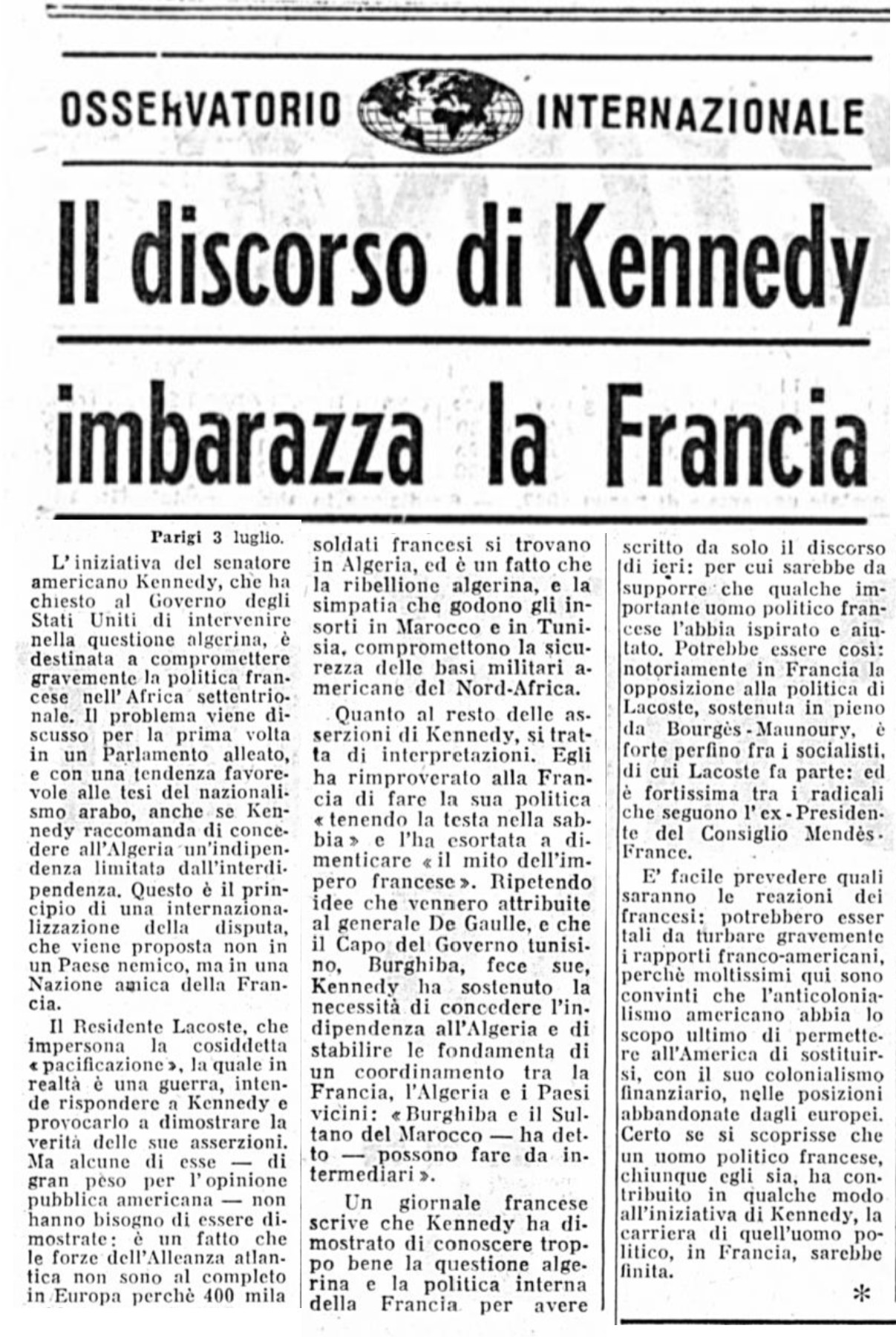
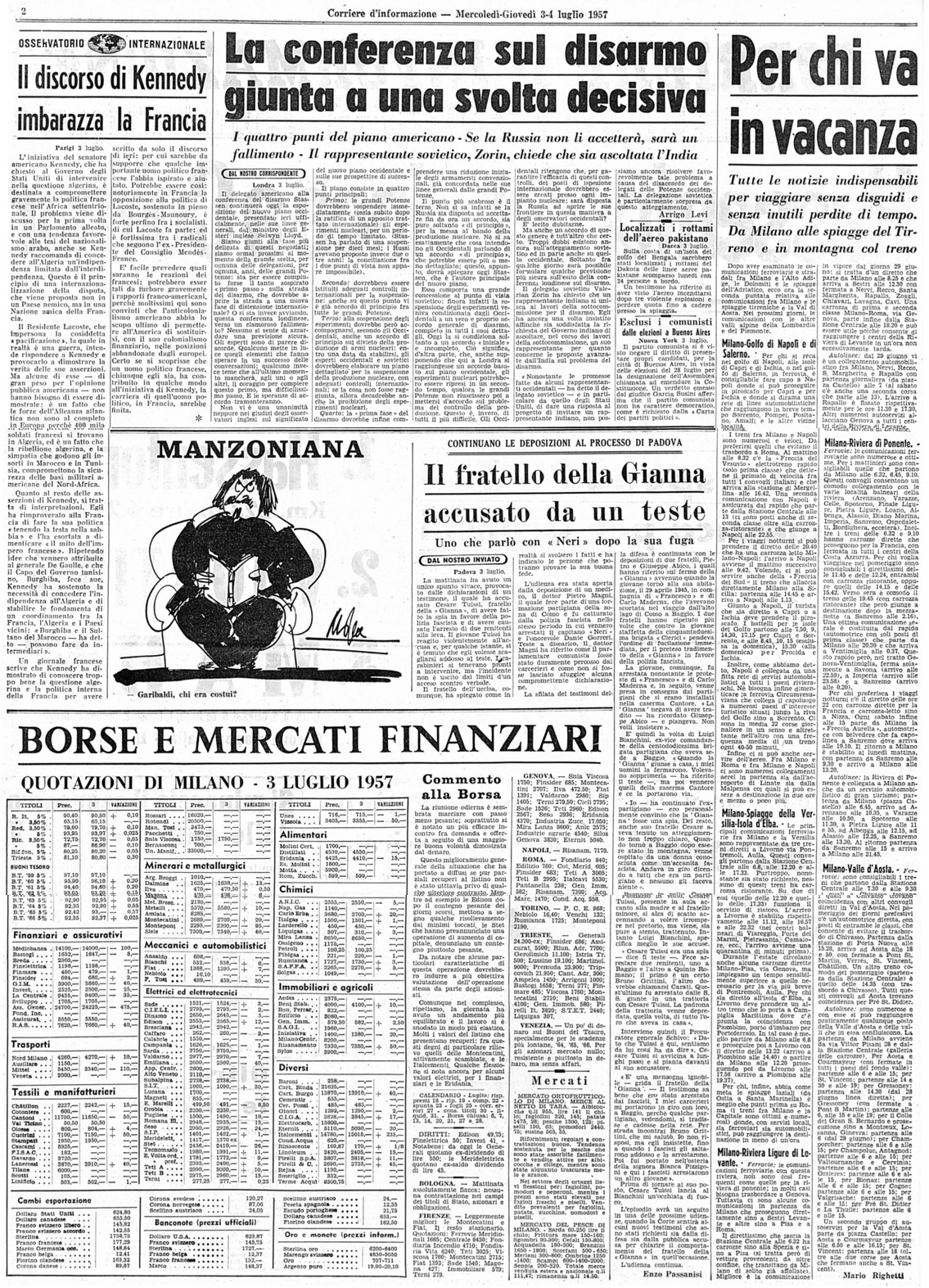
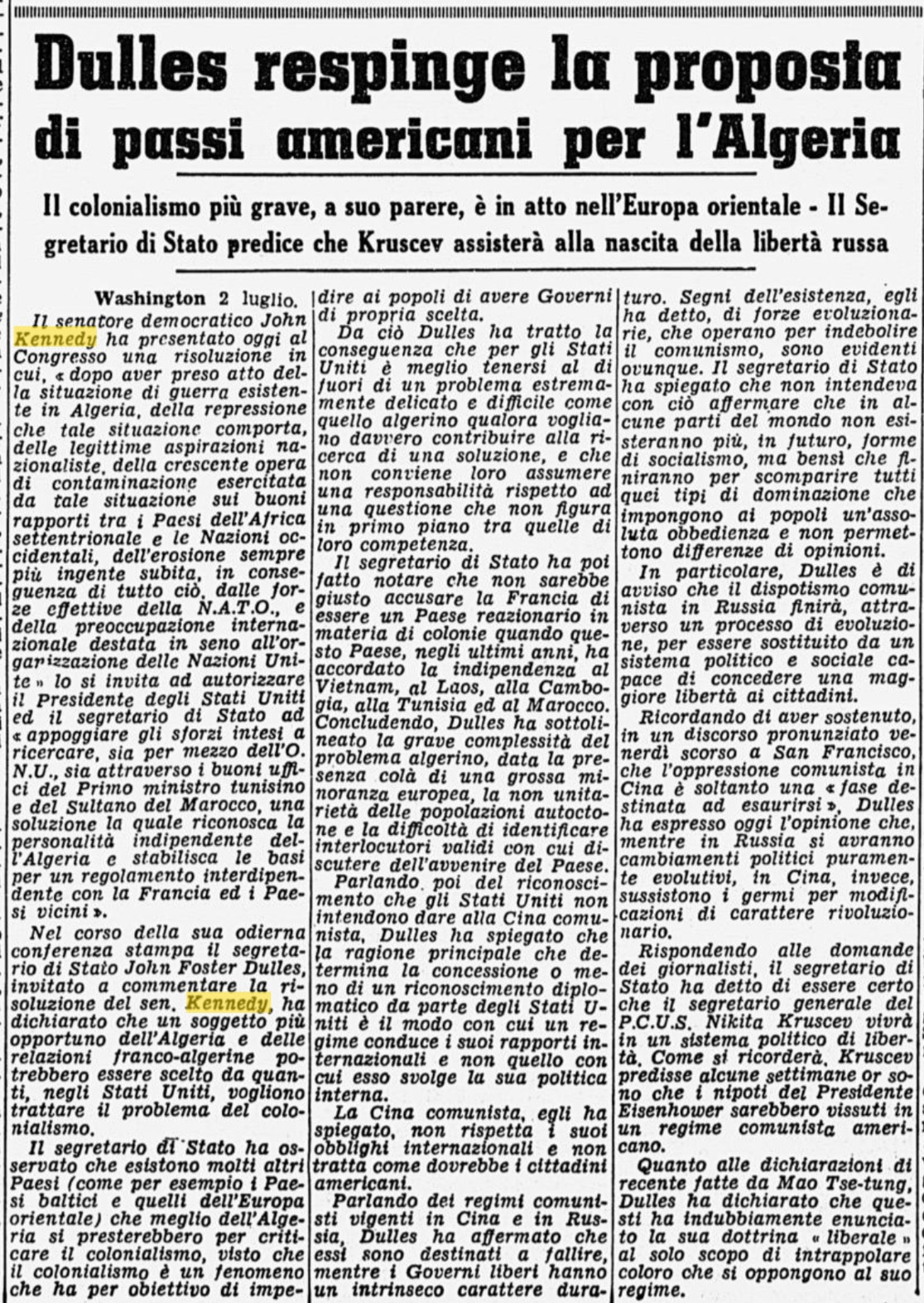
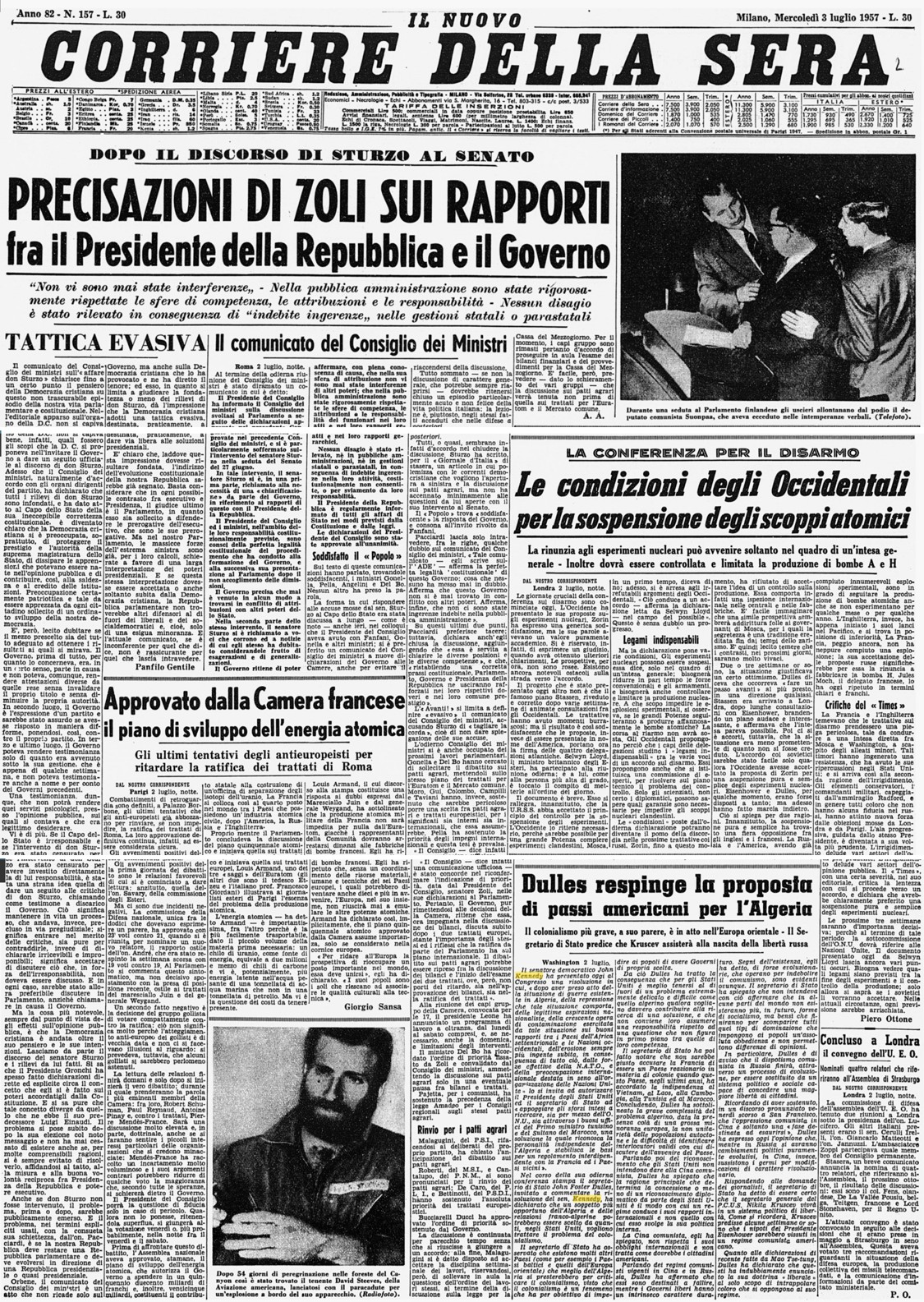
Copies of two articles
from the Italian daily newspaper *Corriere della Sera*, dated Wednesday,
July 3, 1957. |
|
1957, August 12 - Corriere della Sera |
||
|
|
|
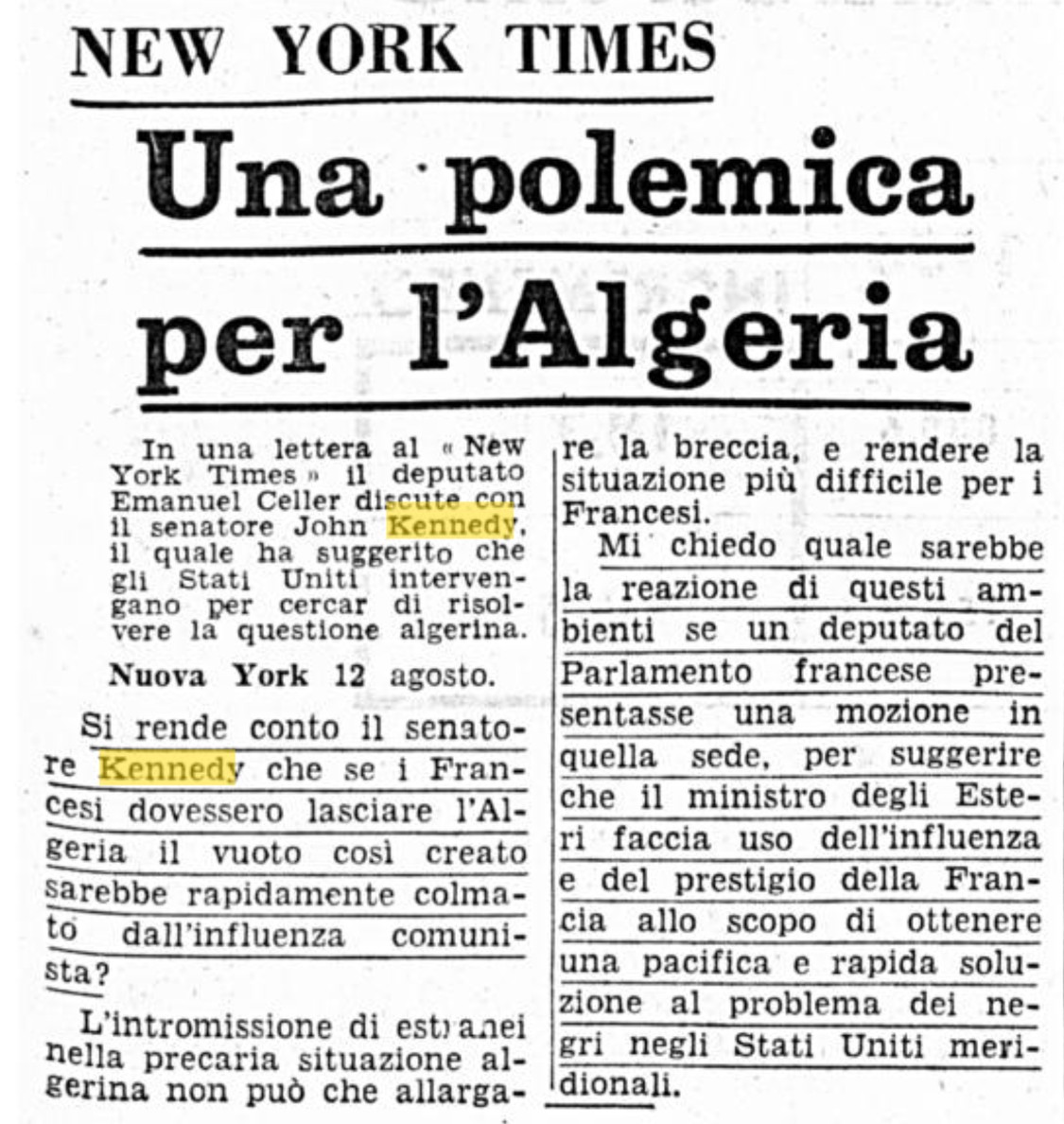
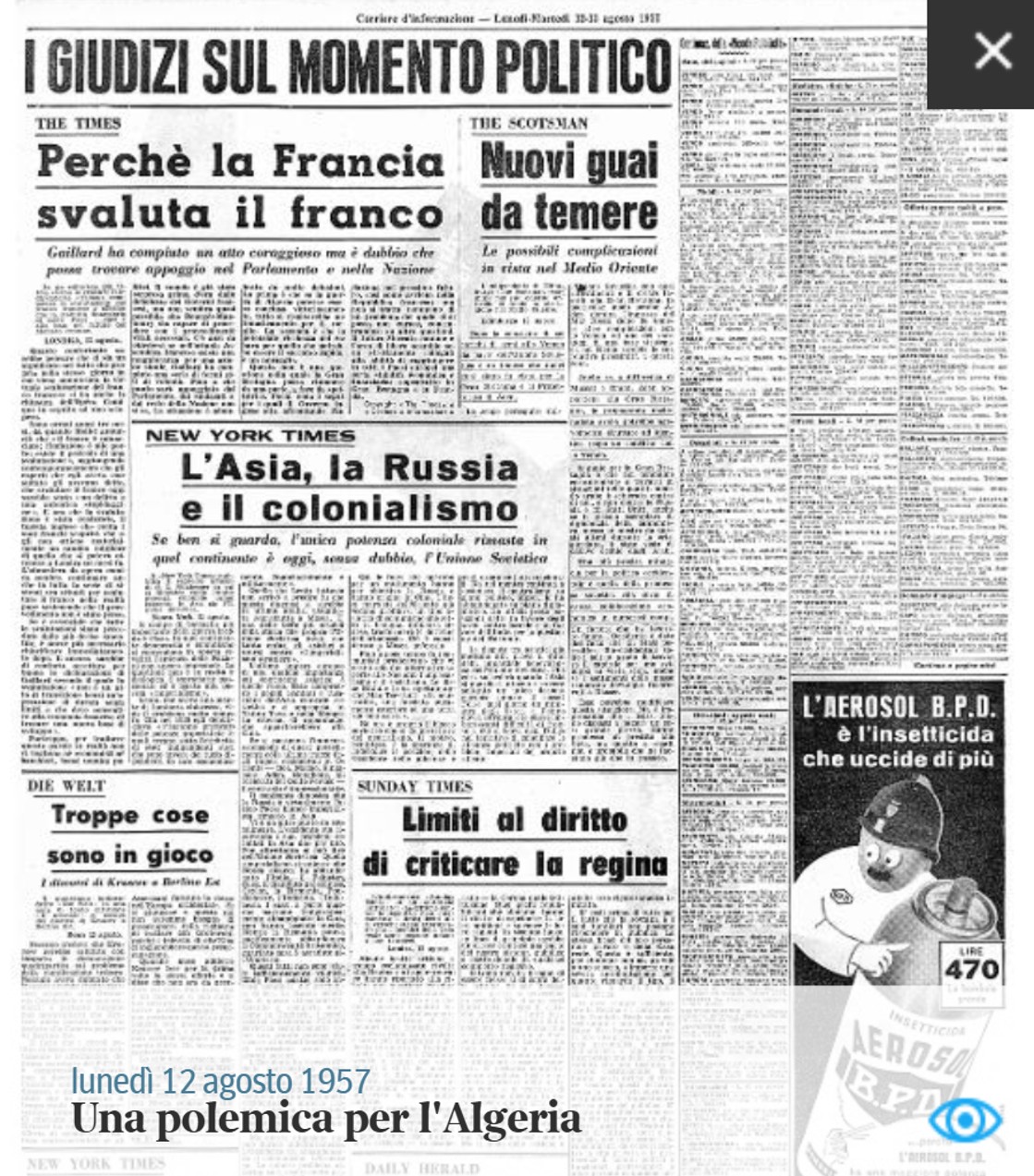
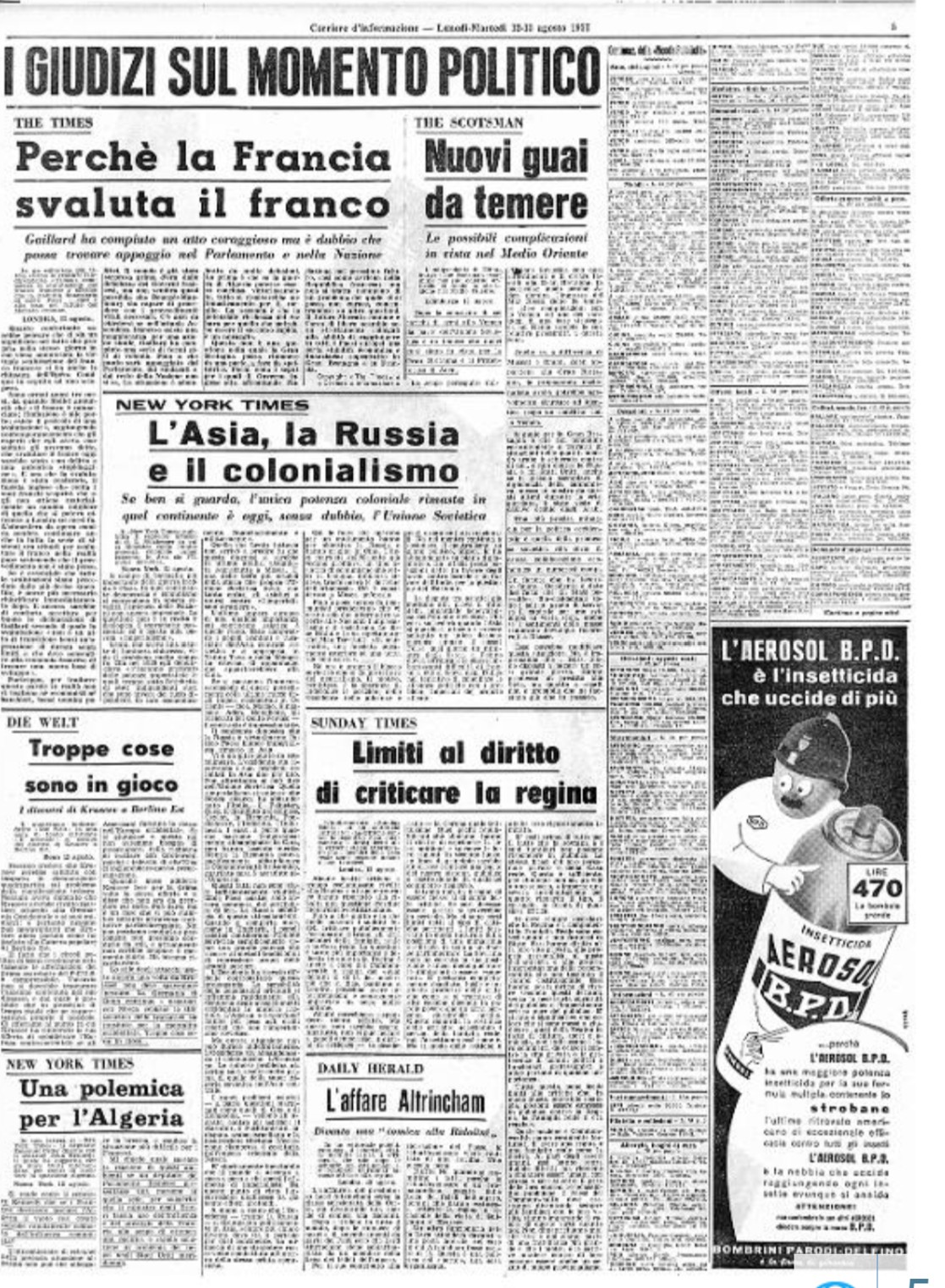
A copy of an article from
the Italian daily newspaper *Corriere della Sera*, dated Monday, August
12, 1957. |
|
1957, August 17 - Corriere della Sera |
||
|
|
|
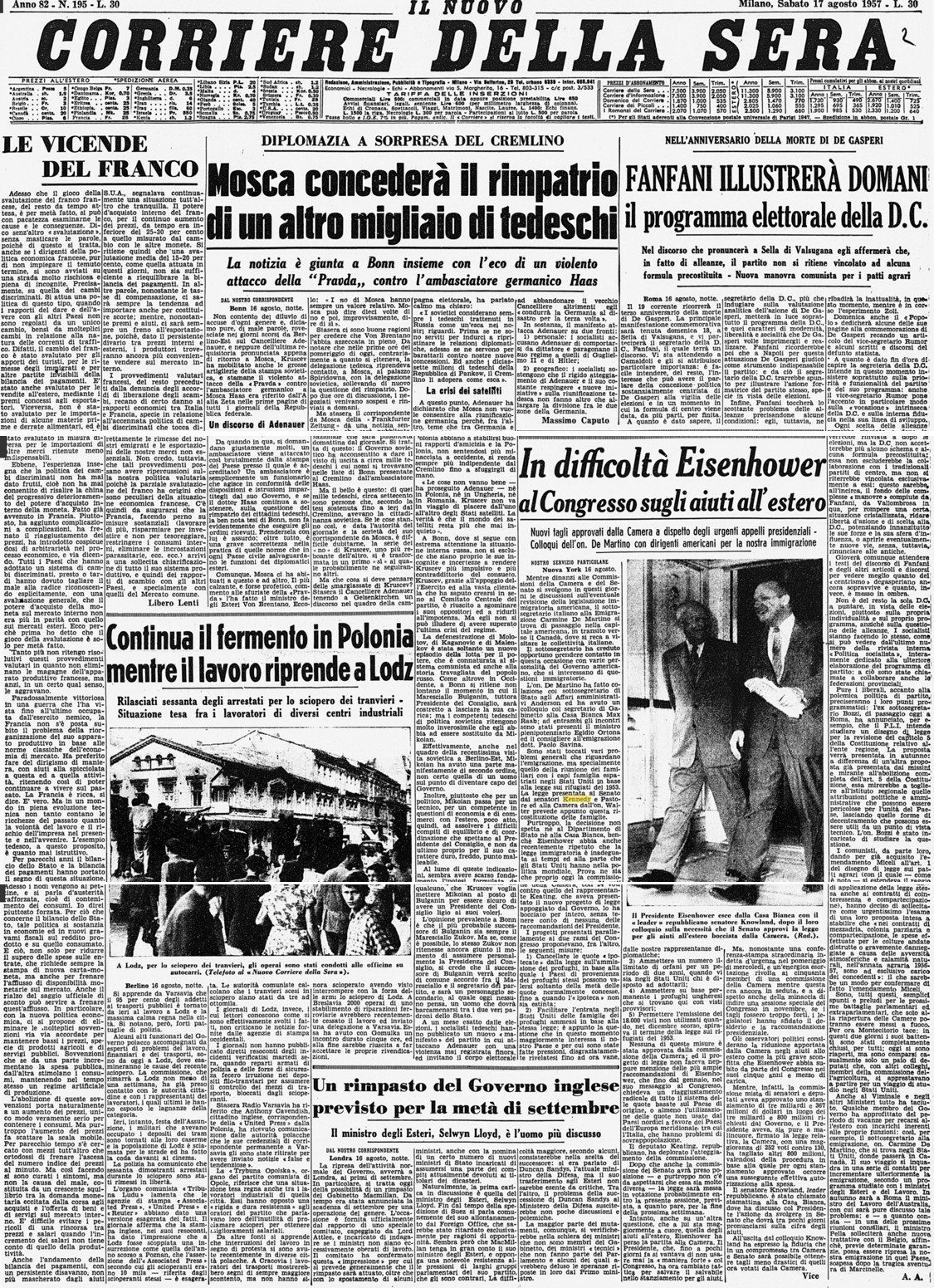
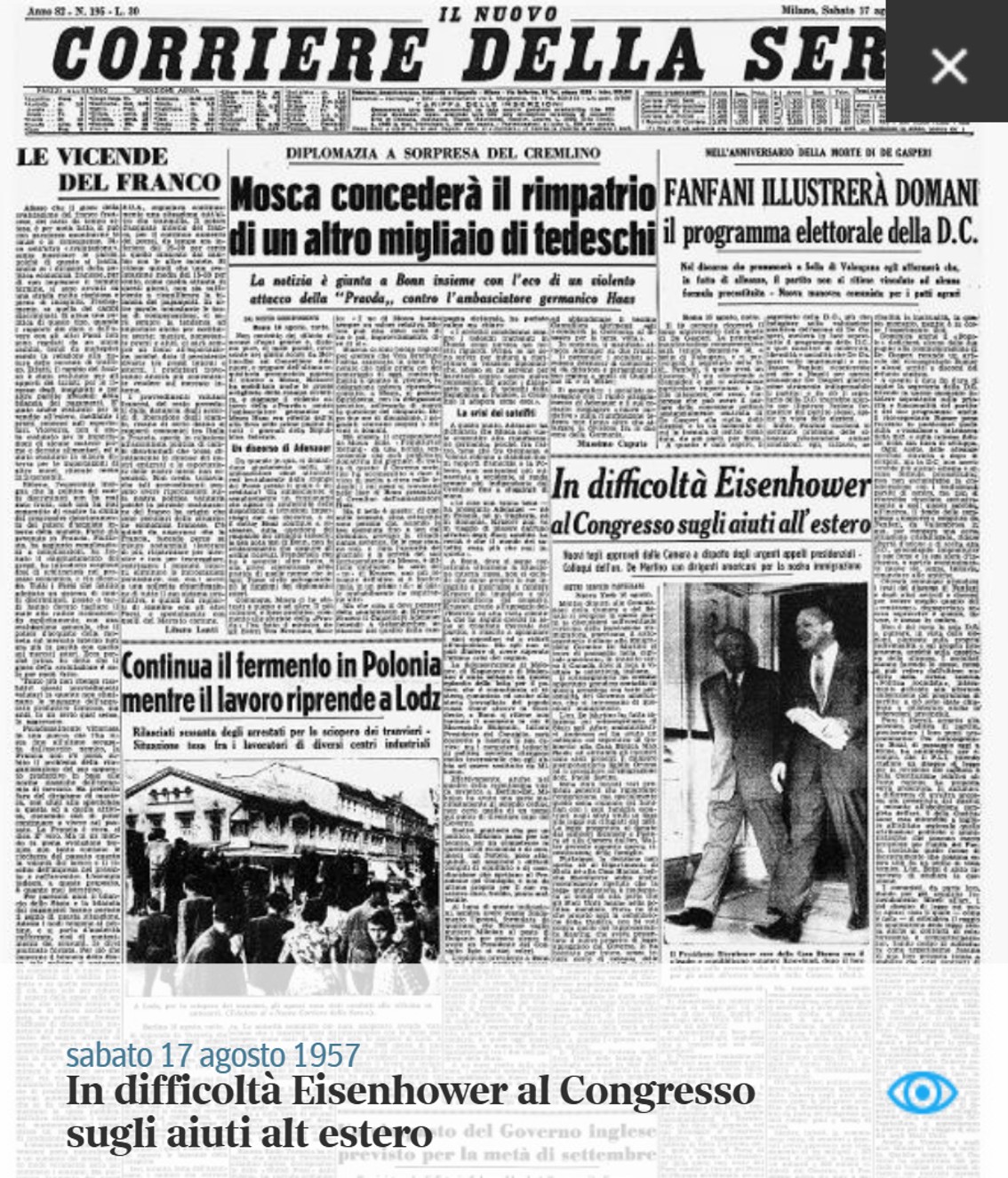
Copy of a front-page
article from the Italian daily newspaper *Corriere della Sera*, dated
Saturday, August 17, 1957. |
|
1957, August 22 - Corriere della Sera |
||
|
|
|
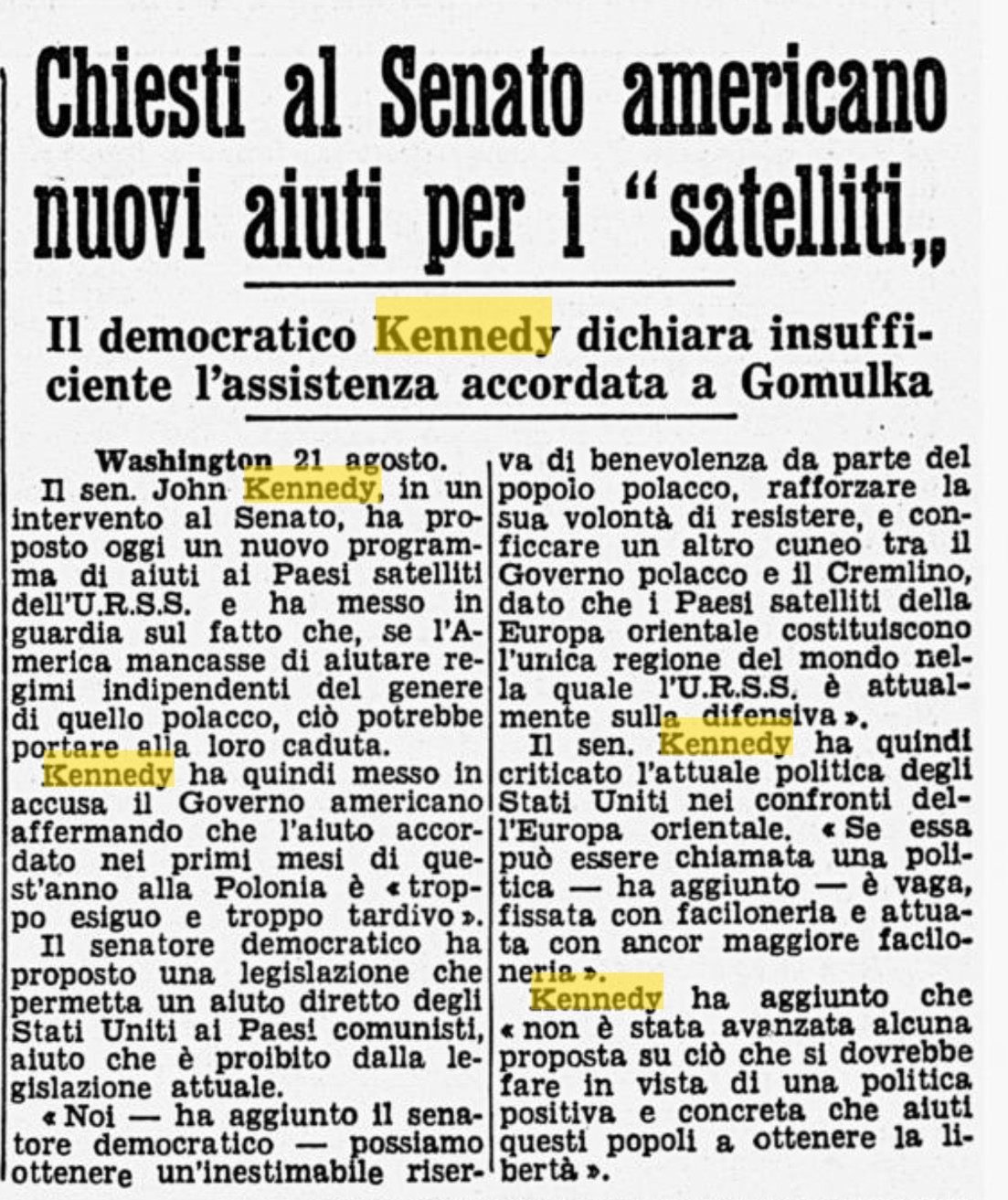
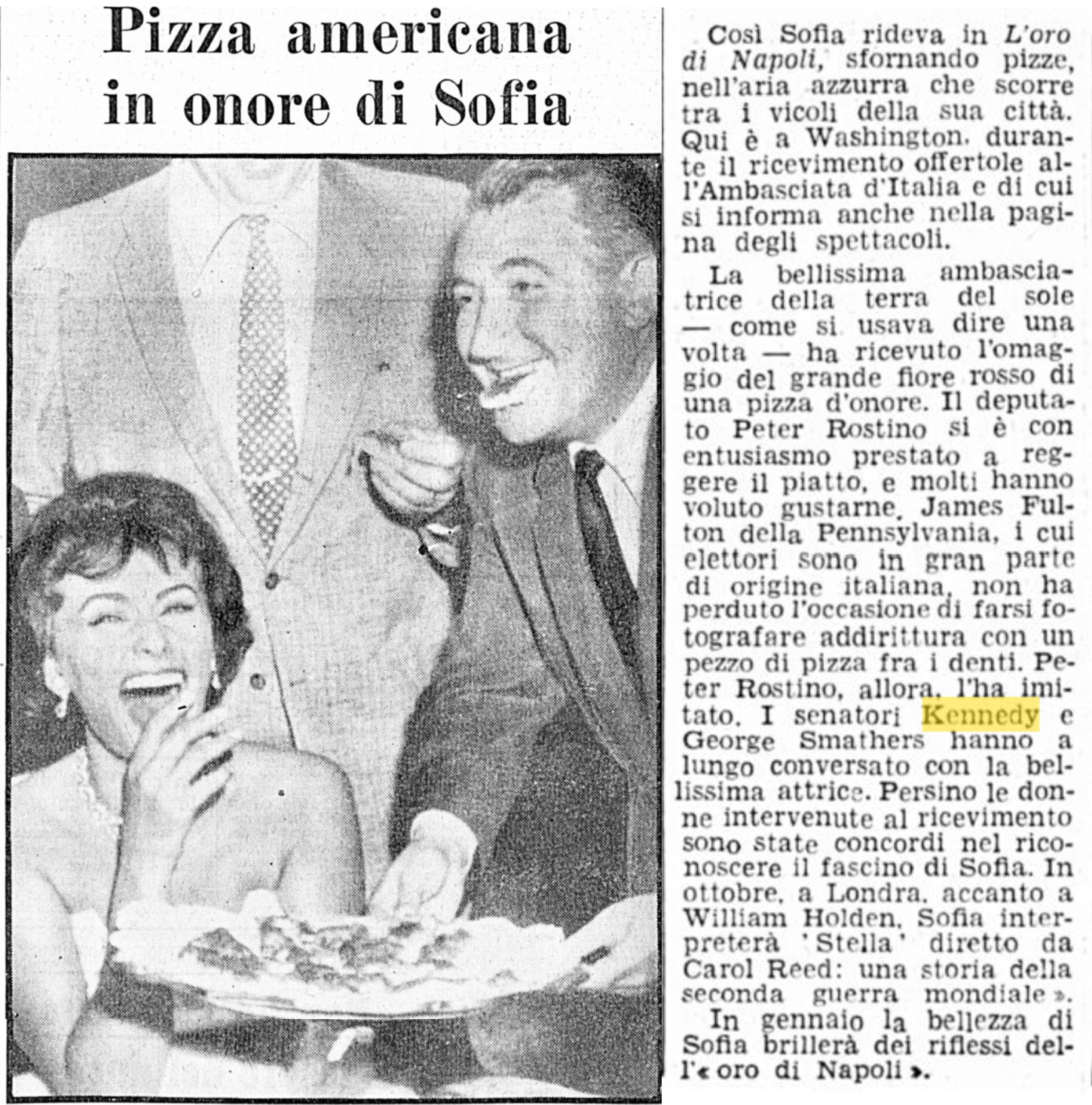
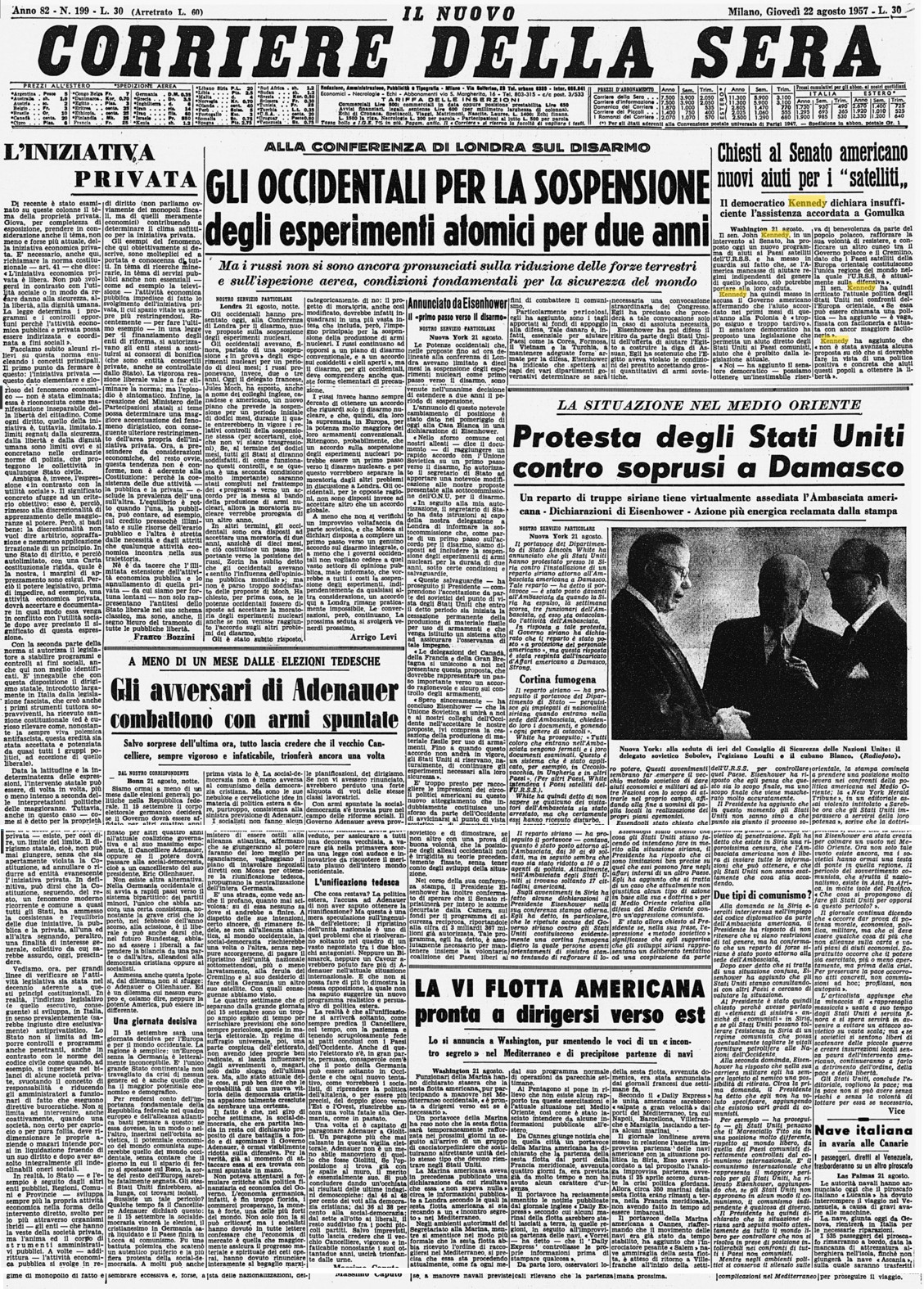
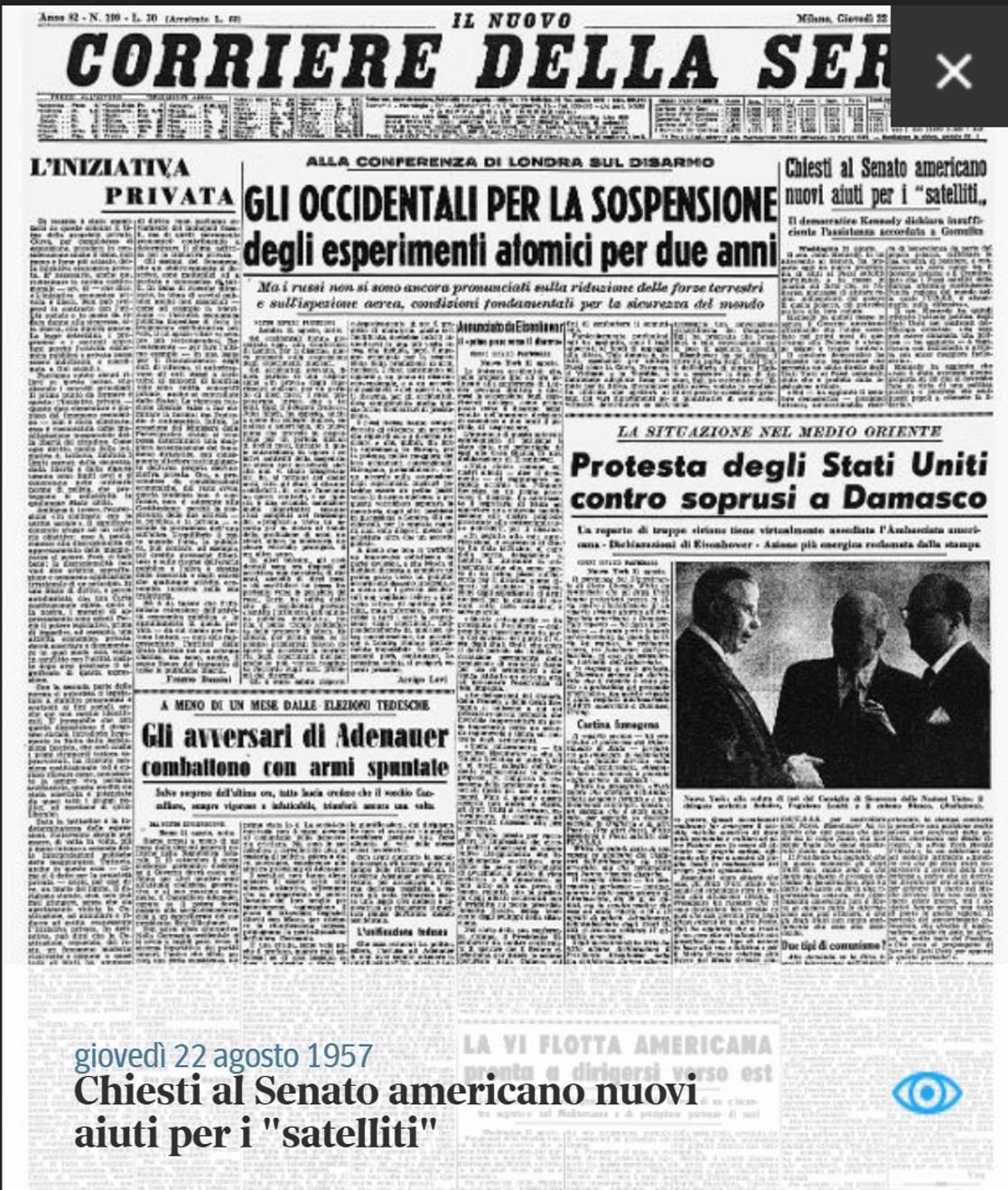
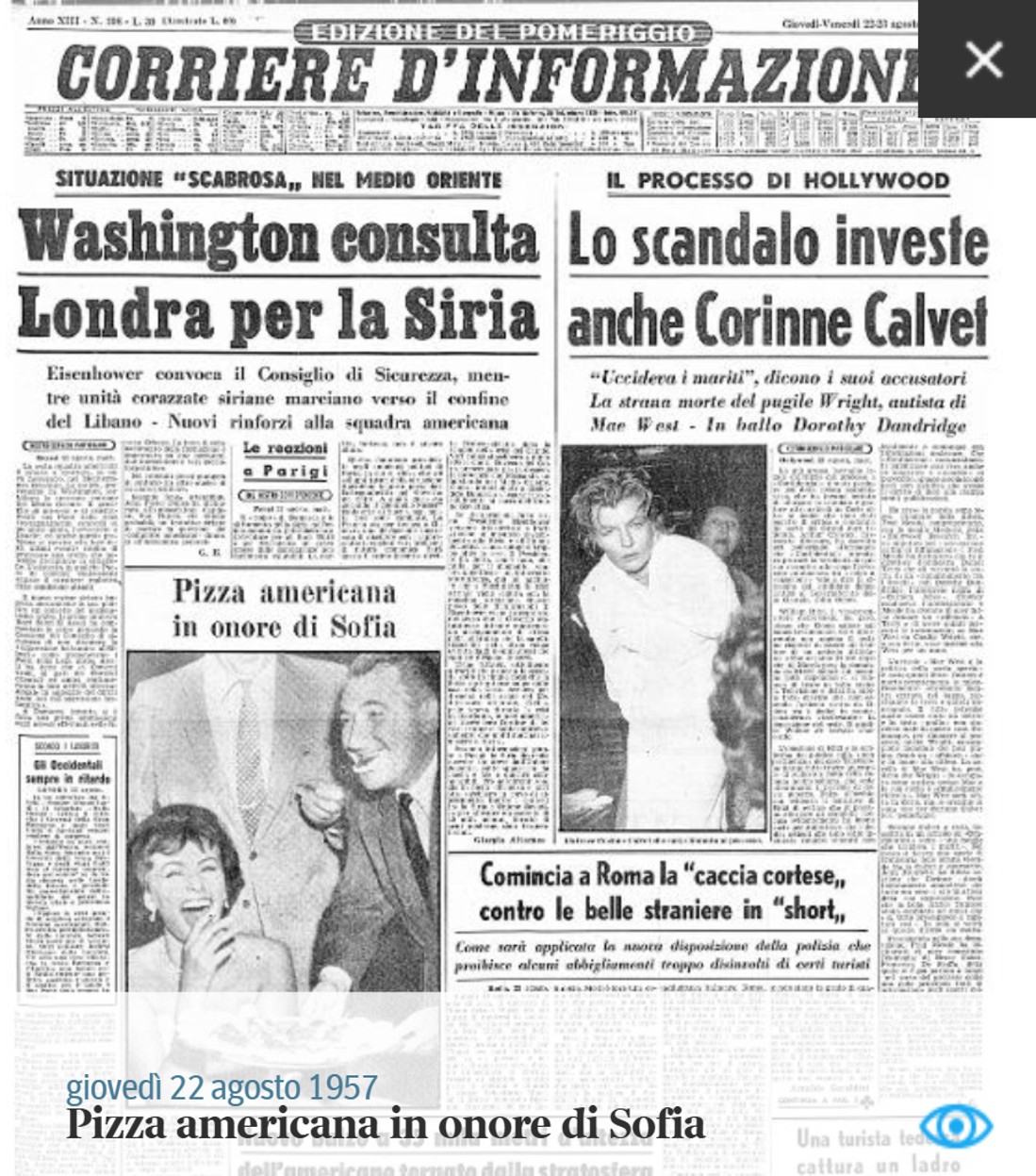
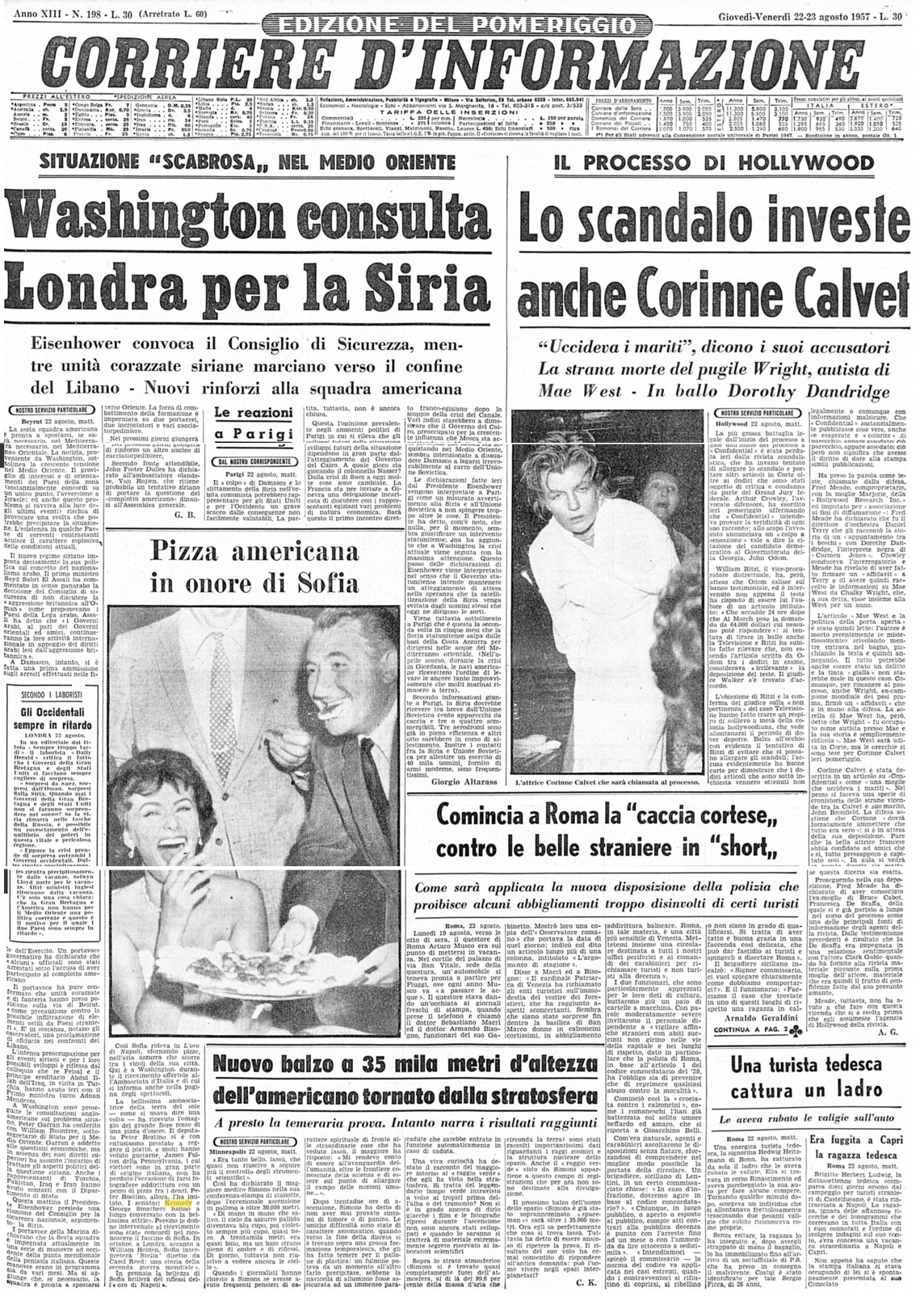
Copies of two
articles from the Italian daily newspaper *Corriere della Sera*, dated
Thursday, August 22, 1957.
.
|
|
1957, August 25 - Corriere della Sera |
||
|
|
|
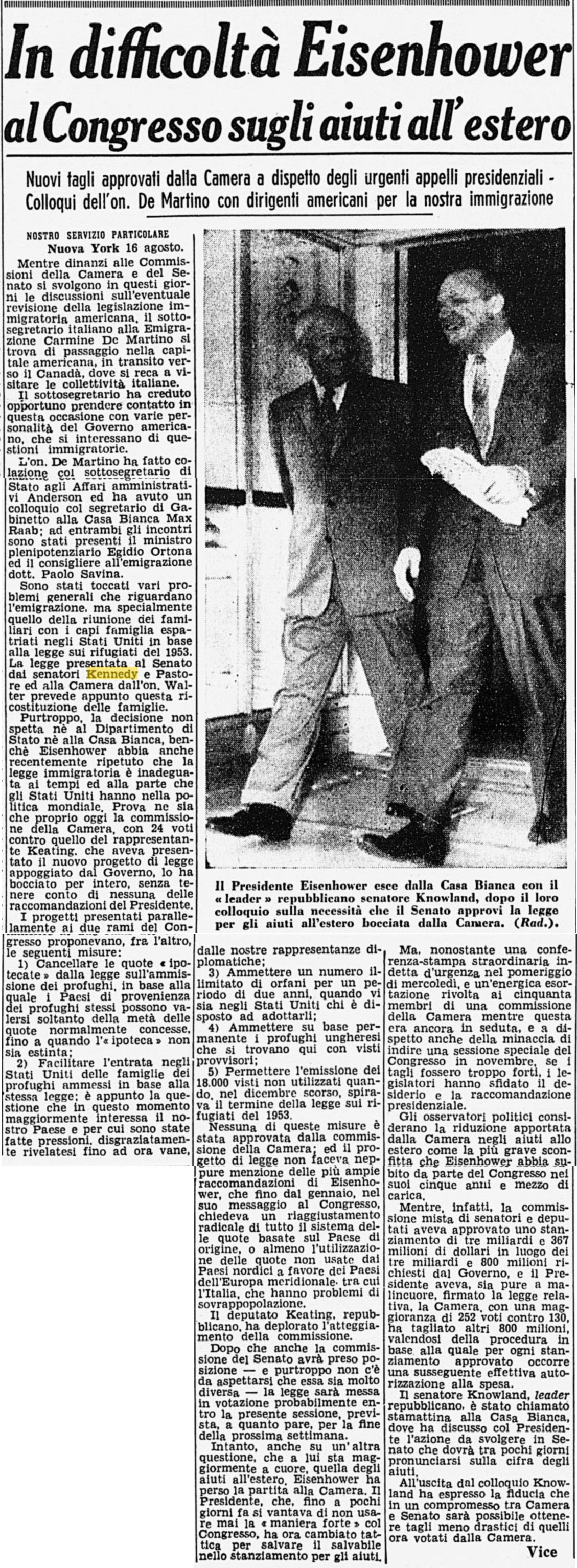
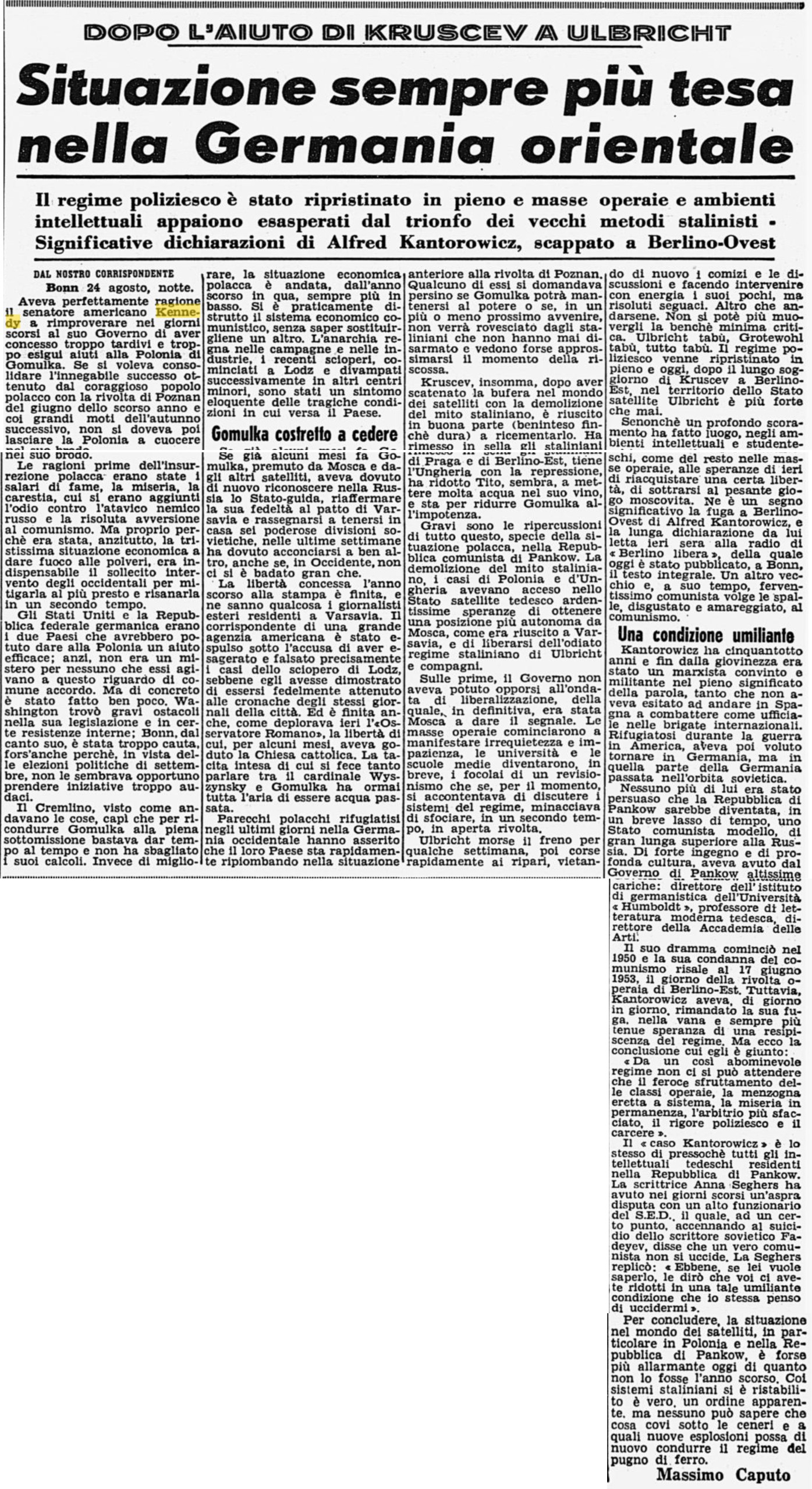
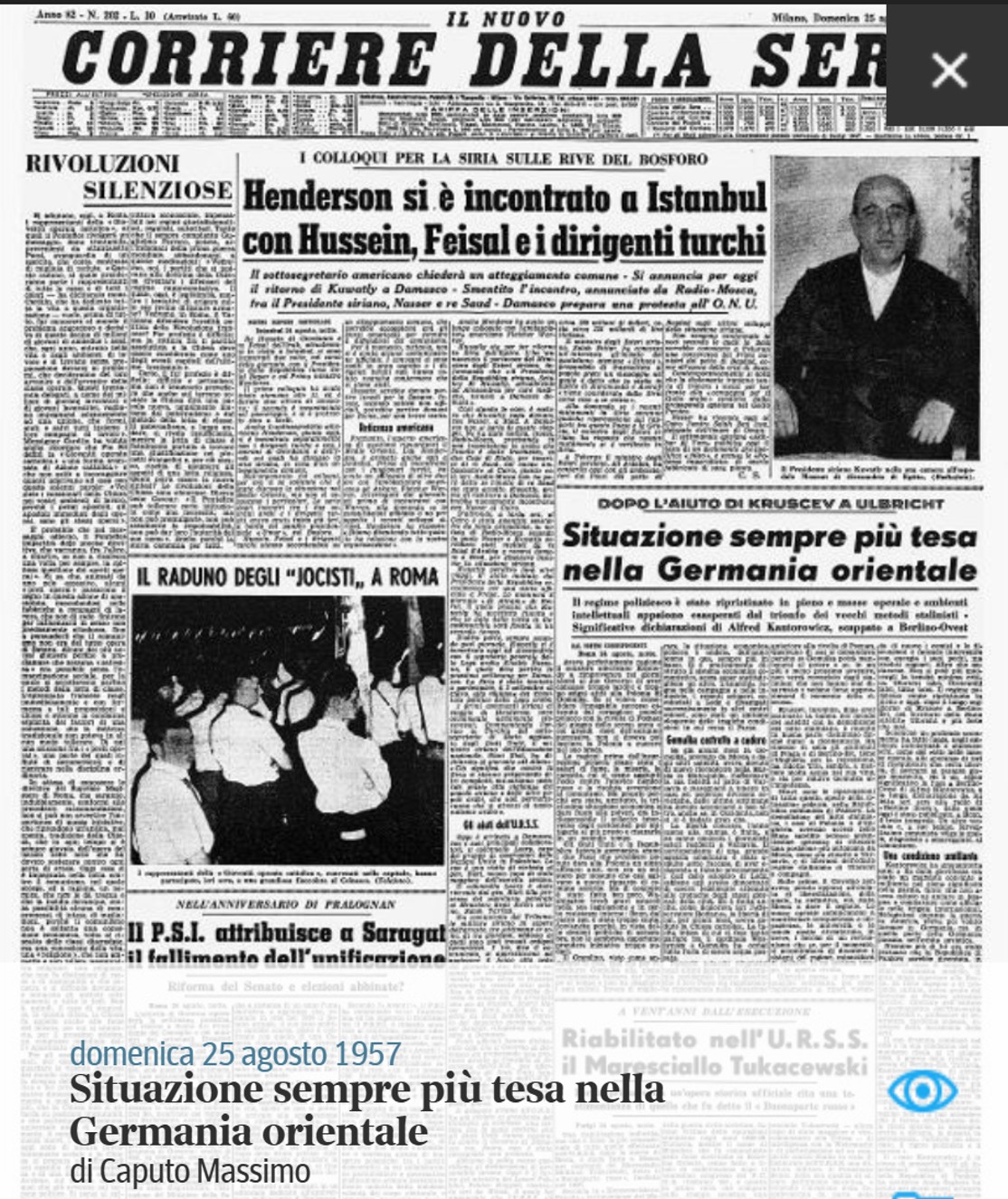
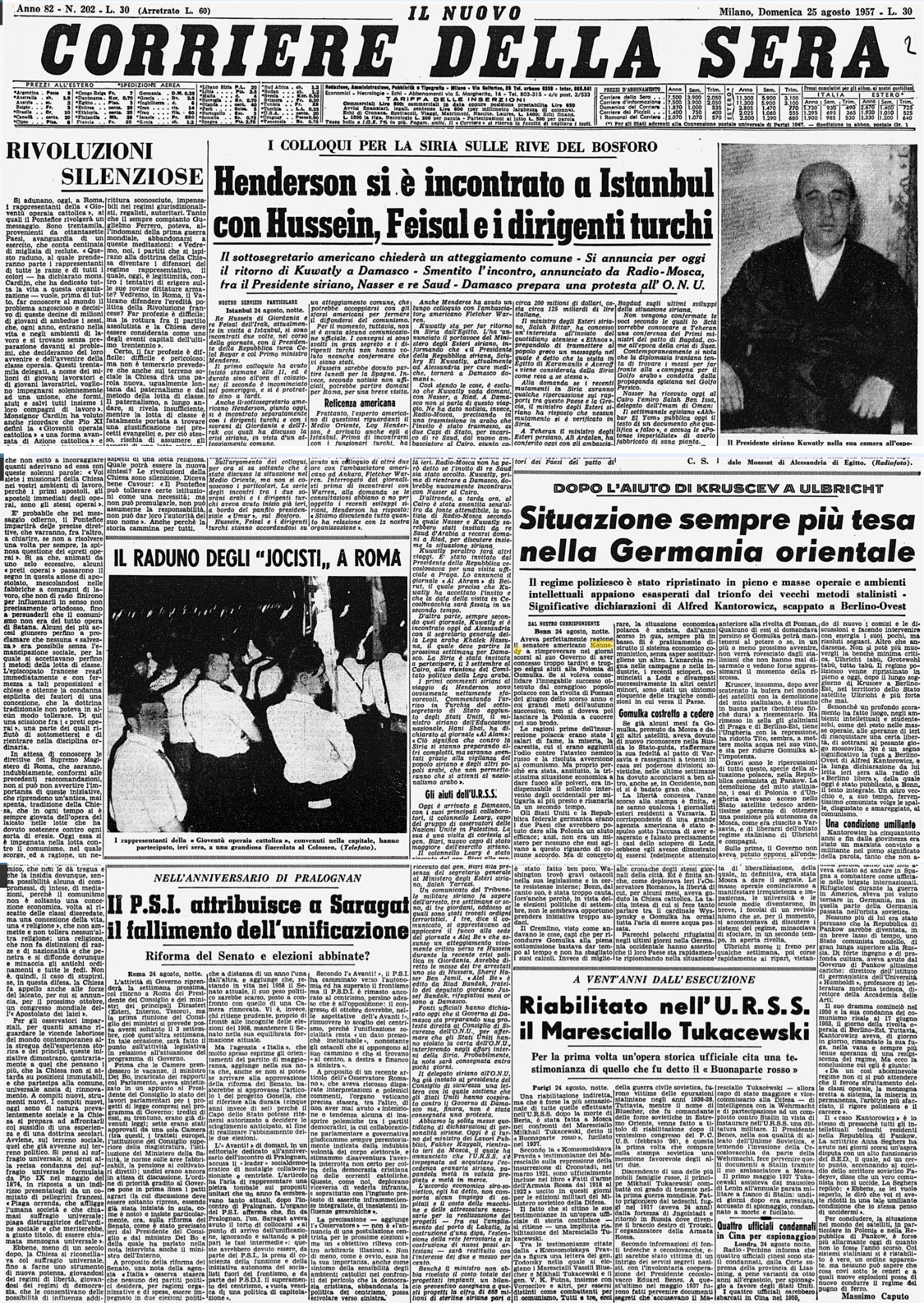
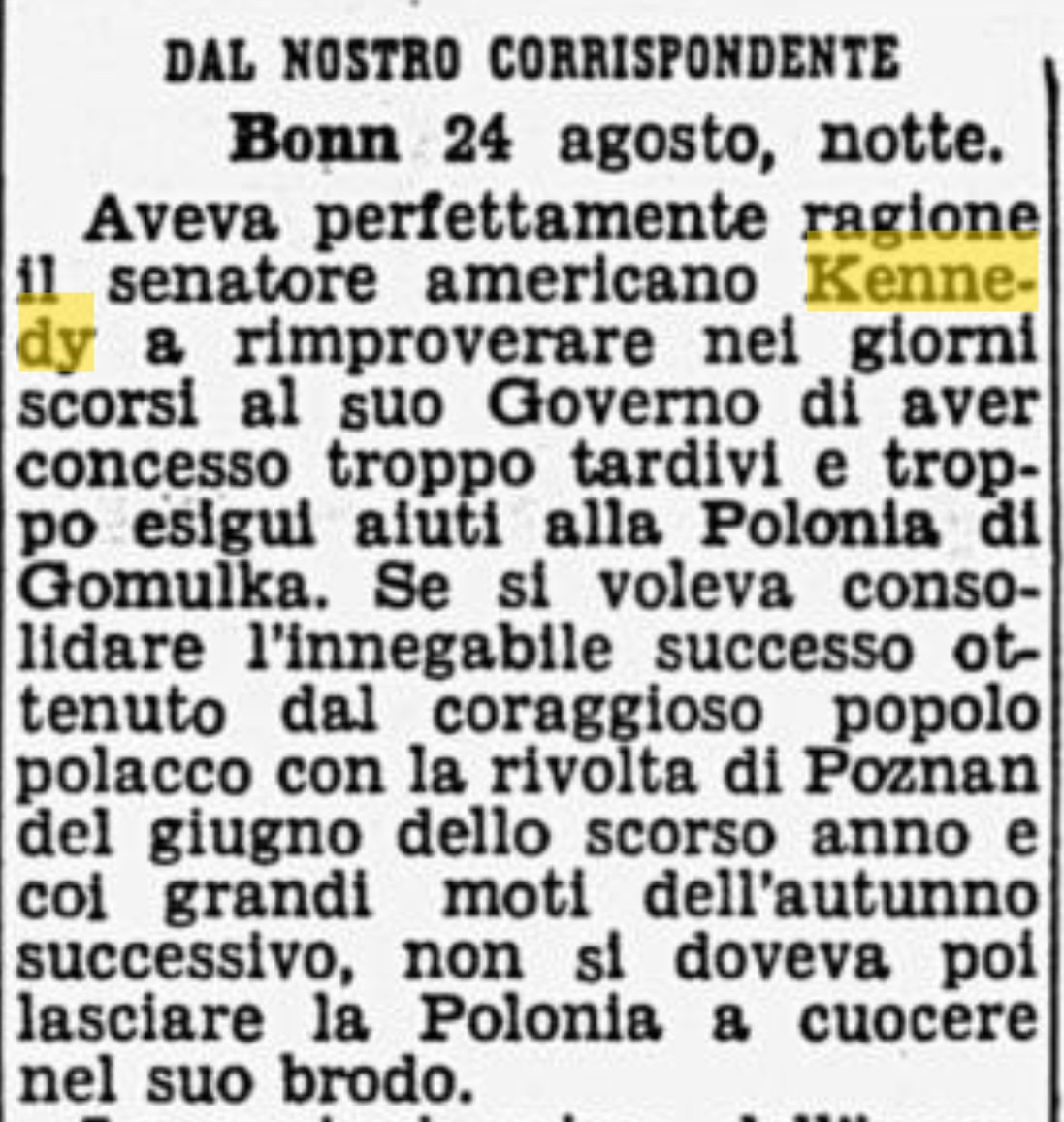
Copy of an article
from the Italian daily newspaper *Corriere della Sera*, dated Sunday,
August 25, 1957. |
|
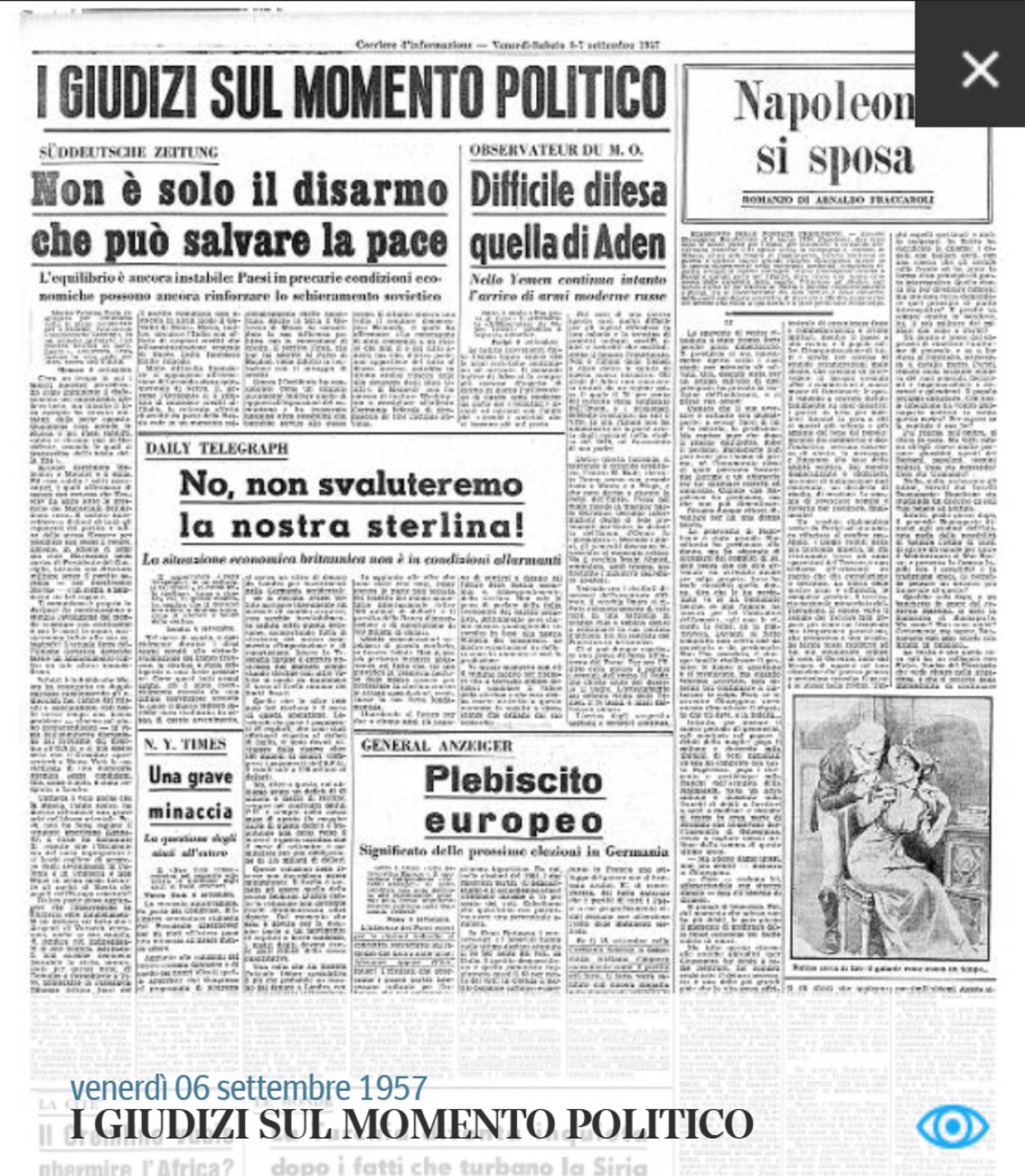
1957, September 6 - Corriere della Sera |
||
|
|
|
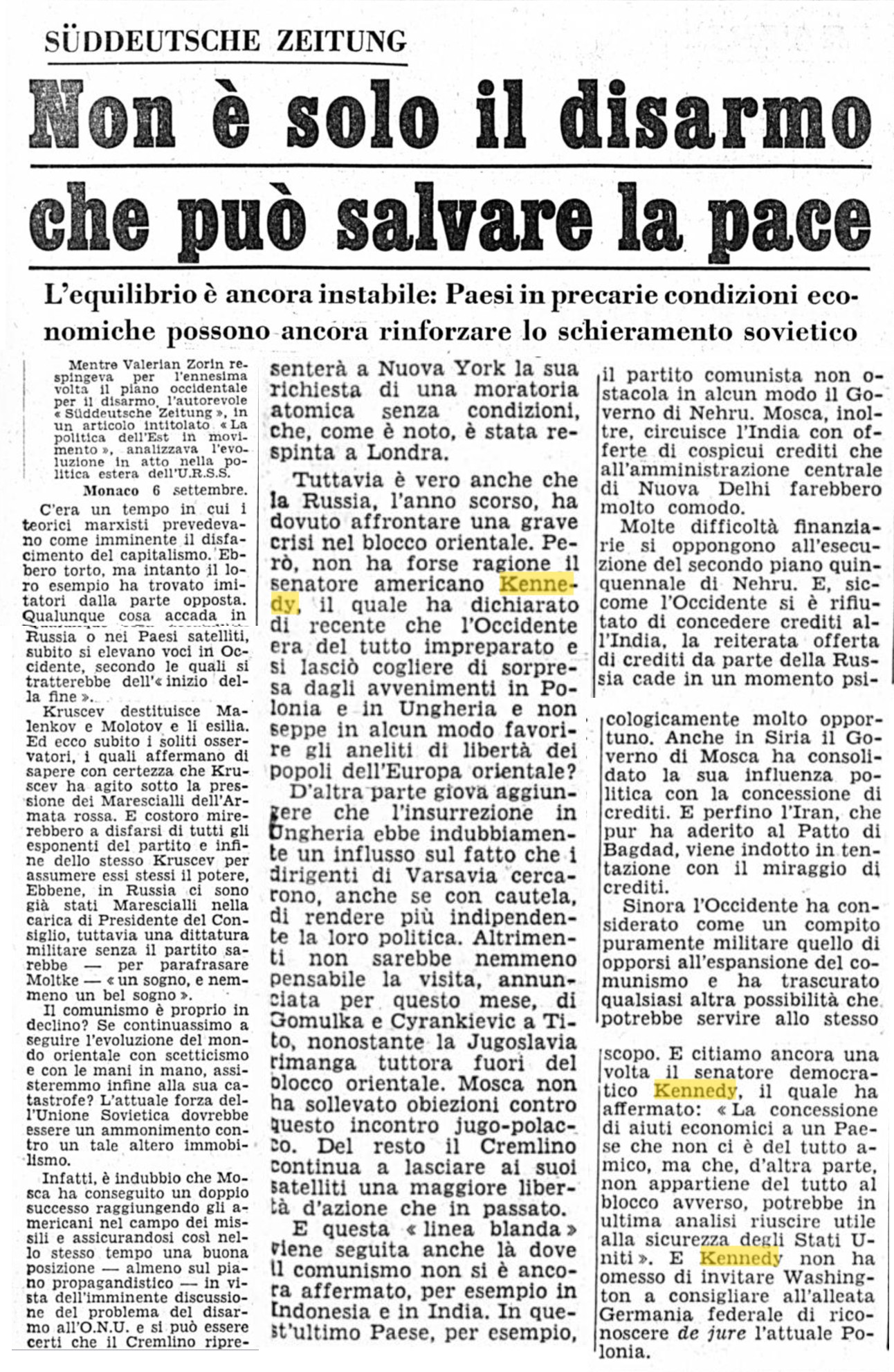
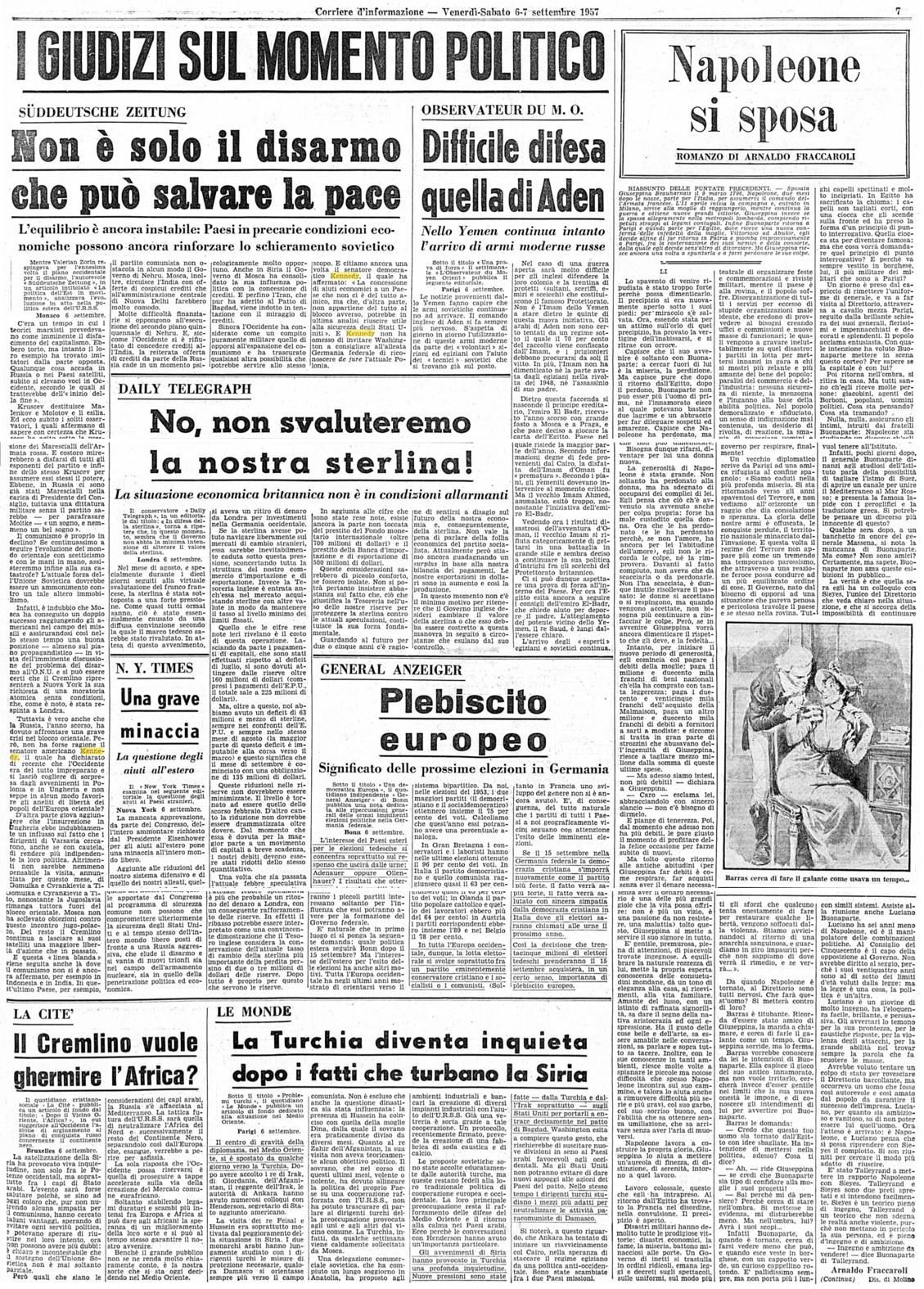
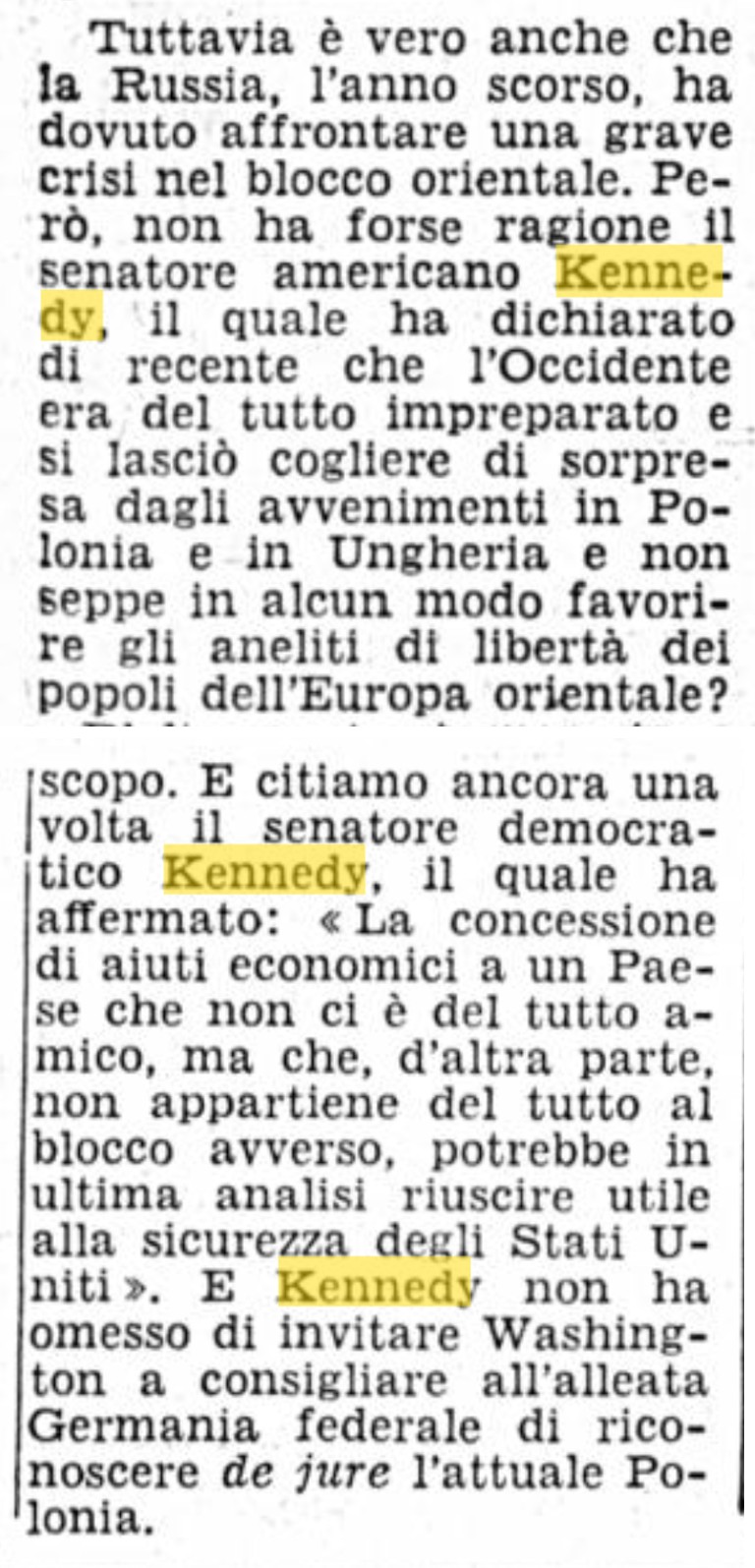
Copy of an article
from the Italian daily newspaper *Corriere della Sera*, dated Friday,
September 6, 1957. |
|
1957, November 25 - Corriere della Sera |
||
|
|
|
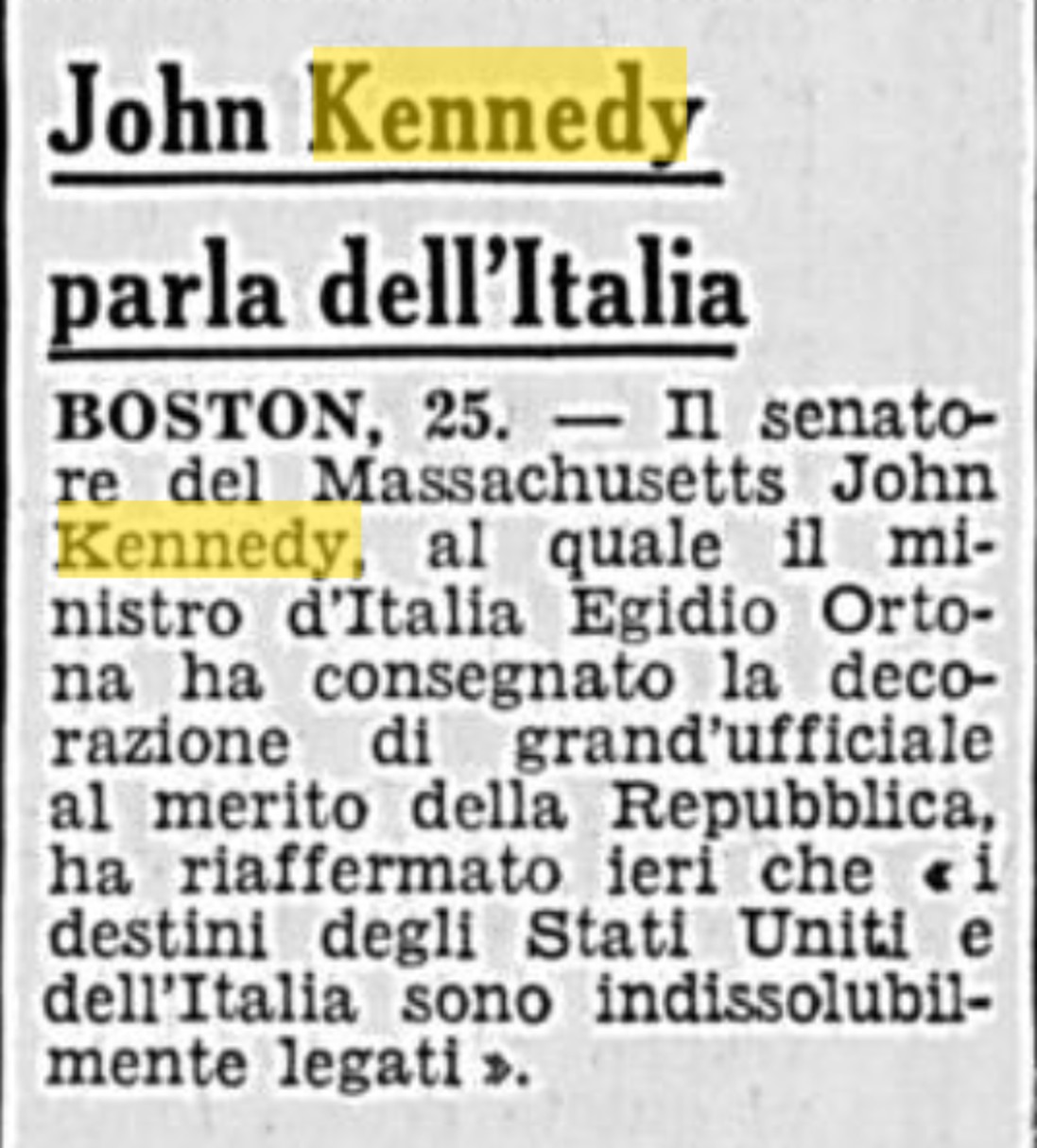
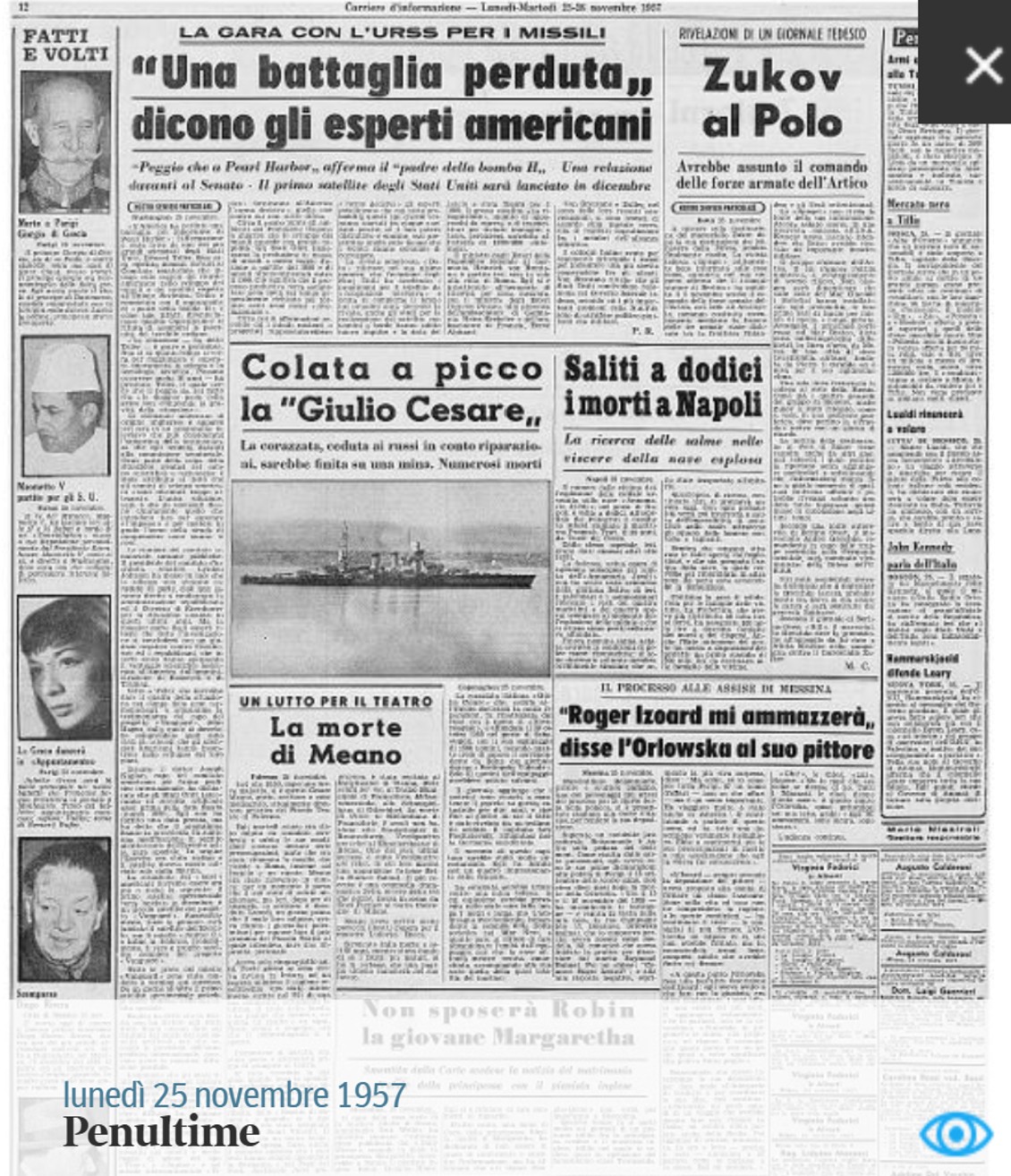
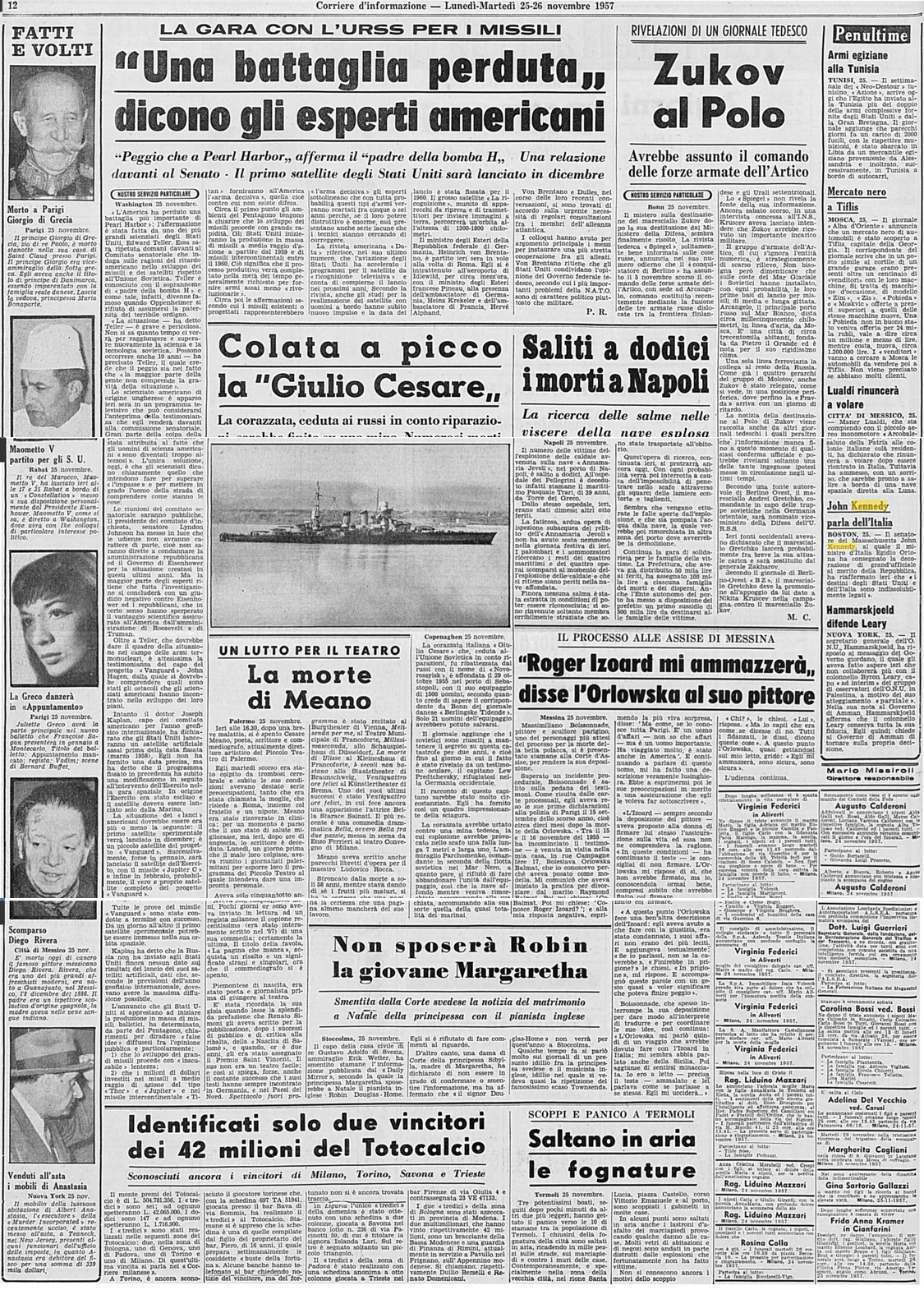
Copy of a
short article from the Italian daily newspaper *Corriere della
Sera*, dated Monday, November 25, 1957. |
|
1958, February 6 - Corriere della Sera |
||
|
|
|
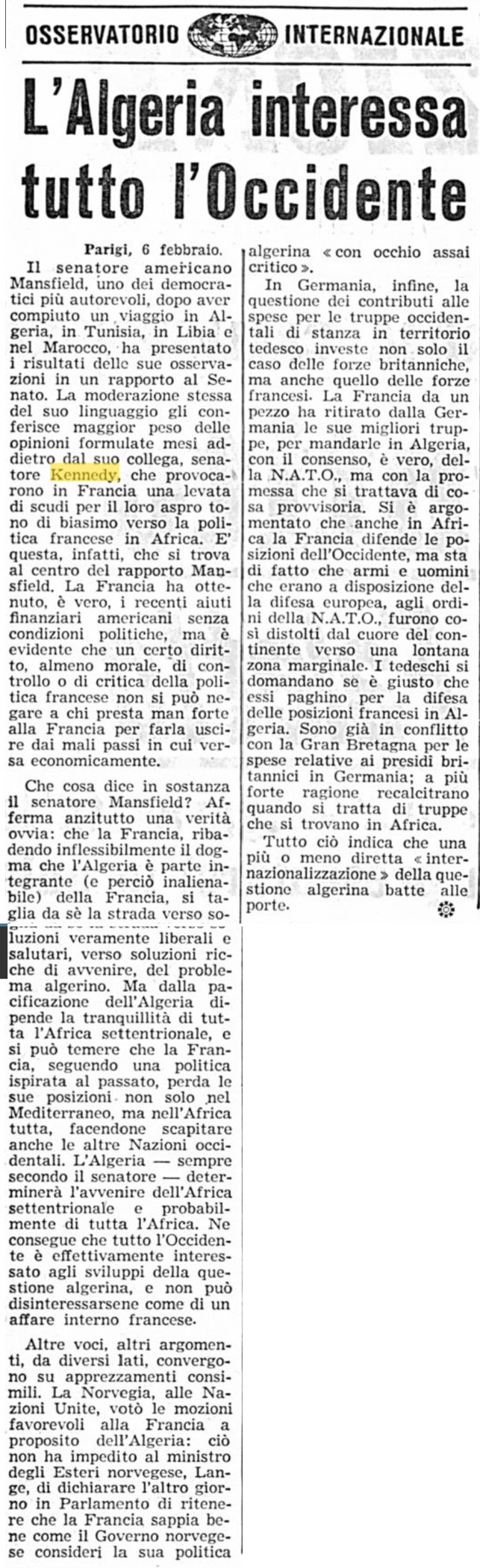
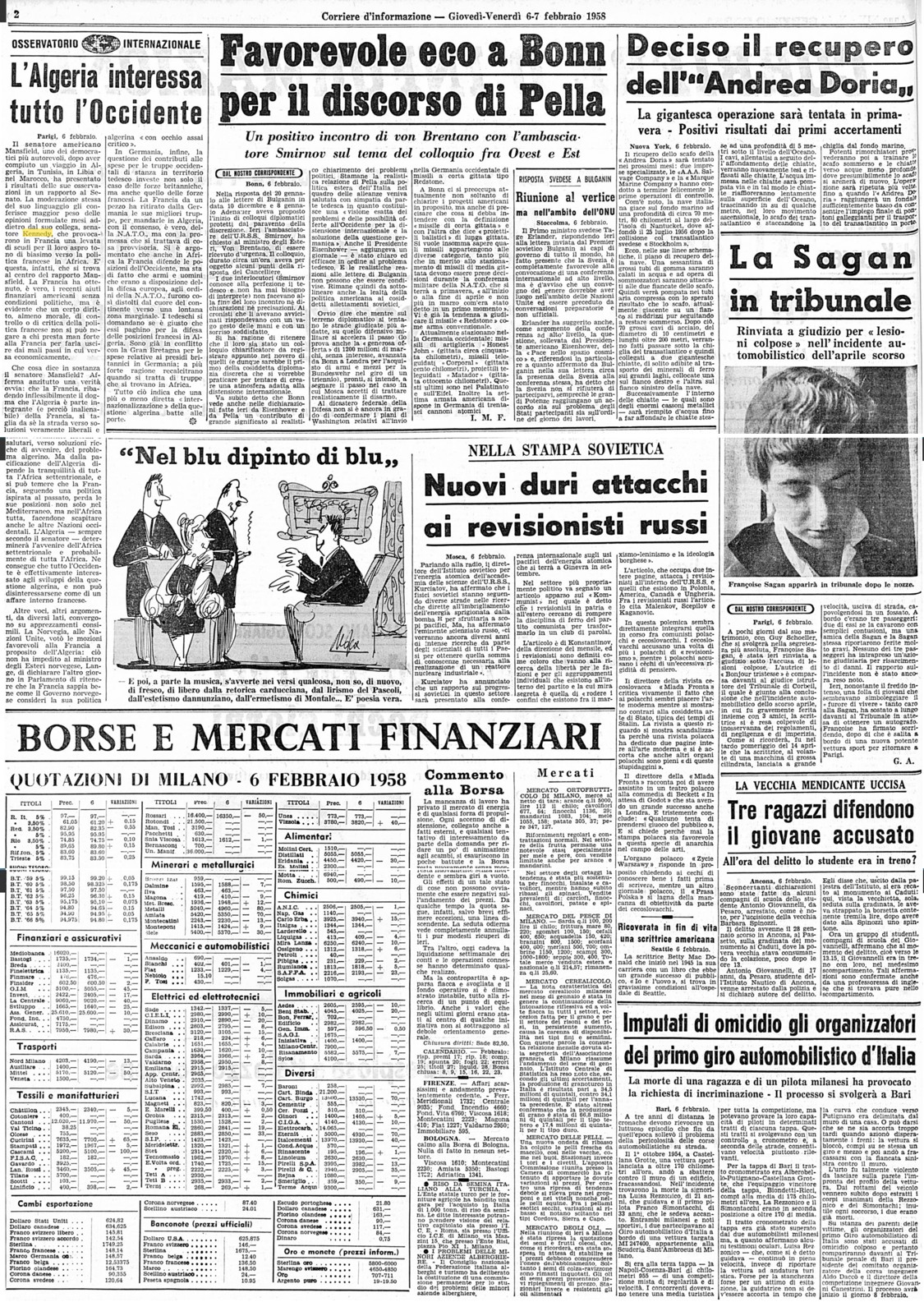
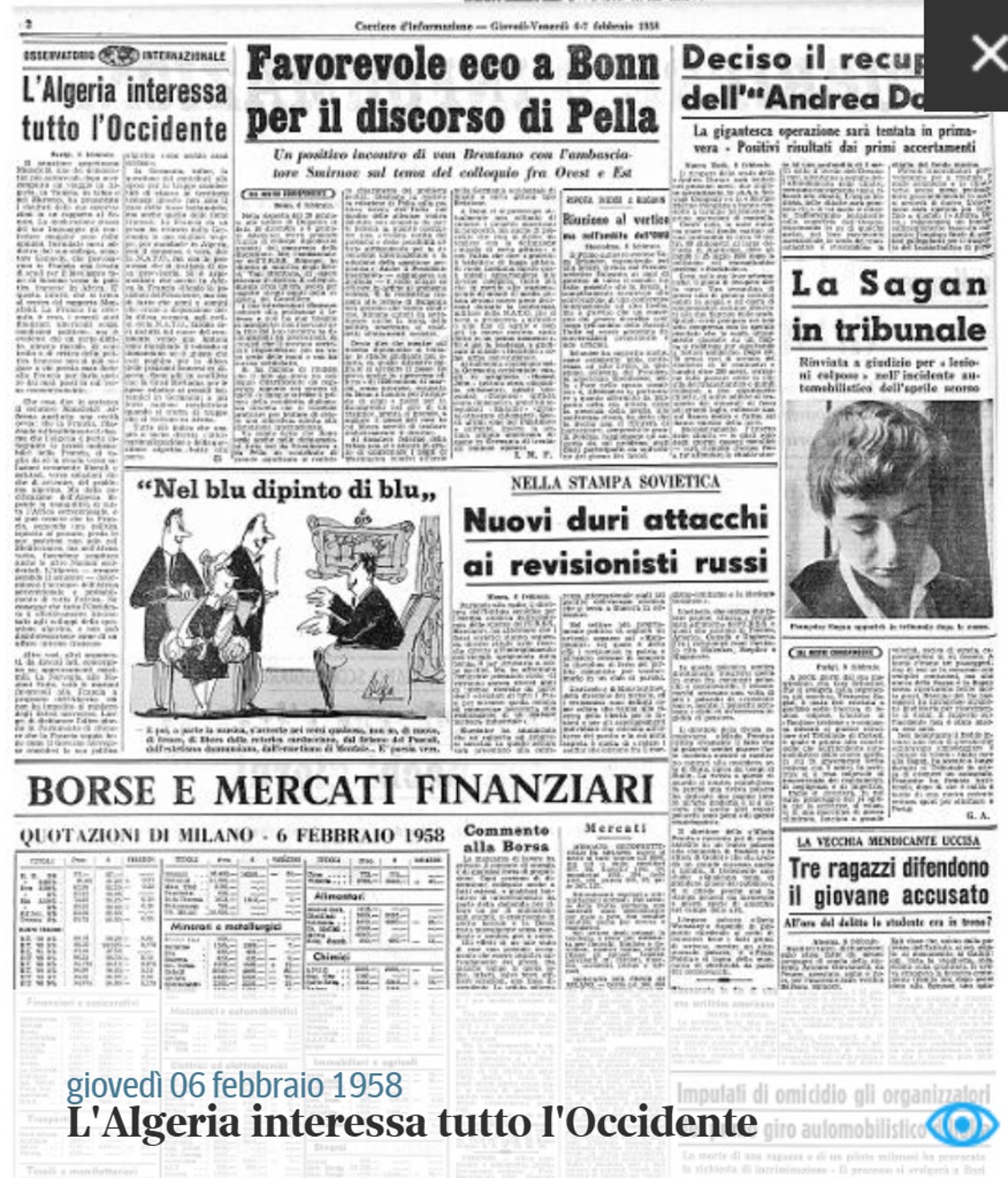
Copy of an
article from the Italian daily newspaper *Corriere della Sera*, dated
Thursday, February 6, 1958. |
|
1958, April 21 - Life |
||
|
|
|
Original. |
|
1958, June 28 - Corriere della Sera |
||
|
|
|
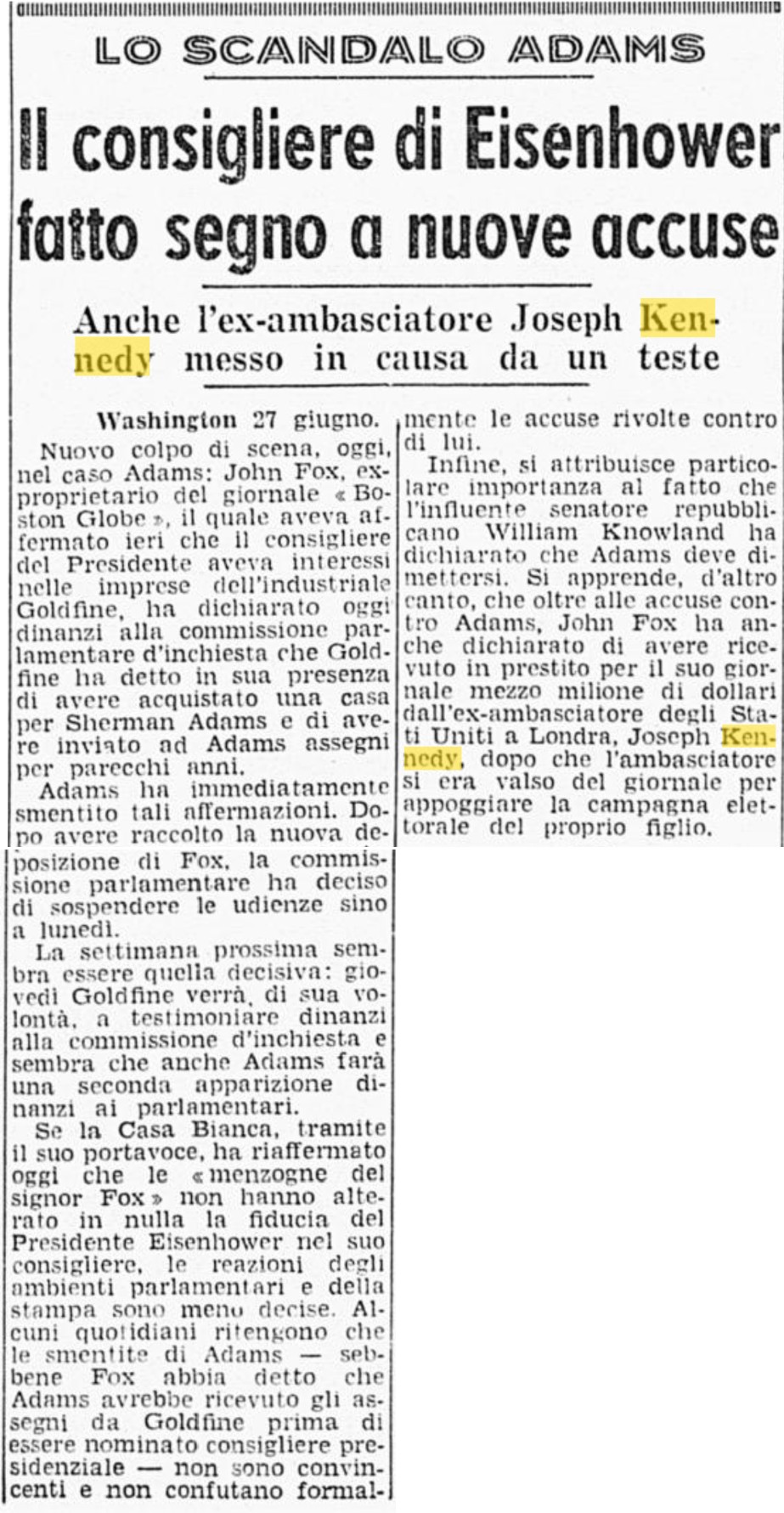
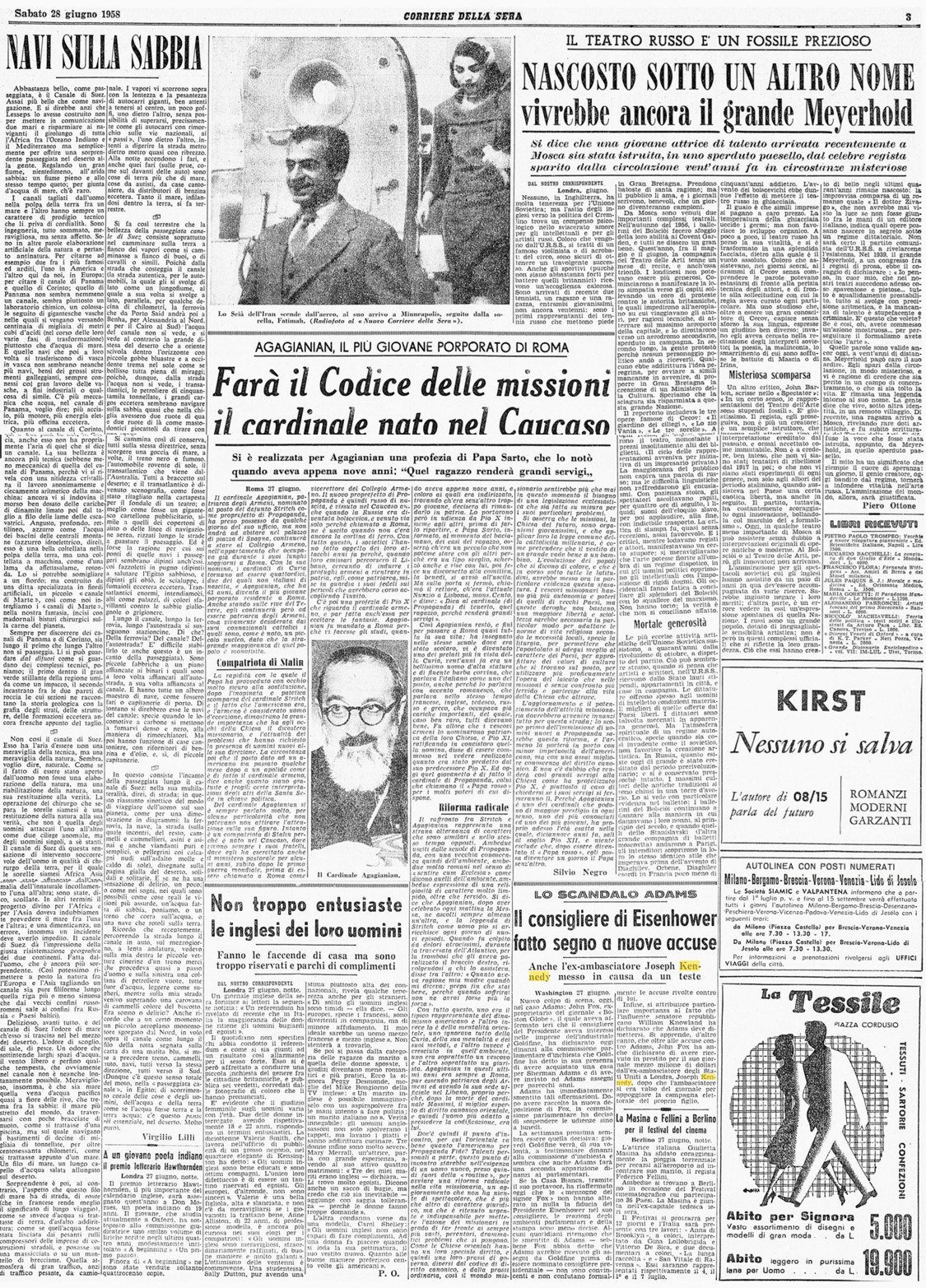
Copy of an
article from the Italian daily newspaper *Corriere della Sera*, dated
Saturday, June 28, 1958. |
|
1958, July 3 - Corriere della Sera |
||
|
|
|
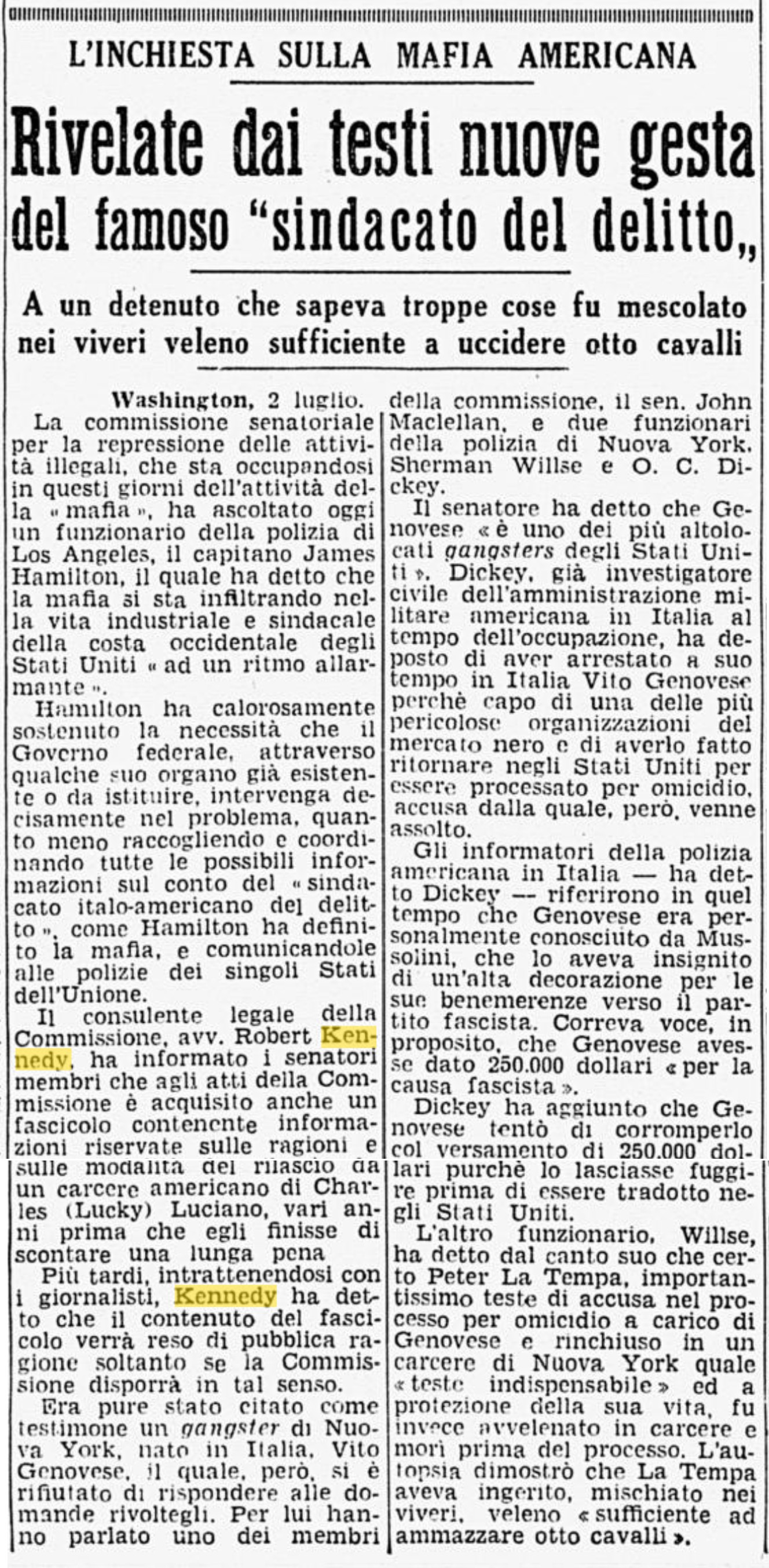
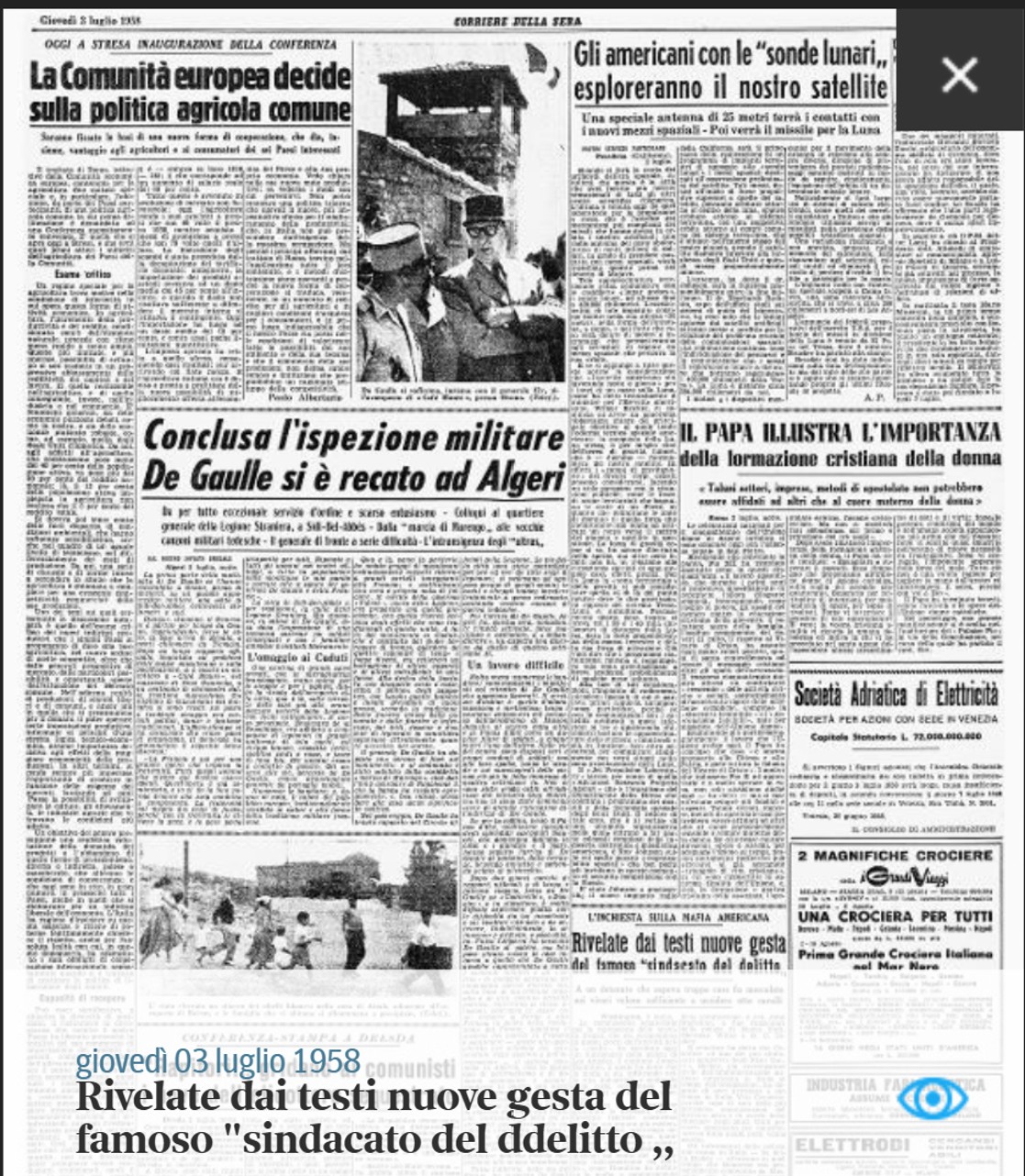
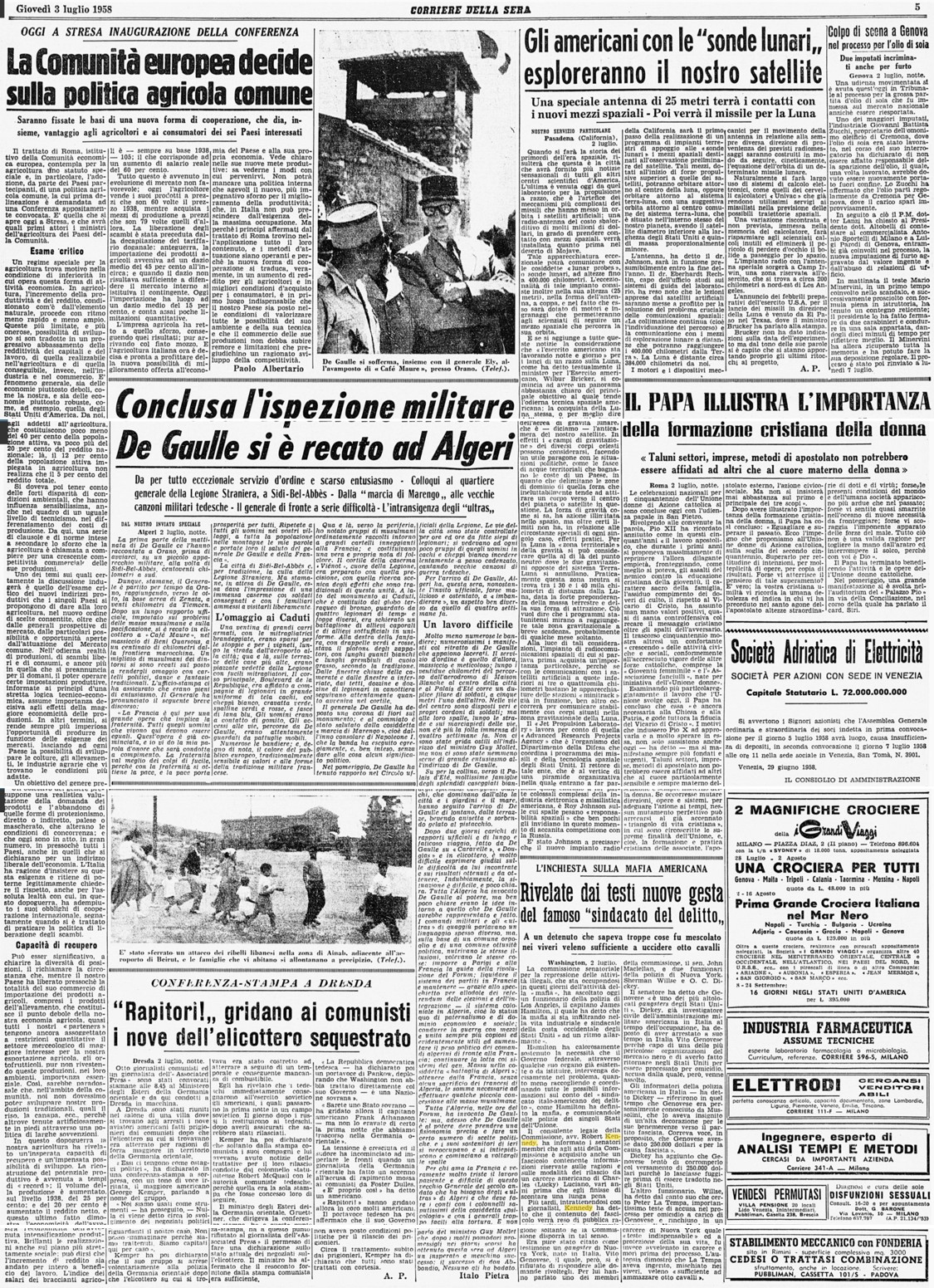
Copy of an article
from the Italian daily newspaper *Corriere della Sera*, dated Thursday,
July 3, 1958. Article title: "The investigation into the American Mafia." Excerpt: "The Commission's legal counsel, Robert Kennedy, informed the member senators that the Commission's records also include a file containing confidential information regarding the reasons for and circumstances surrounding Lucky Luciano's release from an American prison—several years before he had finished serving a long sentence." |
|
1958, July 4 - Corriere della Sera |
||
|
|
|
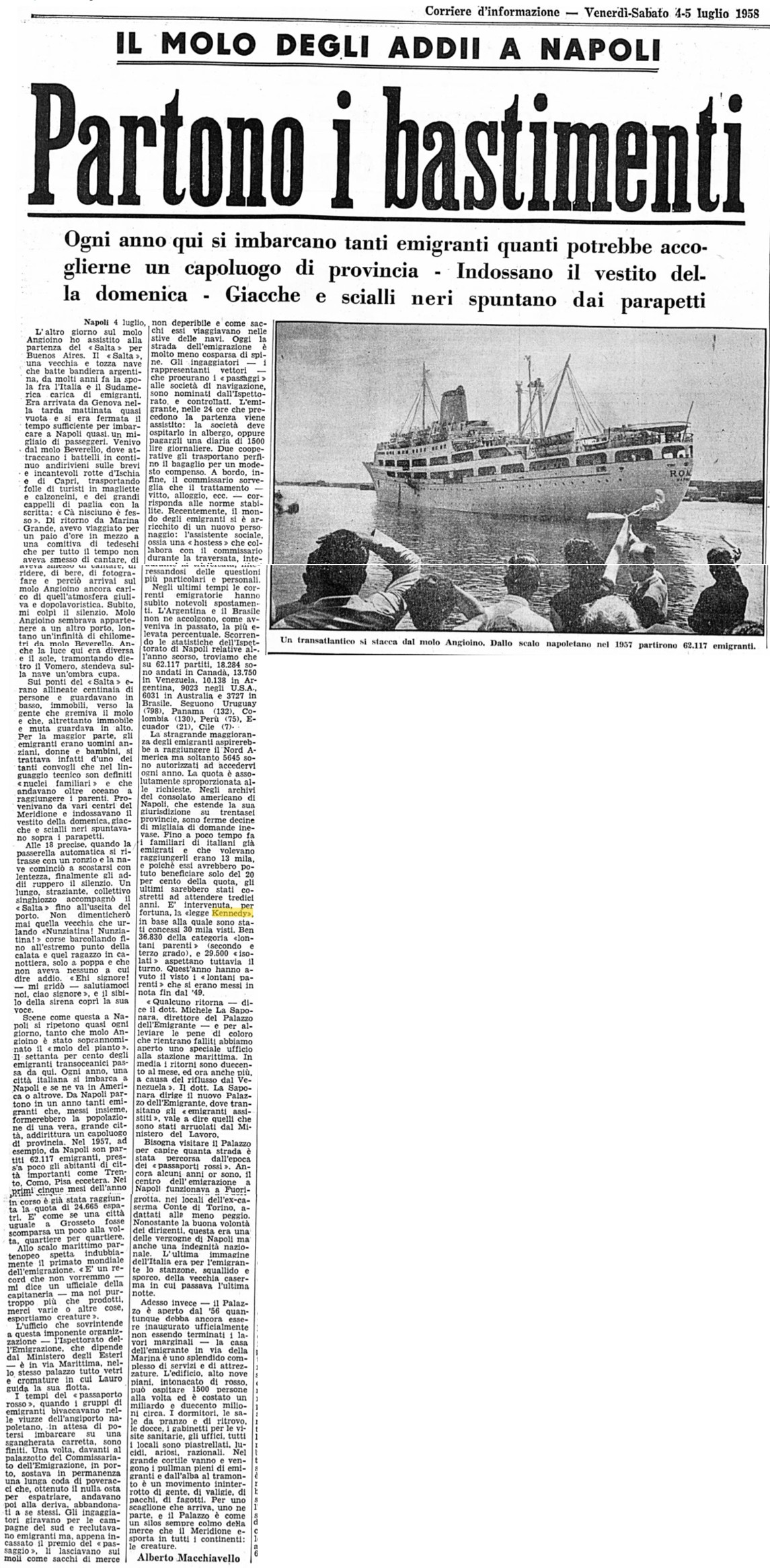
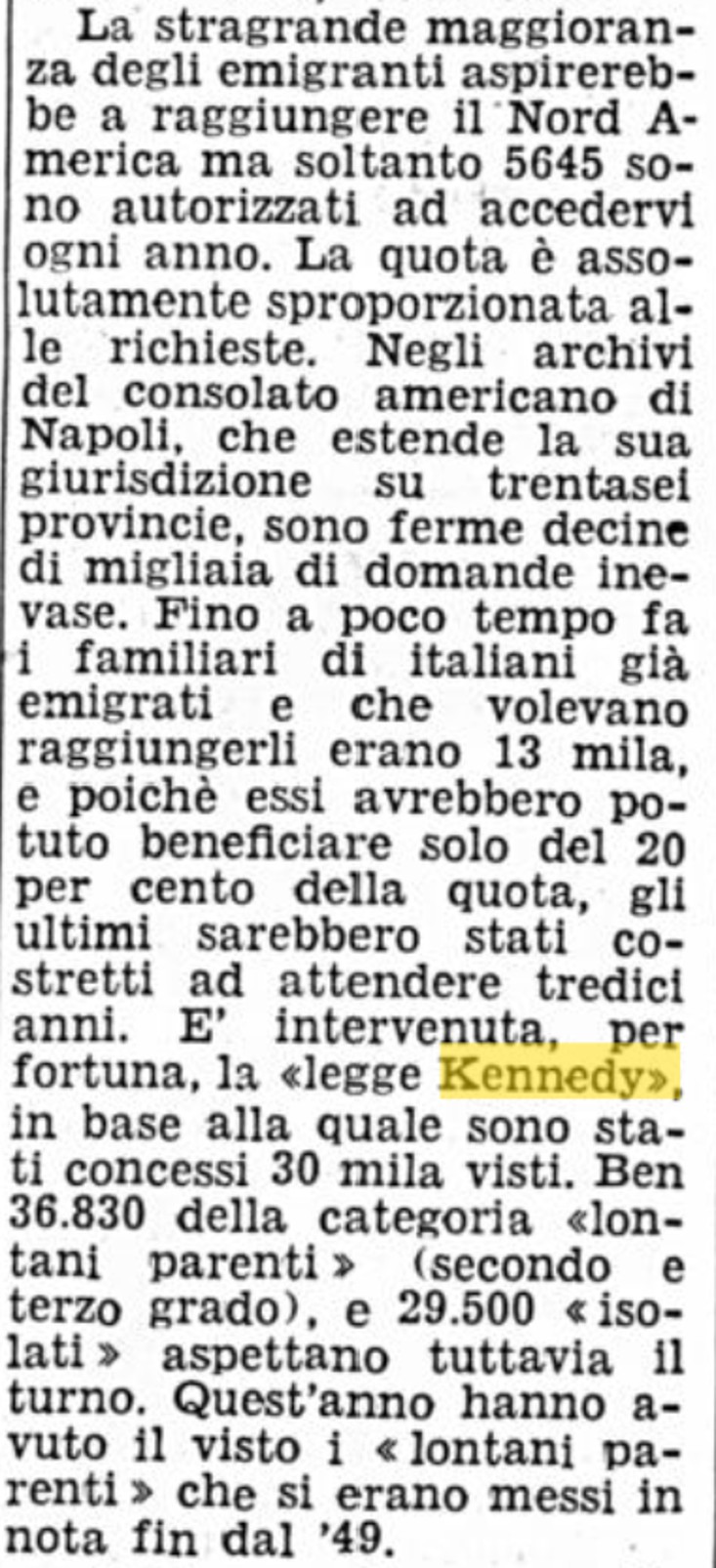
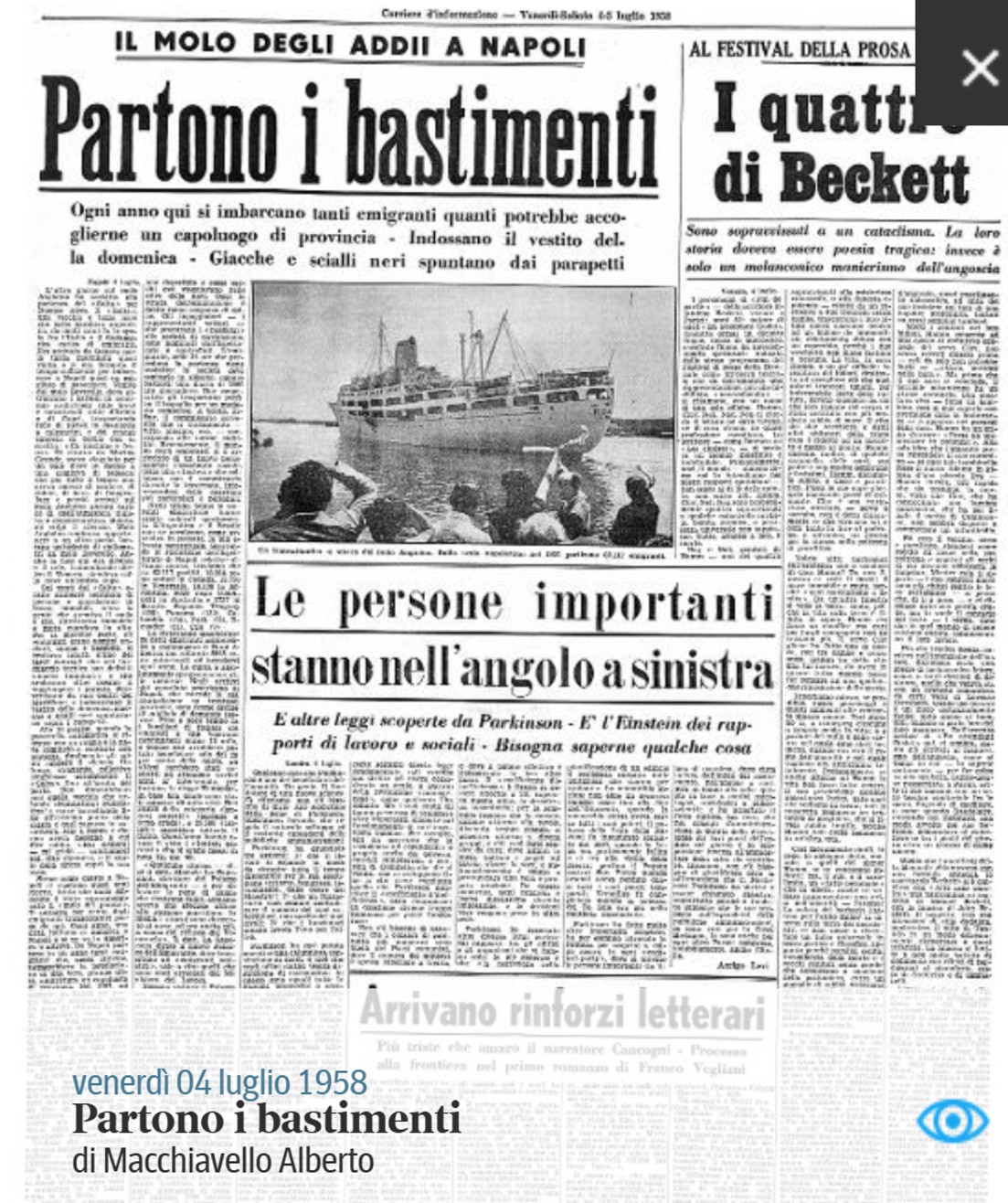
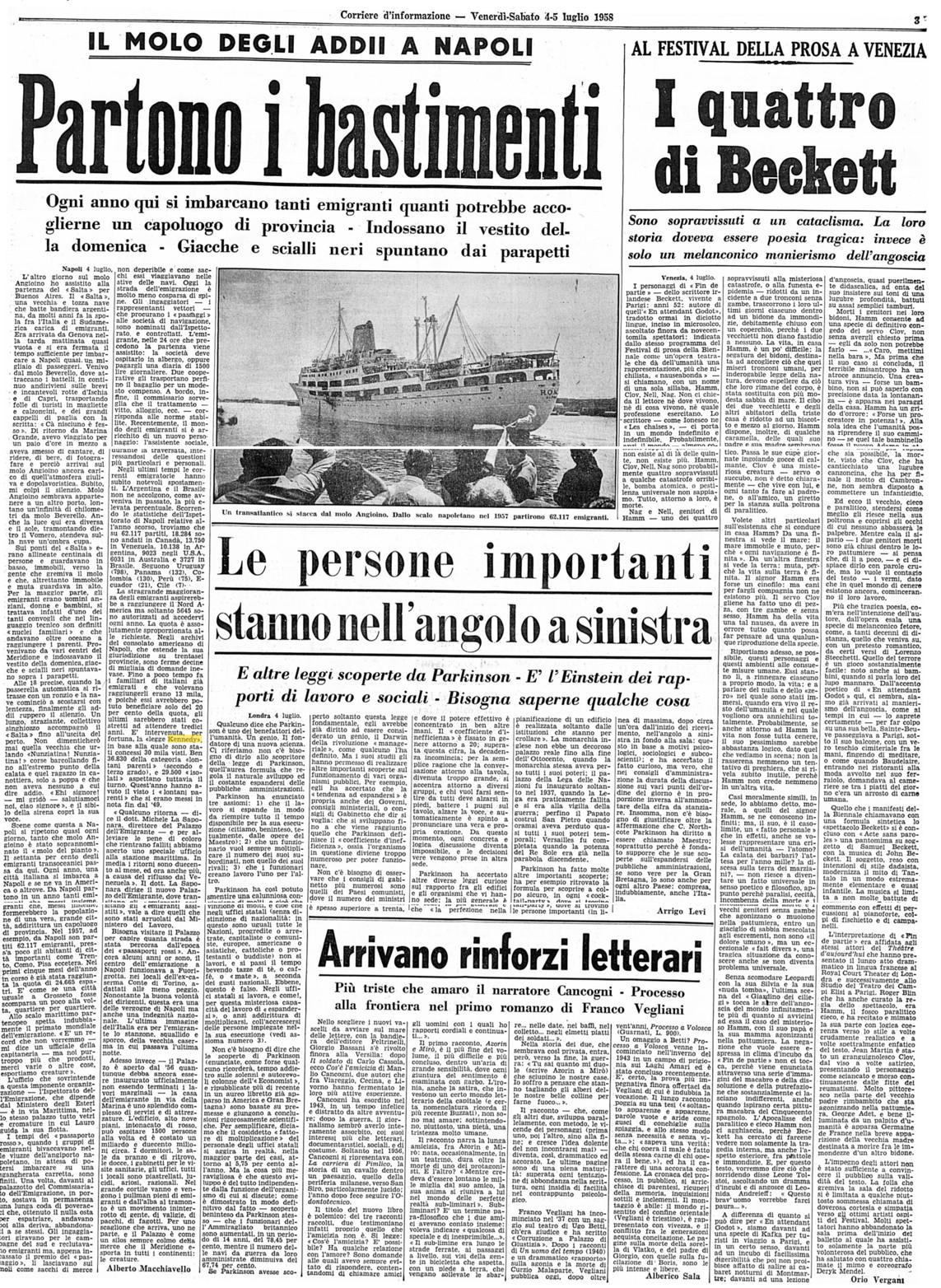
Copy of an article
from the Italian daily newspaper *Corriere della Sera*, dated Friday, July
4, 1958. Article title: "The Ships Depart." Excerpt: "The vast majority of emigrants aspired to reach North America... Until recently, there were 13,000 family members of Italians who had already emigrated and wished to join them; since they could only benefit from 20% of the quota, the last among them would have been forced to wait 13 years. Fortunately, the 'Kennedy Act' intervened, resulting in the granting of as many as 30,000 visas." In 1957, the then-Senator John F. Kennedy initiated an intensive legislative effort to reform United States immigration policy, culminating in proposals that were formally articulated in his famous essay *A Nation of Immigrants* (1958). The cornerstone of this vision was family reunification, designed to overcome the discriminatory barriers of the national-origins quota system. That same year, the U.S. Congress passed the Immigration and Nationality Act of 1957 (Public Law 85-316), a measure intended to amend the restrictive McCarran-Walter Act of 1952. This 1957 law introduced significant exceptions based on humanitarian grounds and family unity, facilitating, for instance, the immigration of adopted children and stepchildren of U.S. citizens. The principles championed by Kennedy in 1957 laid the groundwork for the historic reform of 1965 (the Immigration and Nationality Act). That law, passed after his death, definitively abolished national quotas and established family reunification as the central pillar of the U.S. immigration system. |
|
1958, July 29 - Corriere della Sera |
||
|
|
|
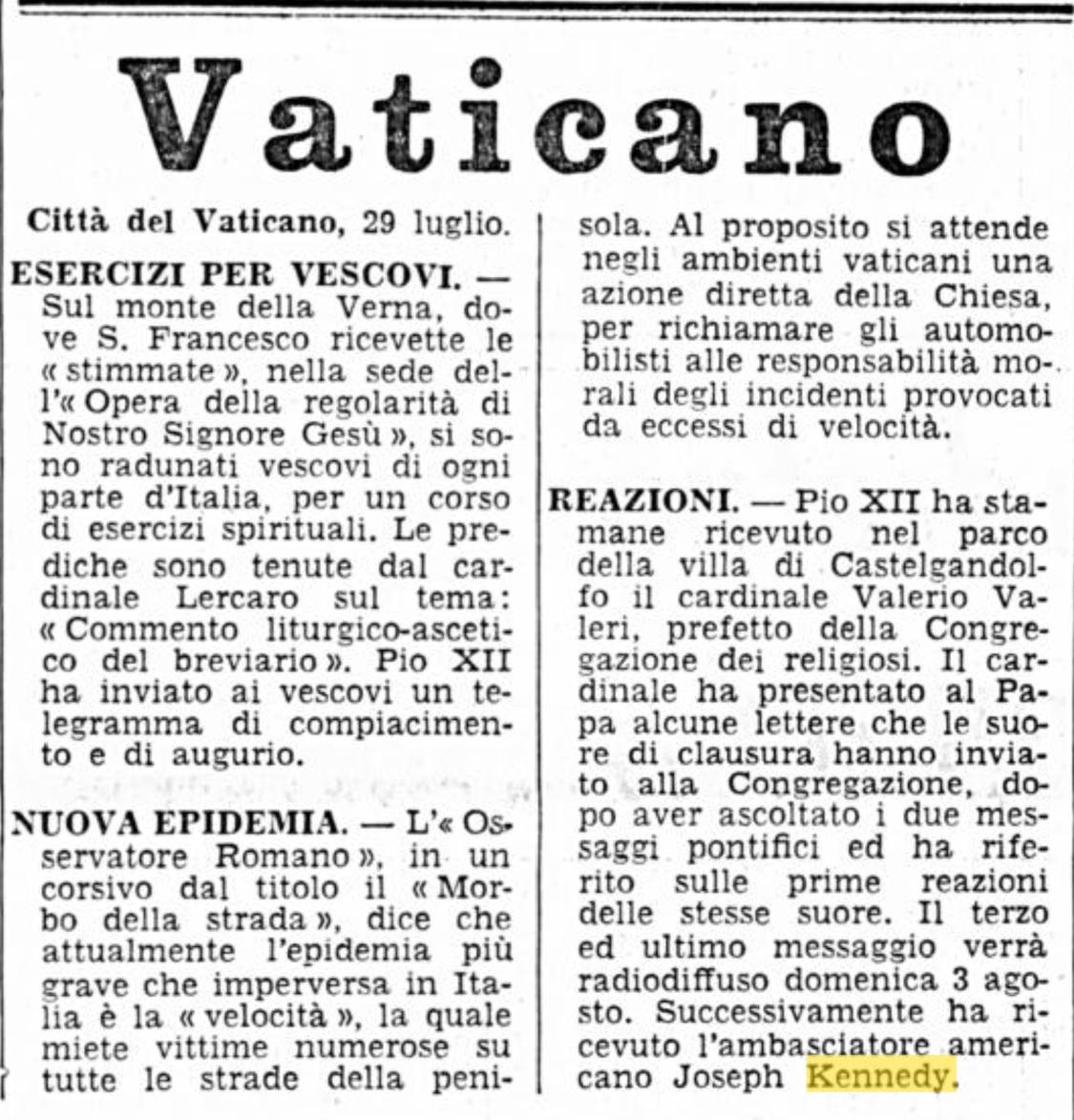
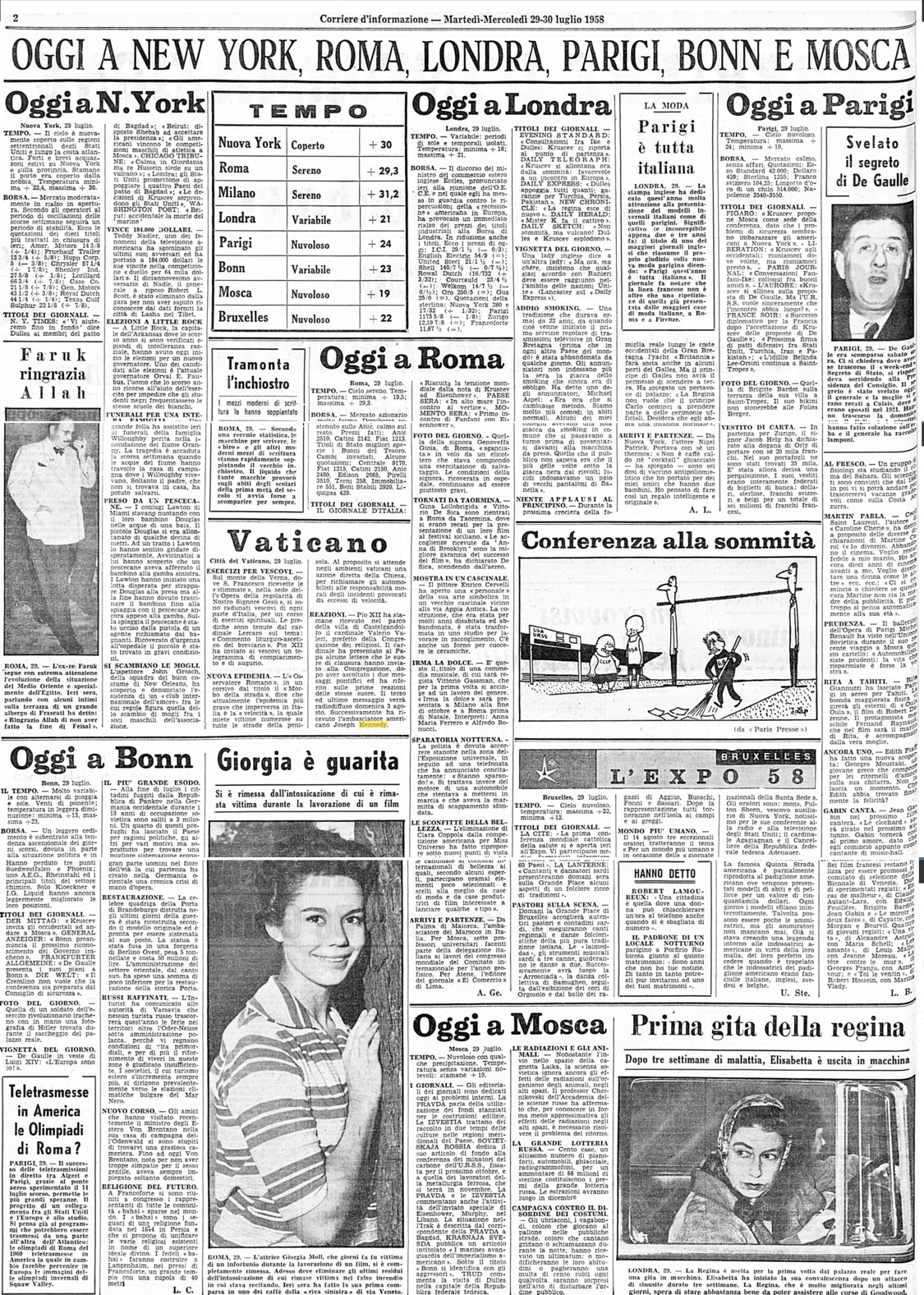
A copy of a short
article from the Italian daily newspaper *Corriere della Sera*, dated
Tuesday, July 29, 1958. A brief piece in the "Vatican" section: "Pius XII received American Ambassador Joseph Kennedy." This clipping serves as a valuable, firsthand, and intimate record. In July 1958, despite his declining health and the strict isolation imposed by doctors and his entourage at Castel Gandolfo, Pius XII still maintained avenues for private diplomatic activity. The explicit mention of Joseph Kennedy highlights how the personal ties between the future U.S. president's family and the upper echelons of the Holy See remained active and privileged right up to the final months of Pacelli's pontificate. |
|
1958, November 4 - Corriere della Sera |
||
|
|
|
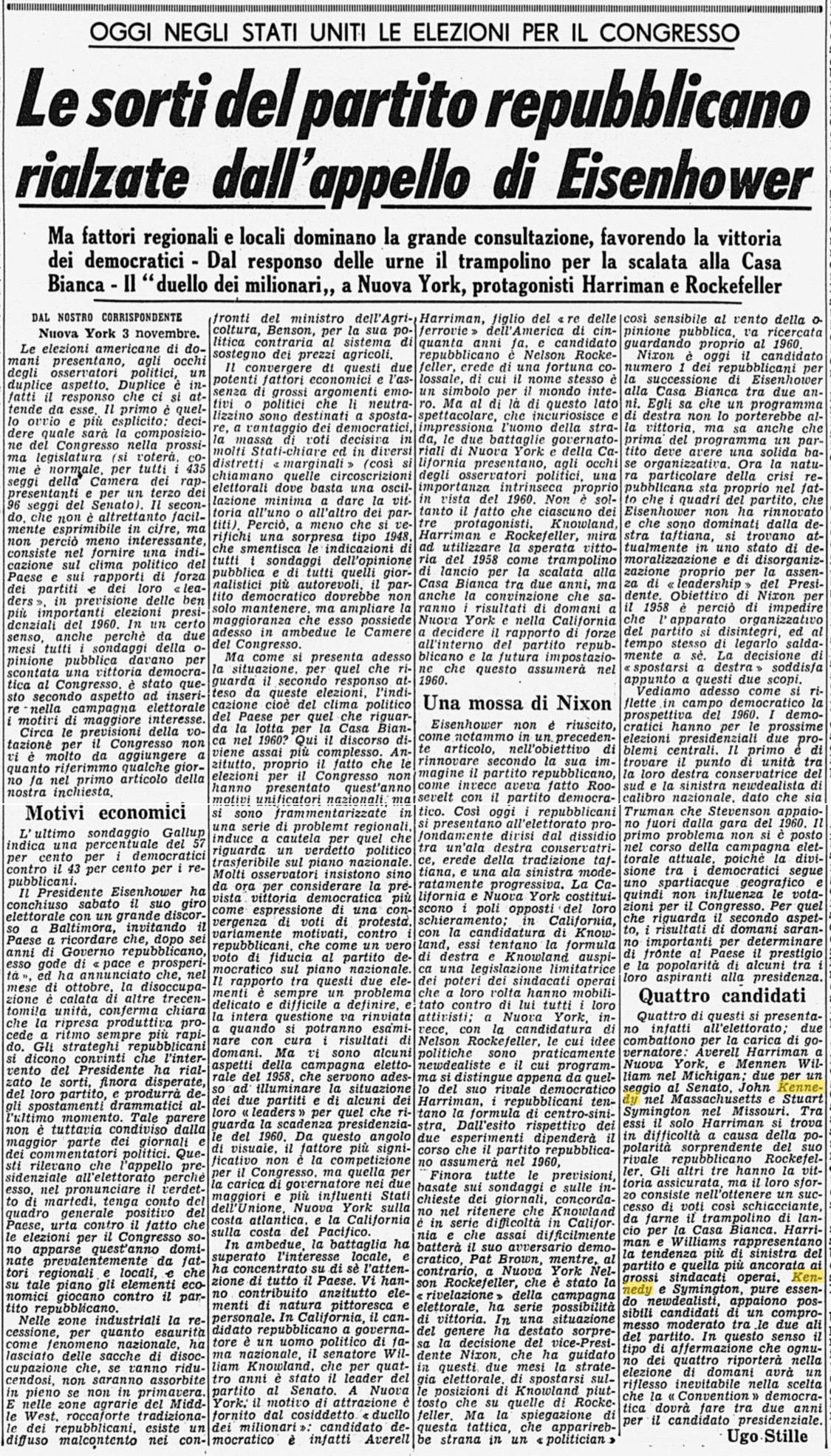
A
copy of a front-page article from the Italian daily newspaper *Corriere
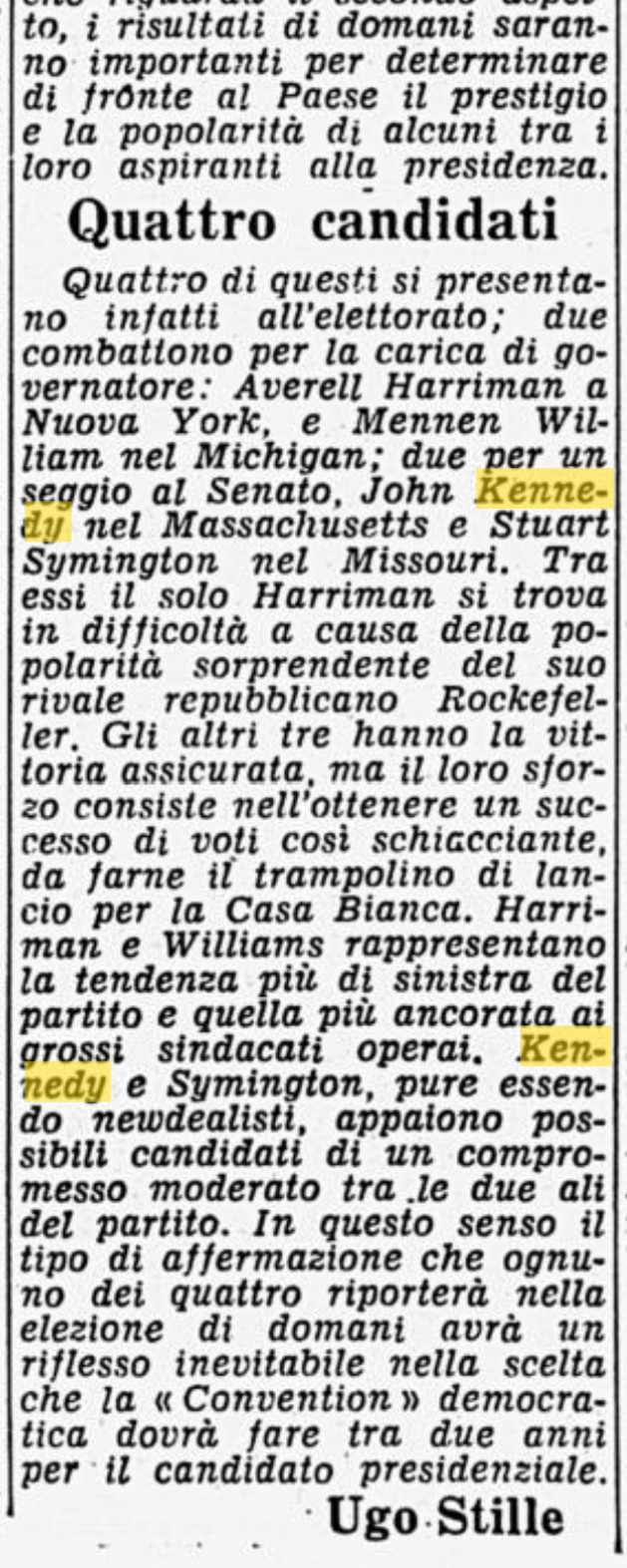
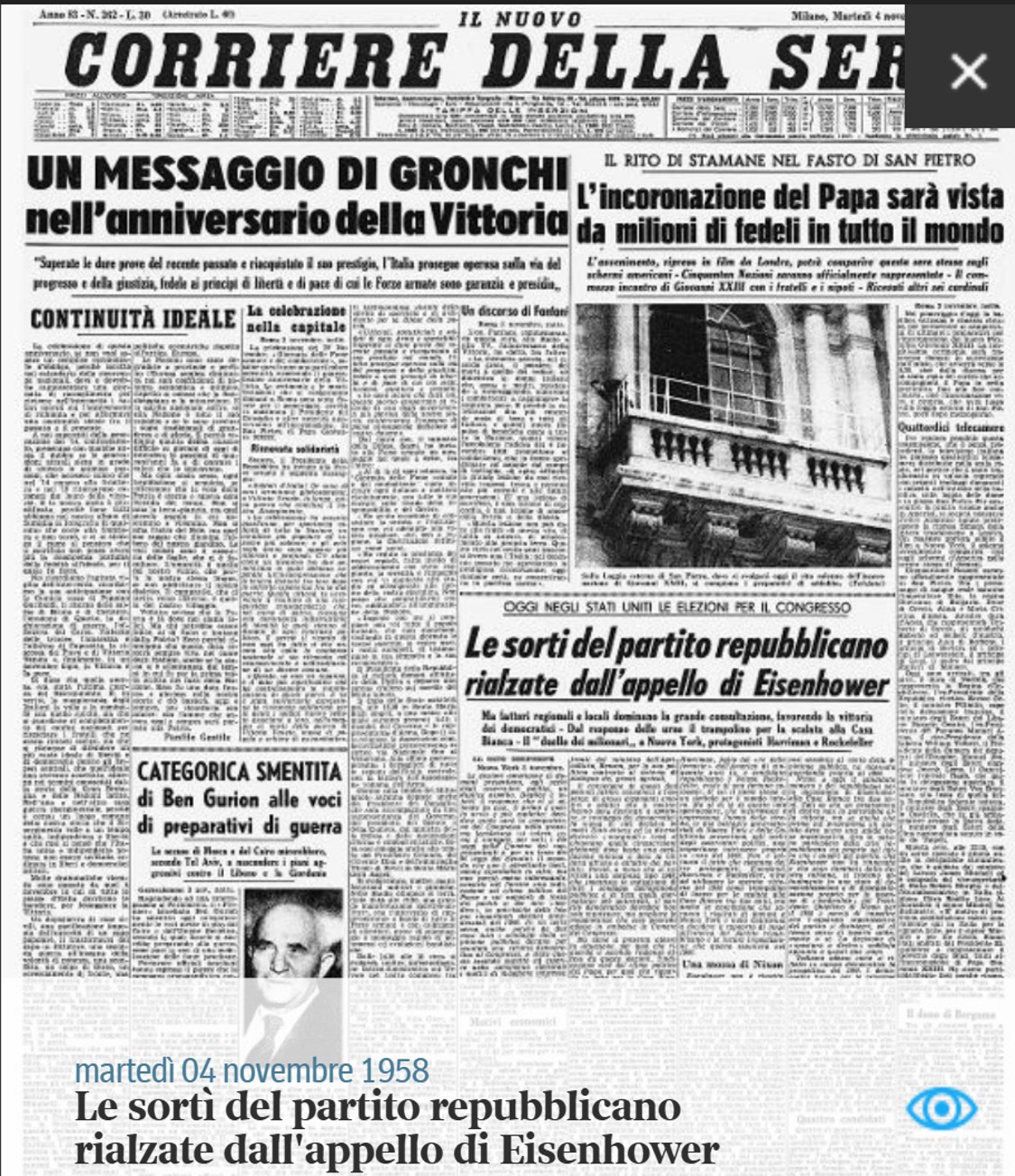
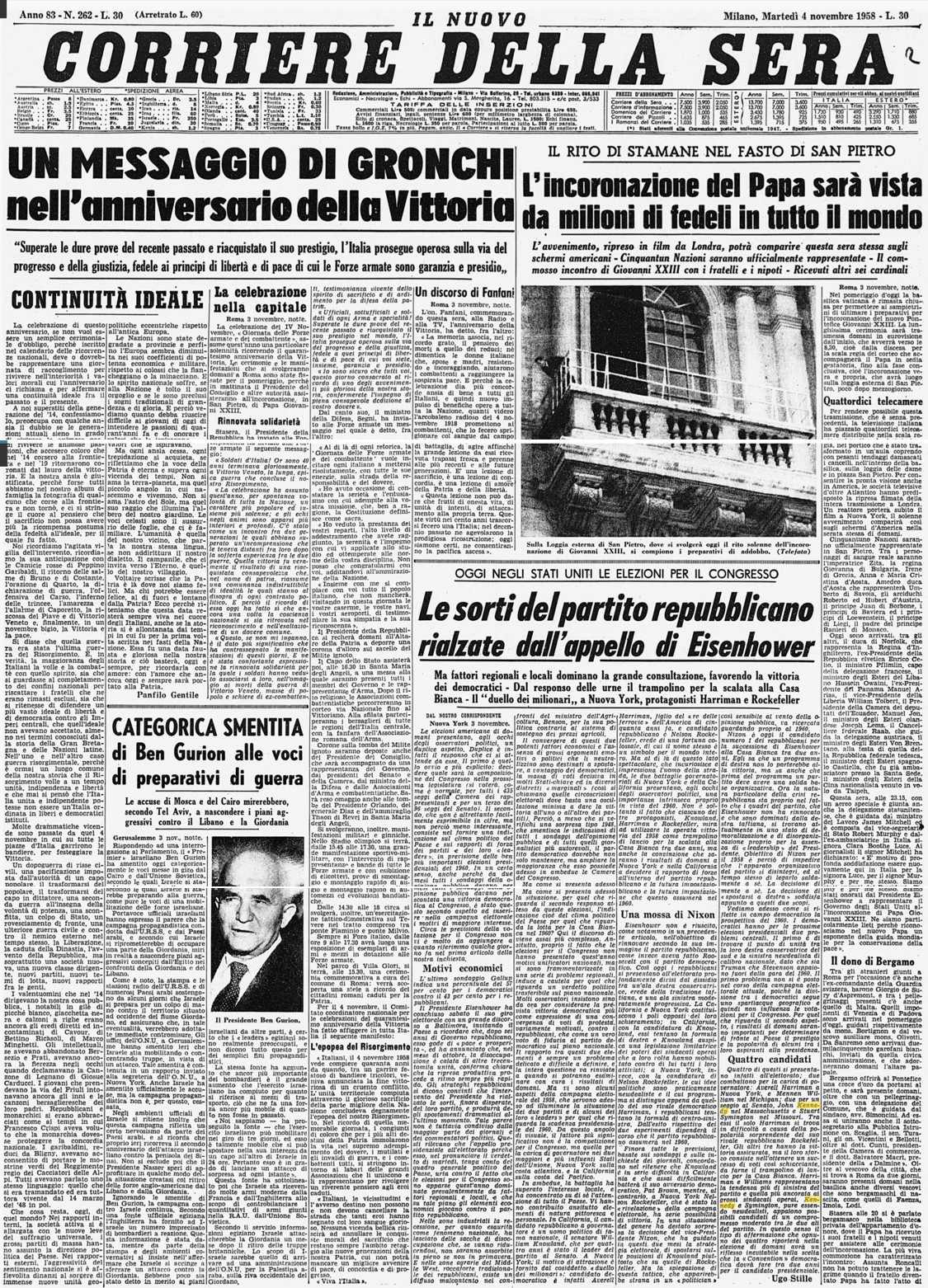
della Sera*, dated Tuesday, November 4, 1958. An article by Ugo Stille titled "Congressional Elections Today in the United States," in which the journalist analyzes the key issues surrounding the 1958 midterm elections. An excerpt: "The results of these elections will be significant in establishing the standing and popularity—in the eyes of the nation—of several potential future presidential contenders. Indeed, four such figures are facing the electorate: two are running for Governor—Averell Harriman in New York and Mennen Williams in Michigan—and two for a Senate seat: John Kennedy in Massachusetts and Stuart Symington in Missouri. Although Kennedy and Symington are New Dealers, they appear to be possible candidates for a moderate compromise between the party's two wings." |
|
1958, November 5 - Corriere della Sera |
||
|
|
|
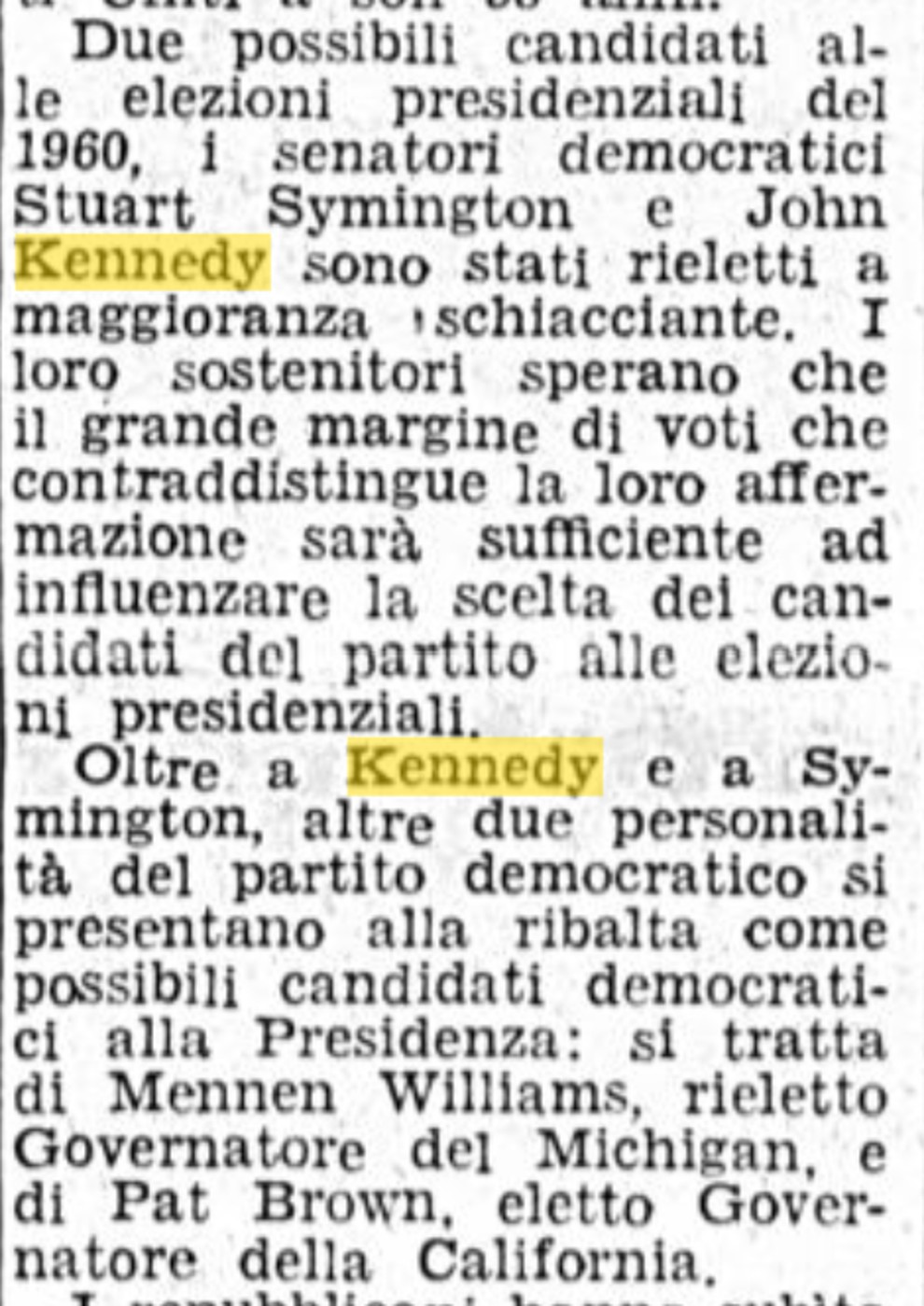
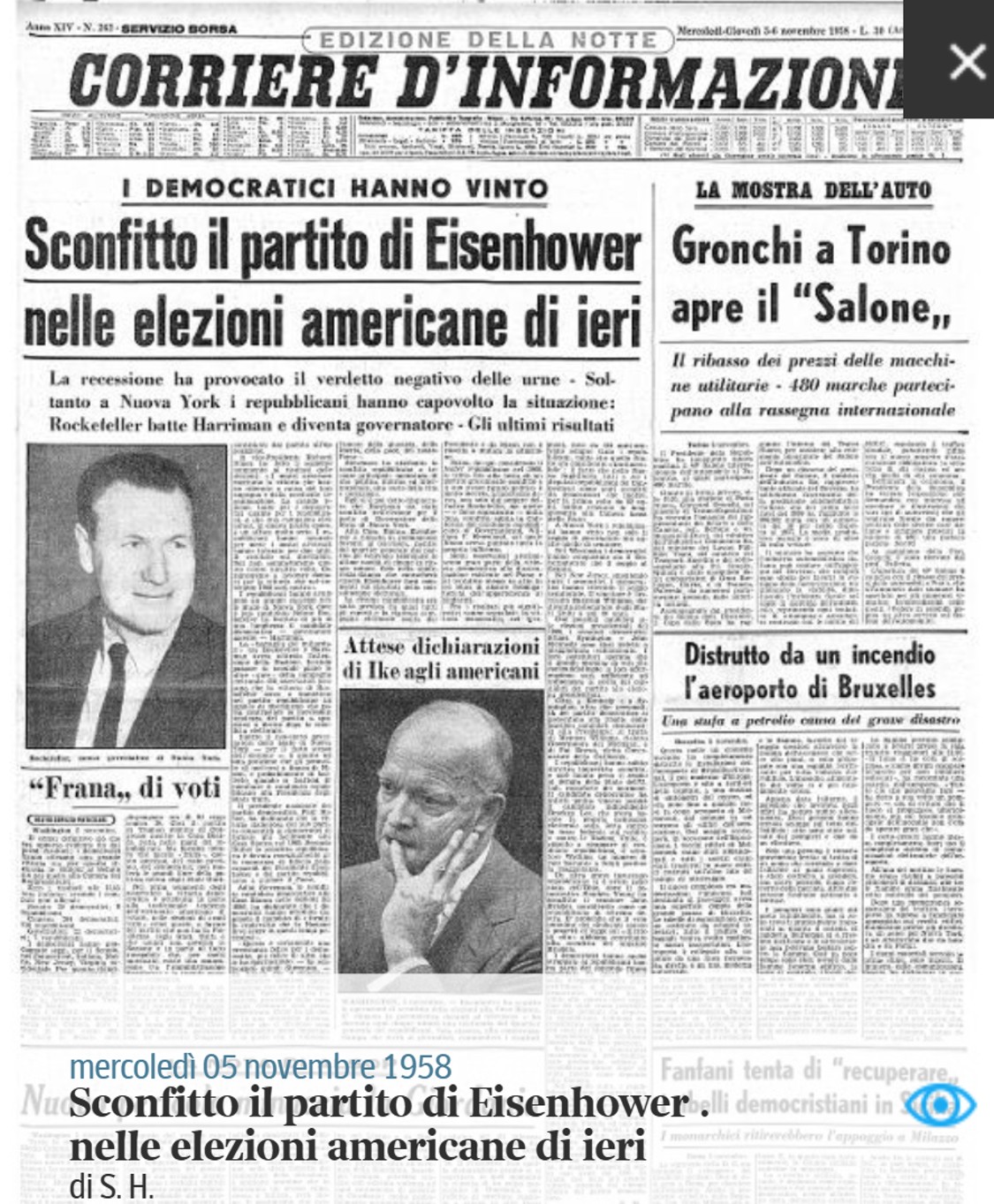
Copy
of a front-page article from the Italian daily newspaper *Corriere della
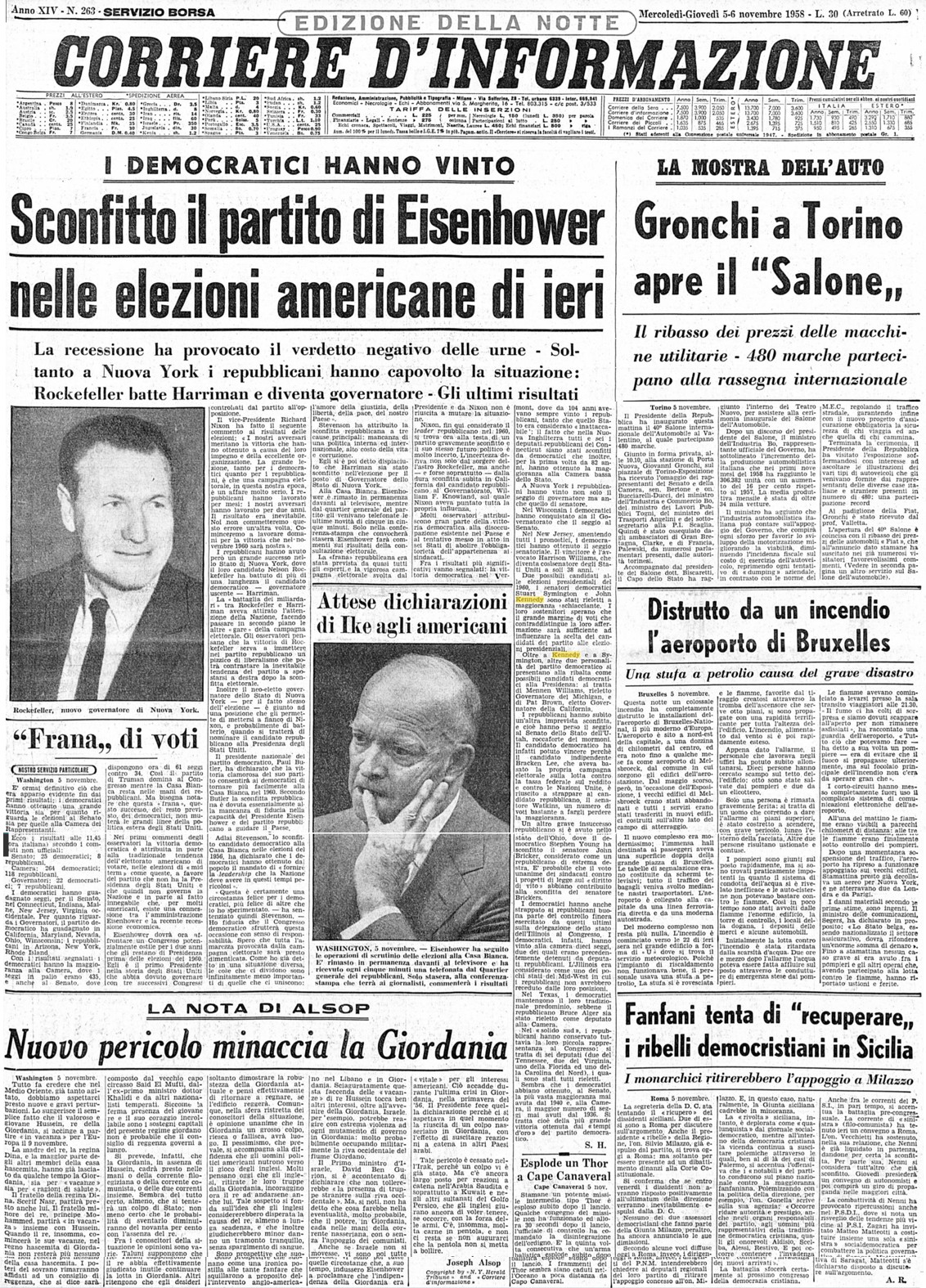
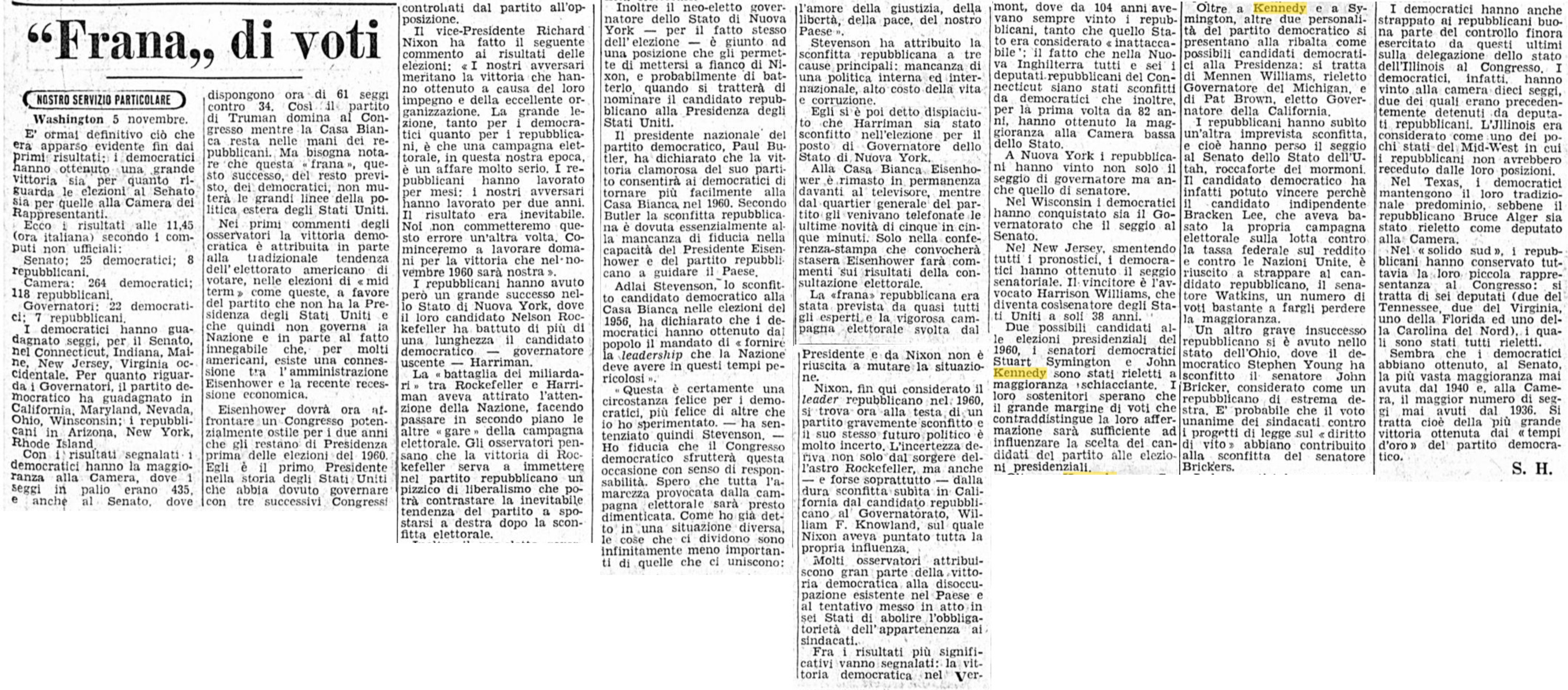
Sera* (night edition), Wednesday, November 5, 1958. Article by S.H.: "The Democrats Have Won: Eisenhower's Party Defeated in Yesterday's US Elections." Subheading: "Recession Drives Negative Verdict at the Polls. Republicans Buck the Trend Only in New York: Rockefeller Beats Harriman to Become Governor – Latest Results." An excerpt: "Here are the unofficial results: Senate: 25 Democrats and 8 Republicans. House: 264 Democrats and 118 Republicans. Governors: 22 Democrats and 7 Republicans. .... Eisenhower will now have to face a potentially hostile Congress for the remaining two years of his presidency. .... Two possible candidates for the 1960 presidential election—Democratic Senators Stuart Symington and John Kennedy—were re-elected by landslide margins. Their supporters hope that the wide margins of victory characterizing their success will be enough to influence the Democratic Party's choice of candidates for the presidential election." |
|
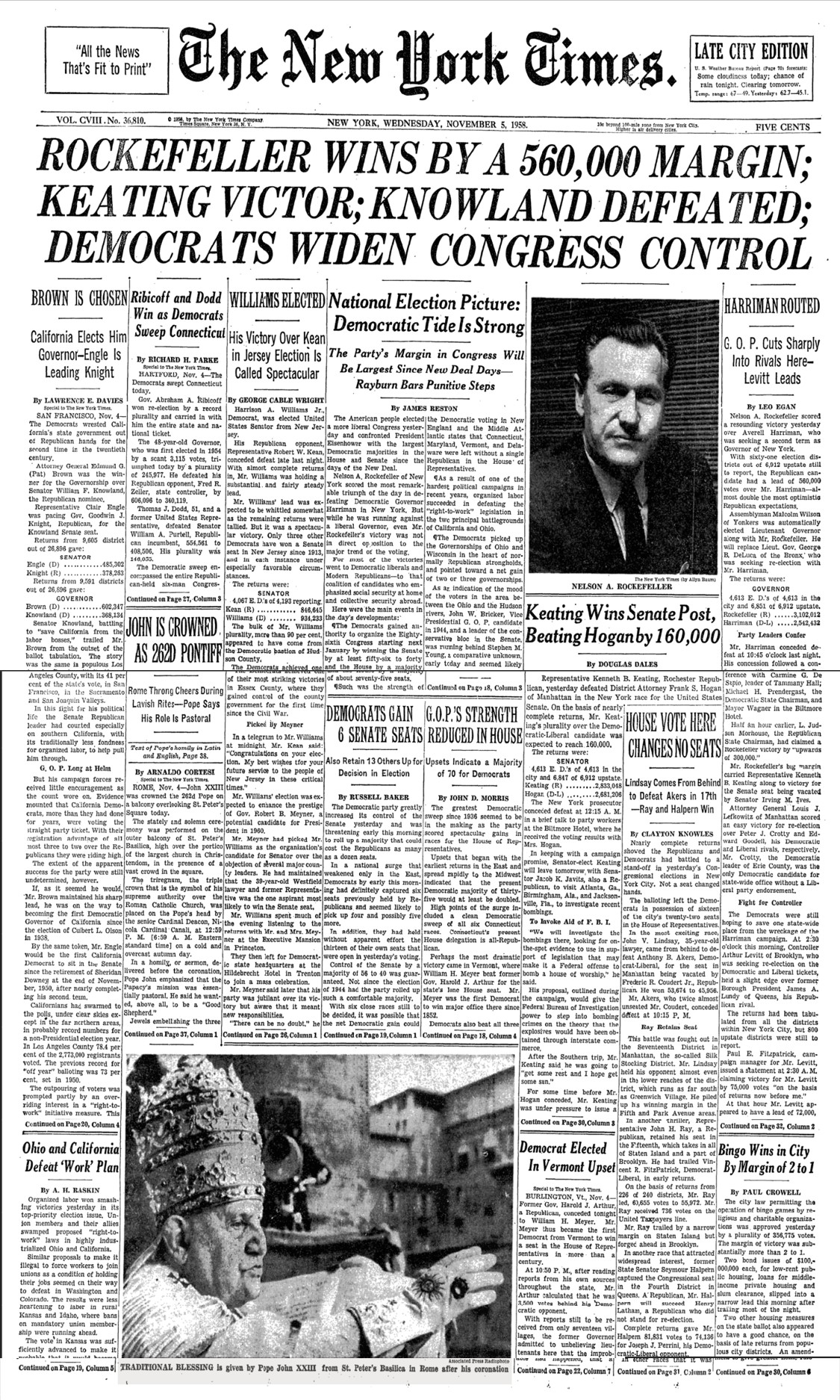
1958, November 5 - The New York Times |
||
|
|
|
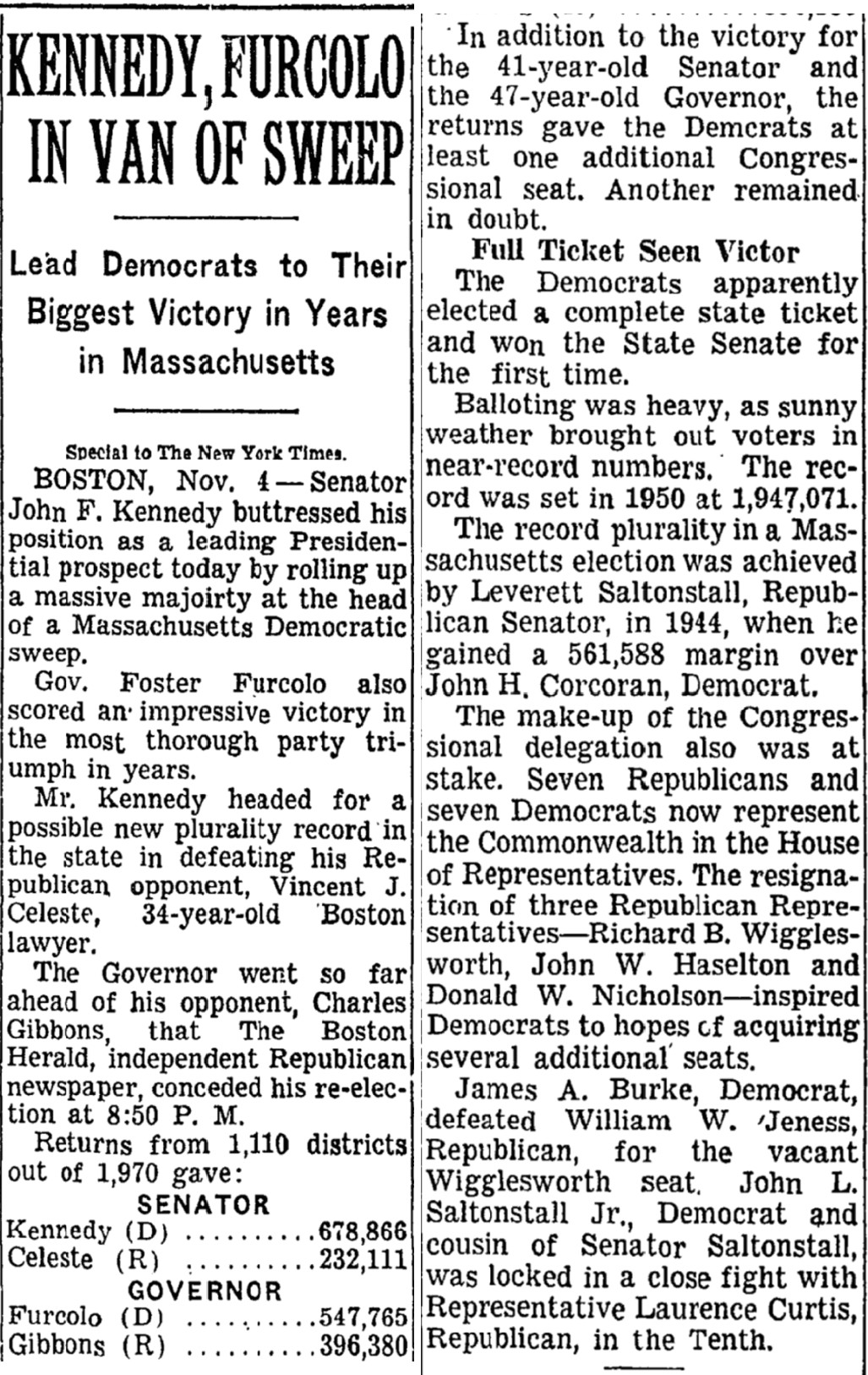
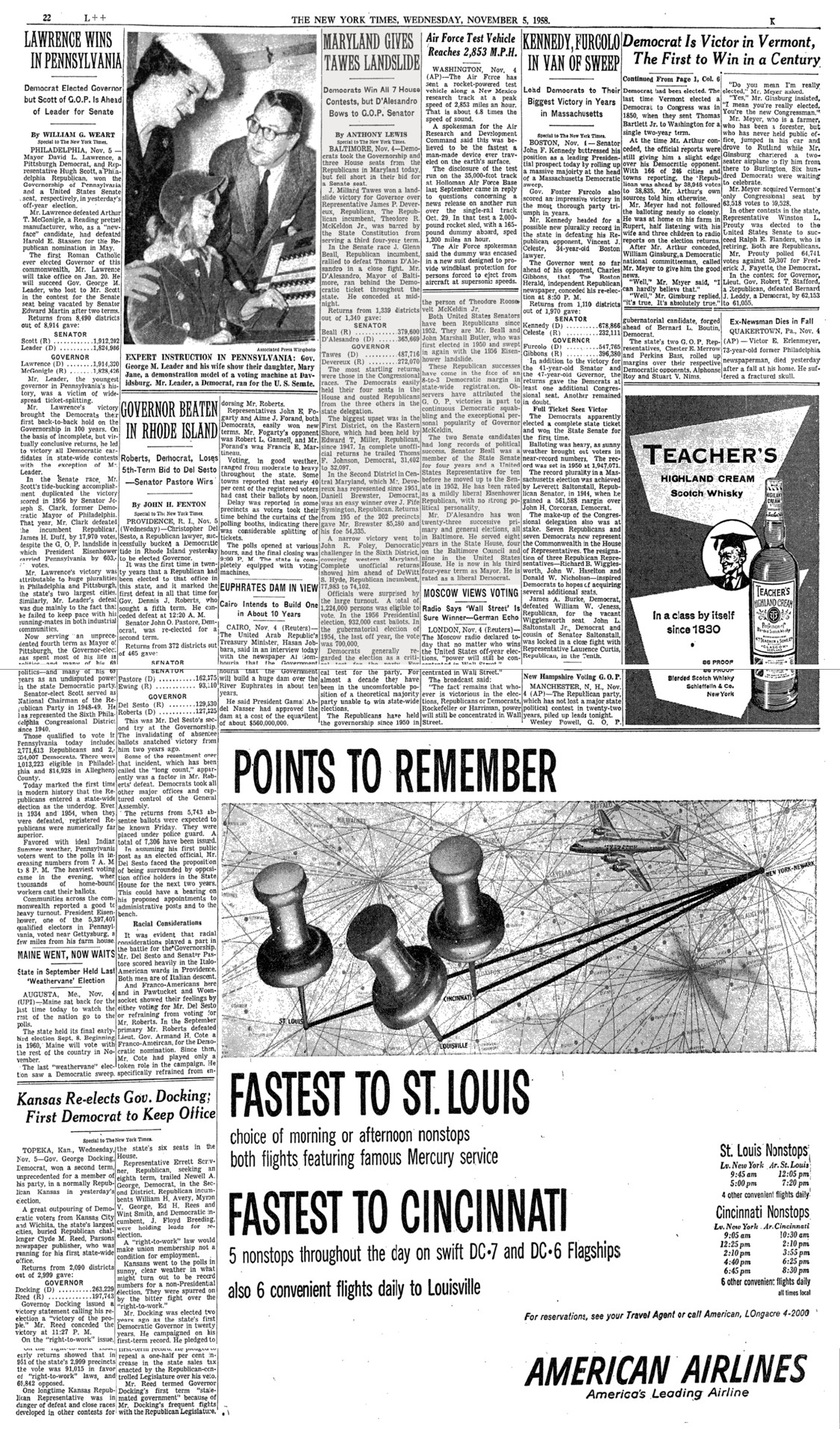
Copy
of an article from american newspaper THE NEW YORK TIMES on Tuesday,
November 5 1958. Article : ", Furcolo in van of sweep". Subtitle: "Lead democrats to their biggest victory in years in Massachusetts". An excerpt: "Senator John F.Kennedy buttressed his position as a leading Presidential prospect today by rolling up a massive majority at the head of a Massachusetts democratic sweep." |
|
1958, November 7 - Corriere della Sera |
||
|
|
|
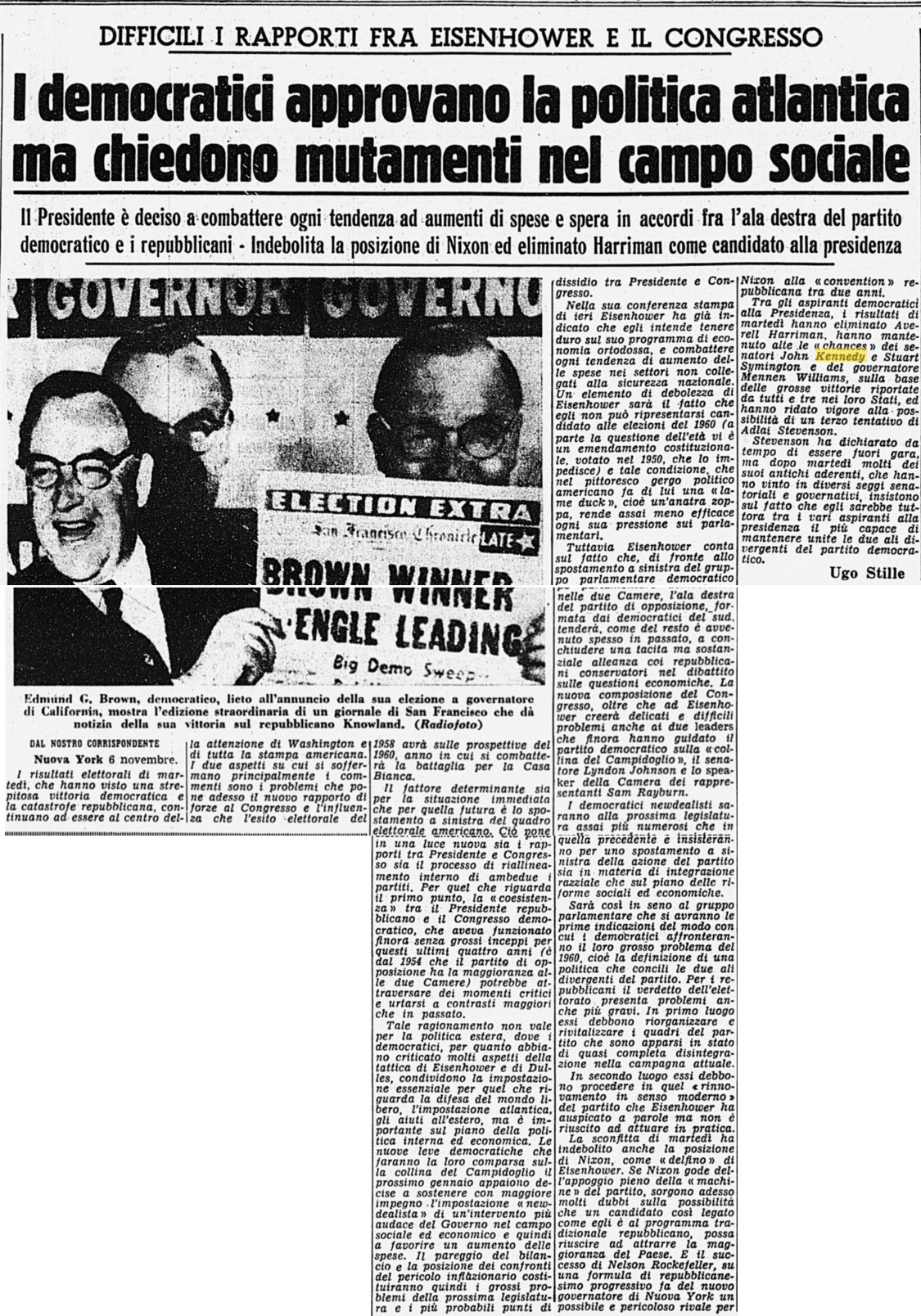
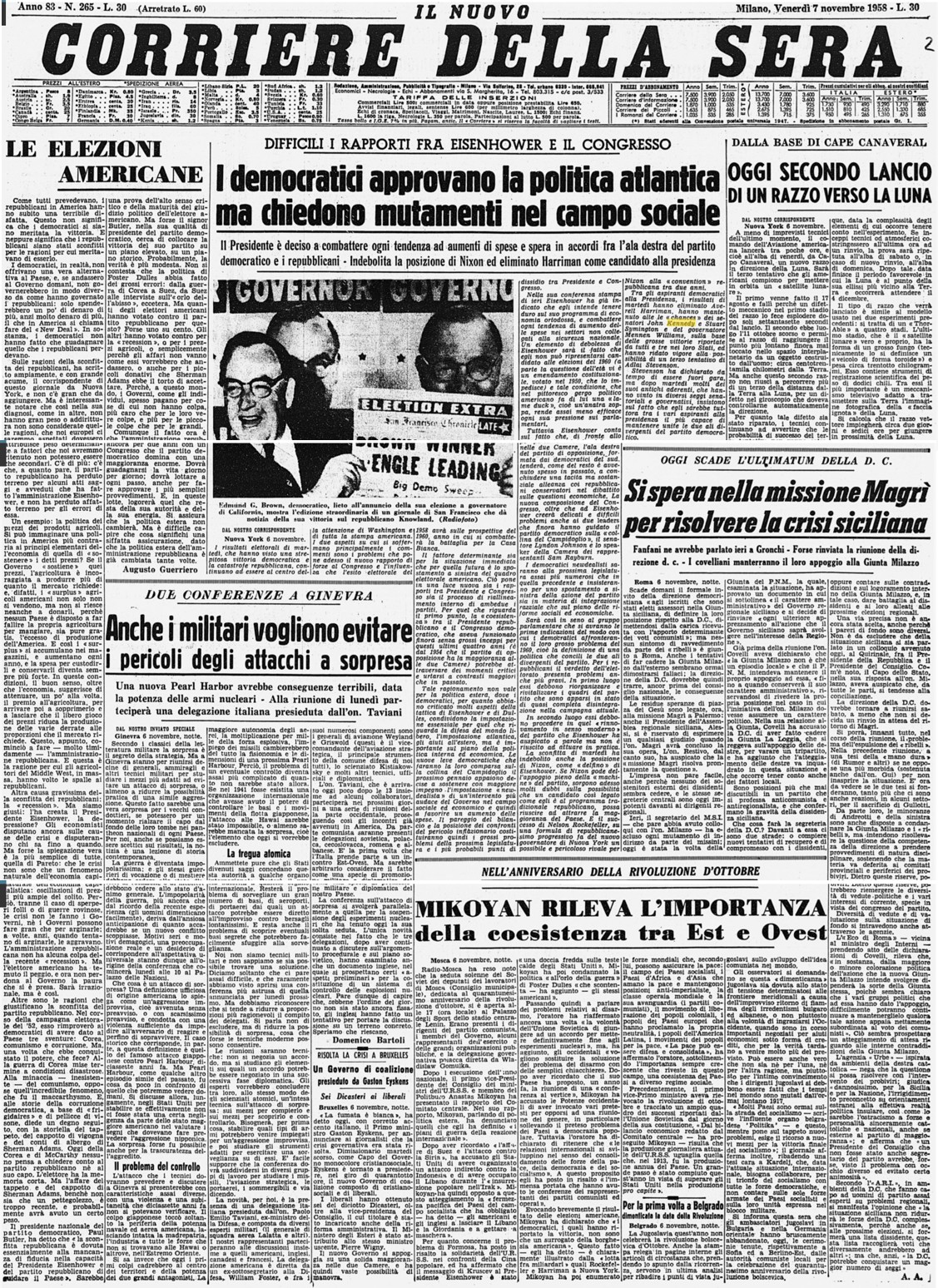
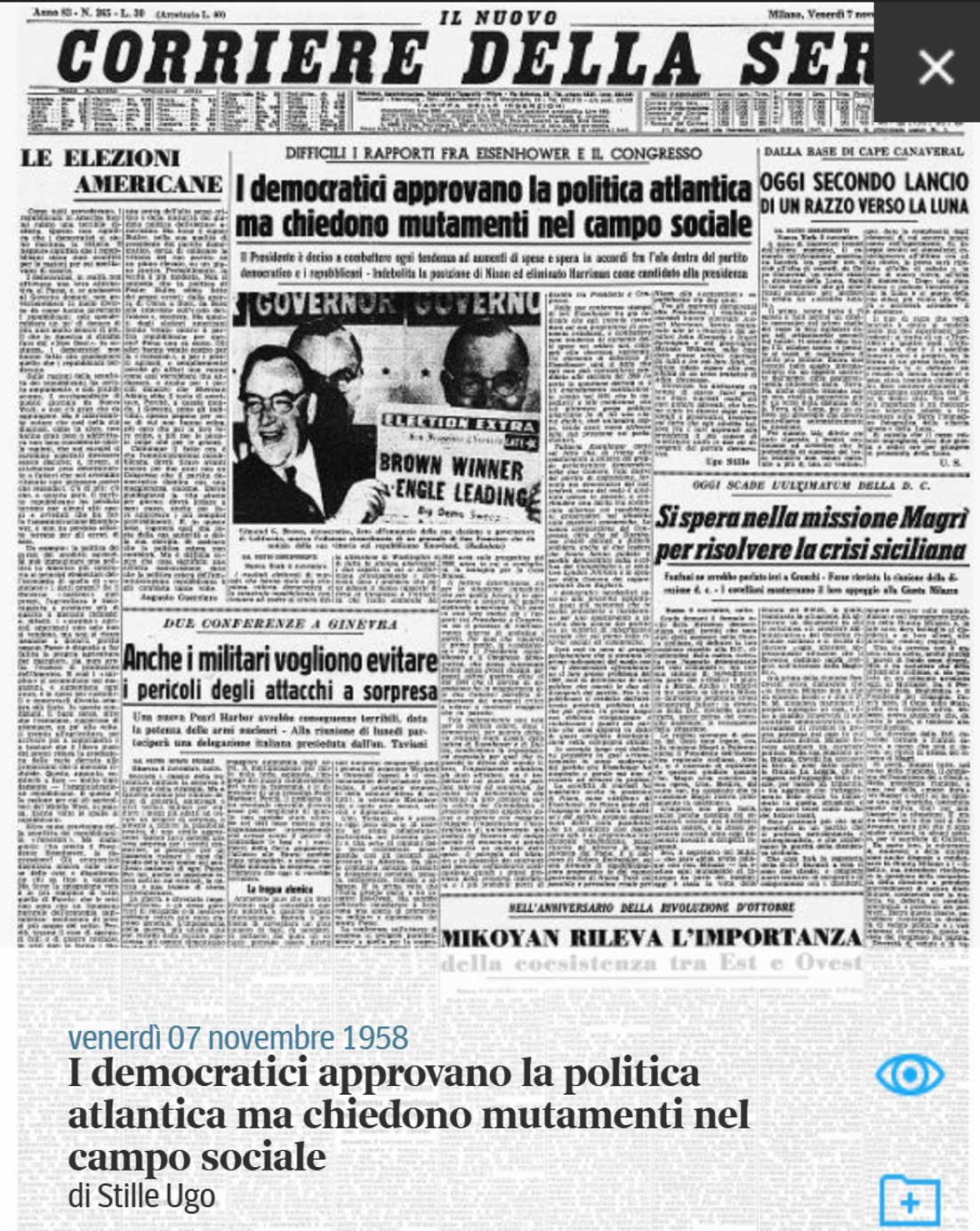
A
copy of a front-page article from the Italian daily newspaper *Corriere
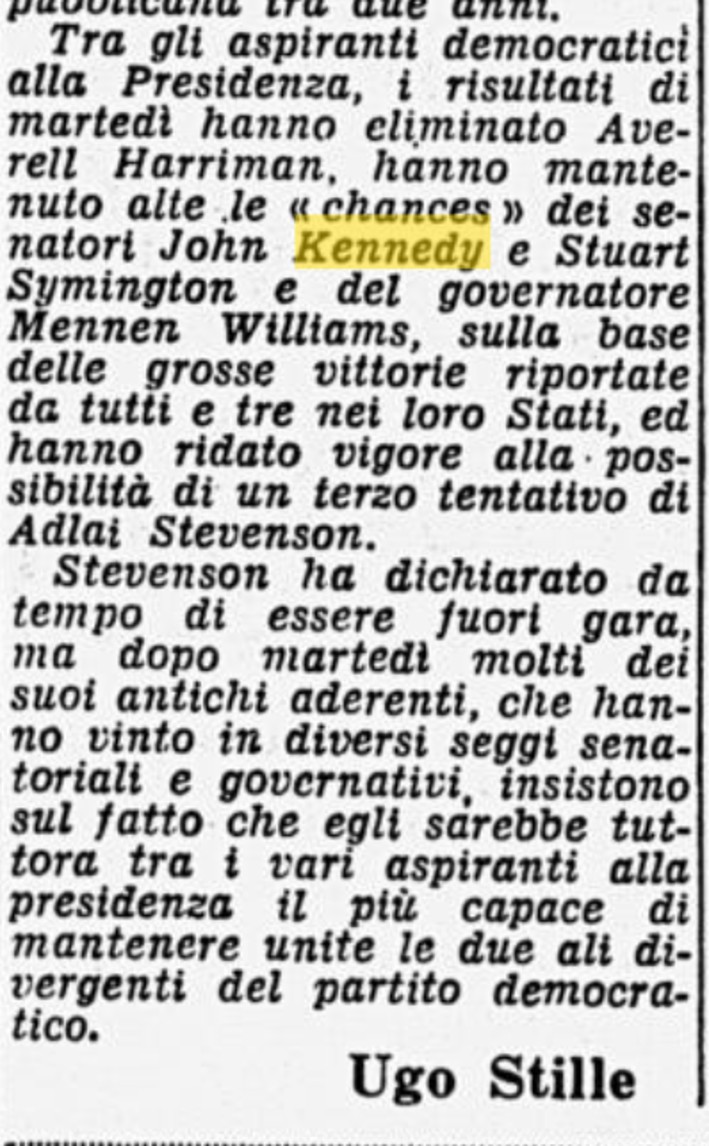
della Sera*, dated Friday, November 7, 1958. Article by Ugo Stille: "Difficult relations between Eisenhower and Congress: Democrats endorse Atlantic policy but call for changes in the social sphere." An excerpt: "Among the Democratic presidential hopefuls, Tuesday's results eliminated Averell Harriman; kept the prospects of Senators John Kennedy and Stuart Symington and Governor Mennen Williams high, based on the major victories all three secured in their respective states; and revitalized the possibility of a third bid by Adlai Stevenson." |
|
1958, November 13 - Corriere della Sera |
||
|
|
|
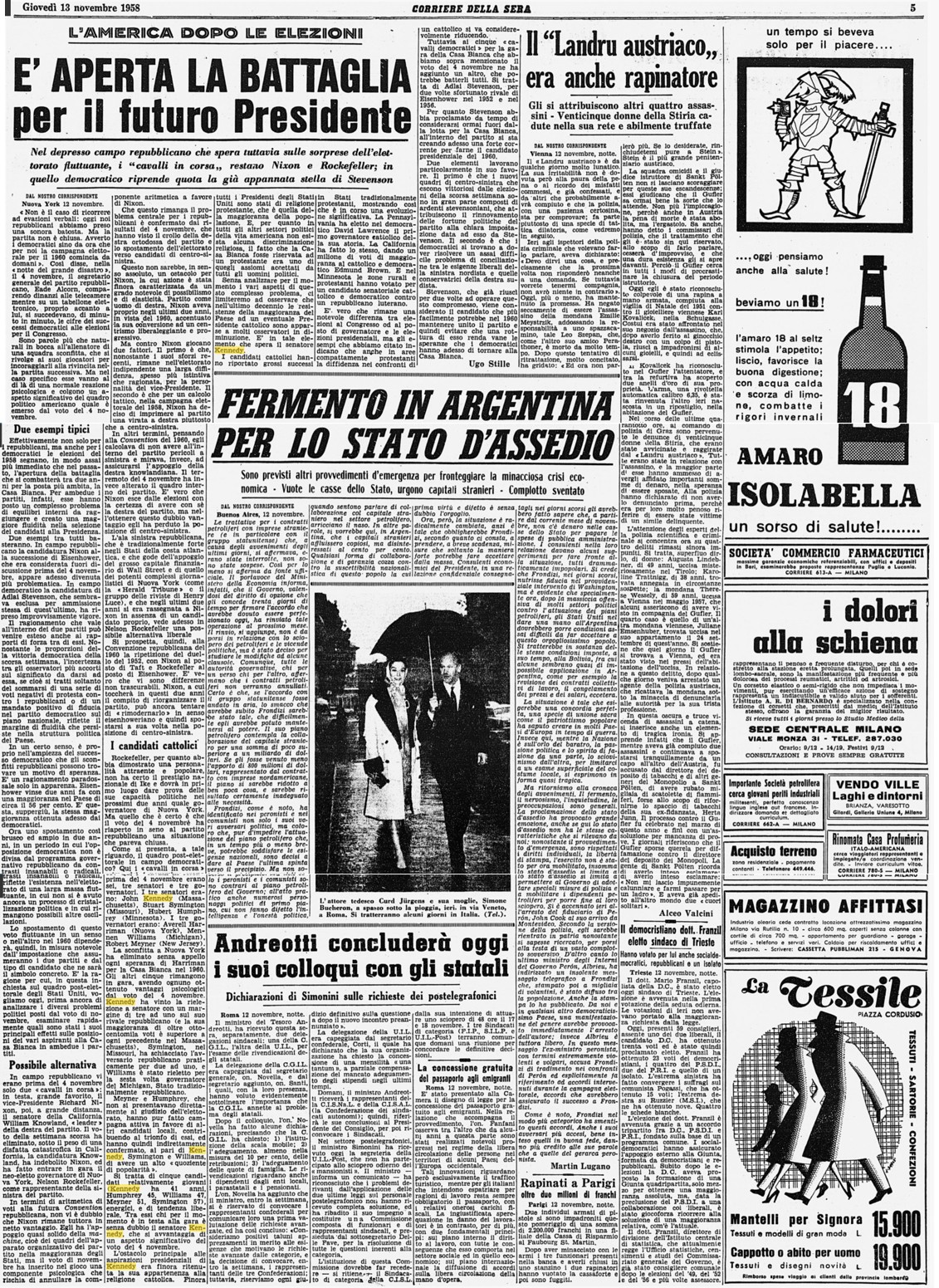
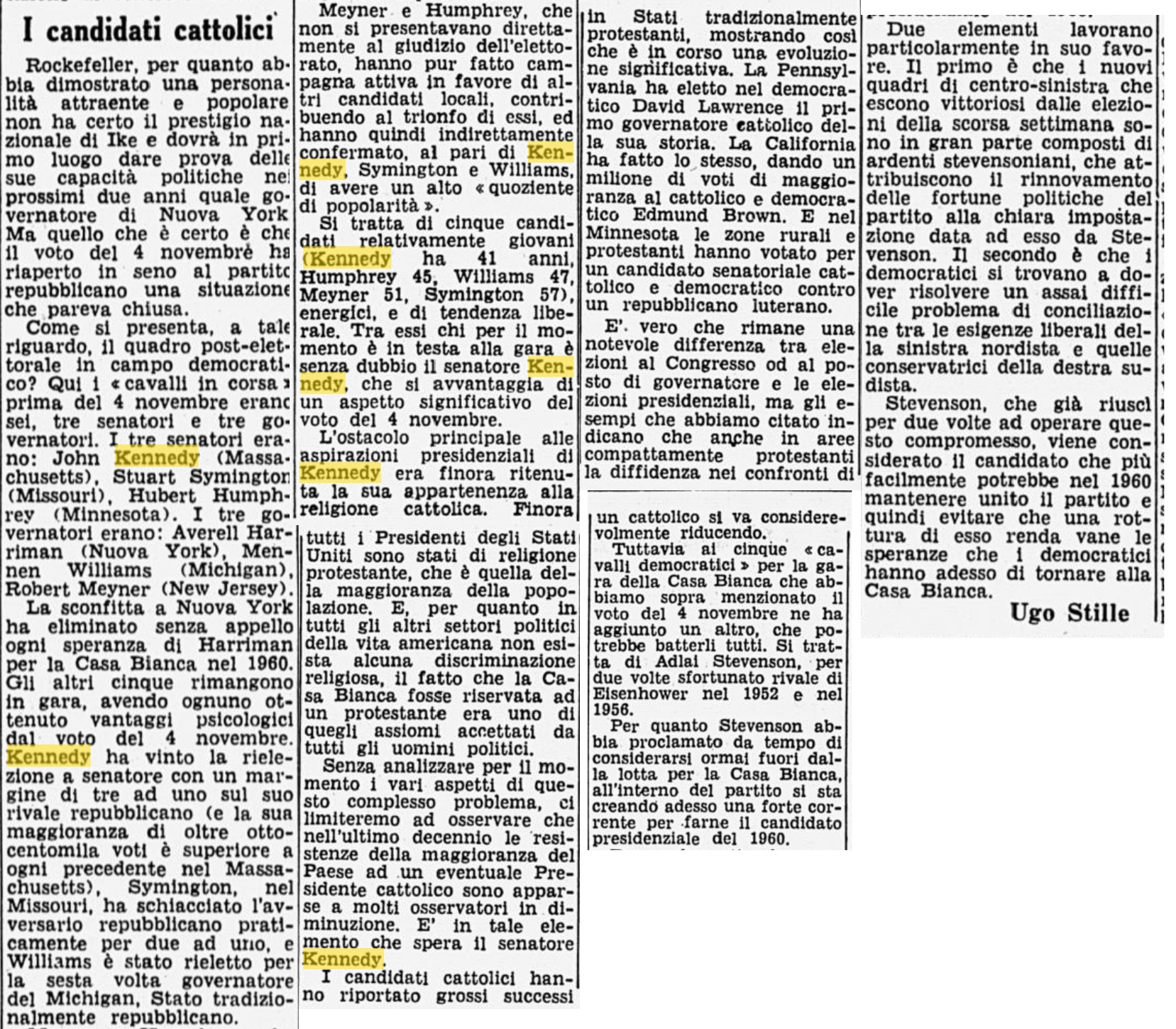
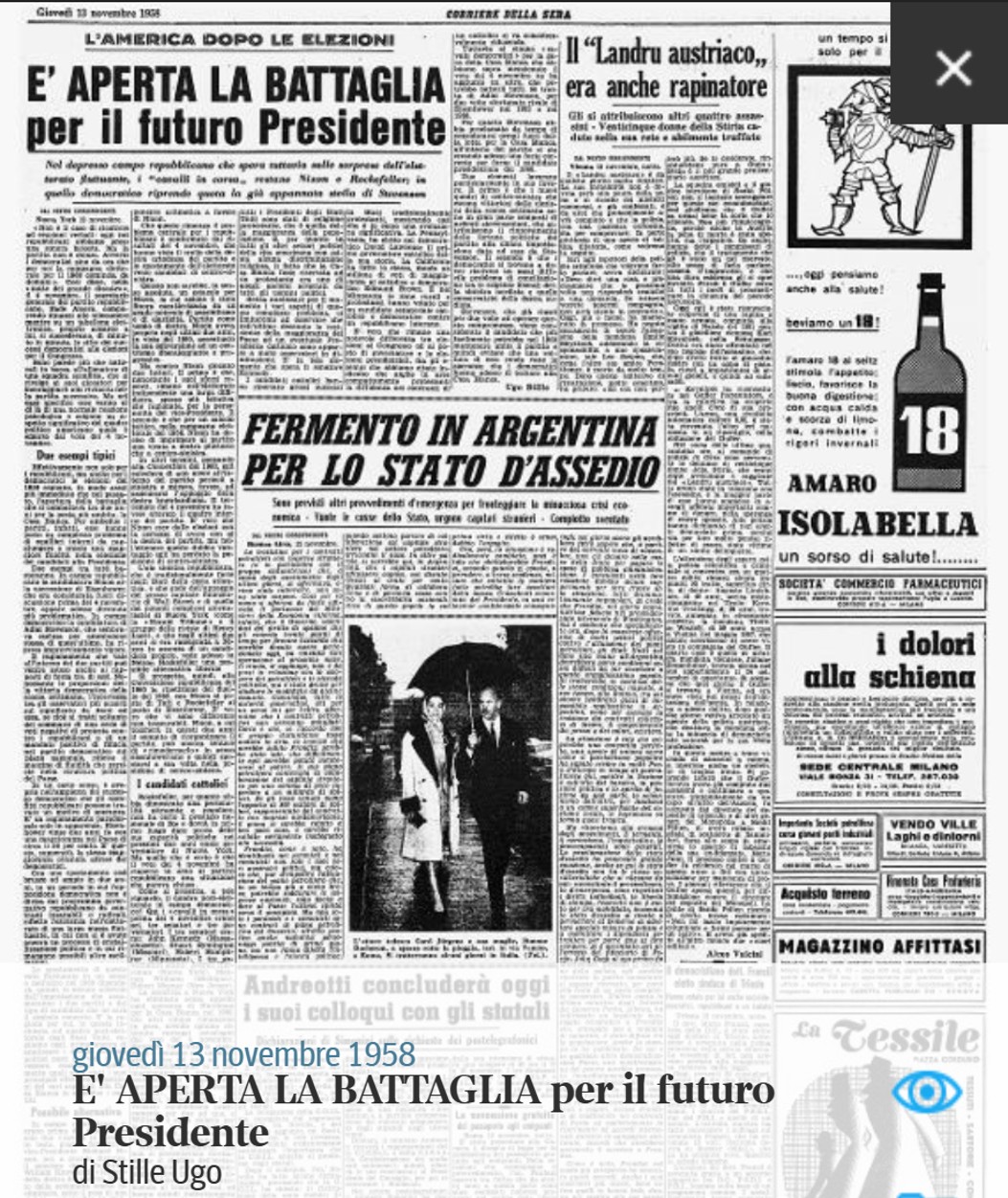
Copy
of an article from the Italian daily newspaper *Corriere della Sera*,
dated Thursday, November 13, 1958. Article by Ugo Stille: "America After the Elections: The Battle for the Future President Is Underway." An excerpt: "What does the post-election landscape look like for the Democrats? There were six 'horses in the race' prior to November 4: three senators and three governors. The three senators were: John Kennedy (Massachusetts), Stuart Symington (Missouri), and Hubert Humphrey (Minnesota). The three governors were: Averell Harriman (New York), Mennen Williams (Michigan), and Robert Meyner (New Jersey). ... Kennedy won re-election to the Senate by a 3-to-1 margin over his Republican rival (and his majority of over eight hundred thousand votes surpasses any previous record in Massachusetts)." |







Back to Top Back to Biagio's
J.F.Kennedy Home Page


Biagio Privitera's
Home Page. You can contact me at
biagio@biagioprivitera.it