
|
E - My Newspapers&Magazines related to JFK & KENNEDY Family |
| Items 1 - 50 | ||
|
1938, February 7 - Corriere della Sera |
||
|
|
|
Copy of an article from
the Italian daily newspaper *Corriere della Sera*, dated Monday, February
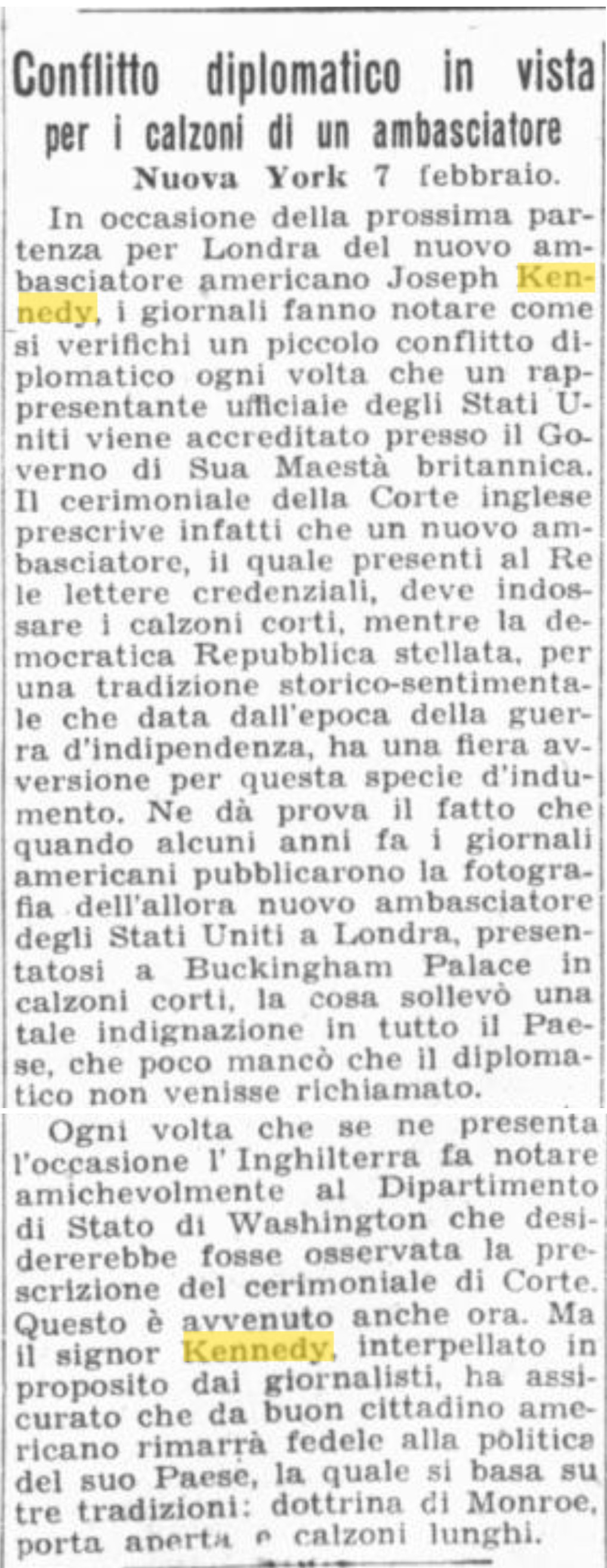
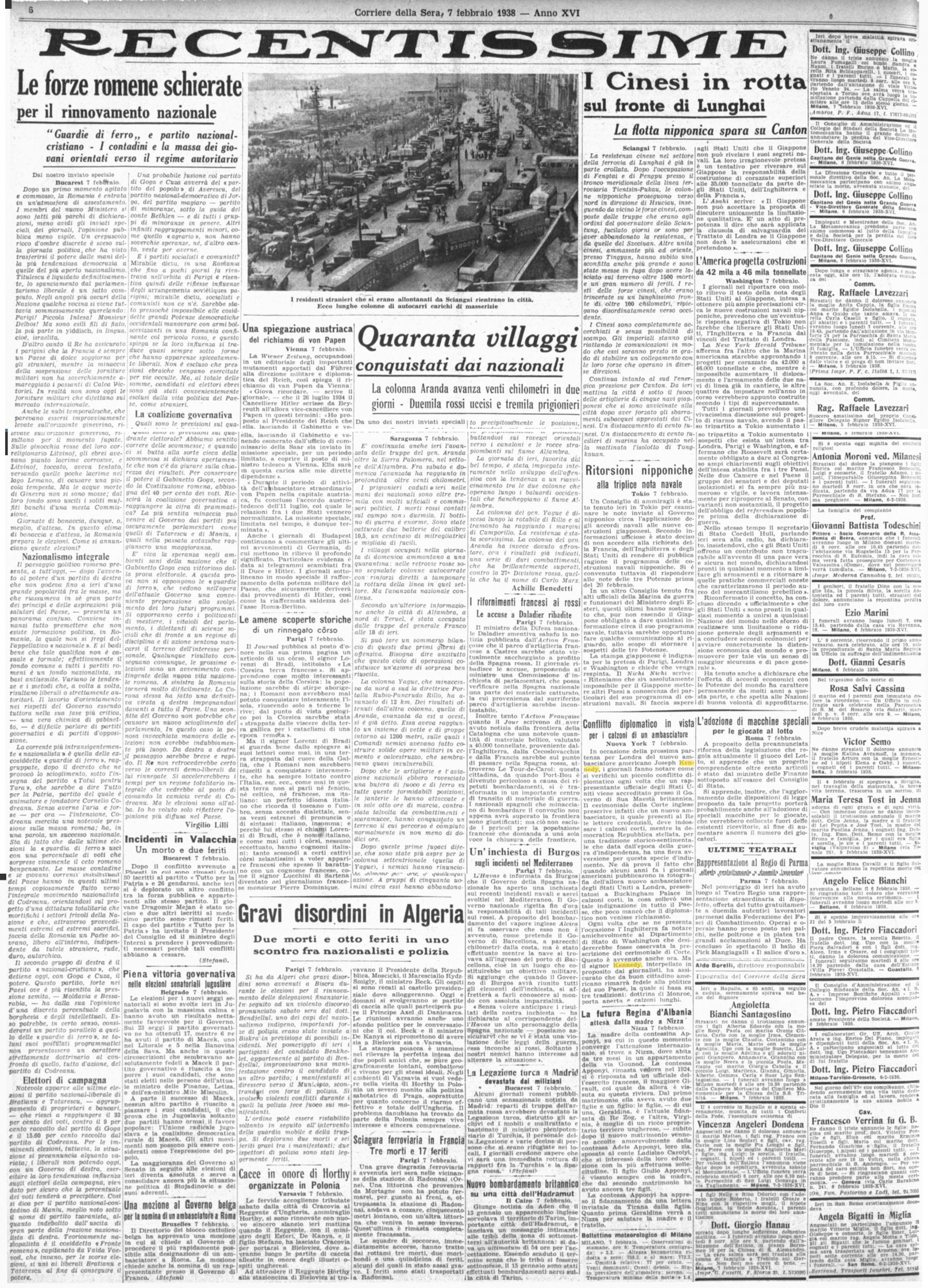
7, 1938. Article: "Diplomatic conflict looming over an ambassador's trousers." The article reports on the departure for London of the new American ambassador, Joseph Kennedy (father of the future President JFK). Excerpt: "Mr. Kennedy assured that, as a good American citizen, he would remain faithful to his country's policy, which is based on three traditions: the Monroe Doctrine, the Open Door, and long trousers." |
|
1938, February 24 - Corriere della Sera |
||
|
|
|
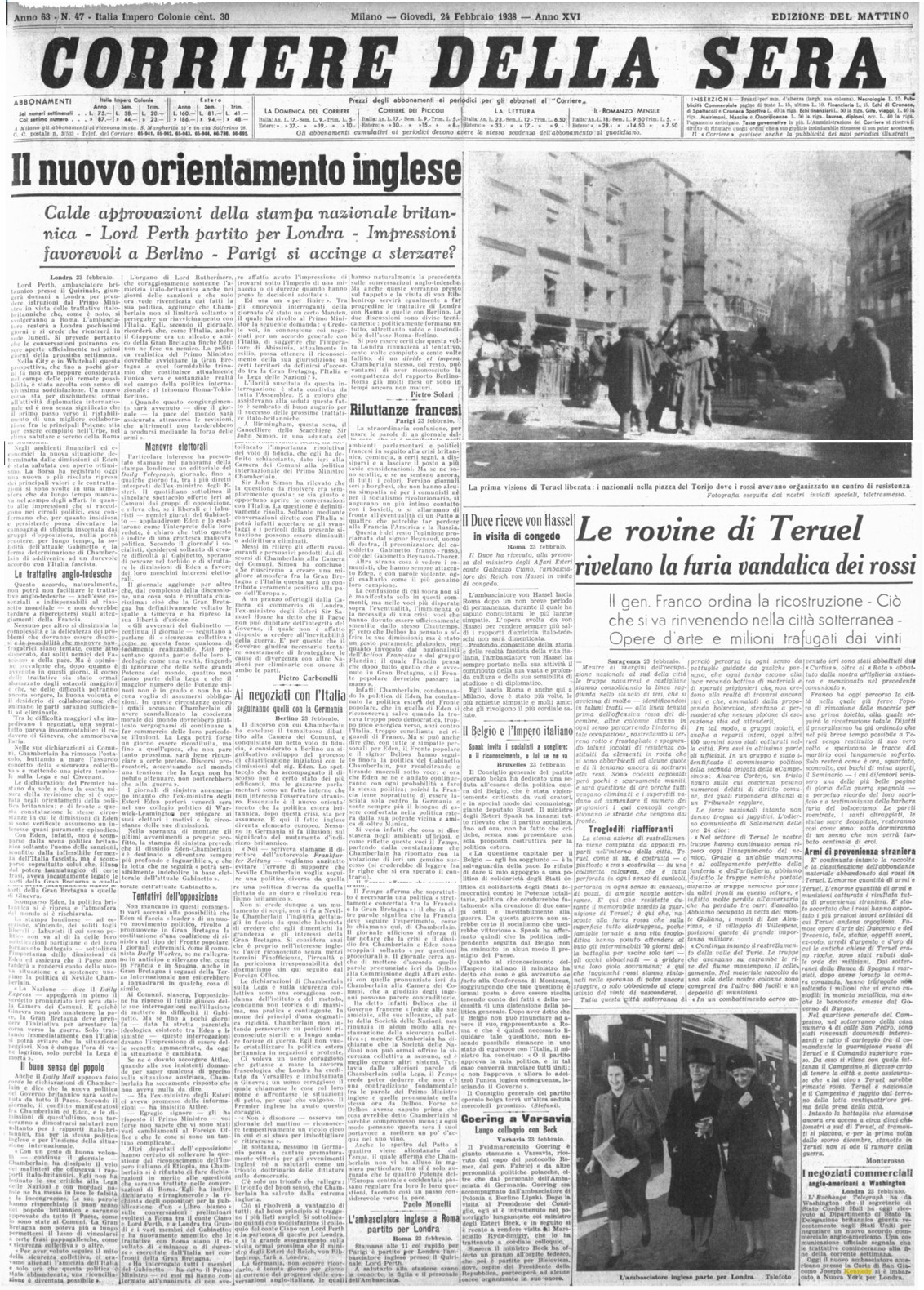
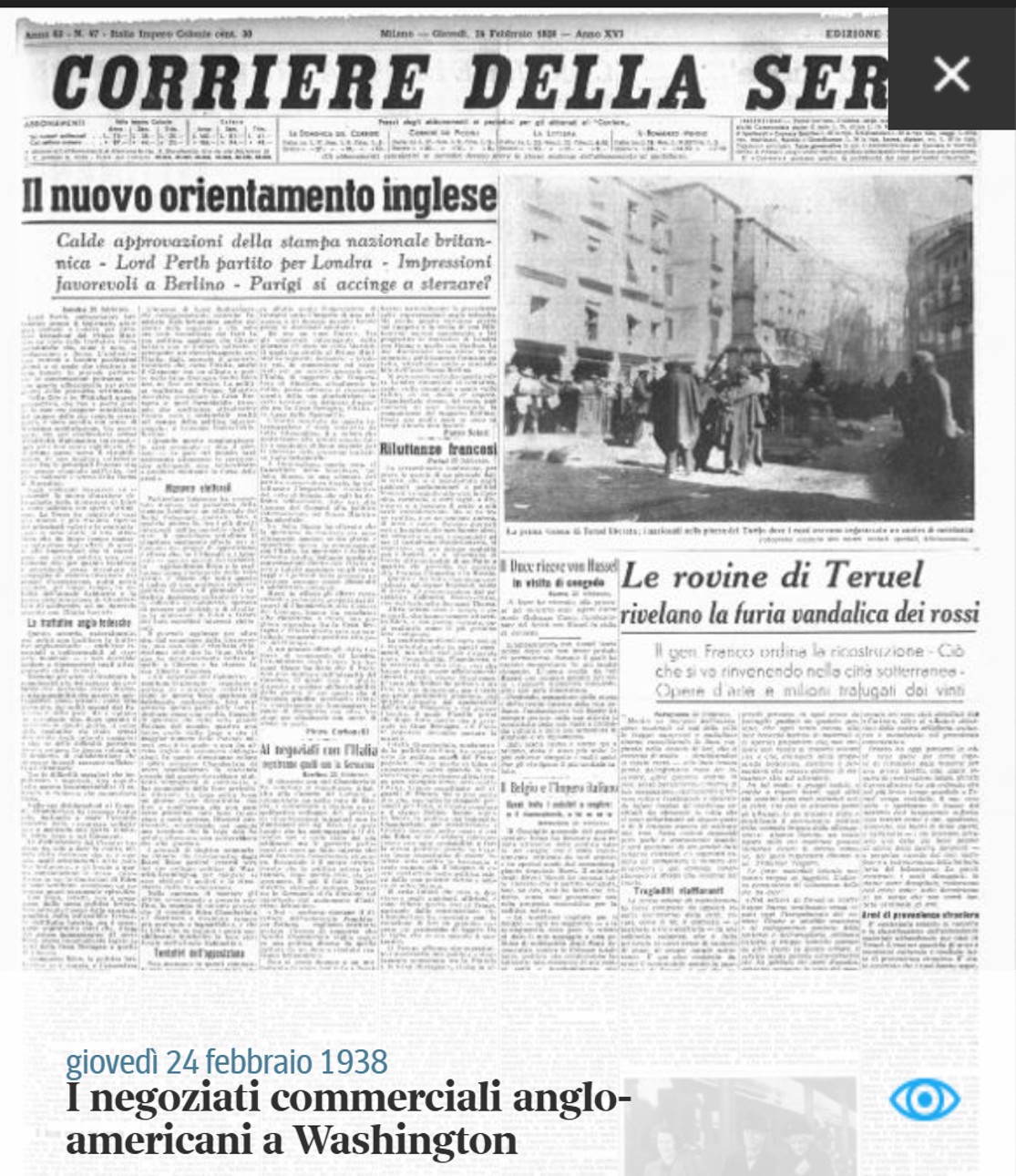
Copy of an article
from the Italian daily newspaper *Corriere della Sera*, dated Thursday,
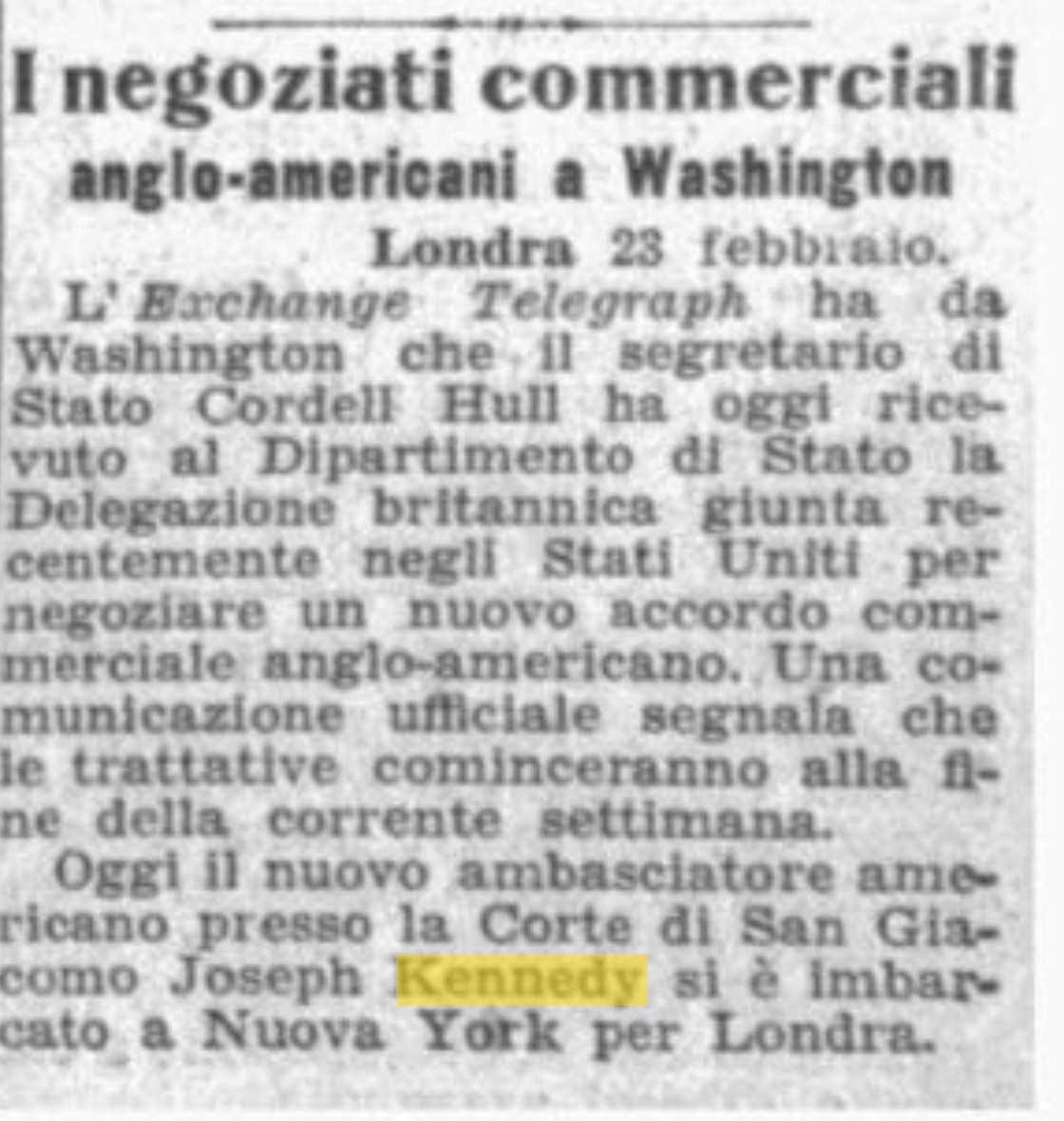
February 24, 1938. Article: "Anglo-American trade negotiations in Washington." Excerpt: "The new American Ambassador to the Court of St. James's, Joseph Kennedy, has embarked from New York for London." |
|
1938, March 9 - Corriere della Sera |
||
|
|
|
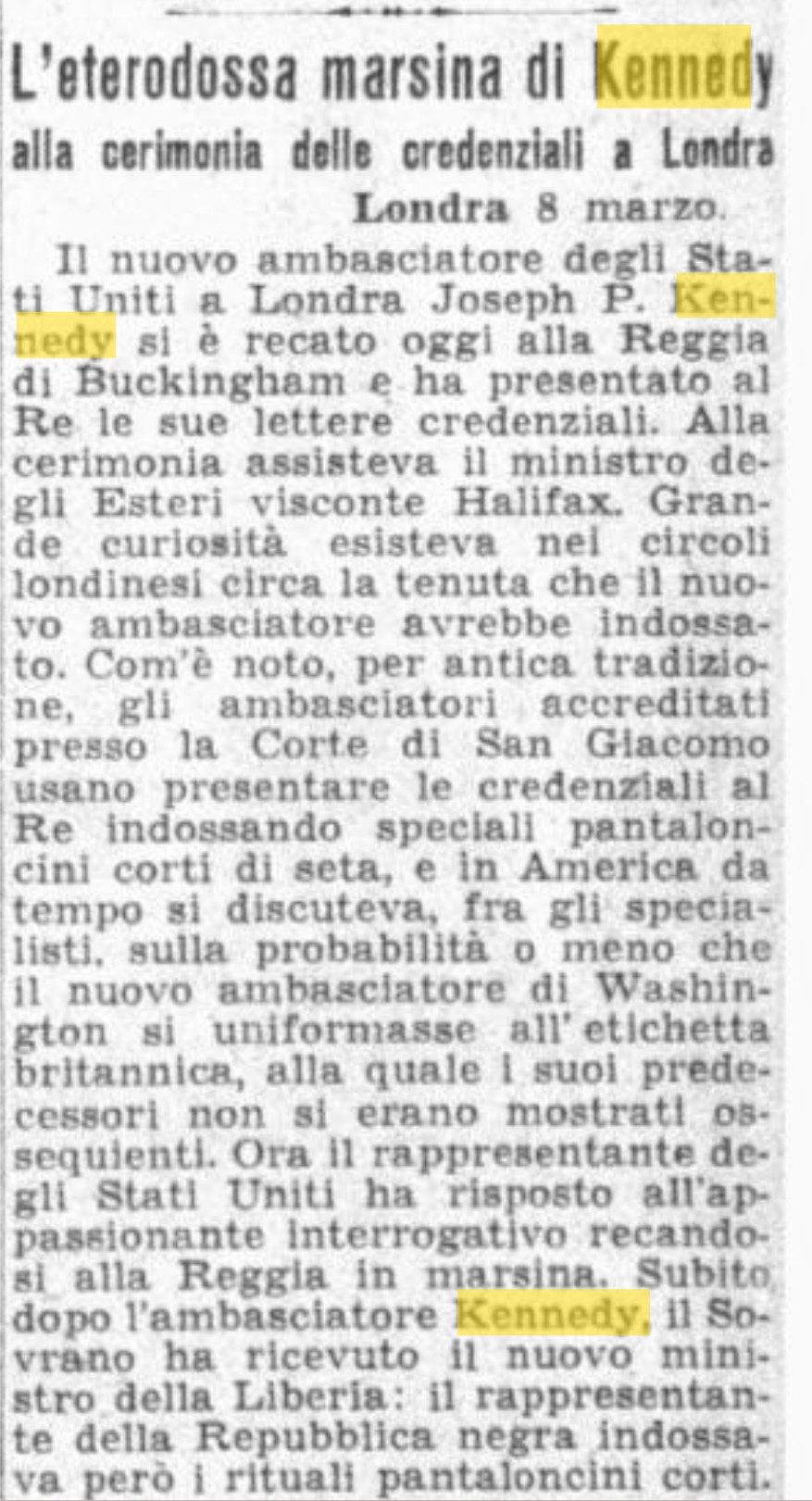
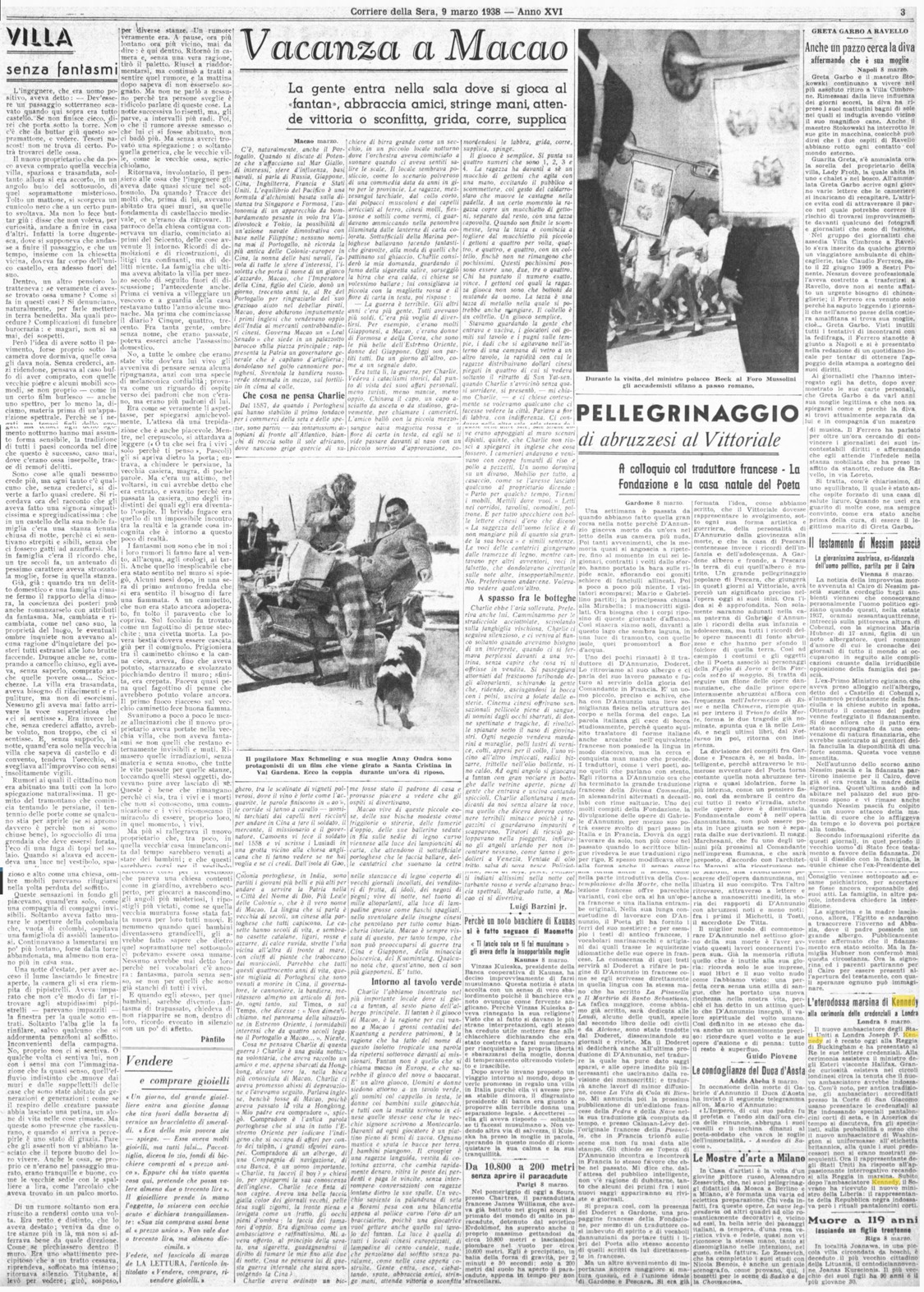
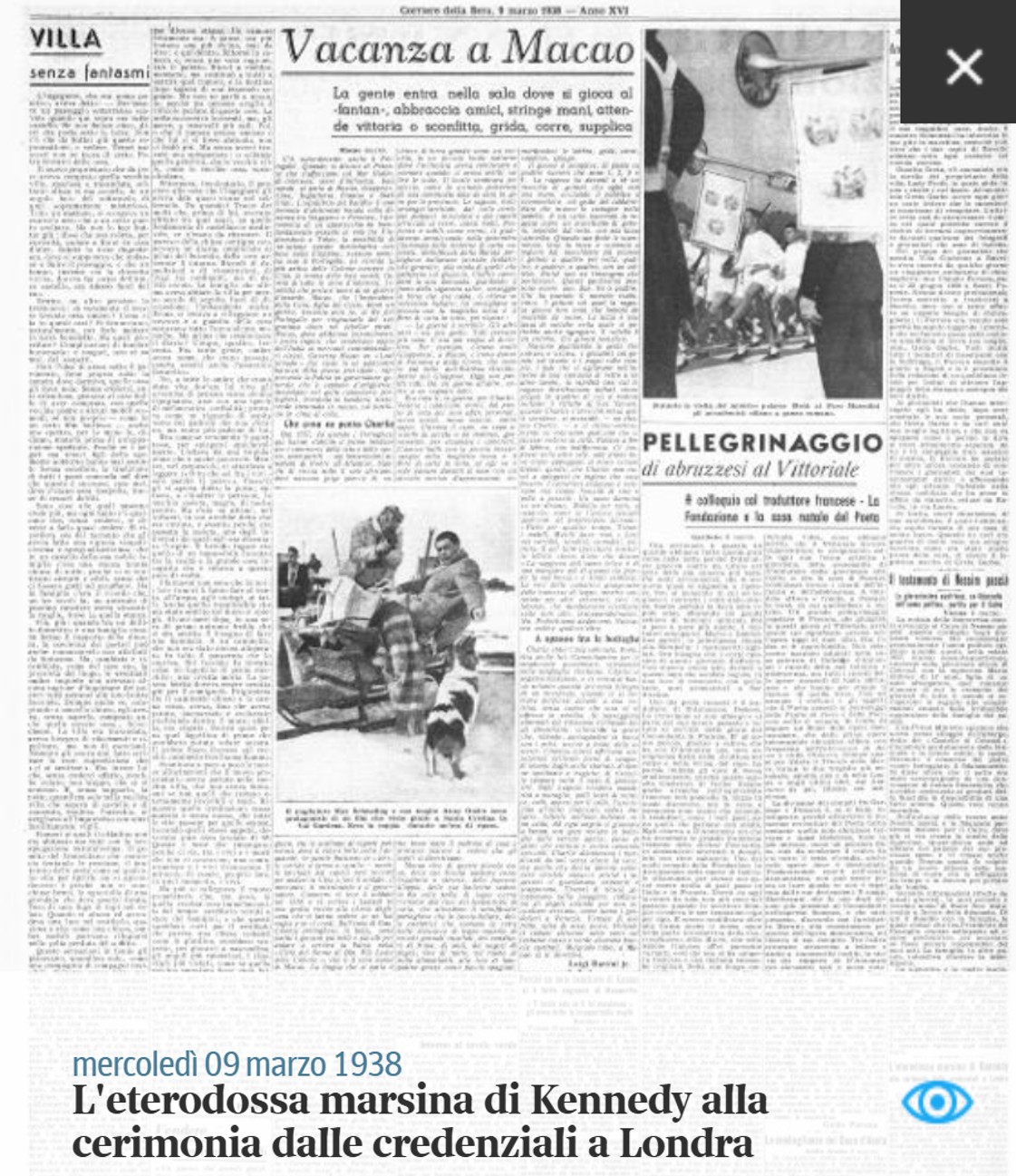
A copy of an article
from the Italian daily newspaper *Corriere della Sera*, dated Wednesday,
March 9, 1938. Article: "Kennedy's Unconventional Tailcoat at the Presentation of Credentials in London." When Joseph P. Kennedy was appointed United States Ambassador to the Court of St. James's in 1938, he flatly refused to wear the traditional court breeches for the formal presentation of his credentials to King George VI. Deeming knee-length breeches outdated and unbefitting the image of a representative of the American Republic, Kennedy secured permission to appear in an elegant tailcoat (*frac*) with long trousers (Morning/Formal Dress with tailcoat). His decision marked a significant turning point, leading to the permanent abandonment of the requirement for foreign diplomats in London to wear breeches. |
|
1938, March 19 - Corriere della Sera |
||
|
|
|
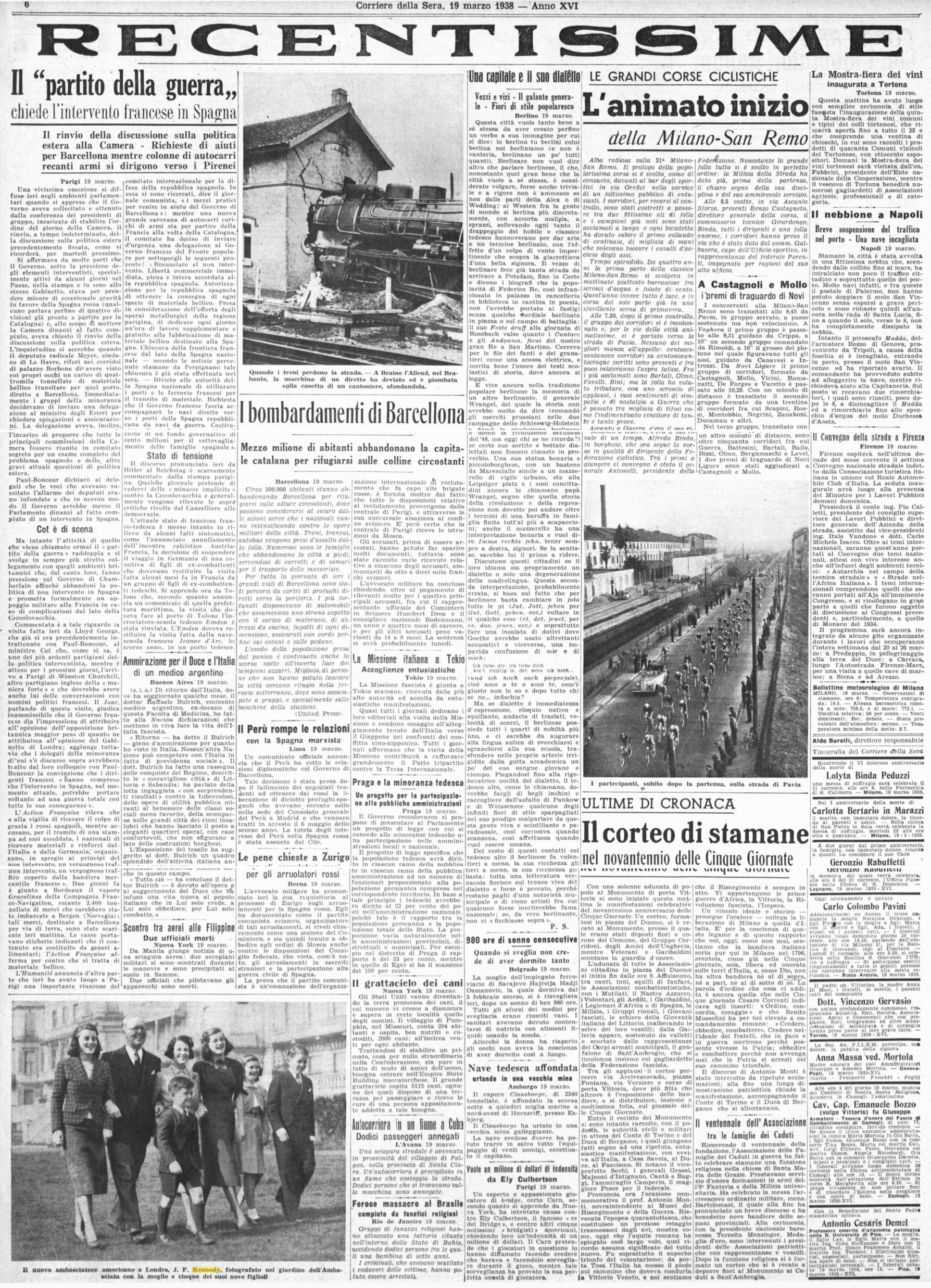
Copy of an article
from the Italian daily newspaper *Corriere della Sera*, dated Saturday,
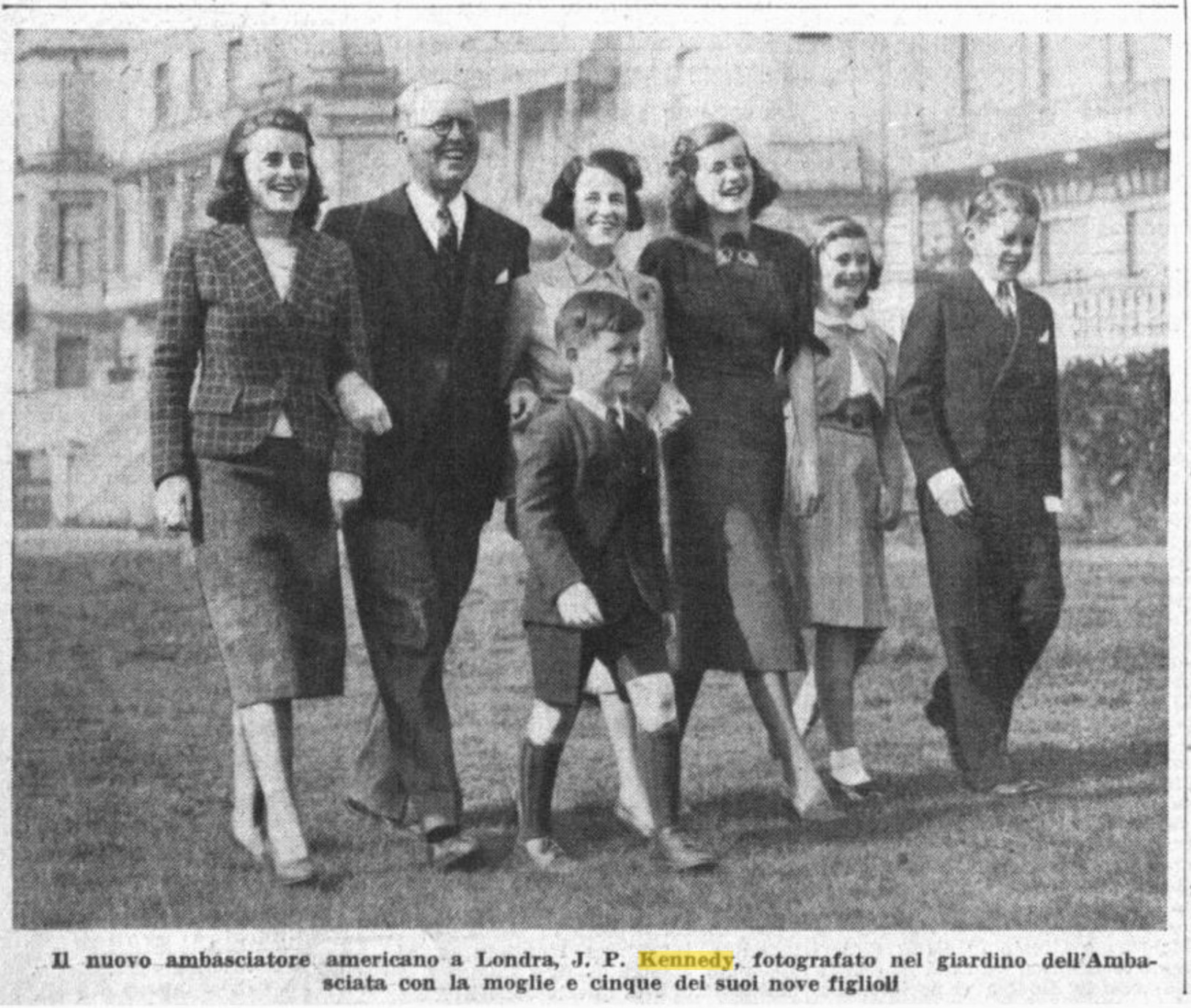
March 19, 1938. Photograph of the new American ambassador to London, J.P. Kennedy, pictured in the embassy garden with his wife and five of his nine children. In the photo, from left to right: Kathleen Kennedy Joseph P. Kennedy Sr. (the father/ambassador) Rose Fitzgerald Kennedy (the mother) Edward Kennedy (front, center) Patricia Kennedy Jean Kennedy Robert Kennedy (The other four children—Joseph Jr., John F., Rosemary, and Eunice—were still in the United States at the time the photo was taken.) |
|
1938, April 16 - Corriere della Sera |
||
|
|
|
Copy of an article
from the Italian daily newspaper *Corriere della Sera*, dated Saturday,
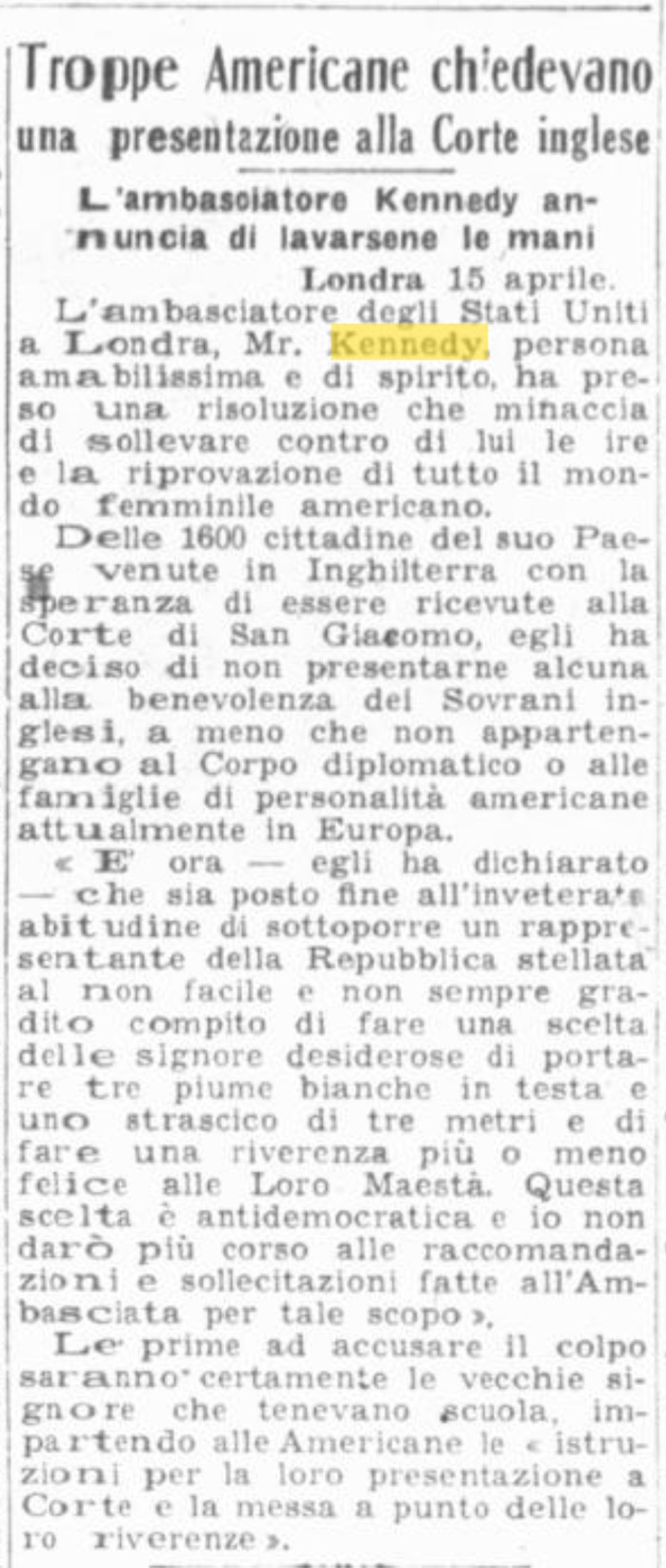
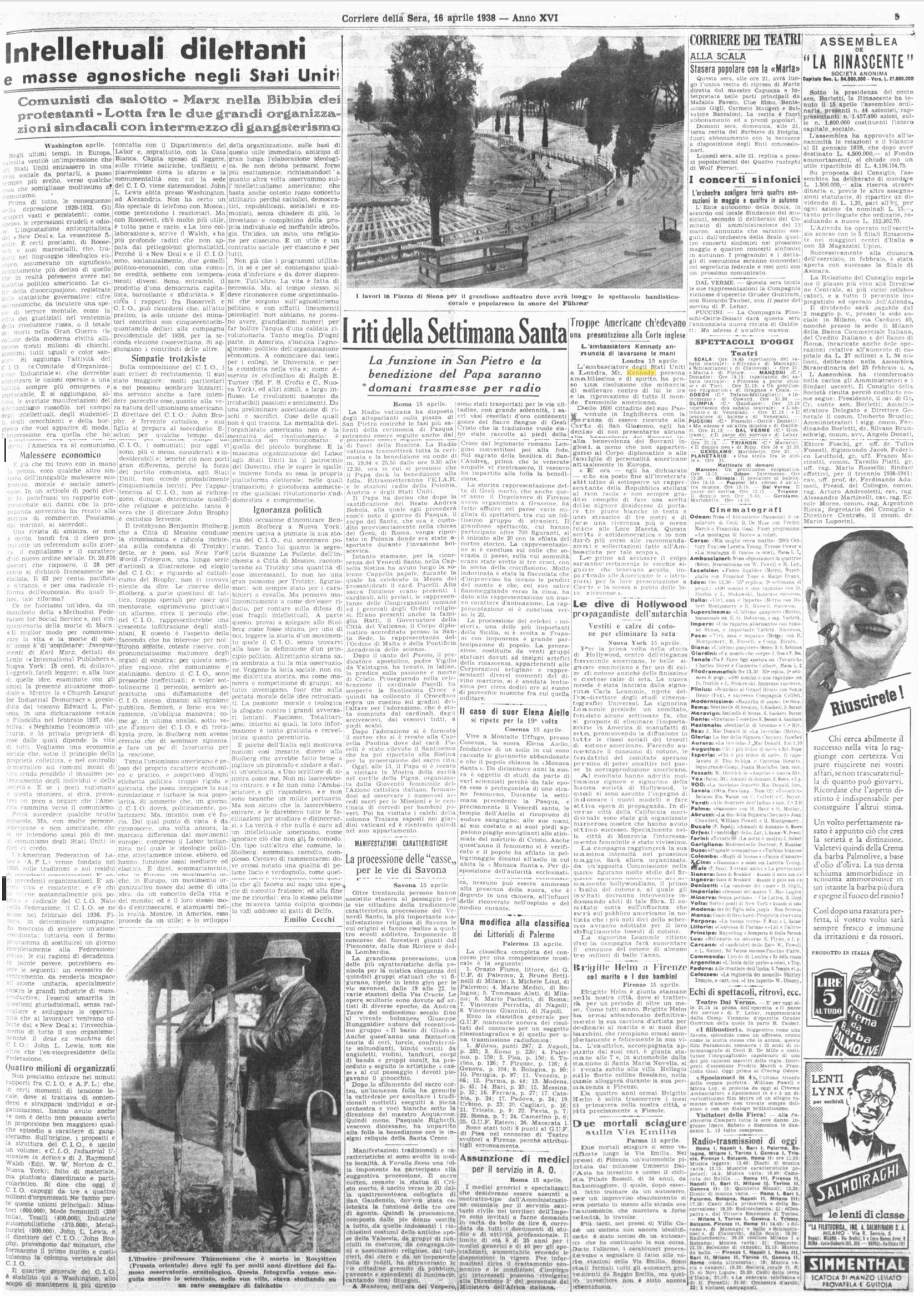
April 16, 1938. Article headline: "Too many American women were asking for a presentation at the English Court; Ambassador Kennedy announces he is washing his hands of the matter." The U.S. Ambassador to London, Joseph P. Kennedy, has decided to stop presenting American women at the English Court of St. James's, with the exception of members of the diplomatic corps or the families of prominent Americans visiting Europe. Faced with approximately 1,600 requests, Kennedy described this selection process as "undemocratic" and unwelcome, announcing that the Embassy would no longer entertain such appeals, thereby putting an end to the practice. |
|
1938, July 1 - Corriere della Sera |
||
|
|
|
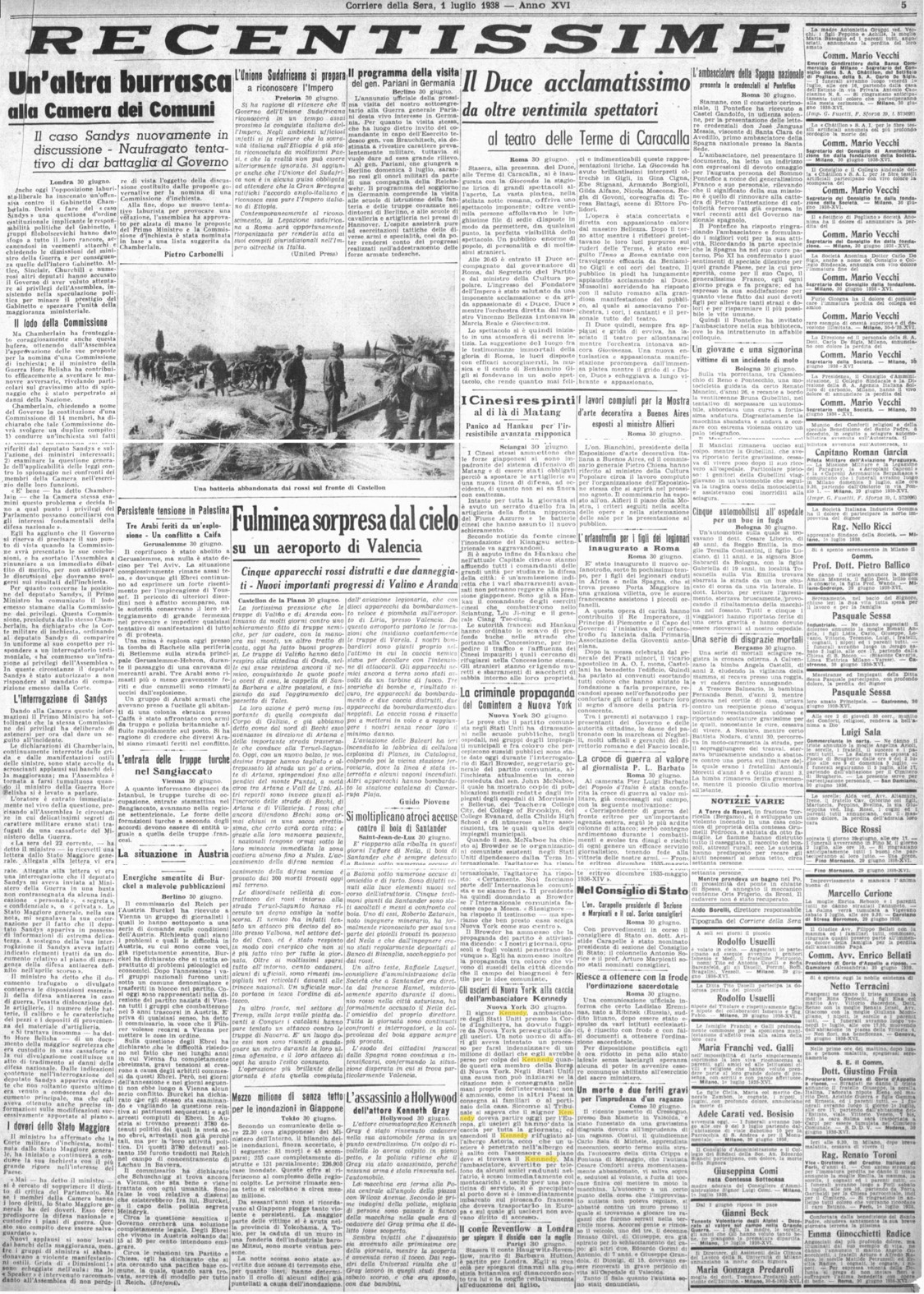
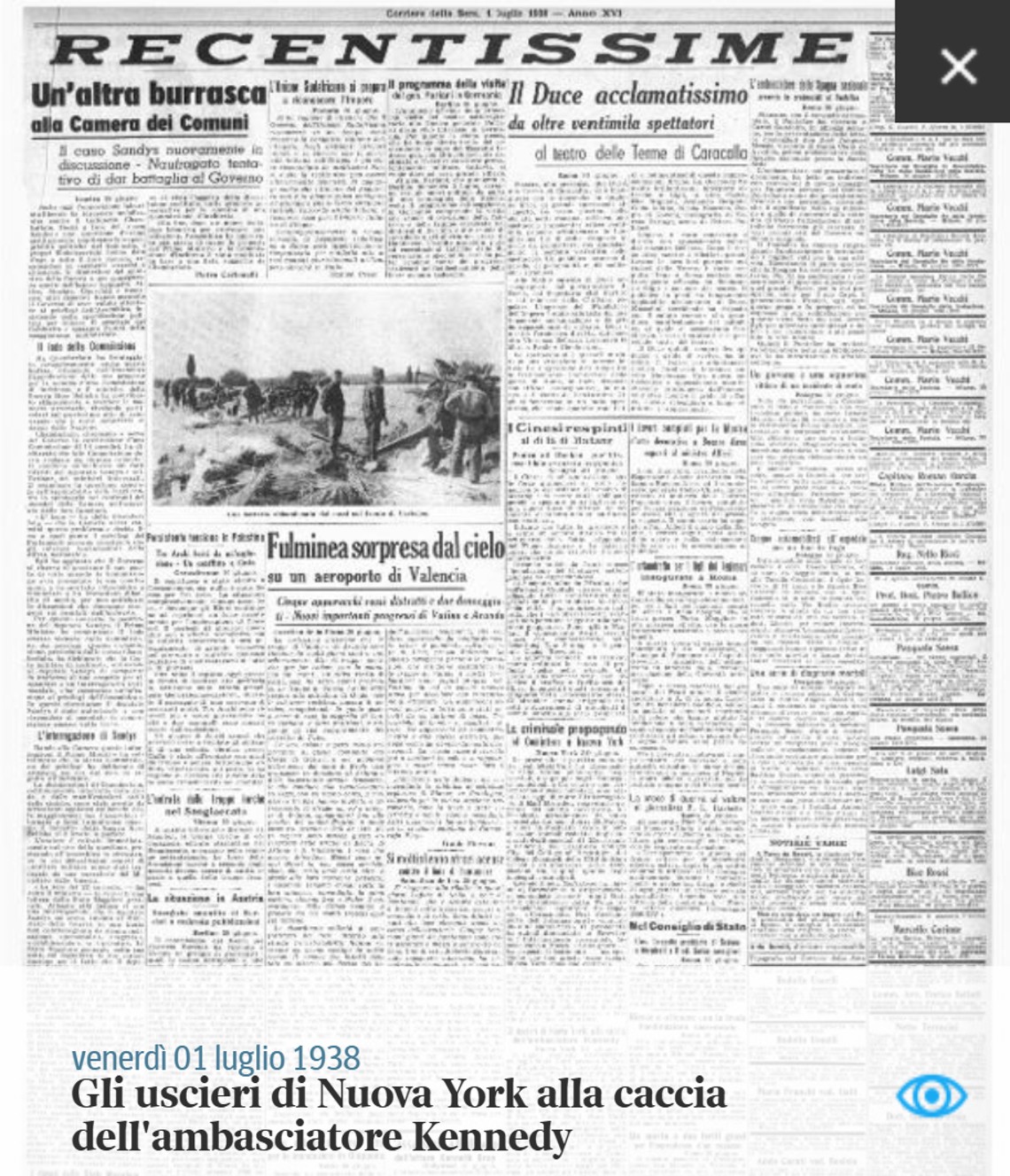
Copy of an article
from the Italian newspaper CORRIERE DELLA SERA, dated Friday, July 1,
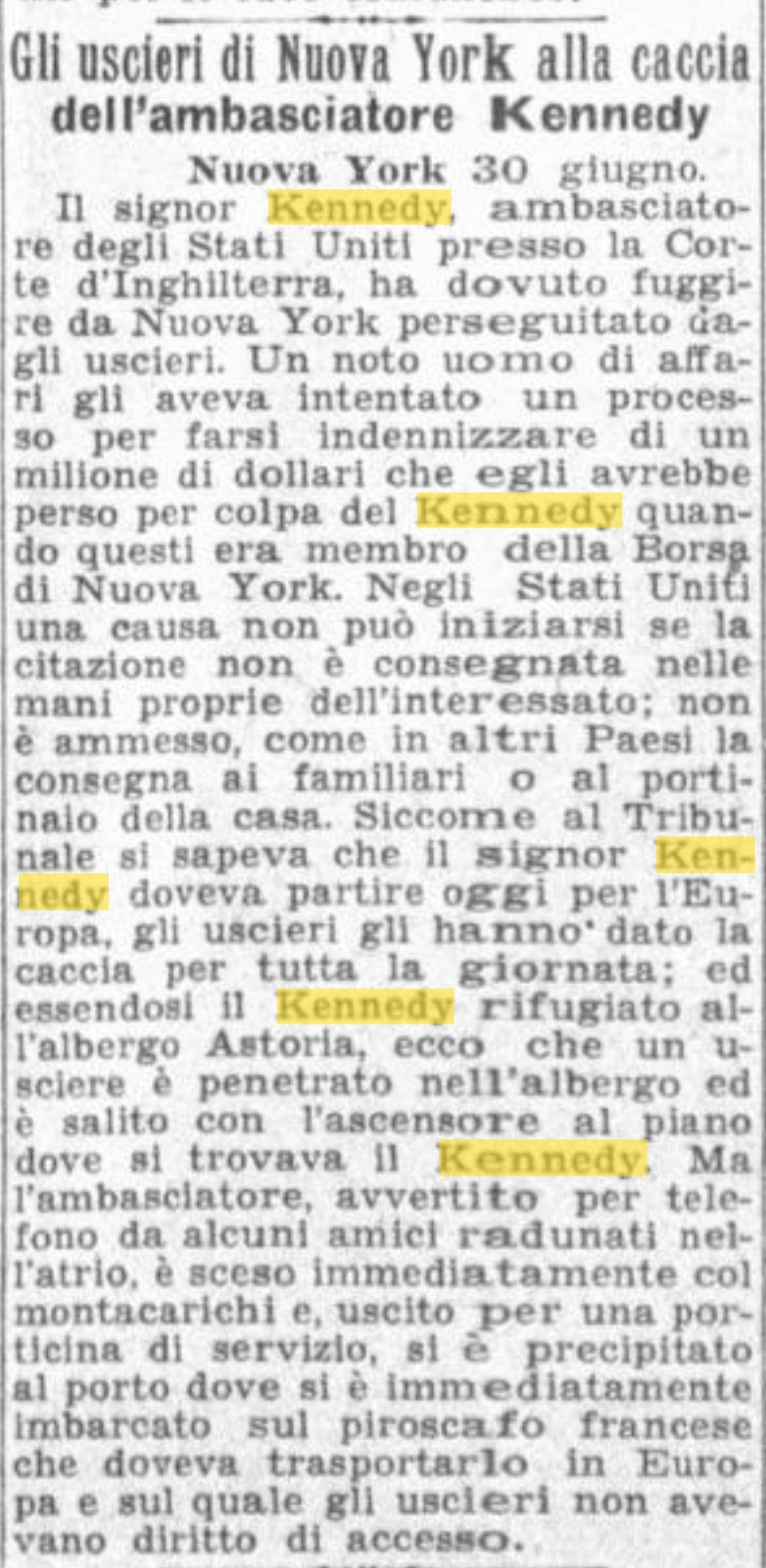
1938. Article title: "New York process servers on the hunt for Ambassador Kennedy." The United States Ambassador to London, Joseph P. Kennedy, made a dramatic escape in New York to avoid being served with a legal document by a businessman seeking one million dollars in damages. Pursued by process servers—due to strict American laws requiring the personal delivery of a summons—Kennedy managed to give them the slip at the last moment at the Hotel Astoria and board a steamship bound for Europe, thereby evading the service of process. |
|
1938, August 6 - Corriere della Sera |
||
|
|
|
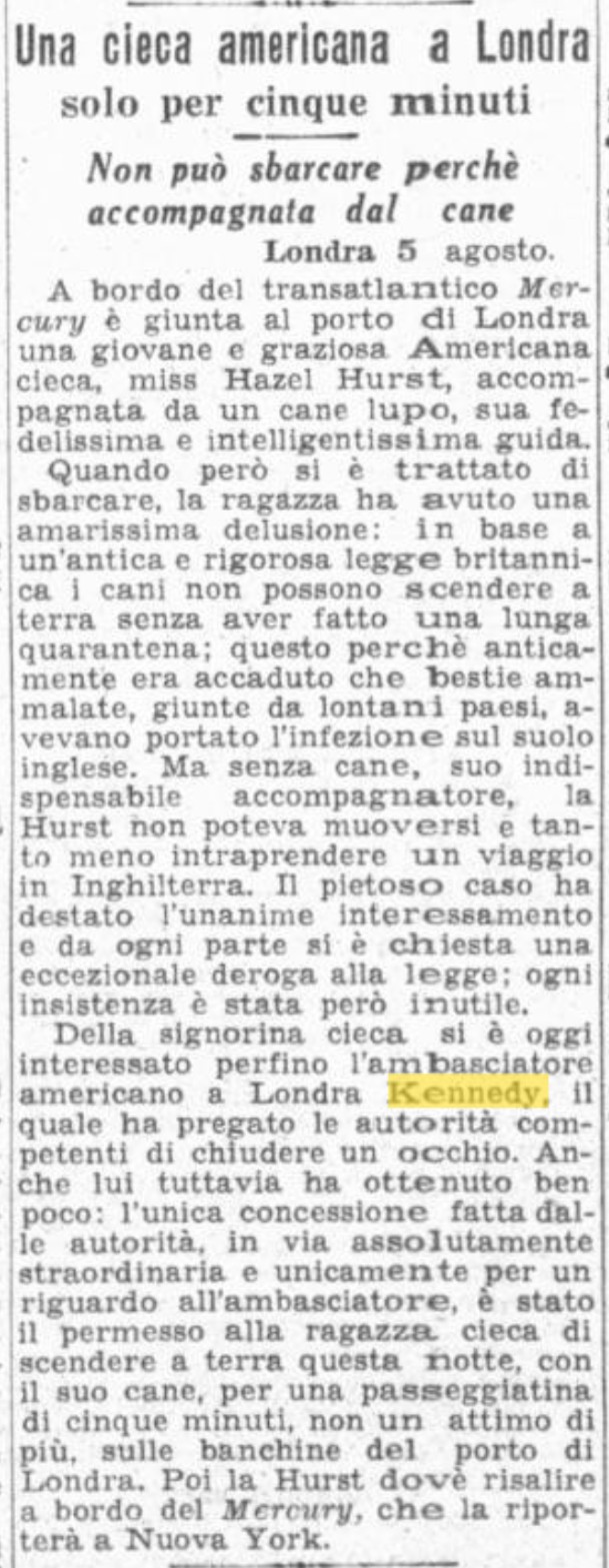
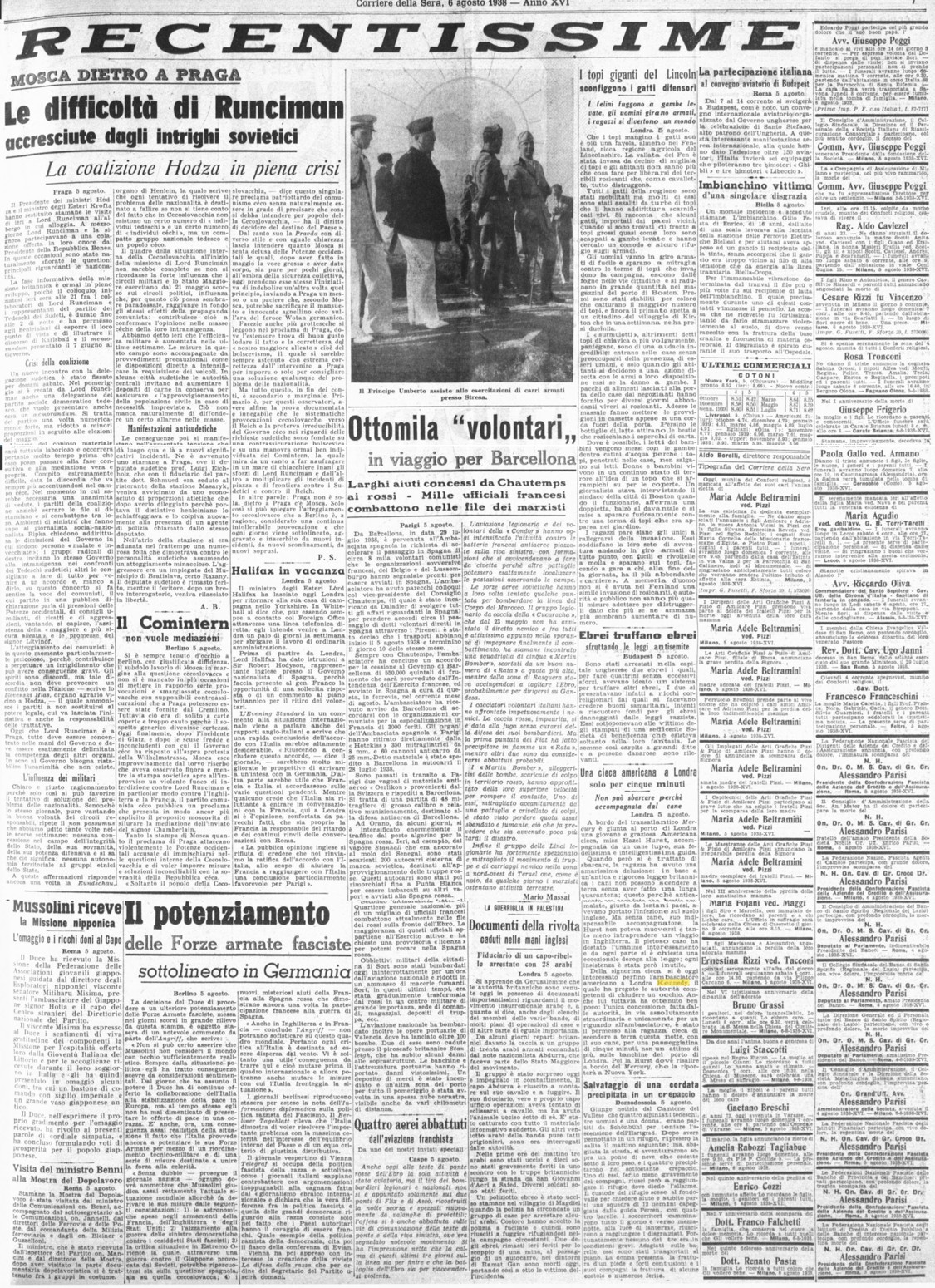
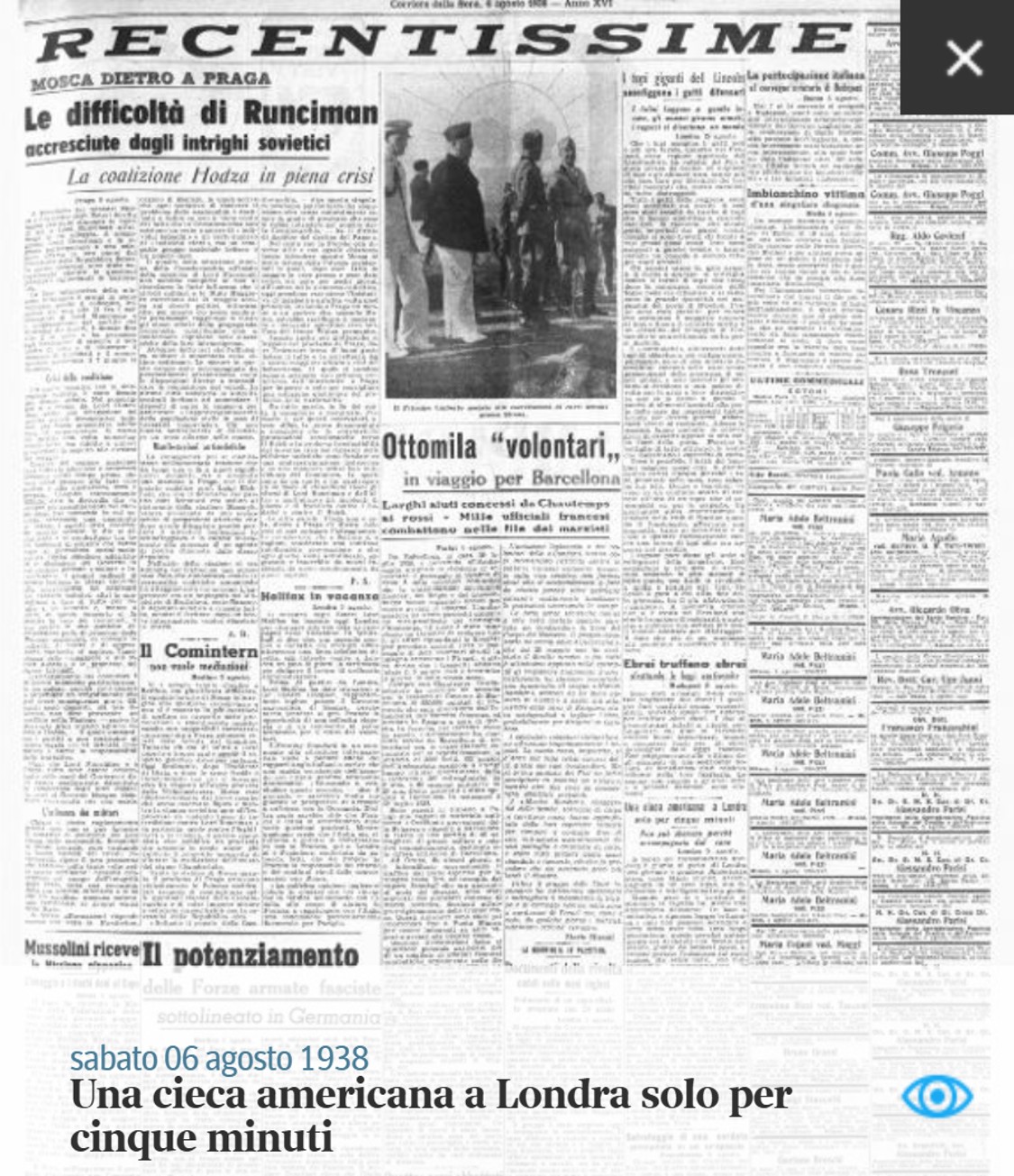
A copy of an article
from the Italian newspaper CORRIERE DELLA SERA, dated Saturday, August 6,
1938. Article headline: "A blind American woman in London for only 5 minutes. She cannot disembark because she is accompanied by her dog." A young blind American woman, Miss Hazel Hurst, arrived in London aboard the steamship *Mercury*, accompanied by her guide dog. Due to strict British laws regarding animal quarantine, she was forbidden from disembarking with her dog. Despite the direct intervention of U.S. Ambassador Kennedy, the British authorities granted only one exceptional concession: a brief, five-minute walk on the dock before her immediate return to New York. |
|
1938, August 31 - Corriere della Sera |
||
|
|
|
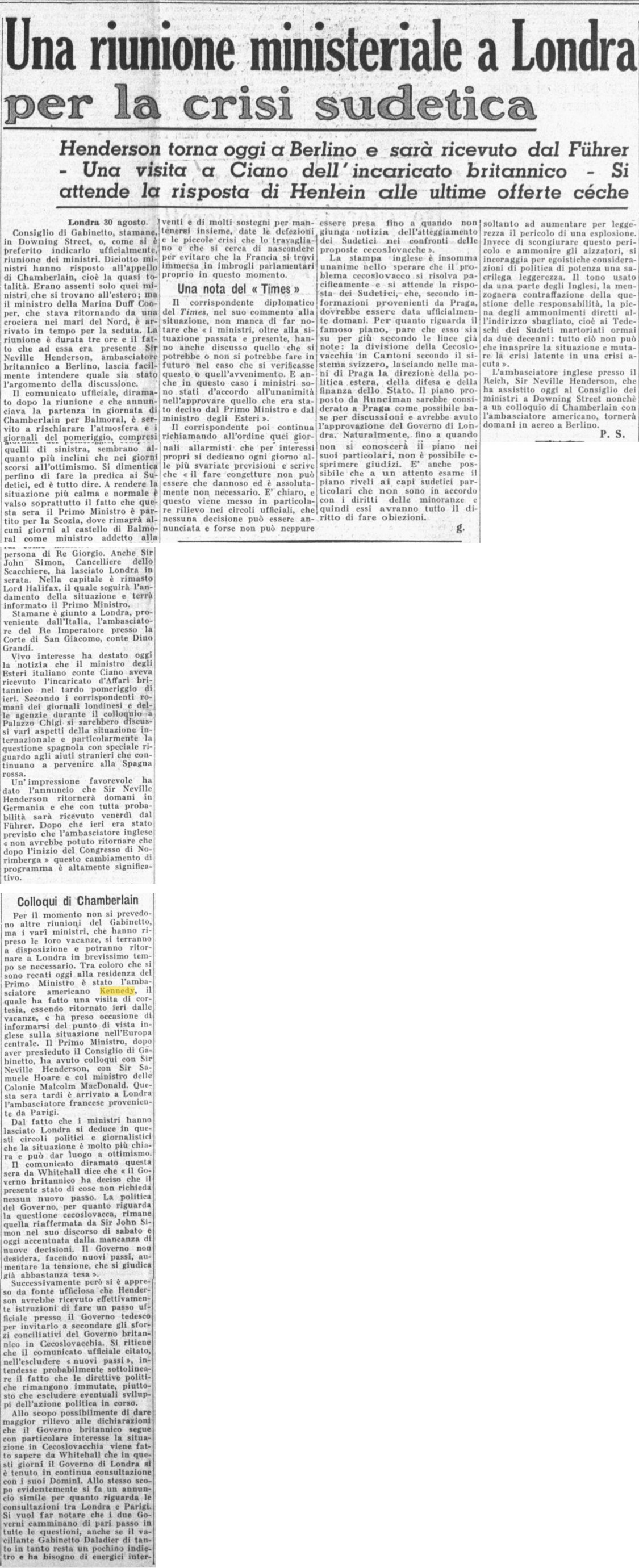
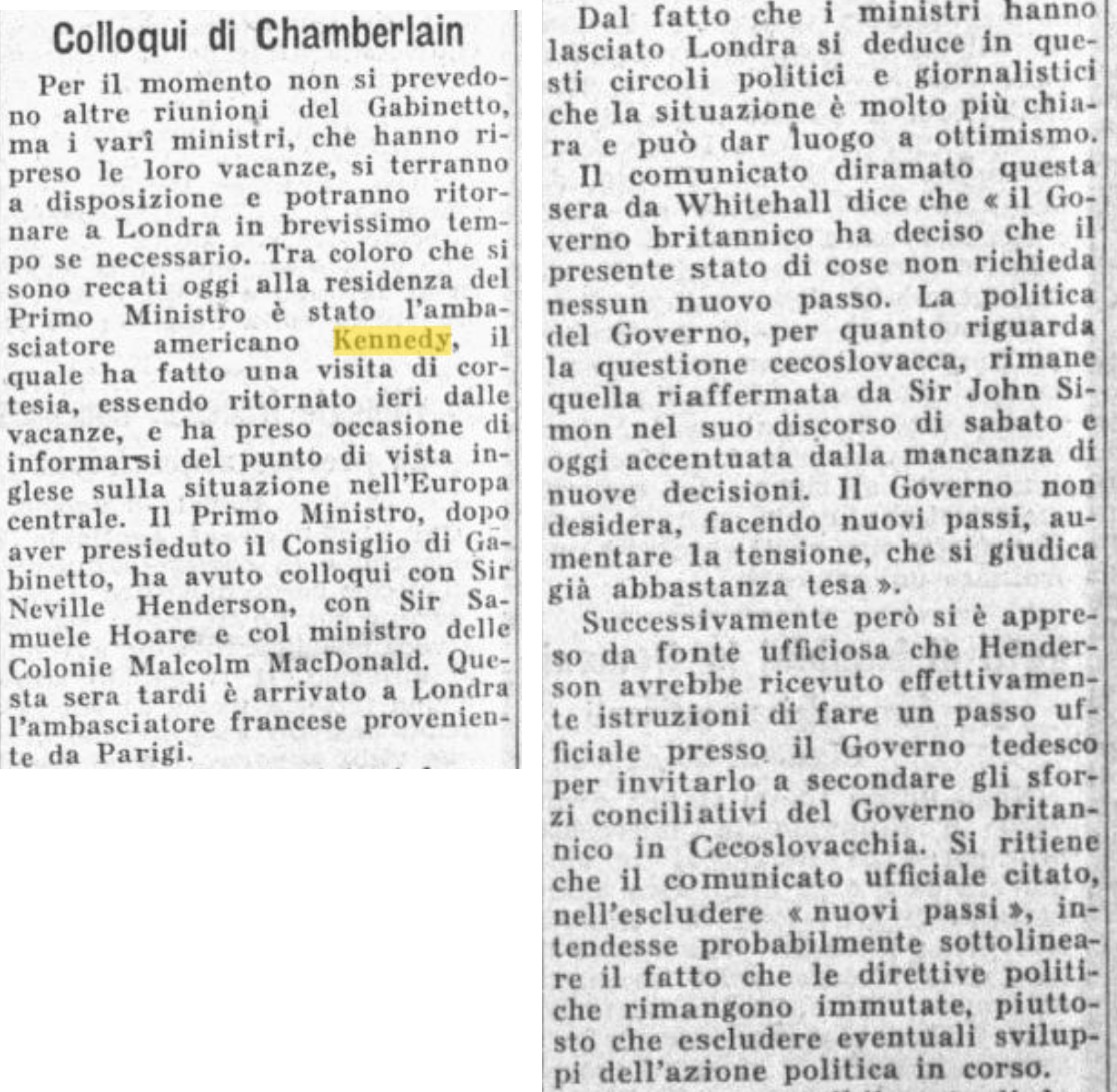
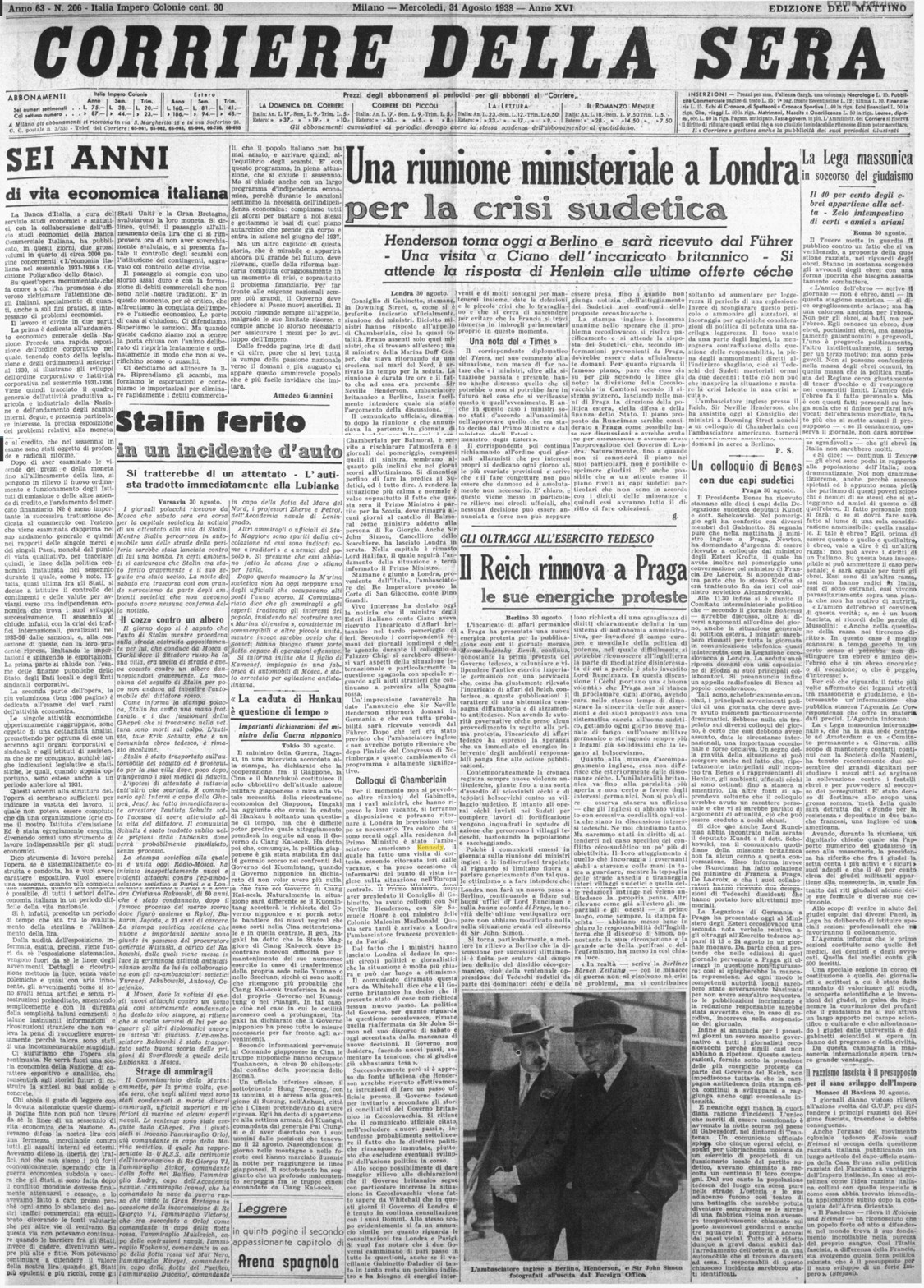
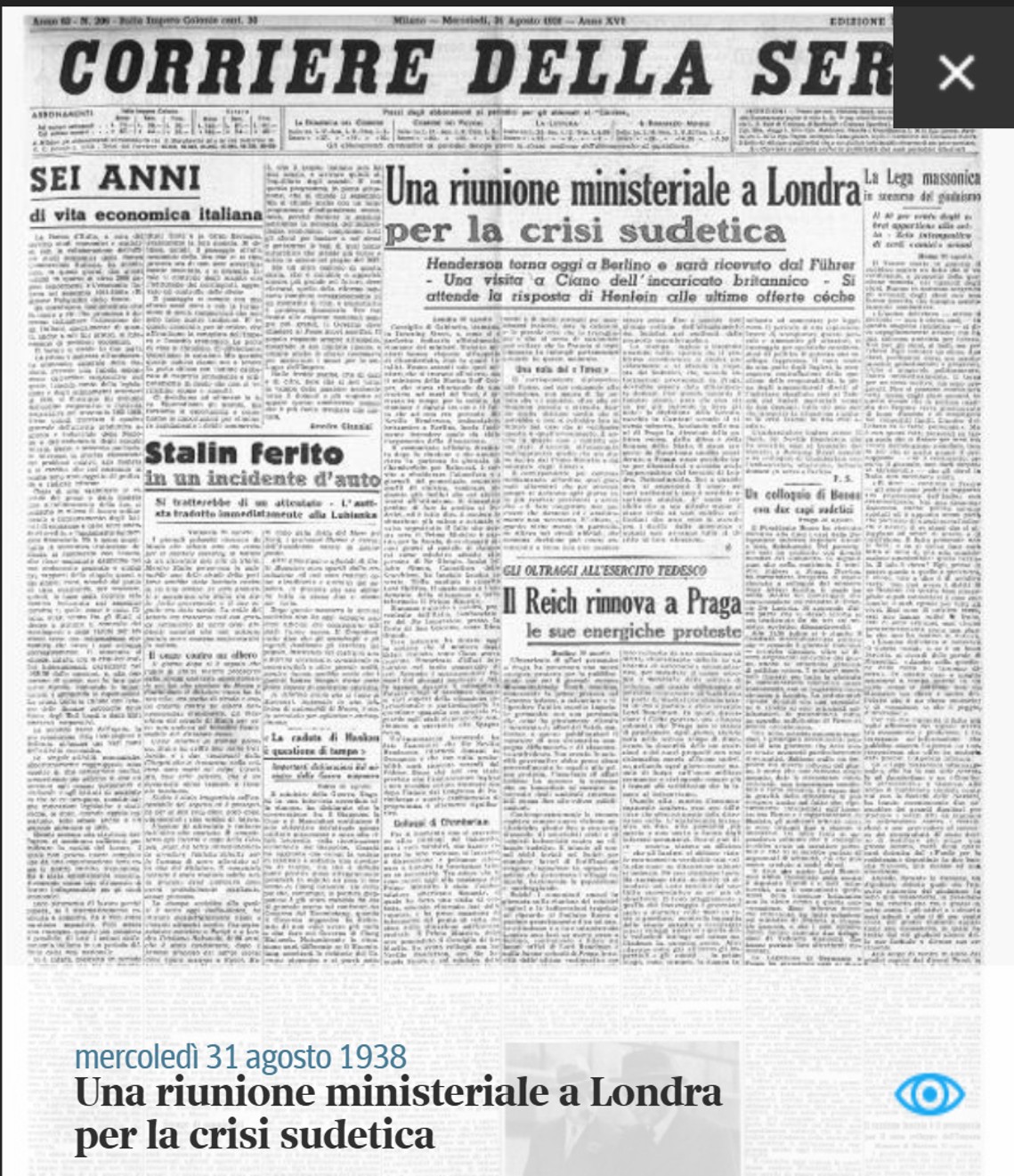
A copy of an article from
the Italian newspaper *Corriere della Sera*, dated Wednesday, August 31,
1938. Article title: "A Ministerial Meeting in London Regarding the Sudeten Crisis." The article covers developments in the Sudeten crisis and the British government's Cabinet meetings held to address the situation in Czechoslovakia. The meeting with the Prime Minister: the section titled "Chamberlain's Talks" notes that the British Prime Minister, having just returned from his vacation, received the American ambassador, Joseph Kennedy, at his residence. It was a courtesy visit, during which Kennedy took the opportunity to learn directly from Chamberlain about the general situation in Central Europe. Further diplomatic developments: the Prime Minister also held discussions with other ministers and with the British ambassador to Berlin, Sir Neville Henderson, who is preparing to return to Germany for an audience with Hitler. |
|
1938, September 1 - Corriere della Sera |
||
|
|
|
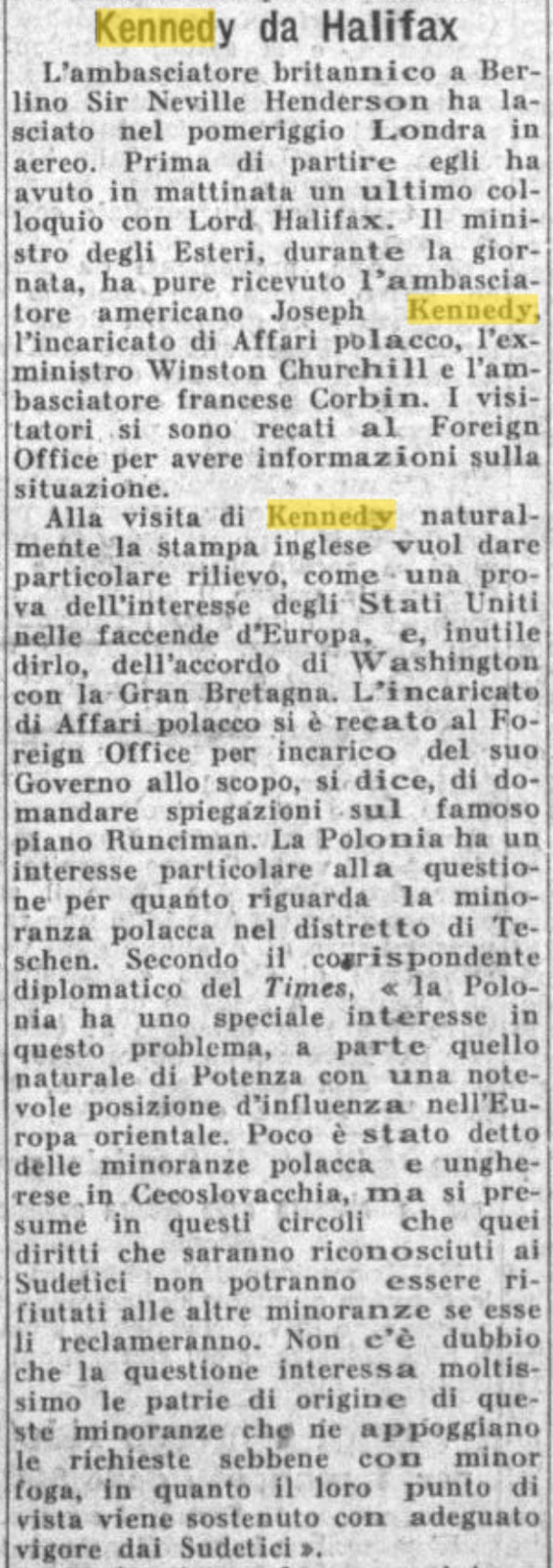
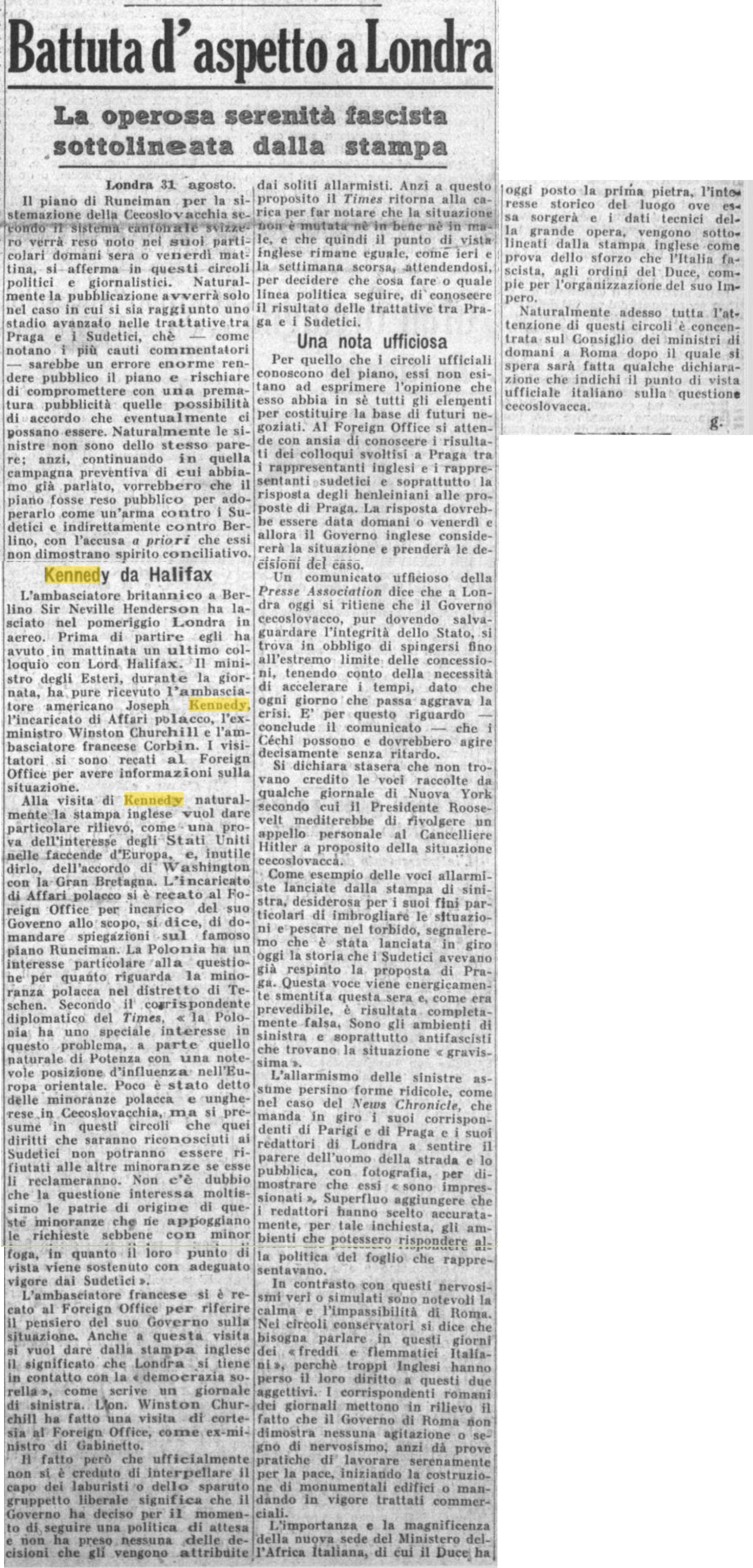
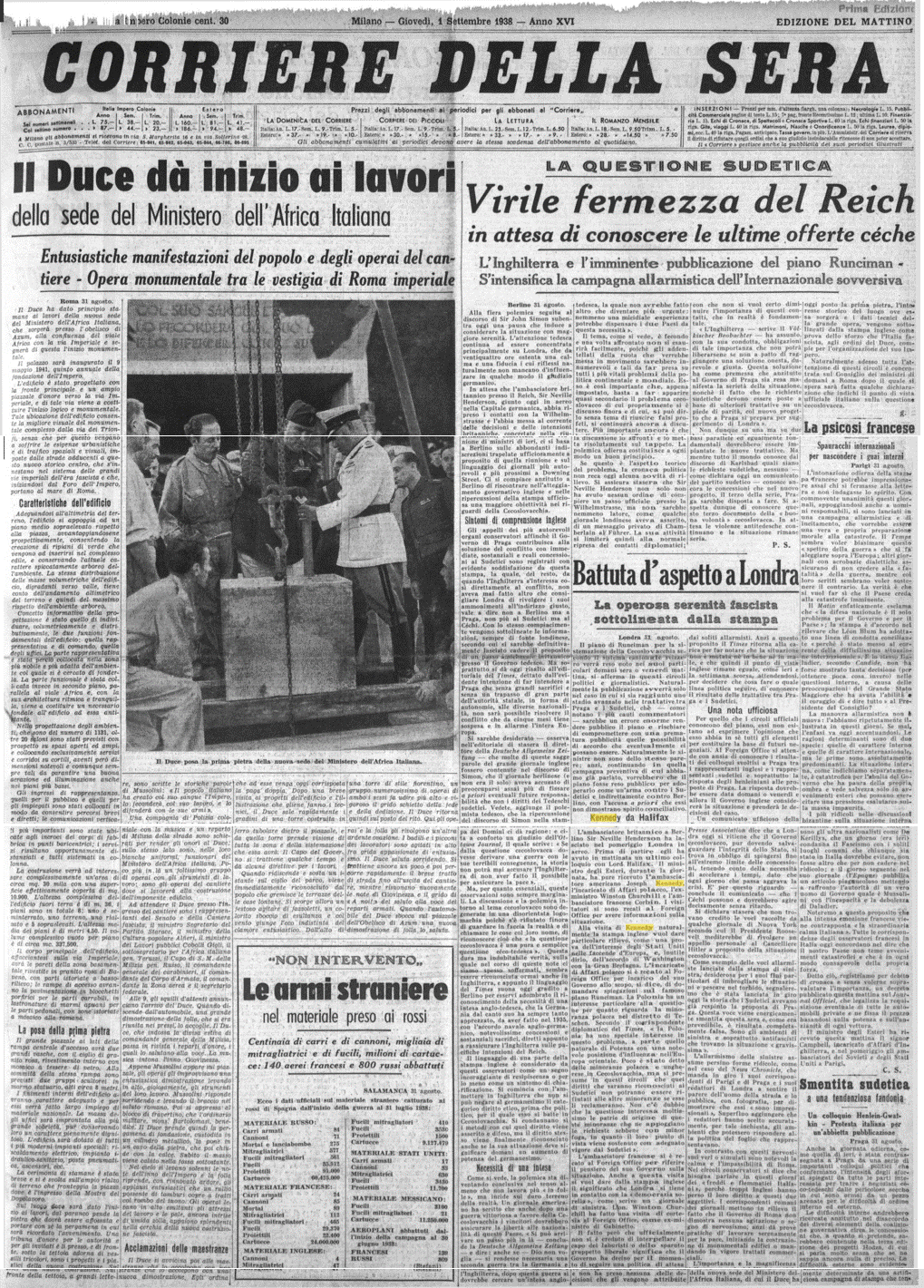
A copy of an article from
the Italian daily newspaper *Corriere della Sera*, dated Thursday,
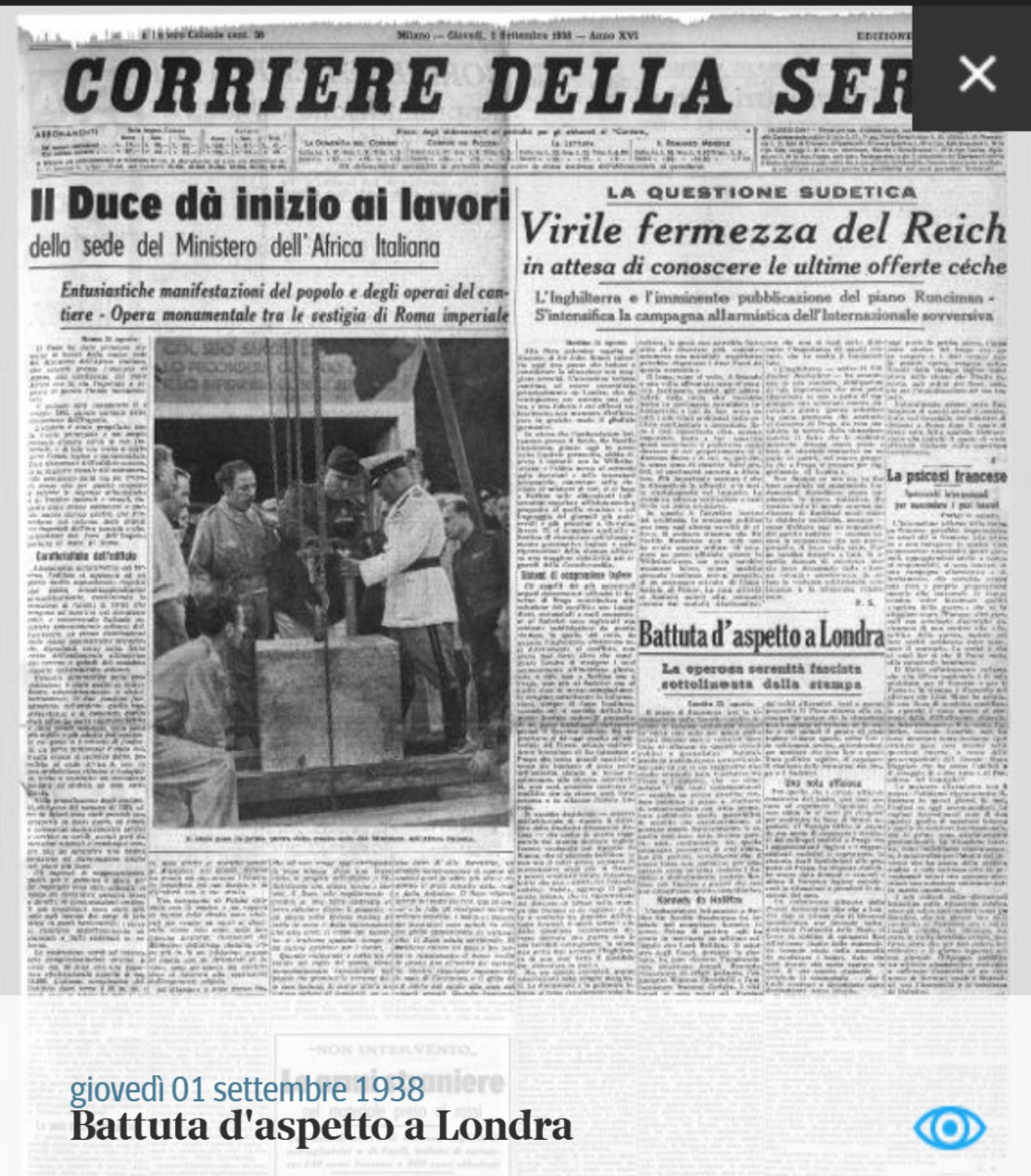
September 1, 1938. Article title: "A Diplomatic Encounter in London: Kennedy Meets with Halifax." The diplomatic meeting: Throughout the day at the Foreign Office, British Foreign Secretary Lord Halifax held official meetings with American Ambassador Joseph Kennedy—as well as other figures, including the Polish Chargé d’Affaires, Winston Churchill, and the French Ambassador, Corbin—to stay informed about the political situation and the Sudeten crisis. The press placed particular emphasis on Kennedy’s visit, interpreting it as a clear sign of the United States' interest and involvement in European affairs, as well as a strong diplomatic alignment with Great Britain. |
|
1938, September 12 - Corriere della Sera |
||
|
|
|
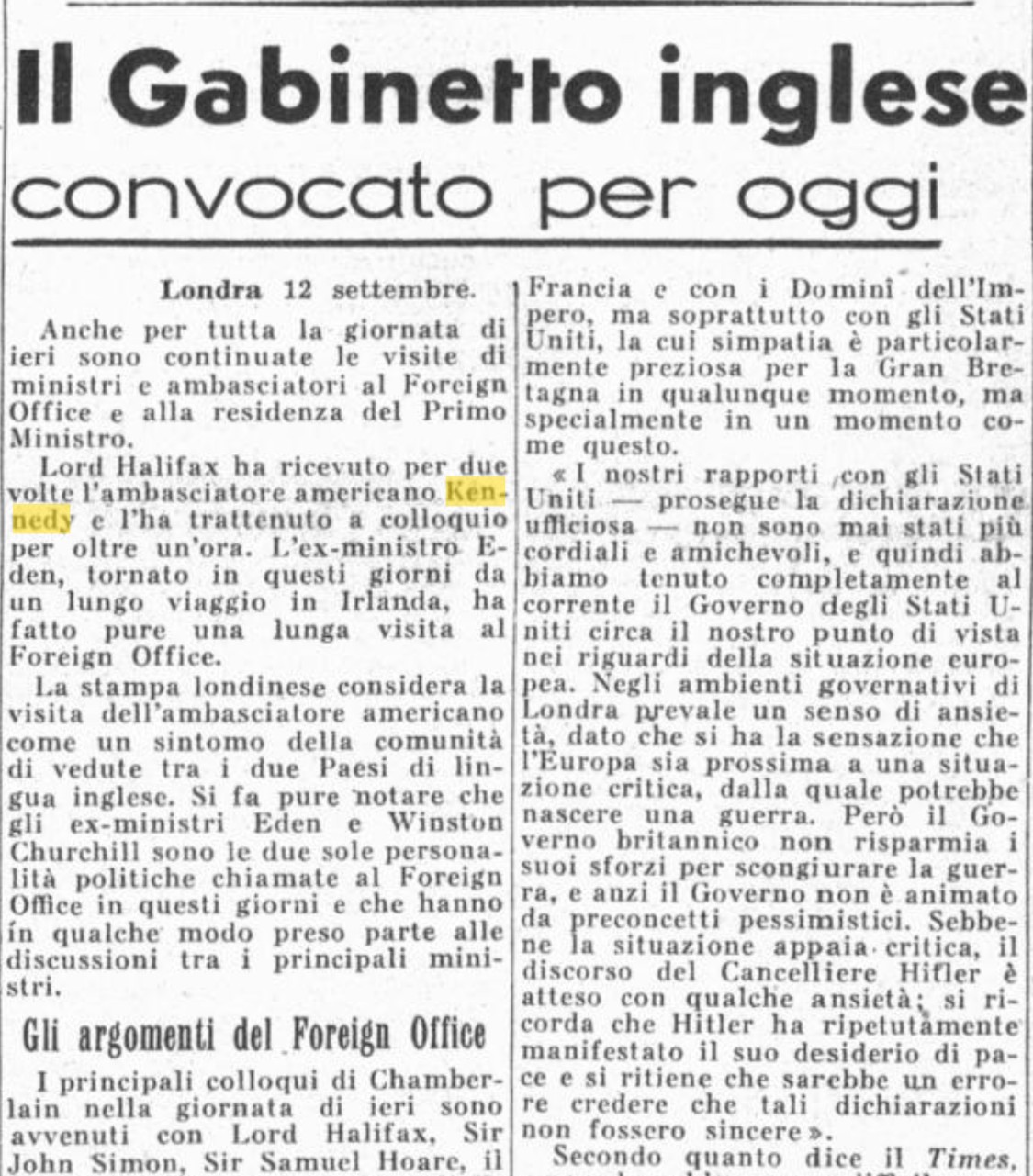
A copy of an article from
the Italian newspaper *Corriere della Sera*, dated Monday, September 12,
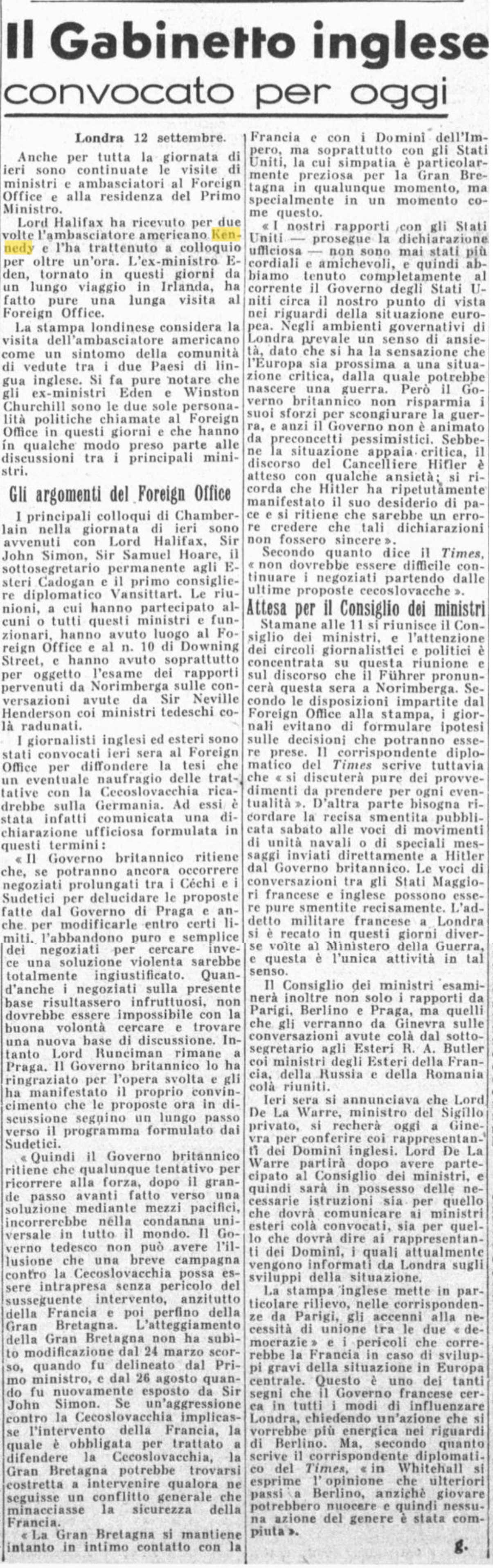
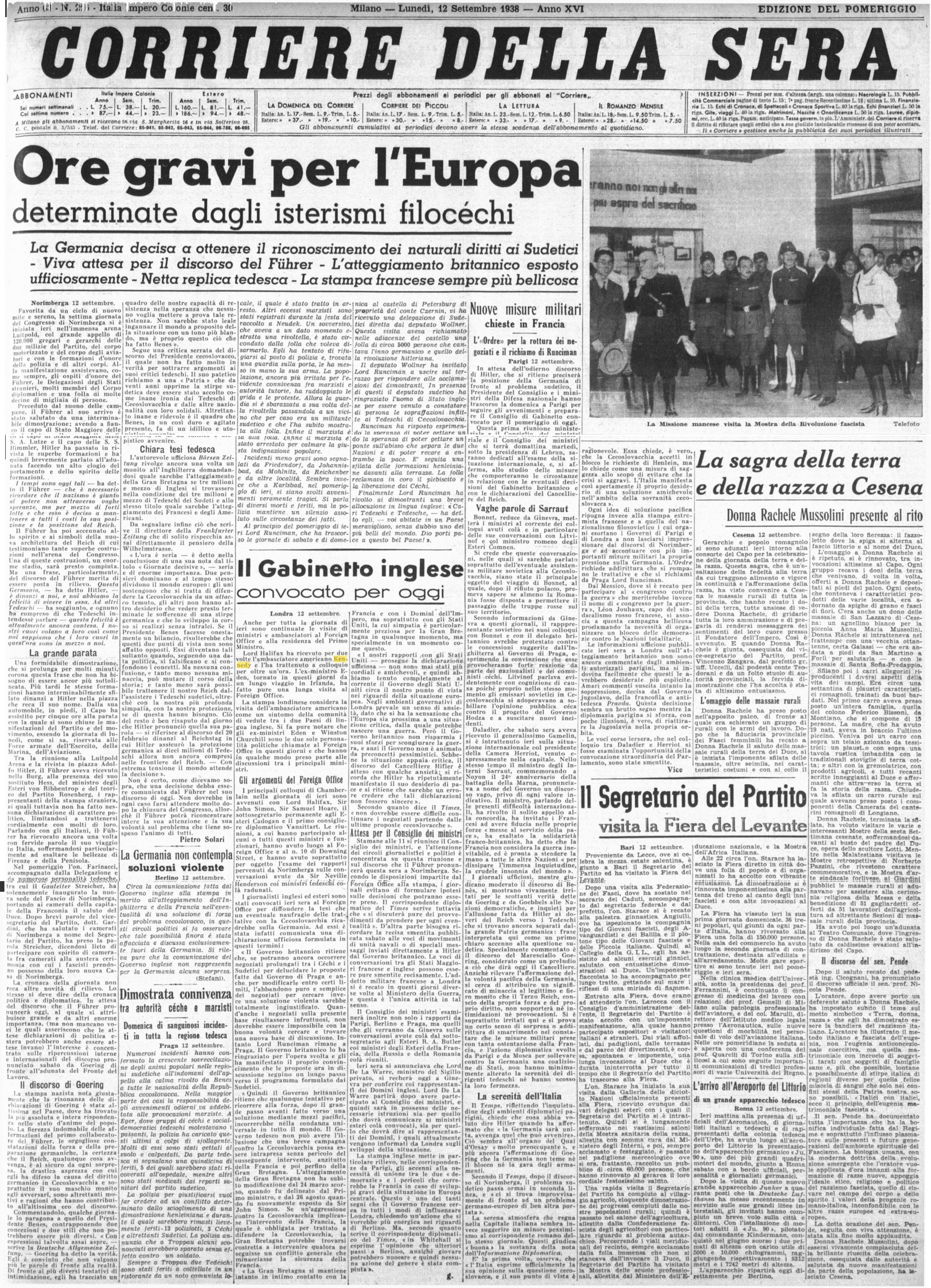
1938. Article headline: "British Cabinet convened for today." The article reports on the urgent summoning of the British Cabinet in London, in anticipation of the tense speech the Führer is set to deliver that same evening in Nuremberg, amid growing anxiety regarding a potential war linked to the Sudeten crisis. Meeting with Ambassador Kennedy: The text notes that Lord Halifax met with American Ambassador Joseph Kennedy twice, holding discussions with him for over an hour. The London press interpreted this visit as a sign of close alignment in views and ongoing contact between the United States and Great Britain in the face of the crisis in Europe. |
|
1938, September 15 - Corriere della Sera |
||
|
|
|
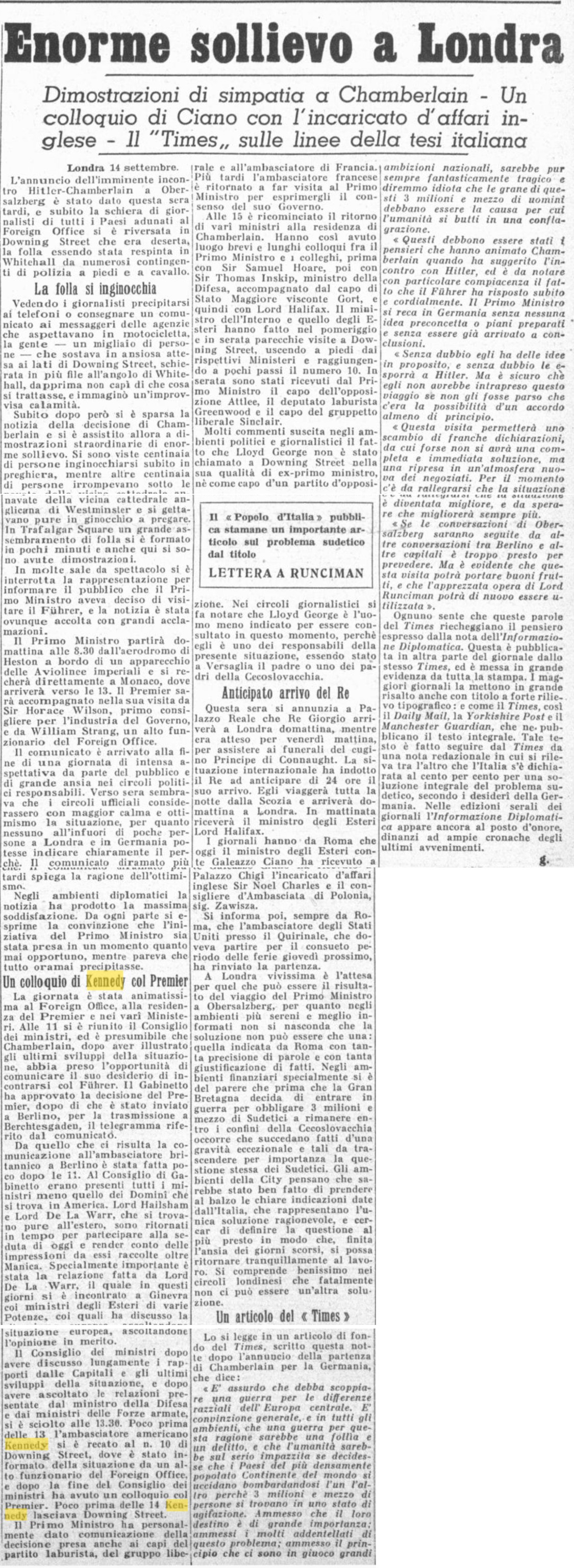
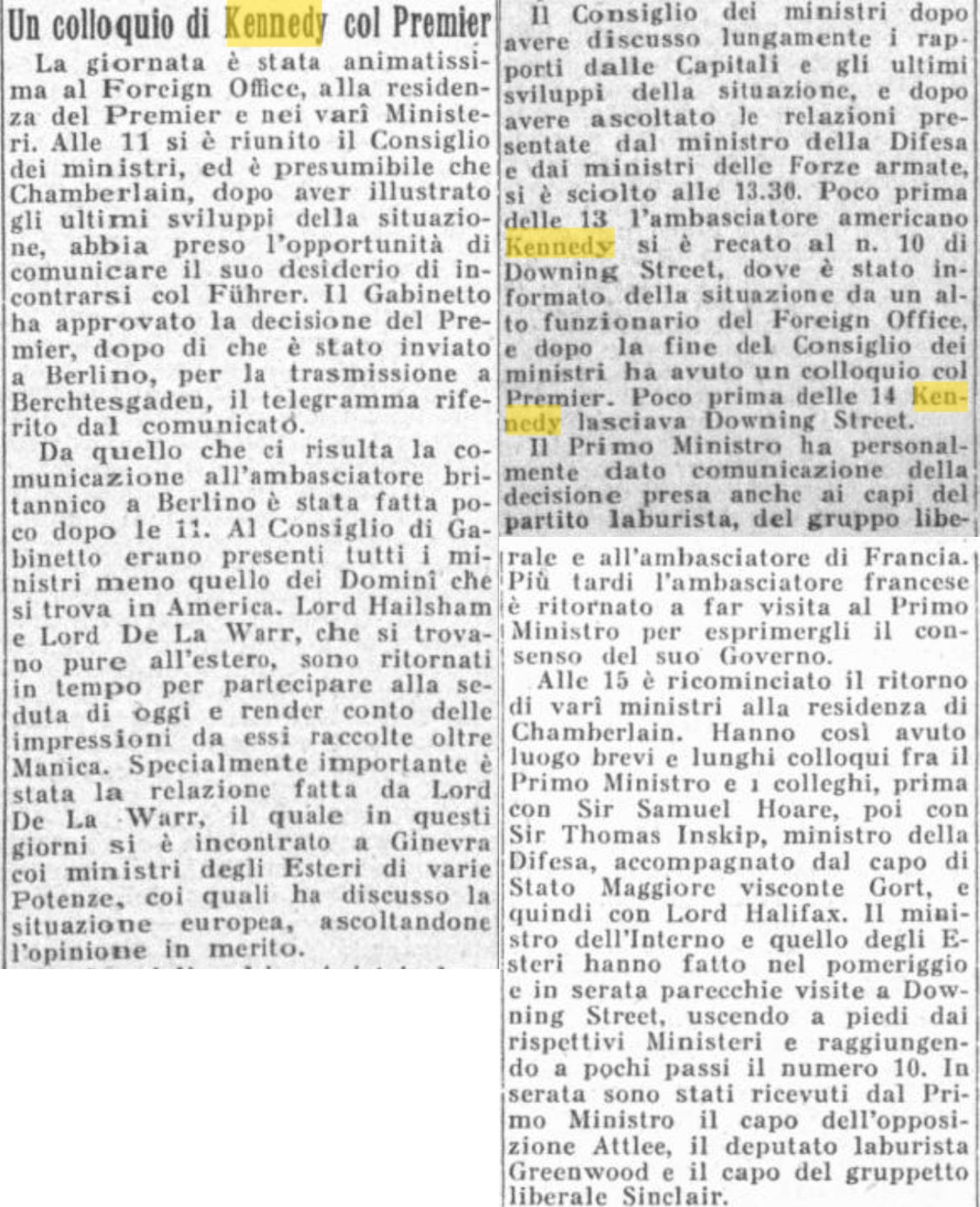
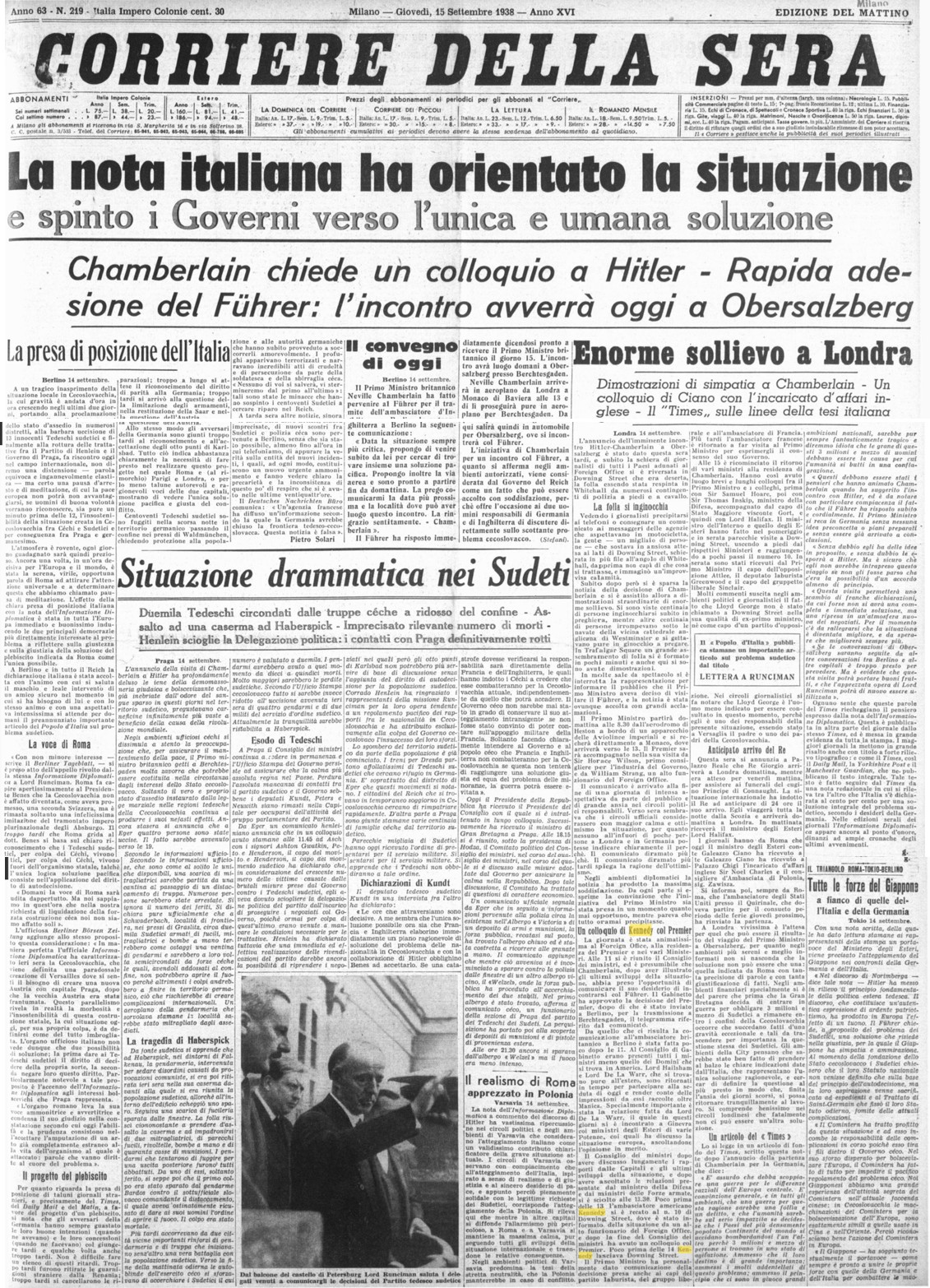
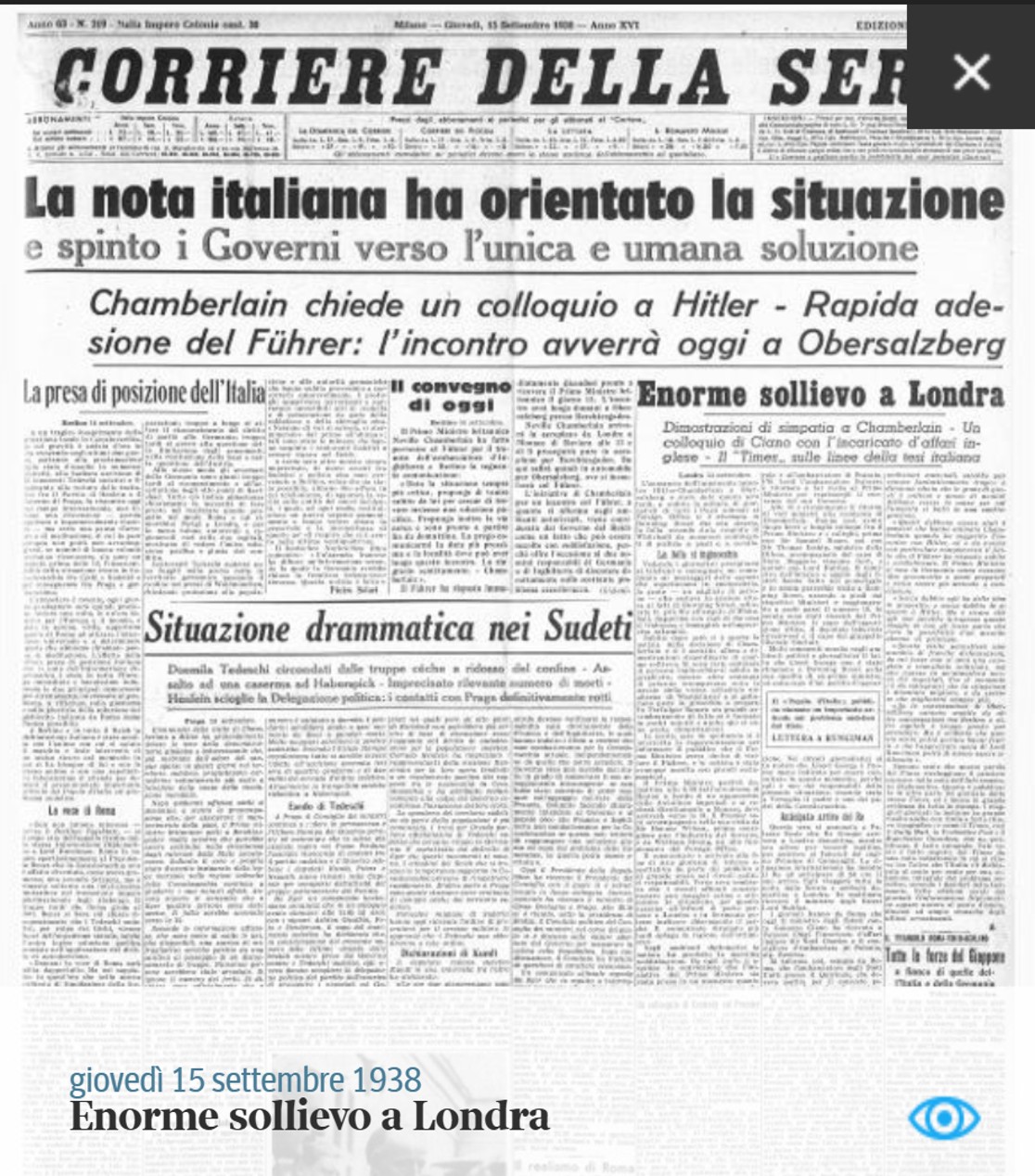
A copy of an article from
the Italian newspaper *Corriere della Sera*, dated Thursday, September 15,
1938. Article headline: "Enormous relief in London. A meeting between Kennedy and the Prime Minister." The article describes the intense anticipation—followed by relief and enthusiasm—in London regarding the announcement of an imminent meeting between British Prime Minister Neville Chamberlain and Adolf Hitler at Berchtesgaden, an encounter viewed as an attempt to avert war over the Sudeten crisis. Within the account of diplomatic developments and the meeting of the British Cabinet, it is noted that the American ambassador, Joseph Kennedy, visited 10 Downing Street. There, he was briefed on the situation by a Foreign Office official and held a direct discussion with Prime Minister Chamberlain just before the latter’s departure for Germany. |
|
1938, September 18 - Corriere della Sera |
||
|
|
|
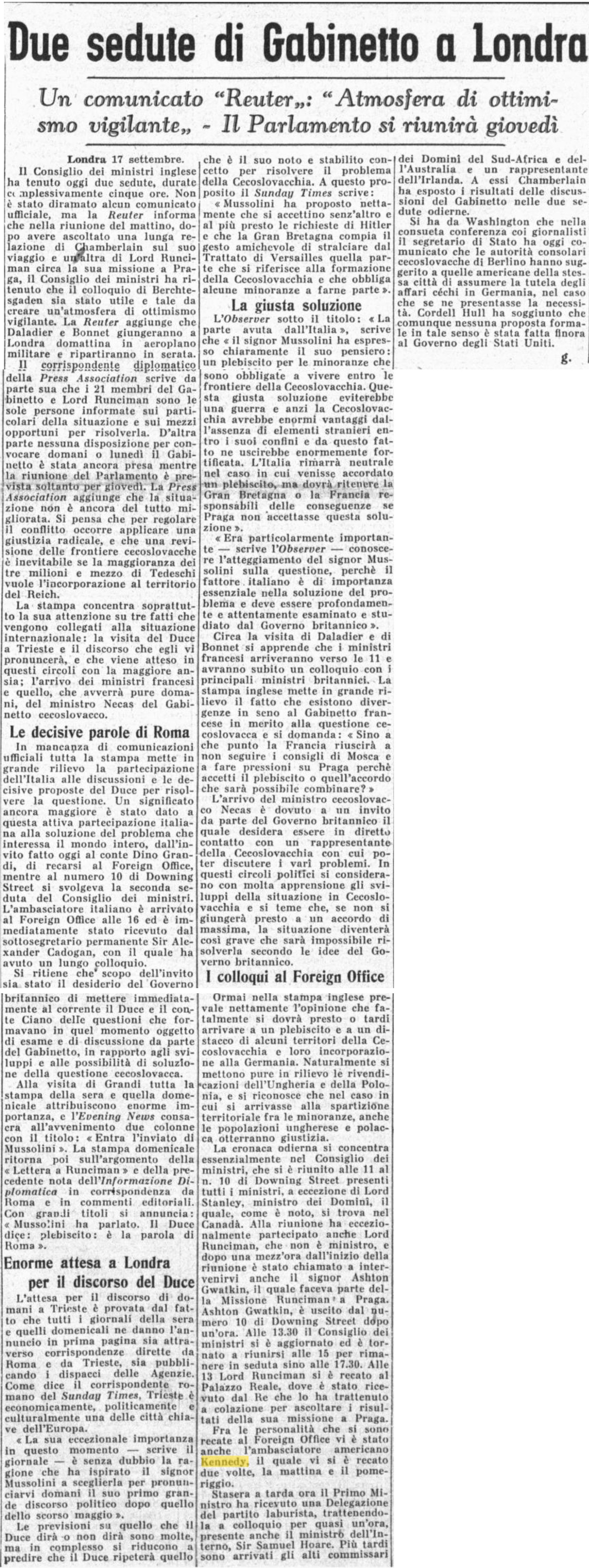
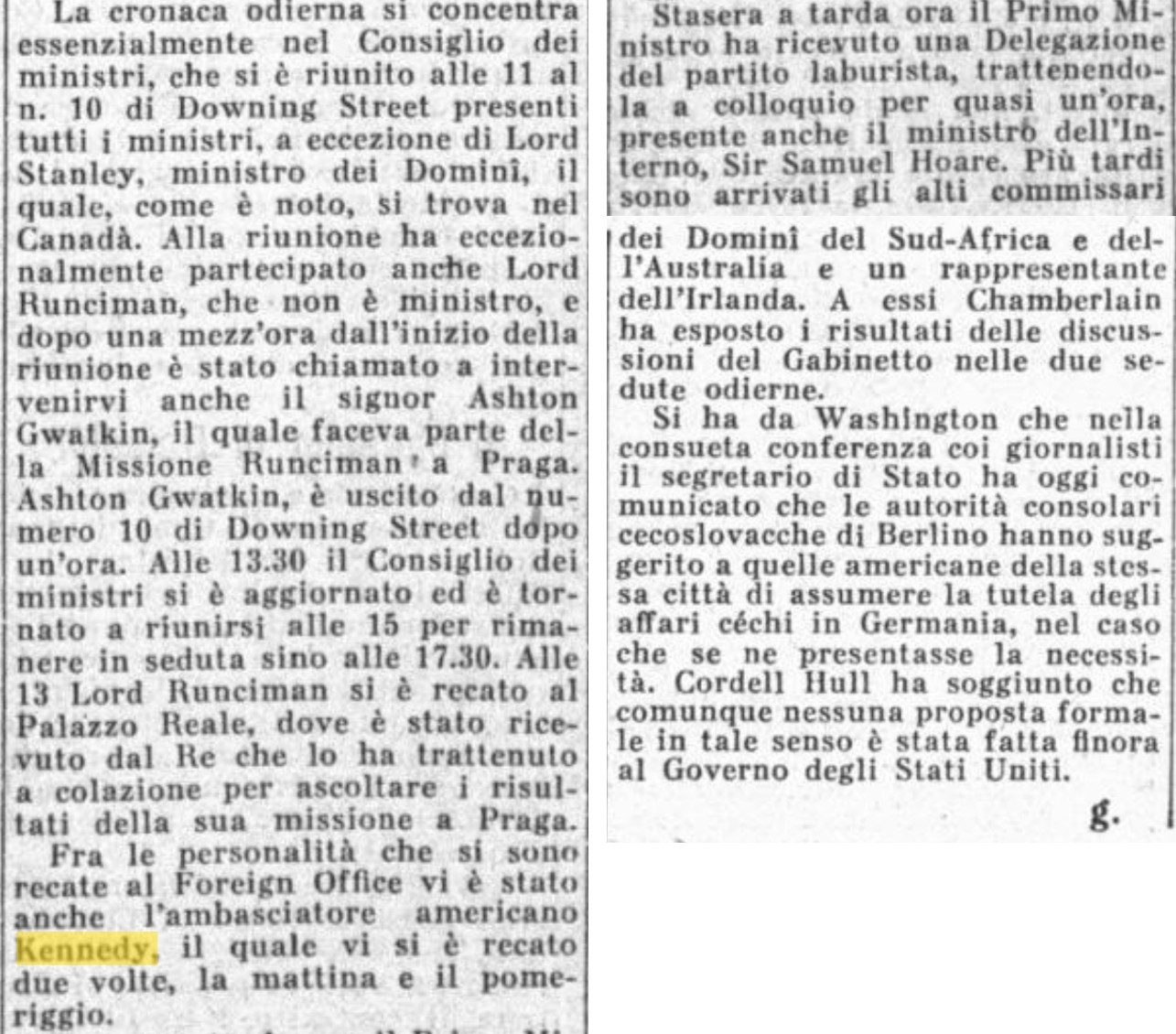
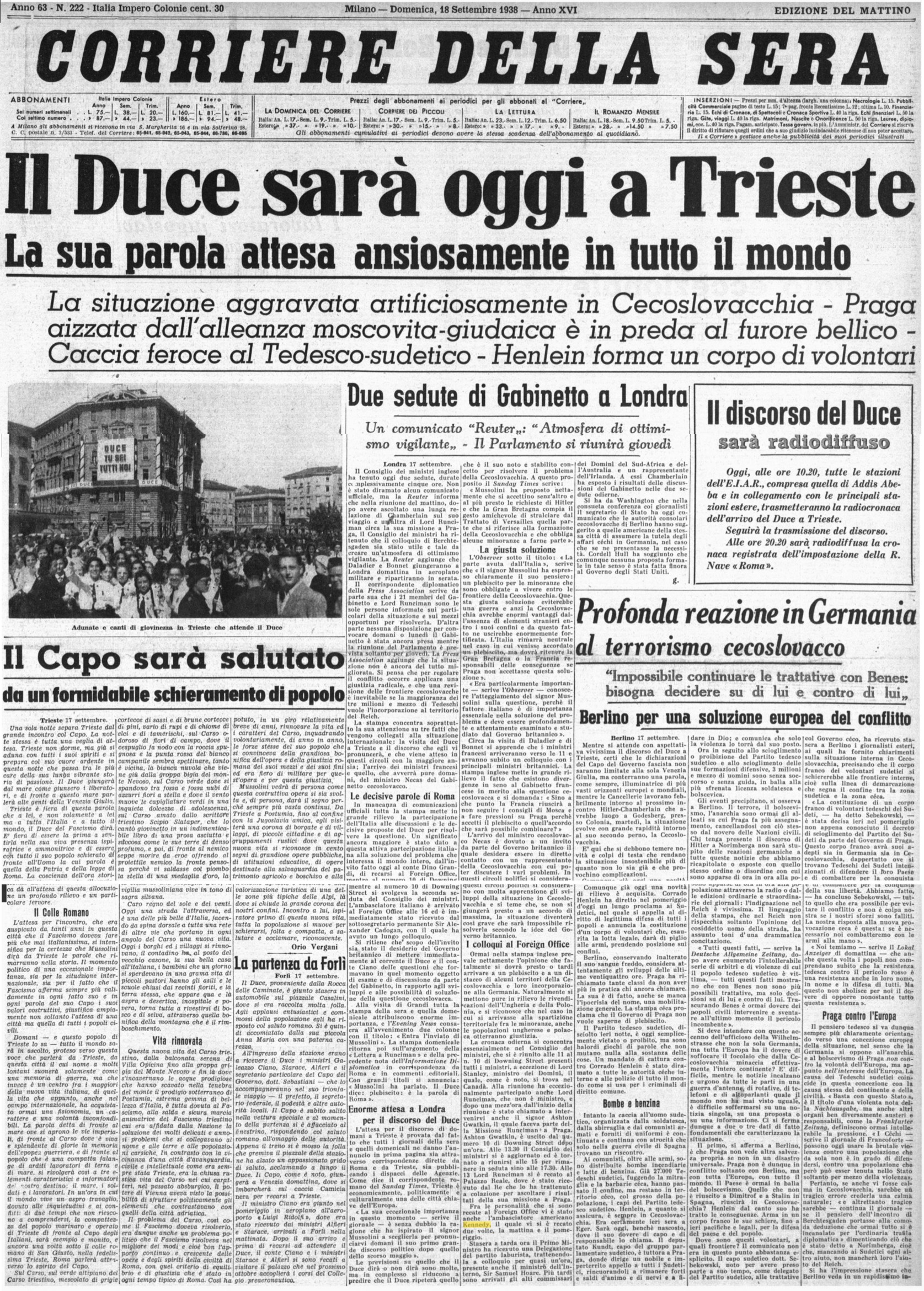
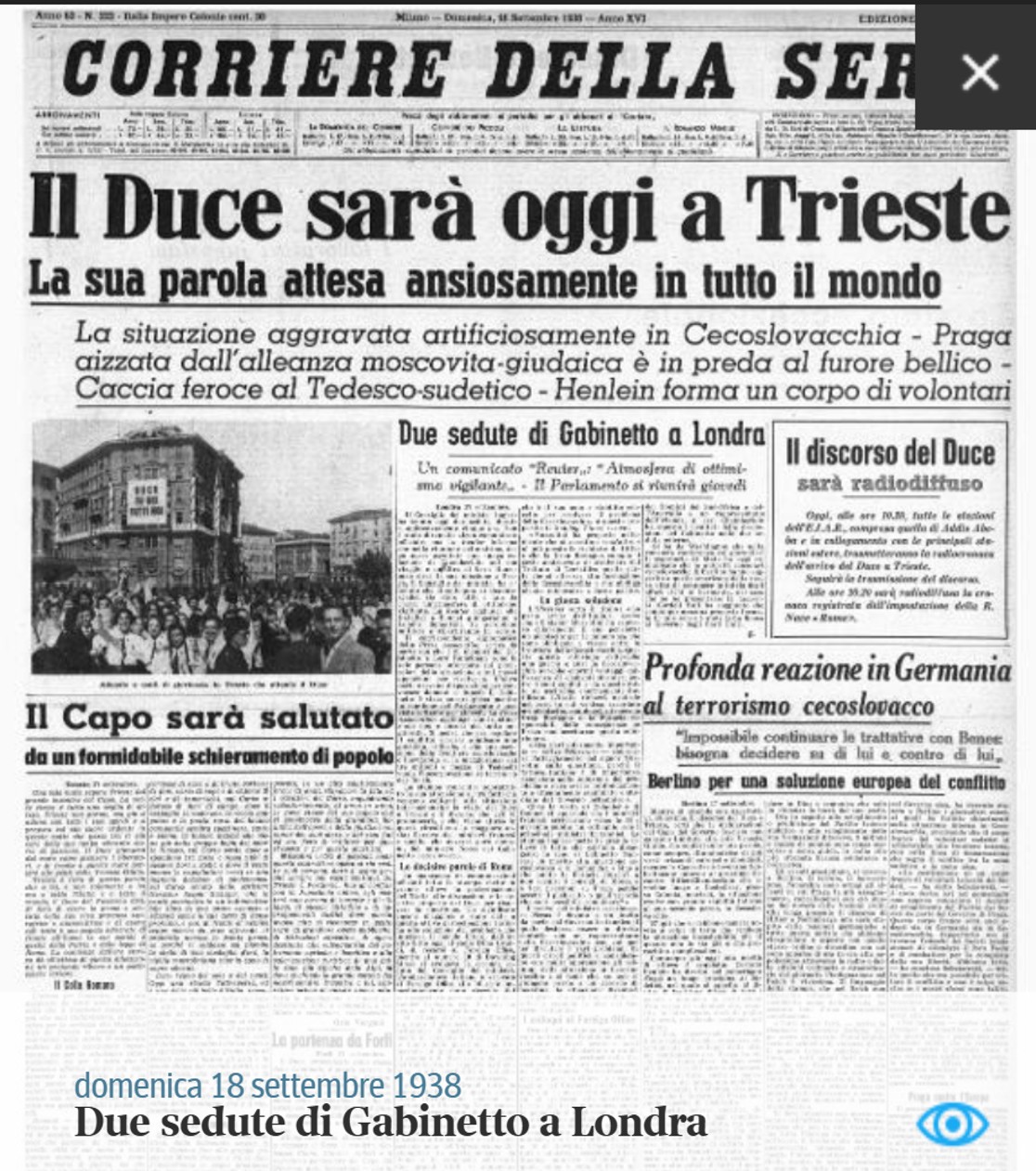
A copy of an article from
the Italian newspaper *Corriere della Sera*, dated Sunday, September 18,
1938. Article title: "Two Cabinet Meetings in London." A summary of the article follows: Cabinet meetings in London: The British Cabinet met for approximately five hours to examine the situation in Czechoslovakia and the outcome of the discussions at Berchtesgaden between Neville Chamberlain and Adolf Hitler—an encounter viewed as a useful step toward an atmosphere of "vigilant optimism." Diplomatic activity and the visit of Ambassador Kennedy: The article notes the intensive discussions taking place at the Foreign Office and reports that the American ambassador, Joseph Kennedy, visited the Foreign Office twice (in the morning and afternoon) to stay informed about developments in the crisis and the ongoing European negotiations. |
|
1938, September 30 - Corriere della Sera |
||
|
|
|
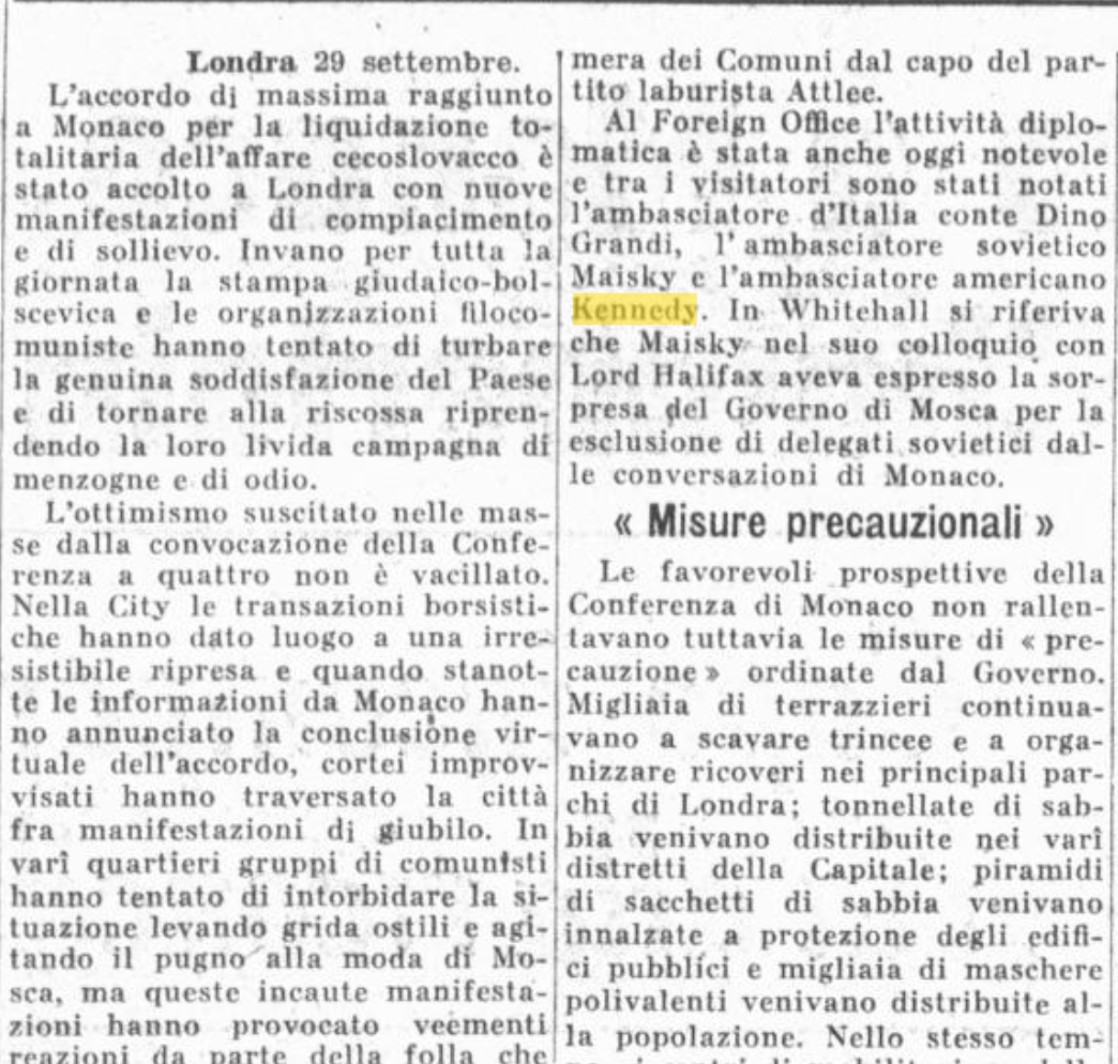
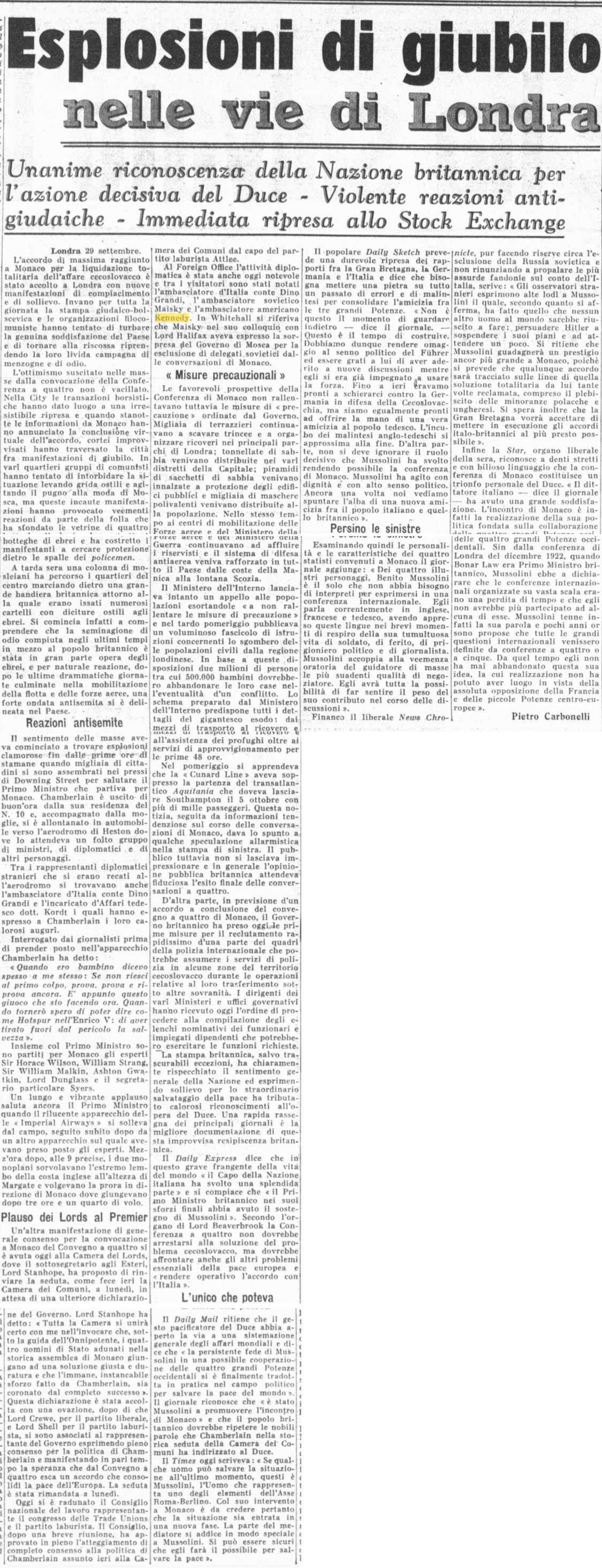
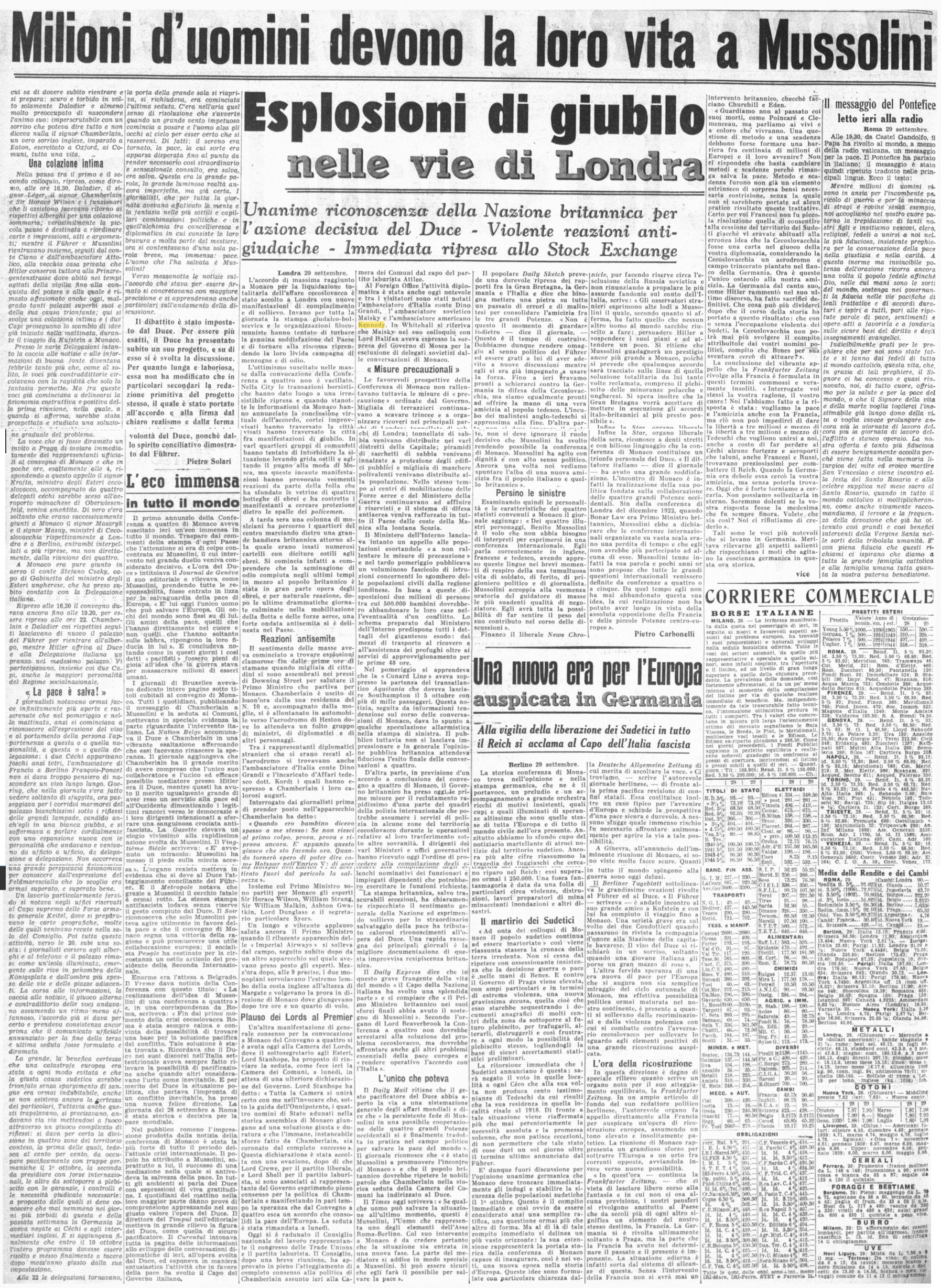
A copy of an article from
the Italian newspaper *Corriere della Sera*, dated Friday, September 30,
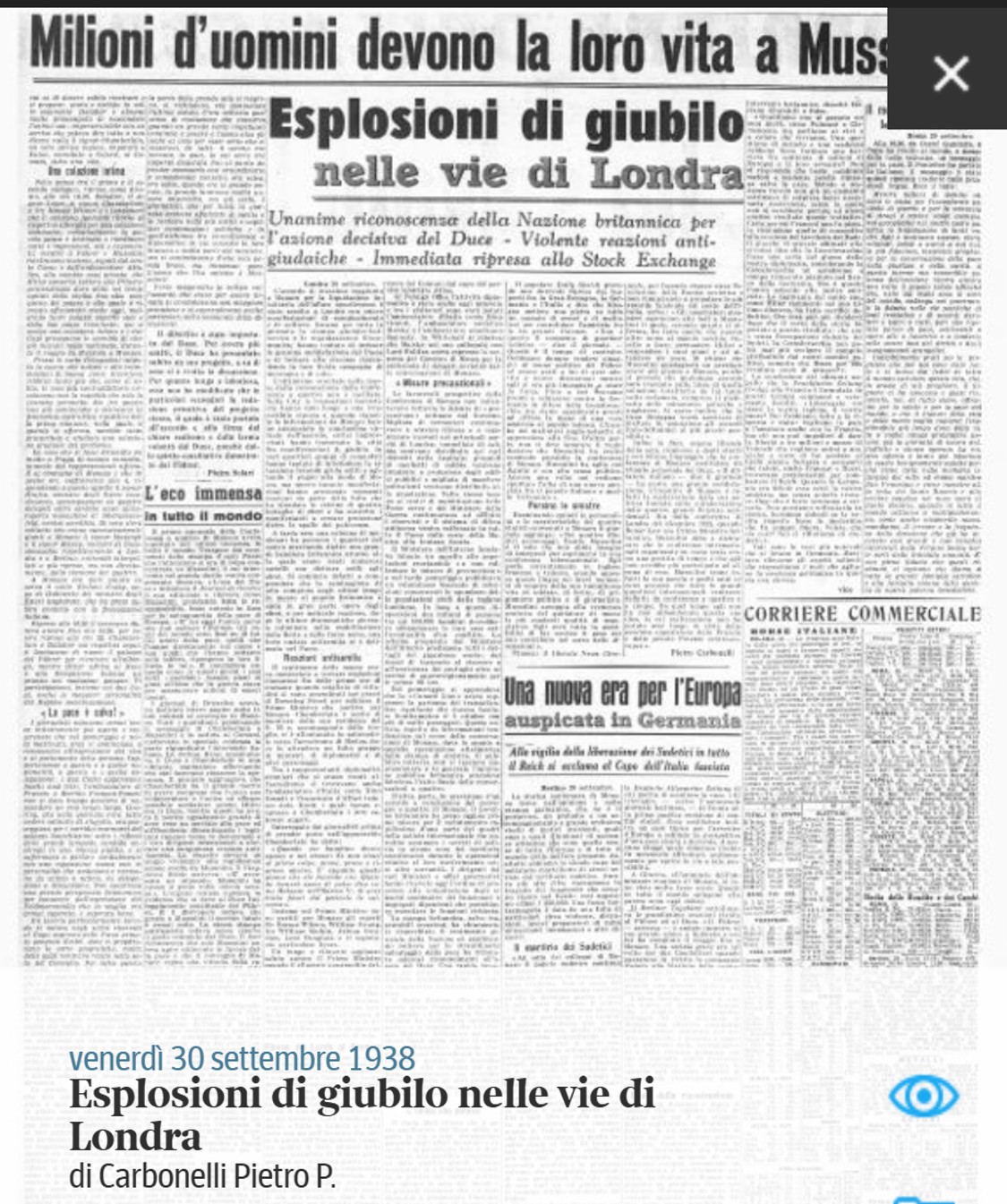
1938. Article title by Pietro Carbonelli: "An Outburst of Jubilation in the Streets of London." Here is a summary of the article: Relief and jubilation in London: The article describes the atmosphere of immense relief and the displays of enthusiasm in London following the Munich Agreement, which was reached to resolve the Czechoslovak crisis and avert the danger of a new war. Reactions and countermeasures: Alongside the celebrations, the text notes both the recovery of the financial markets and the continued implementation of precautionary measures, such as air-raid defenses and the preemptive evacuation of citizens. Diplomatic activity: Among the visitors seen at the Foreign Office were the Italian Ambassador (Count Grandi), the Soviet Ambassador (Maisky), and the American Ambassador (Joseph Kennedy). Maisky (the USSR Ambassador) expressed surprise and reservations regarding the exclusion of Soviet delegates from the Munich talks during his meeting with Lord Halifax. |
|
1938, October 21 - Corriere della Sera |
||
|
|
|
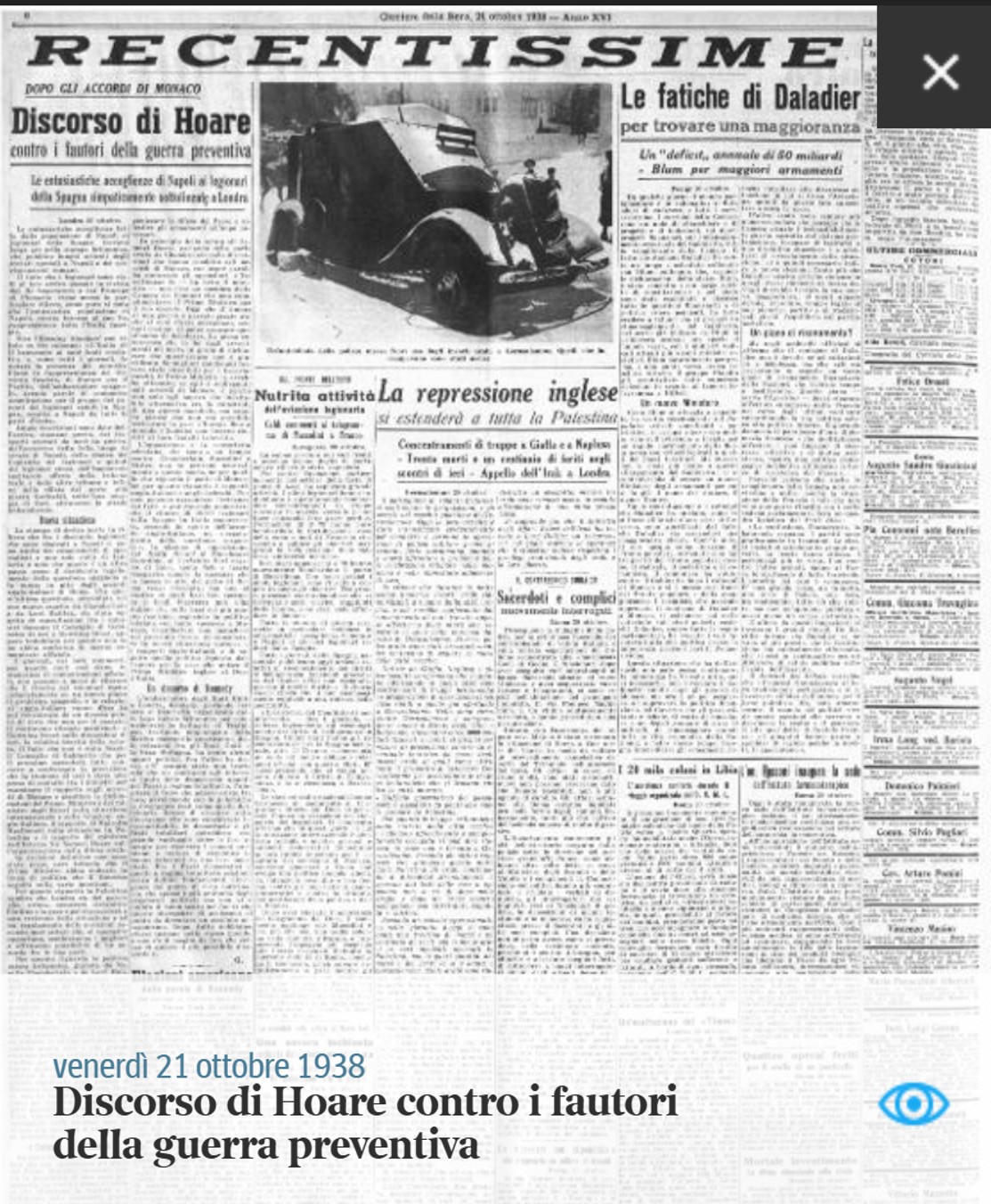
A copy of a page from the
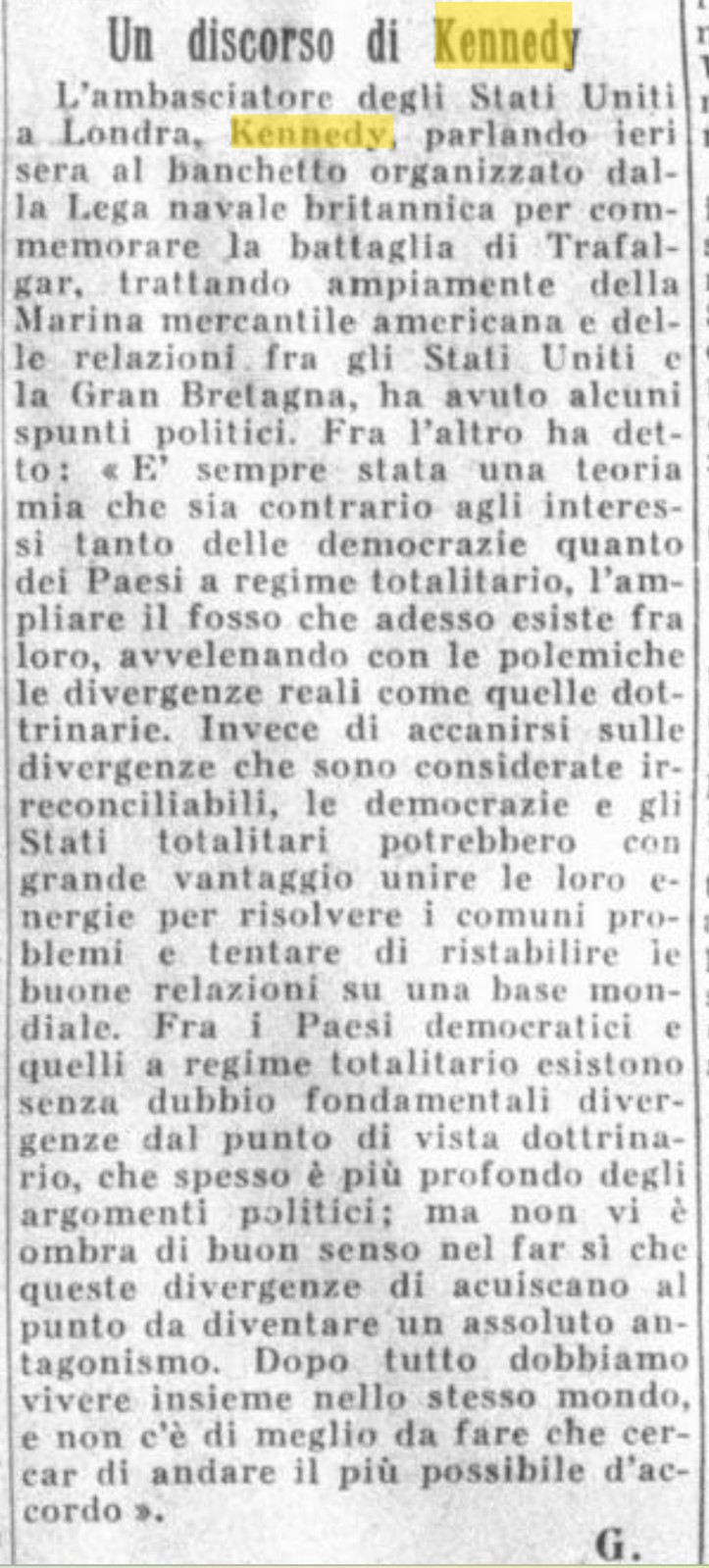
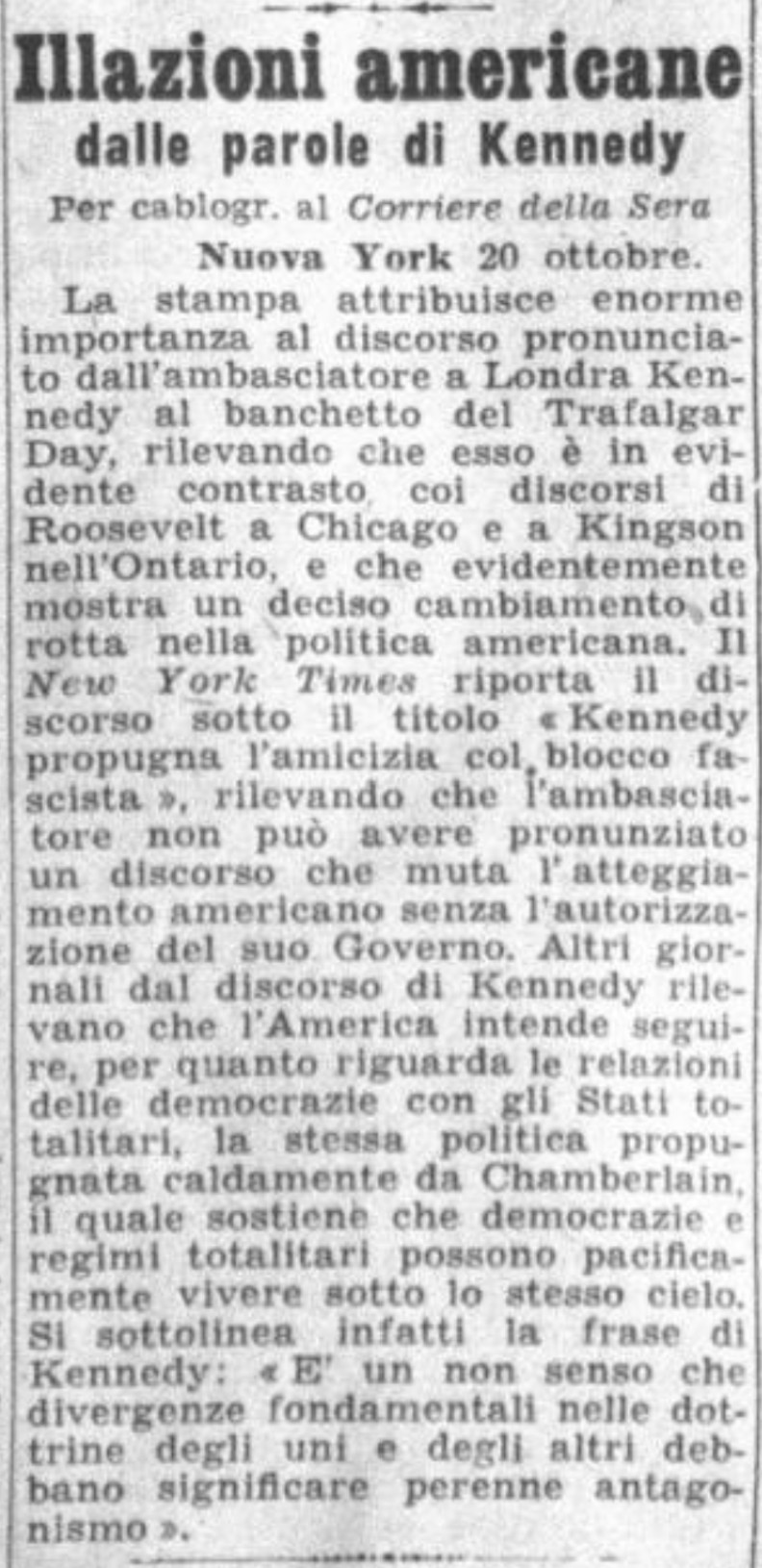
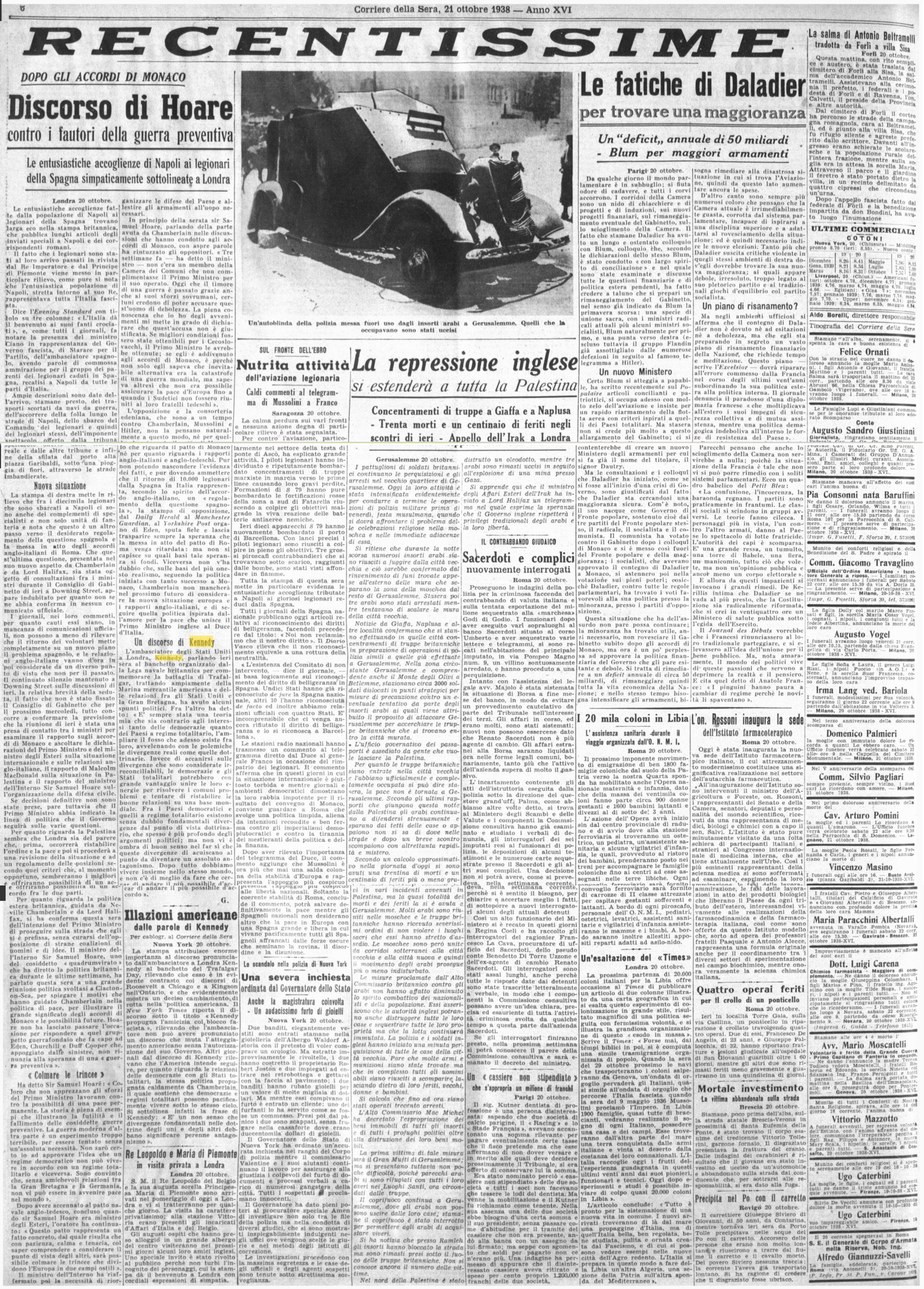
Italian newspaper *Corriere della Sera*, dated Friday, October 21, 1938. First article: "A Speech by Kennedy." Here is a summary of the article: During a banquet organized by the British Navy League to commemorate the Battle of Trafalgar, the United States Ambassador to London, Joseph Kennedy, delivered a speech focusing on the American merchant marine, Anglo-American relations, and international affairs. Kennedy argued that it is against the interests of both democracies and nations with totalitarian regimes to widen the chasm between them by poisoning relations with polemics over doctrinal and political differences. While acknowledging the existence of profound ideological divergences, the ambassador urged nations not to let these evolve into absolute antagonism. He called upon both democracies and totalitarian states to join forces to address common problems and restore good relations globally, emphasizing that, since they must "live together in the same world," the best course of action is to try to "get along as well as possible." Second article: "American Speculation Regarding Kennedy's Remarks." Here is a summary of the article: - U.S. newspapers attach great significance to the speech delivered in London by Ambassador Joseph Kennedy on the occasion of Trafalgar Day. The press notes that his words stand in clear contrast to previous statements made by President Roosevelt in Chicago and Kingston (Ontario), interpreting them as a potential and decisive shift in the direction of American foreign policy. - *The New York Times* runs a headline stating that "Kennedy Advocates Friendship with the Fascist Bloc," speculating that the ambassador could not have expressed such views without prior authorization from the government in Washington. -Other newspapers point out that America appears inclined to follow—in its dealings between democracies and totalitarian regimes—the same policy of appeasement championed by British Prime Minister Neville Chamberlain. Finally, reference is made to a key passage in Kennedy’s speech, in which he dismisses the notion that doctrinal differences must inevitably lead to perpetual antagonism as "nonsense." |
|
1938, December 17 - Corriere della Sera |
||
|
|
|
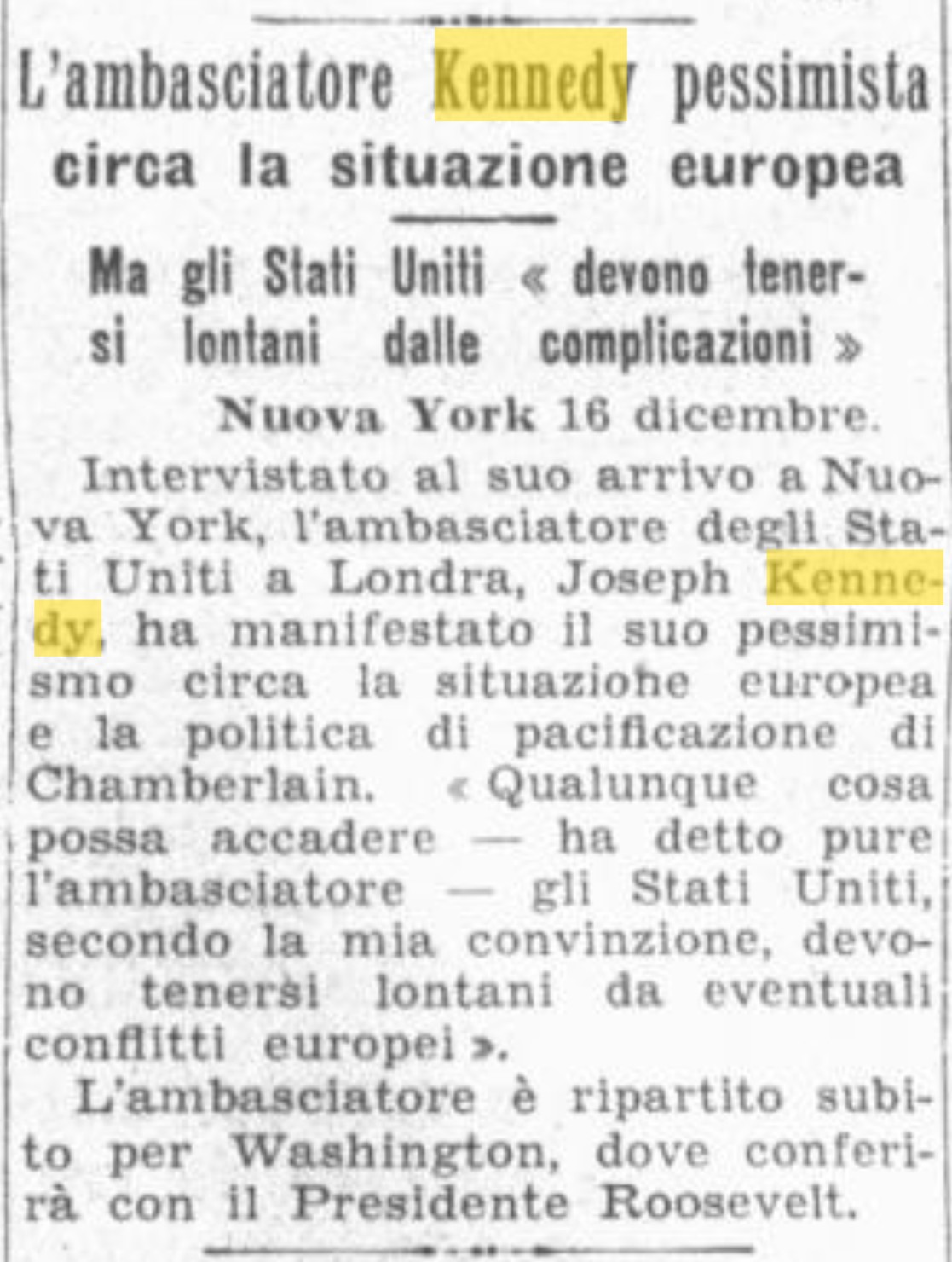
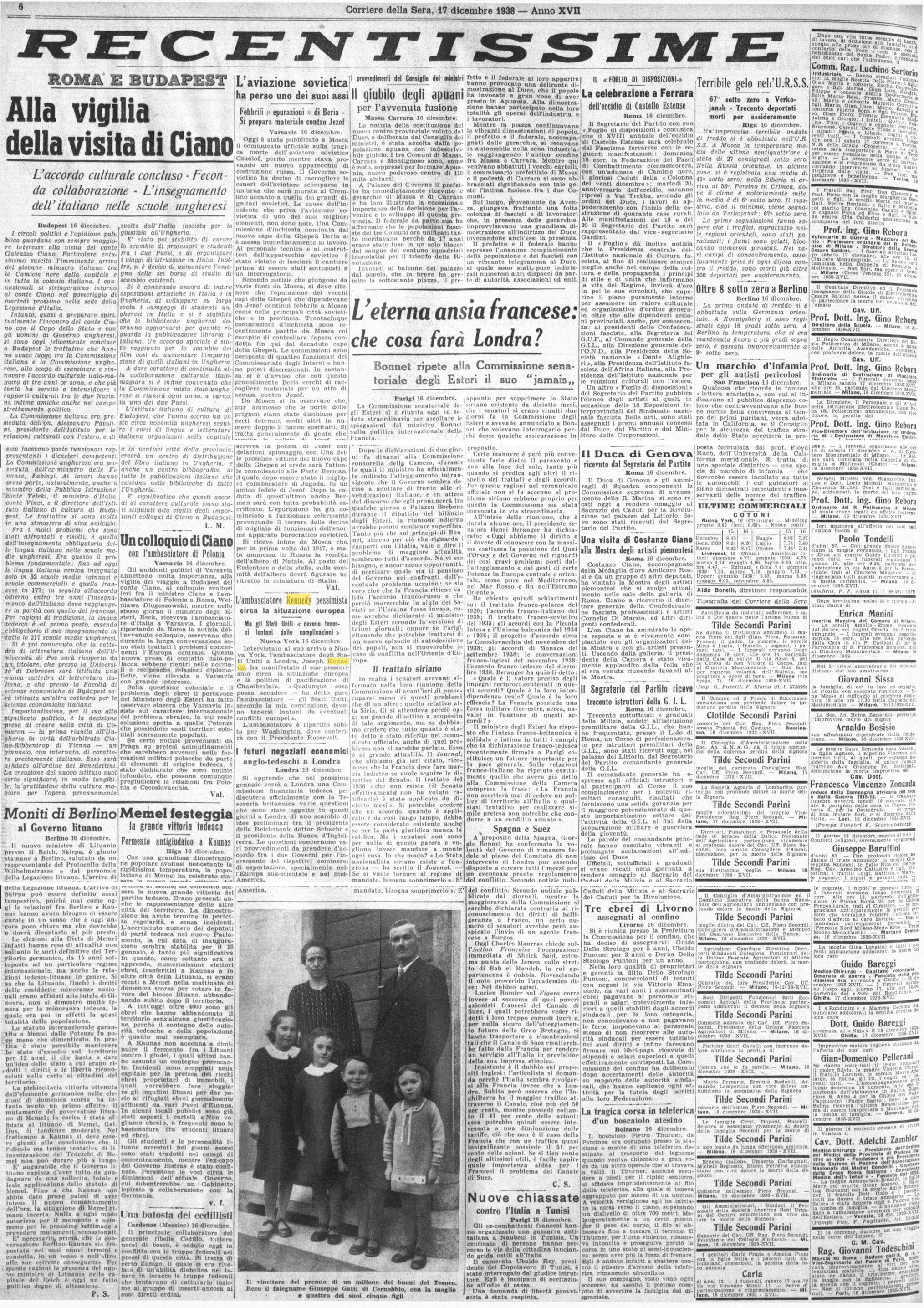
A copy of a page from the
Italian newspaper *Corriere della Sera*, dated Saturday, December 17,
1938. Article: "Ambassador Kennedy pessimistic regarding the European situation." Below is a summary of the article, dispatched from New York on December 16: - Kennedy’s pessimism: Upon his arrival in New York, the U.S. Ambassador to London, Joseph Kennedy, gave an interview in which he expressed deep pessimism regarding the political situation in Europe and the effectiveness of the policy of appeasement pursued by Neville Chamberlain. - American isolationism: Kennedy firmly emphasized his conviction that the United States should remain entirely detached and avoid any involvement in any potential future conflicts in Europe. - Departure for Washington: Immediately following his statements in New York, the ambassador departed for Washington to report directly to President Franklin D. Roosevelt. |
|
1938, December 18 - Corriere della Sera |
||
|
|
|
A copy of a page from the
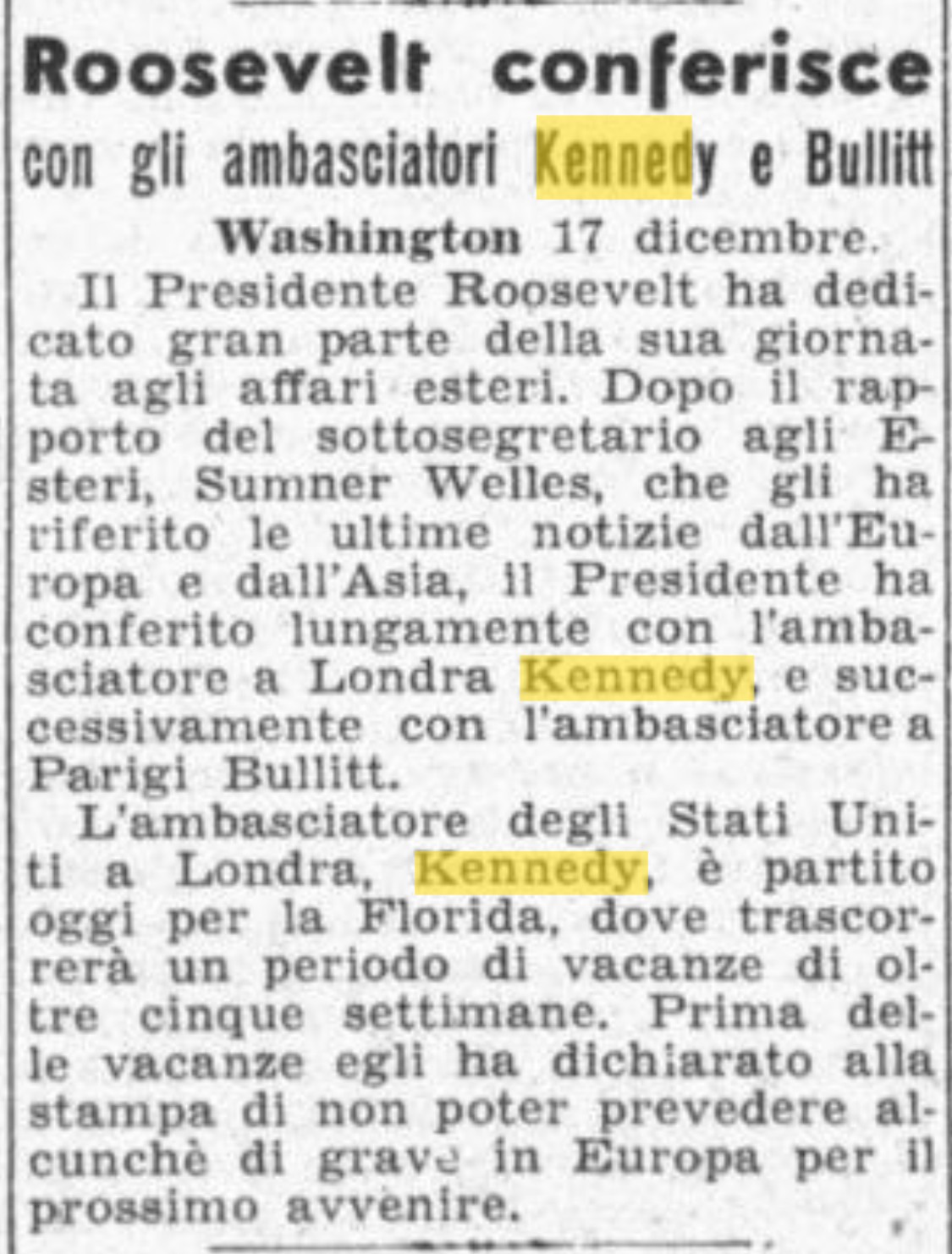
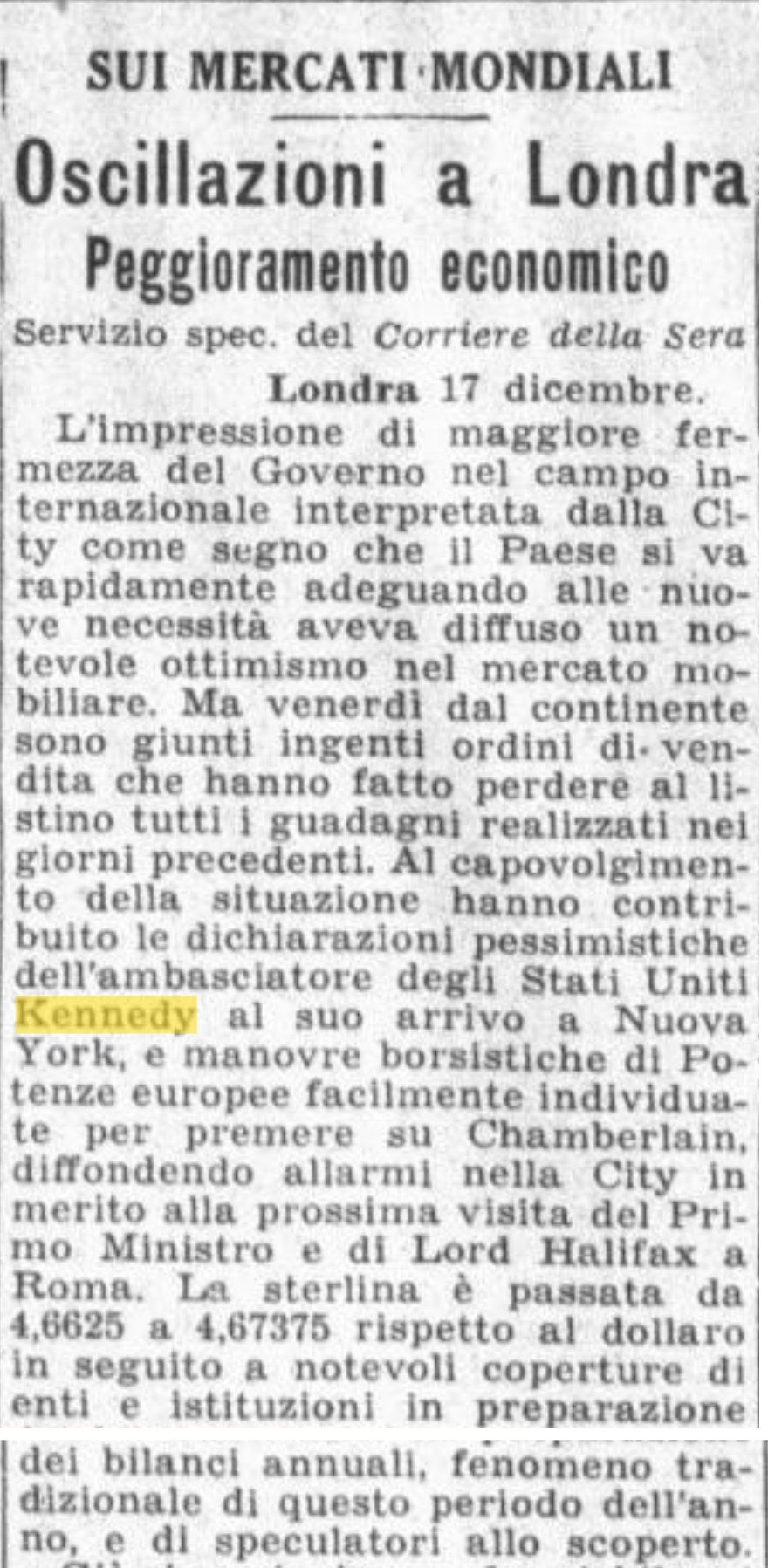
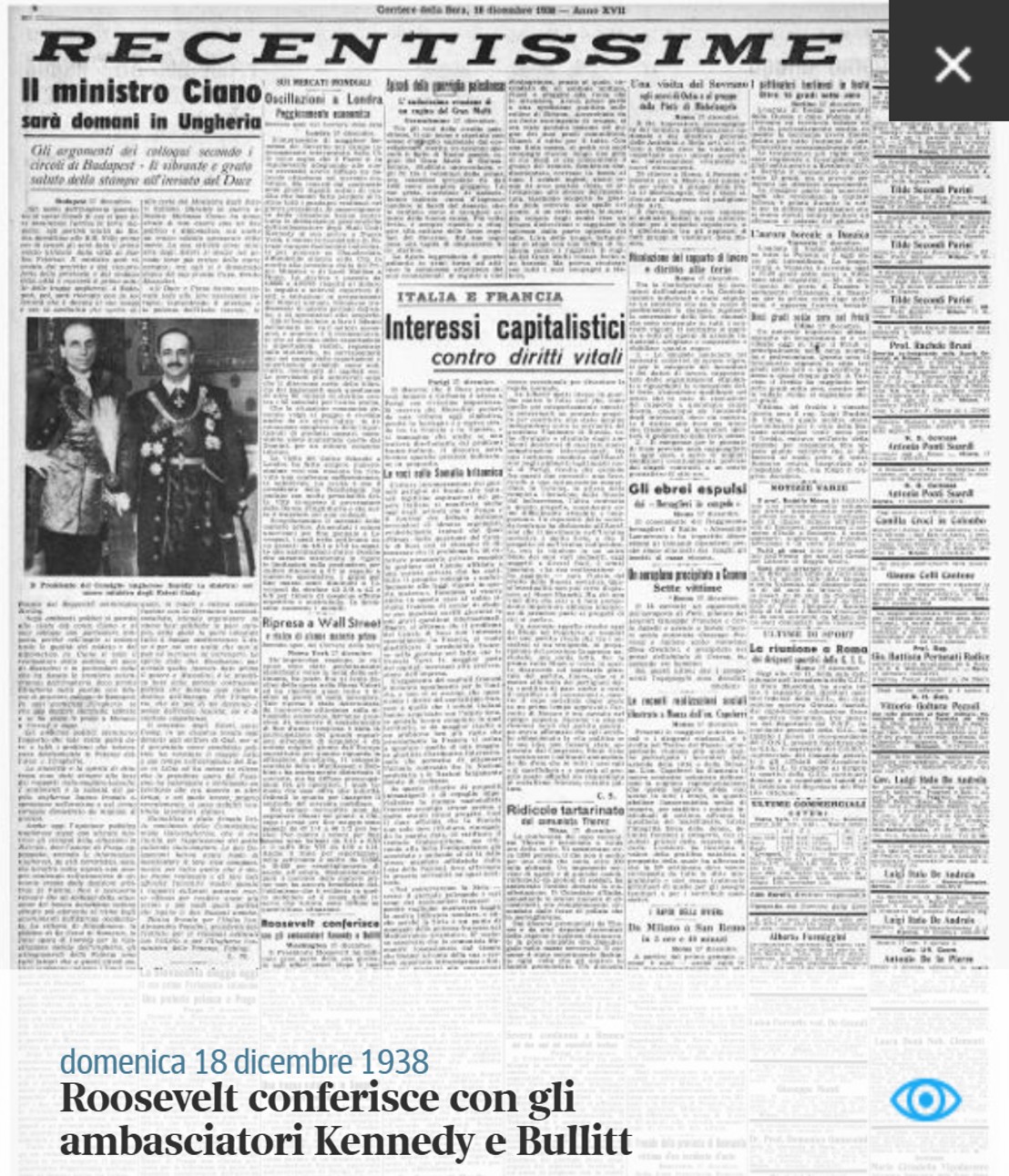
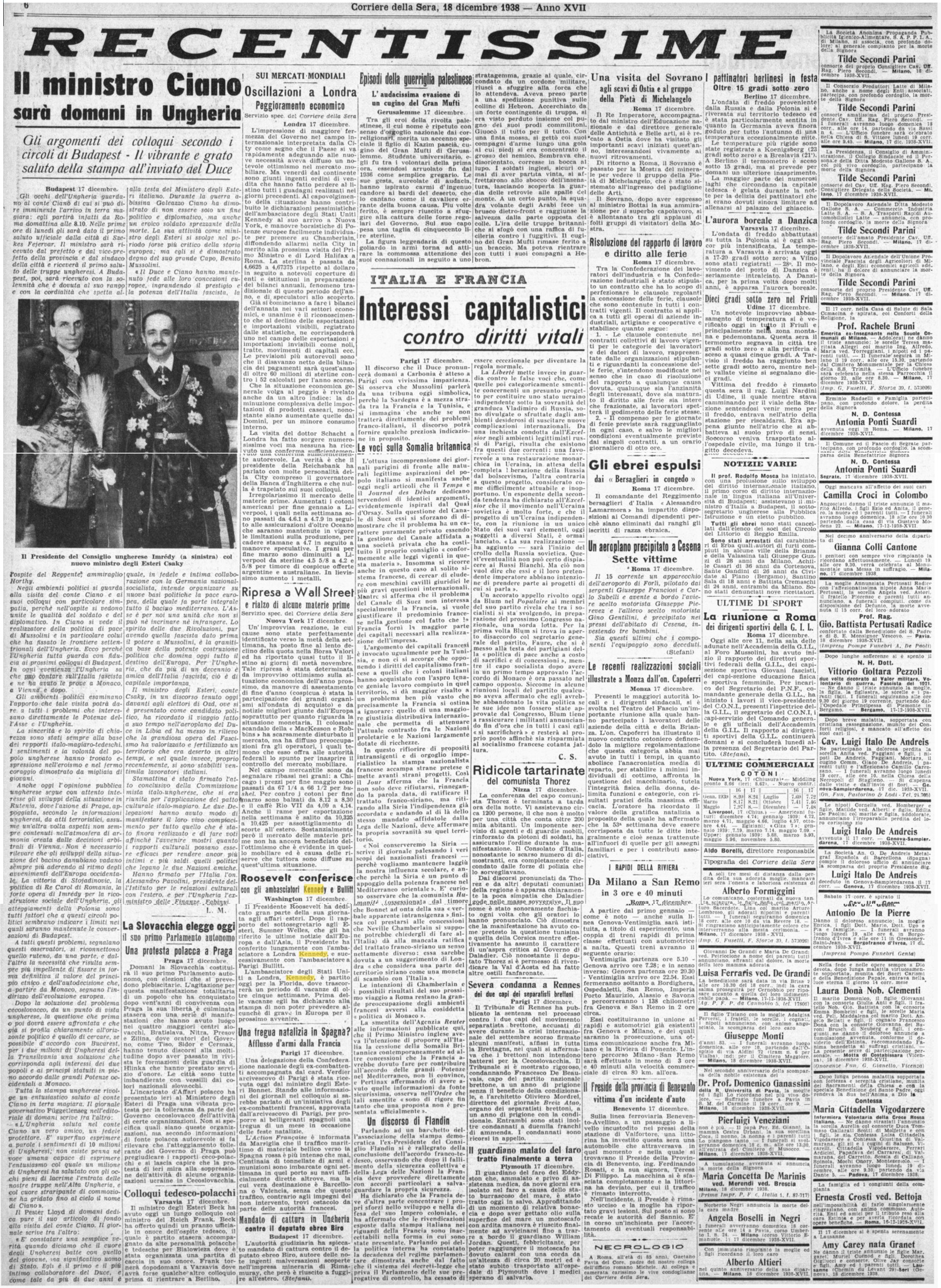
Italian newspaper *Corriere della Sera*, dated Sunday, December 18, 1938. Below is a summary of the two articles: - First article: "Fluctuations in London – Economic Deterioration." ° Impact on the markets: The London stock market lost all its recent gains due to heavy sell orders from the continent and speculative maneuvers ahead of the upcoming visit to Rome by Chamberlain and Lord Halifax. ° The effect of Kennedy’s statements: The pessimistic remarks made by U.S. Ambassador Joseph Kennedy upon his arrival in New York were a decisive factor in the negative turn taken by the financial situation. - Second article: "Roosevelt confers with Ambassadors Kennedy and Bullitt." ° President Roosevelt devoted the day to foreign policy: after hearing from Undersecretary Sumner Welles, he held lengthy discussions with the Ambassador to London, Joseph Kennedy, and subsequently with the Ambassador to Paris, William Bullitt. |
|
1939, January 11 - Corriere della Sera |
||
|
|
|
Copy of an article from
the Italian daily newspaper CORRIERE DELLA SERA, dated Wednesday, January
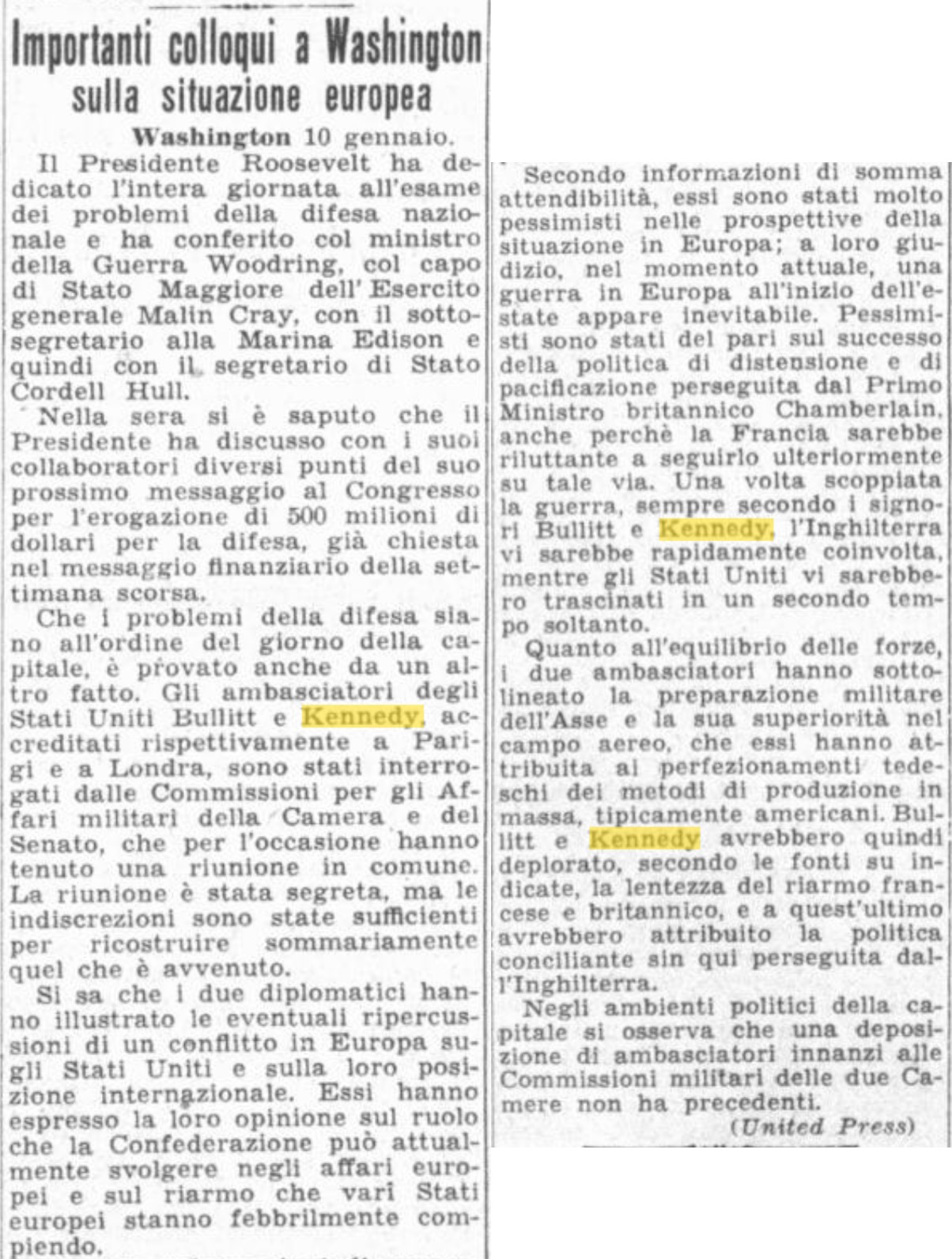
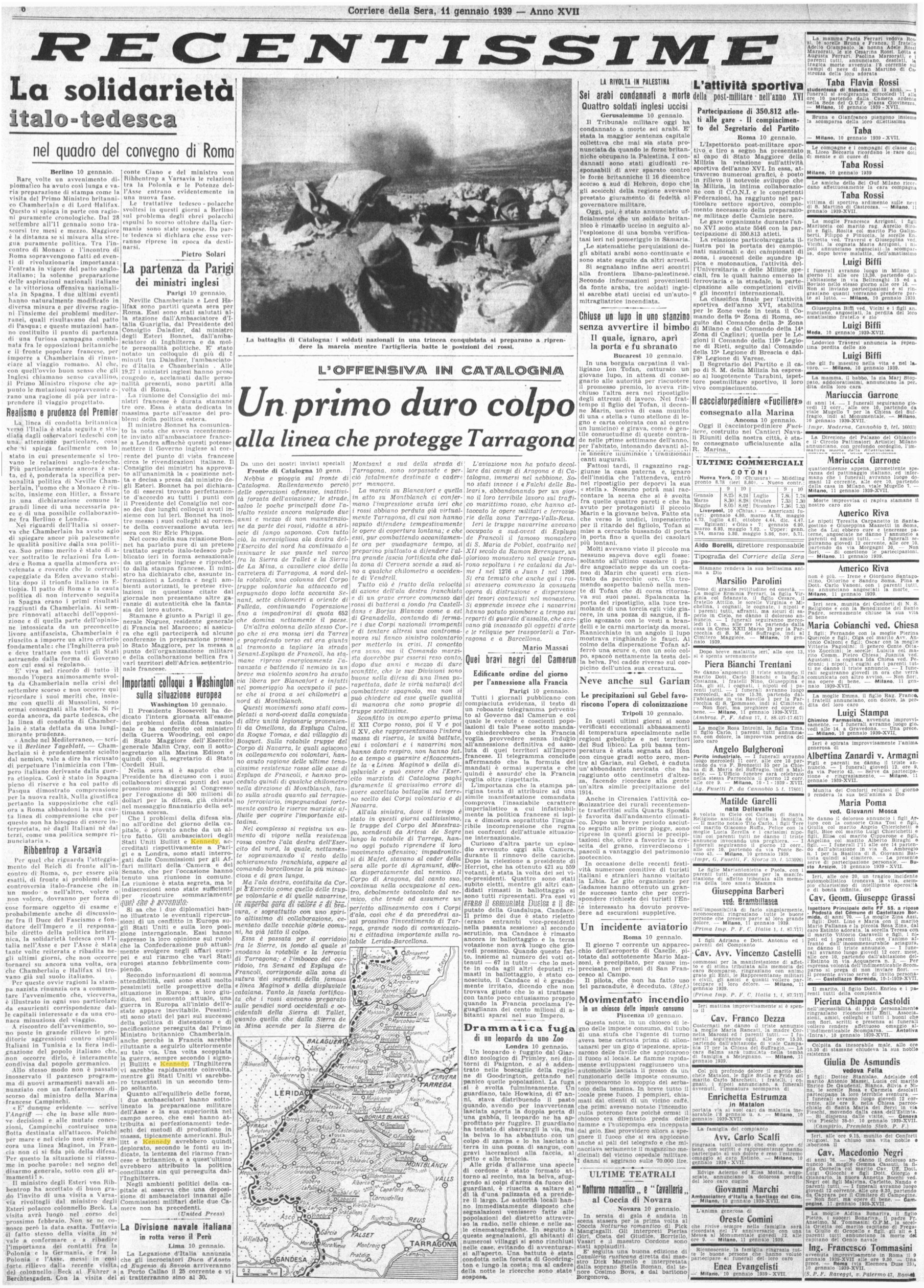
11, 1939. Article: "Important talks in Washington regarding the European situation." Summary: ° Defense talks in Washington: President Roosevelt dedicated an entire day to examining national defense and funding for rearmament (including a request to Congress for 500 million dollars), holding consultations with top military leaders and Secretary of State Cordell Hull. ° Testimony from Joseph Kennedy and William Bullitt: U.S. Ambassadors Joseph Kennedy (London) and William Bullitt (Paris) were questioned during a joint, closed-door session of the House and Senate Committees on Military Affairs regarding the potential repercussions of a European conflict for the United States. ° Pessimism regarding war: According to reliable reports, Kennedy and Bullitt expressed extreme pessimism, viewing a war in Europe as inevitable by the beginning of summer and concluding that Chamberlain’s policy of appeasement had failed. In their assessment, should a conflict break out, England would be immediately involved, and the United States would eventually be drawn in as well. ° The Axis powers' air superiority: Both ambassadors—Kennedy in particular—highlighted the military preparedness of the Axis powers and their air superiority (attributed to German mass-production methods derived from American techniques). They also lamented the slow pace of Franco-British rearmament, which had forced London to pursue a conciliatory policy thus far. |
|
1939, January 12 - Corriere della Sera |
||
|
|
|
A copy of an article from
the Italian daily newspaper *Corriere della Sera*, dated Thursday, January
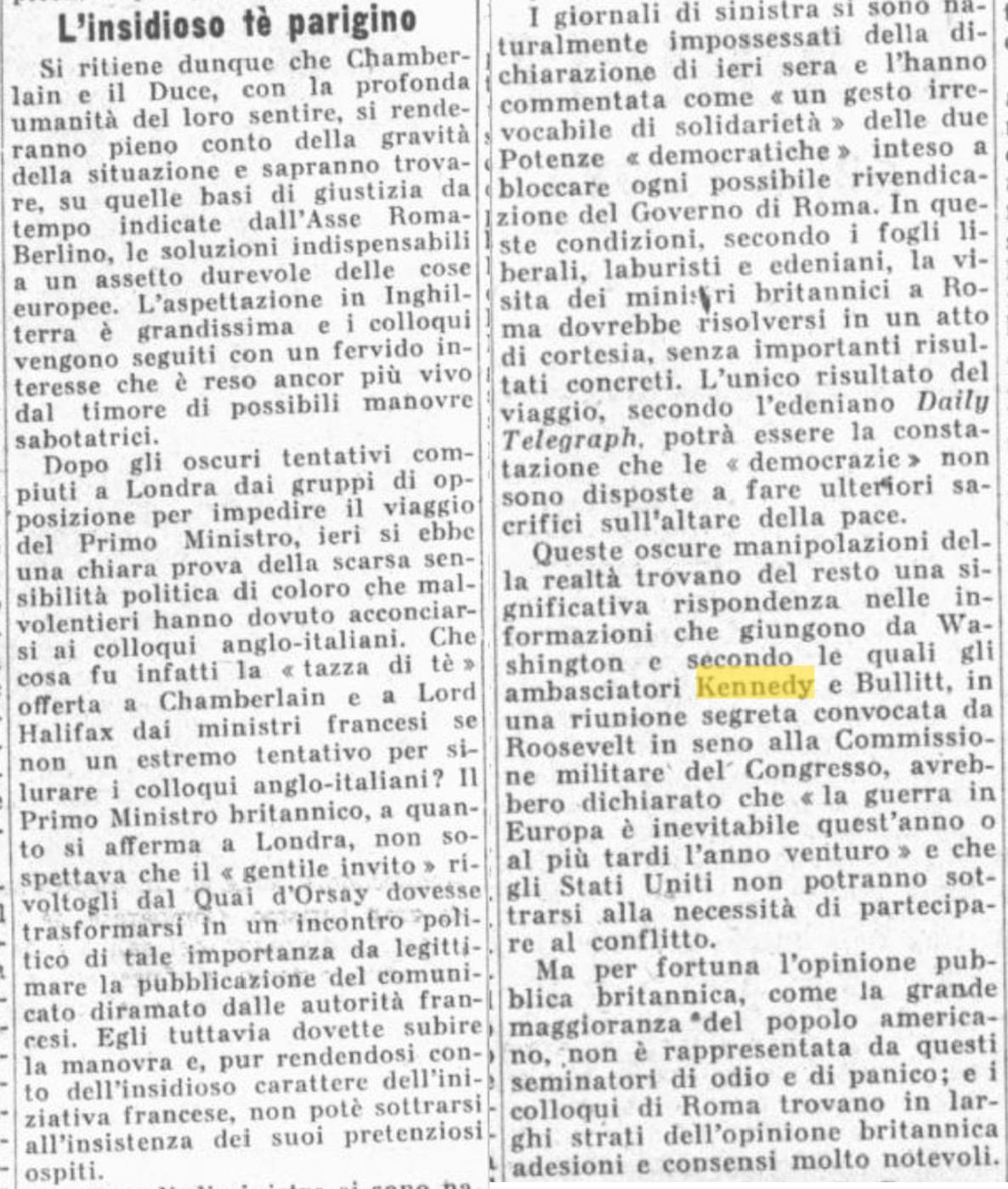
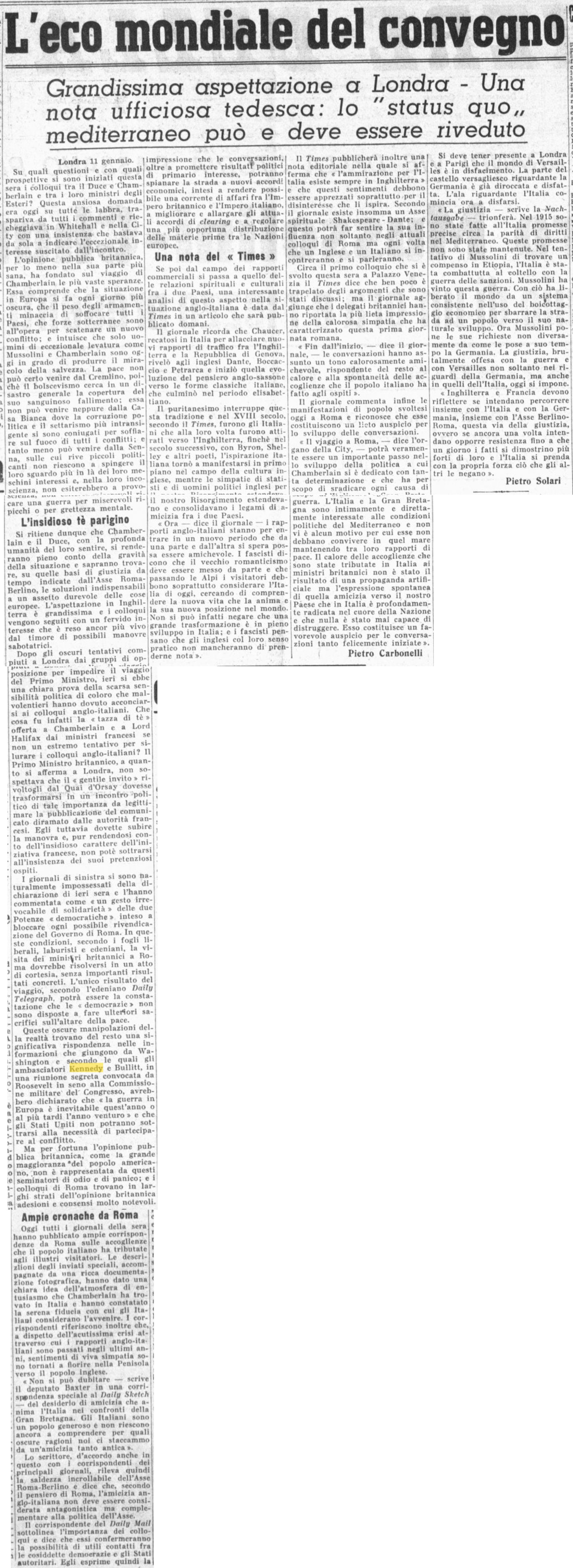
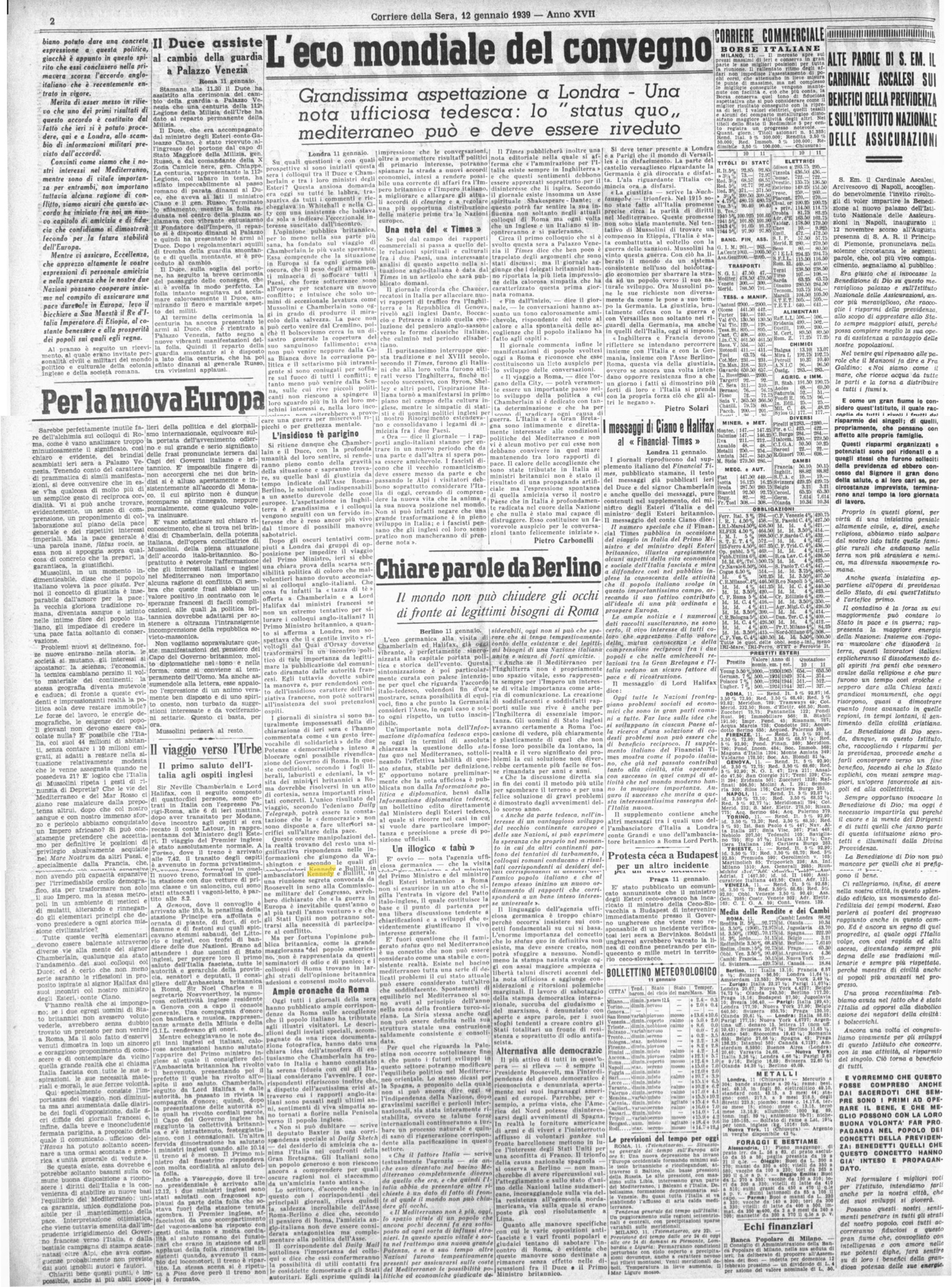
12, 1939. The article, by Pietro Carbonelli, is titled "The Global Echo of the Meeting." Here is a summary: ° Anticipation for the Rome talks: The article describes the intense expectation in London regarding the meetings in Rome between British Prime Minister Neville Chamberlain, Lord Halifax, and Benito Mussolini. Despite attempts by the opposition and circles in Paris to hinder an Anglo-Italian understanding, Chamberlain reaffirmed his firm intention to continue the dialogue. ° Press stances and cultural rapprochement: The text cites an article from *The Times* that focuses on the historical and cultural ties between Italy and England, highlighting a desire to maintain peace in the Mediterranean—while also noting an unofficial German statement suggesting that a revision of the Mediterranean *status quo* is inevitable. ° The role and statements of Ambassador Kennedy: The text makes explicit reference to reports from Washington concerning secret Congressional hearings. The article states that U.S. Ambassadors Kennedy (in London) and Bullitt (in Paris)—during a meeting convened by Roosevelt—reportedly told Congress that "war in Europe is inevitable this year, or at the latest next year," and that the United States would be unable to avoid participating in it. |
|
1939, February 12 - Corriere della Sera |
||
|
|
|
Copy of an article from
the Italian newspaper CORRIERE DELLA SERA, dated Sunday, February 12,
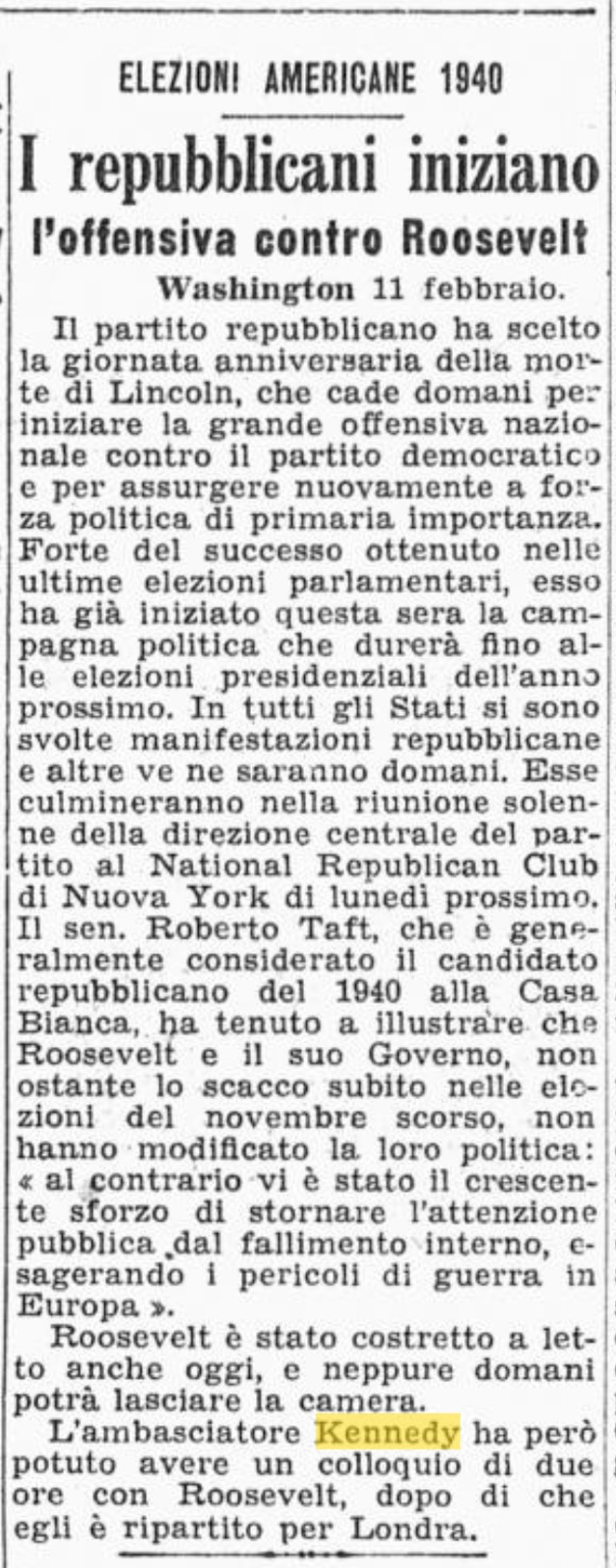
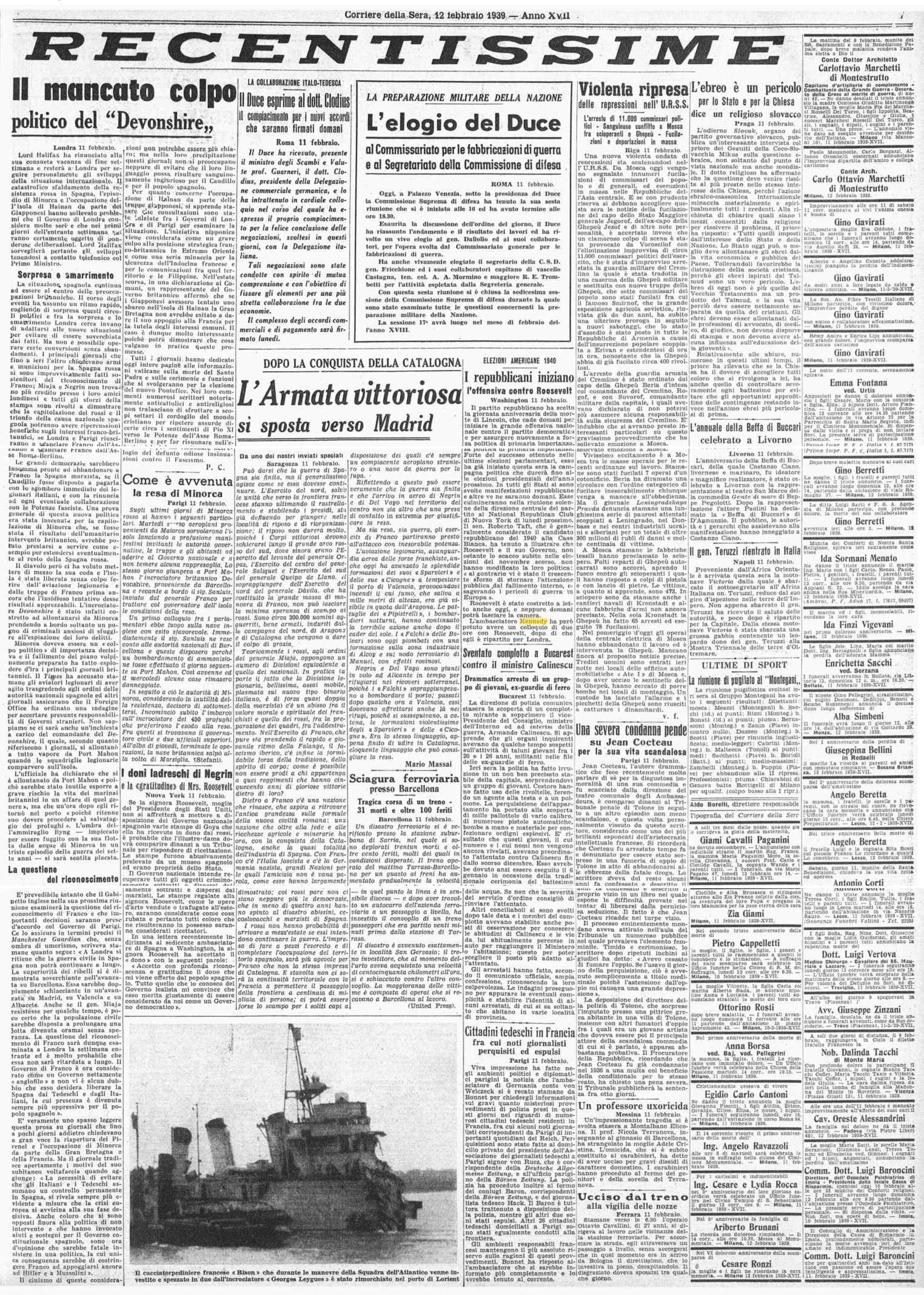
1939. Article: "1940 American Elections. The Republicans begin their offensive against Roosevelt." Here is a summary: ° The Republican Party's offensive: On the anniversary of Lincoln's death, the Republican Party launched its national campaign ahead of the 1940 presidential election. Senator Robert Taft, a leading contender for the White House, accused Roosevelt and his administration of attempting to divert public attention from the failures of their domestic policy by exaggerating the dangers of war in Europe. ° Meeting with Ambassador Kennedy: Although President Roosevelt was confined to his bed due to health issues, Ambassador Joseph Kennedy was able to hold a lengthy, two-hour discussion with him, after which he departed for London. |
|
1939, February 18 - Corriere della Sera |
||
|
|
|
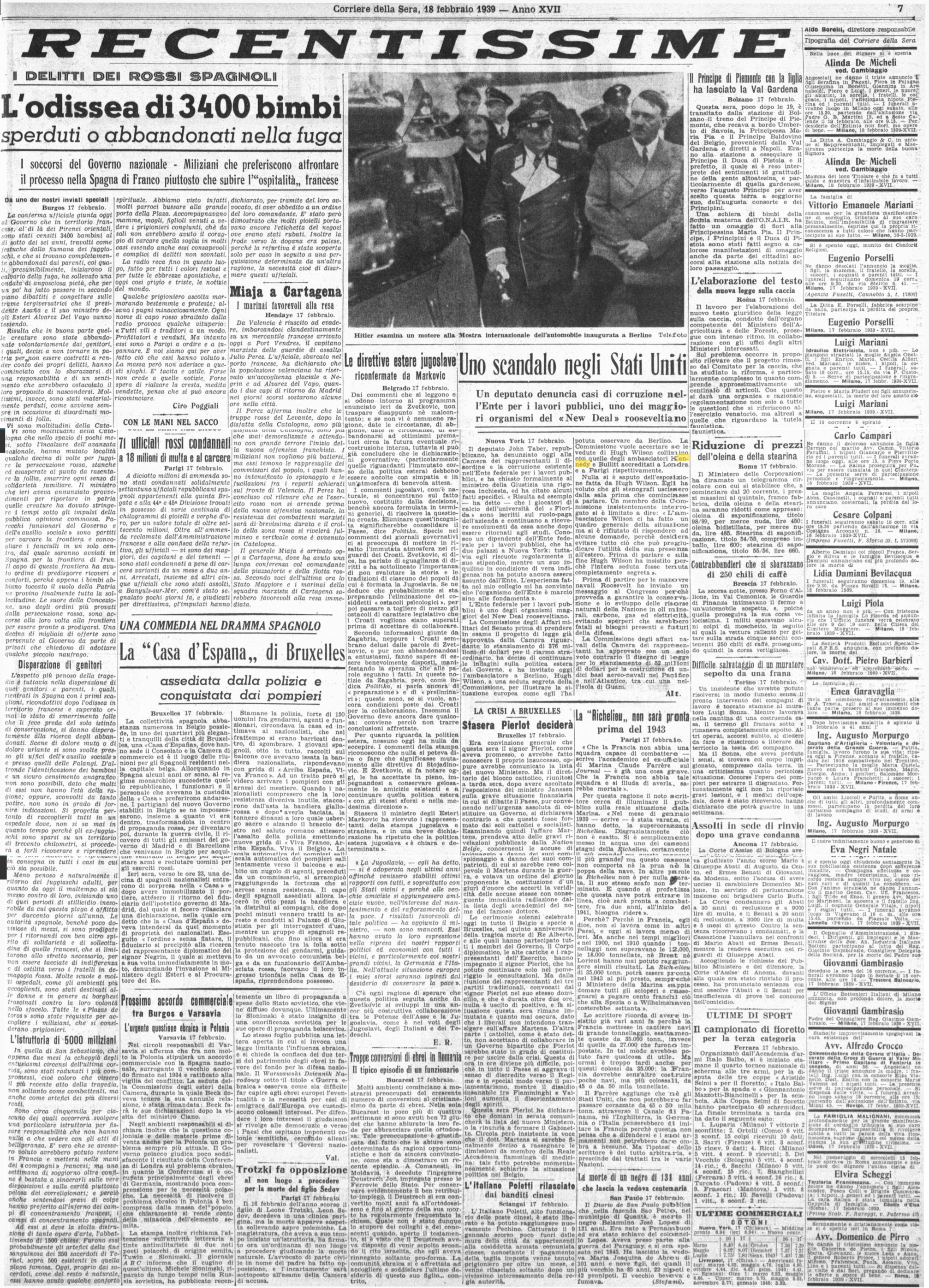
A copy of an article from
the Italian newspaper CORRIERE DELLA SERA, dated Saturday, February 18,
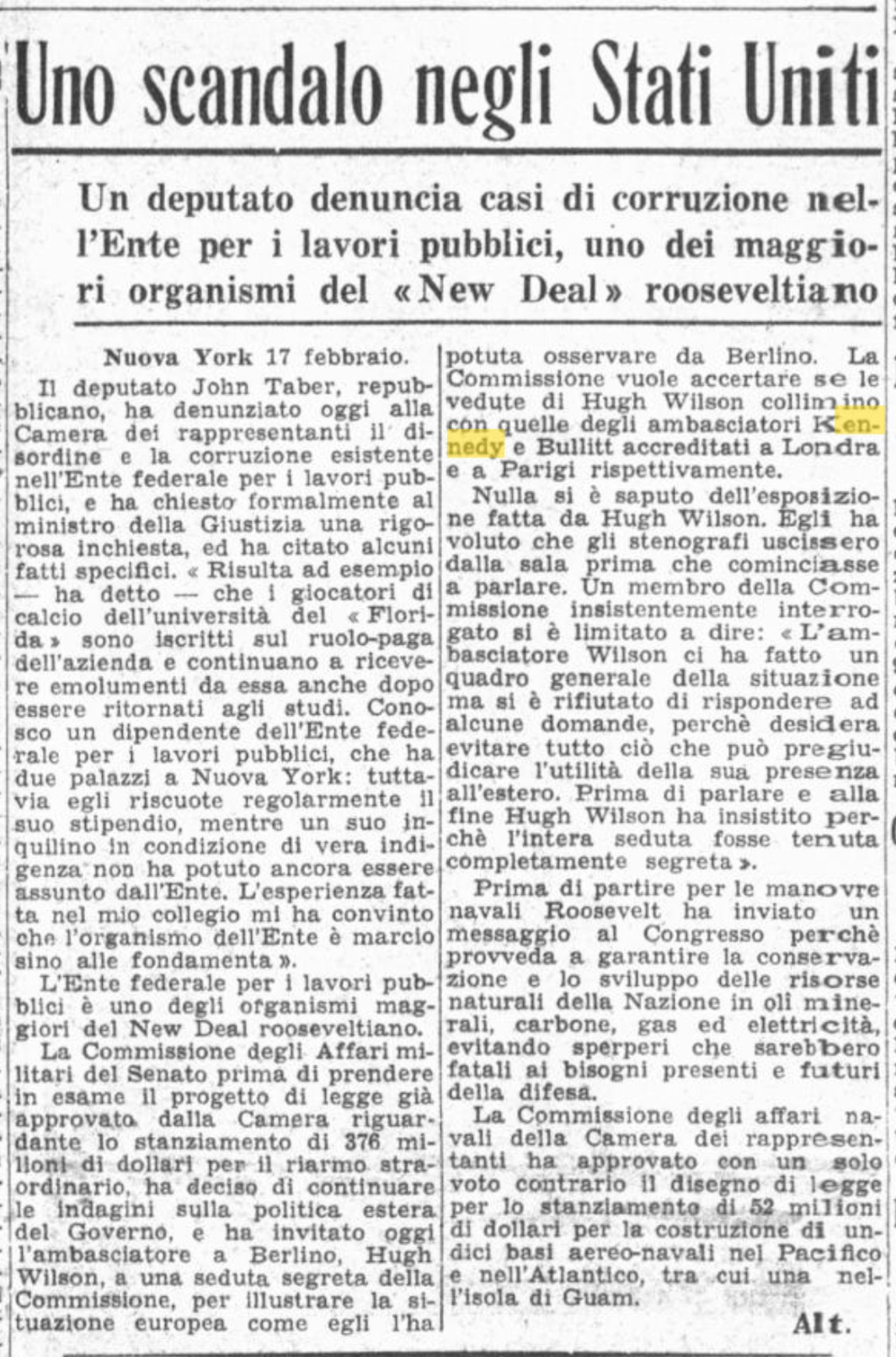
1939. Article (from New York, February 17): "A Scandal in the United States." Here is a summary of the article: ° The New Deal corruption scandal: Republican Congressman John Taber denounced instances of mismanagement and corruption within the federal public works agency (one of the pillars of Roosevelt’s New Deal) before the House of Representatives. He called for an investigation, citing examples such as football players being paid by the agency, and officials living in affluence while those in genuine need were left out. ° The secret hearing of Ambassador Wilson: The Senate Committee on Military Affairs continued its inquiry into the government’s foreign policy by hearing testimony—in a closed session—from the American Ambassador to Berlin, Hugh Wilson. ° Comparison with Ambassador Kennedy: The Committee sought to determine whether Hugh Wilson’s assessments of the European situation aligned with the views previously expressed by Ambassadors Joseph Kennedy (London) and William Bullitt (Paris). Wilson provided an overview of the situation but insisted on strict confidentiality, declining to answer certain questions so as not to compromise his diplomatic efforts. |
|
1939, February 28 - Corriere della Sera |
||
|
|
|
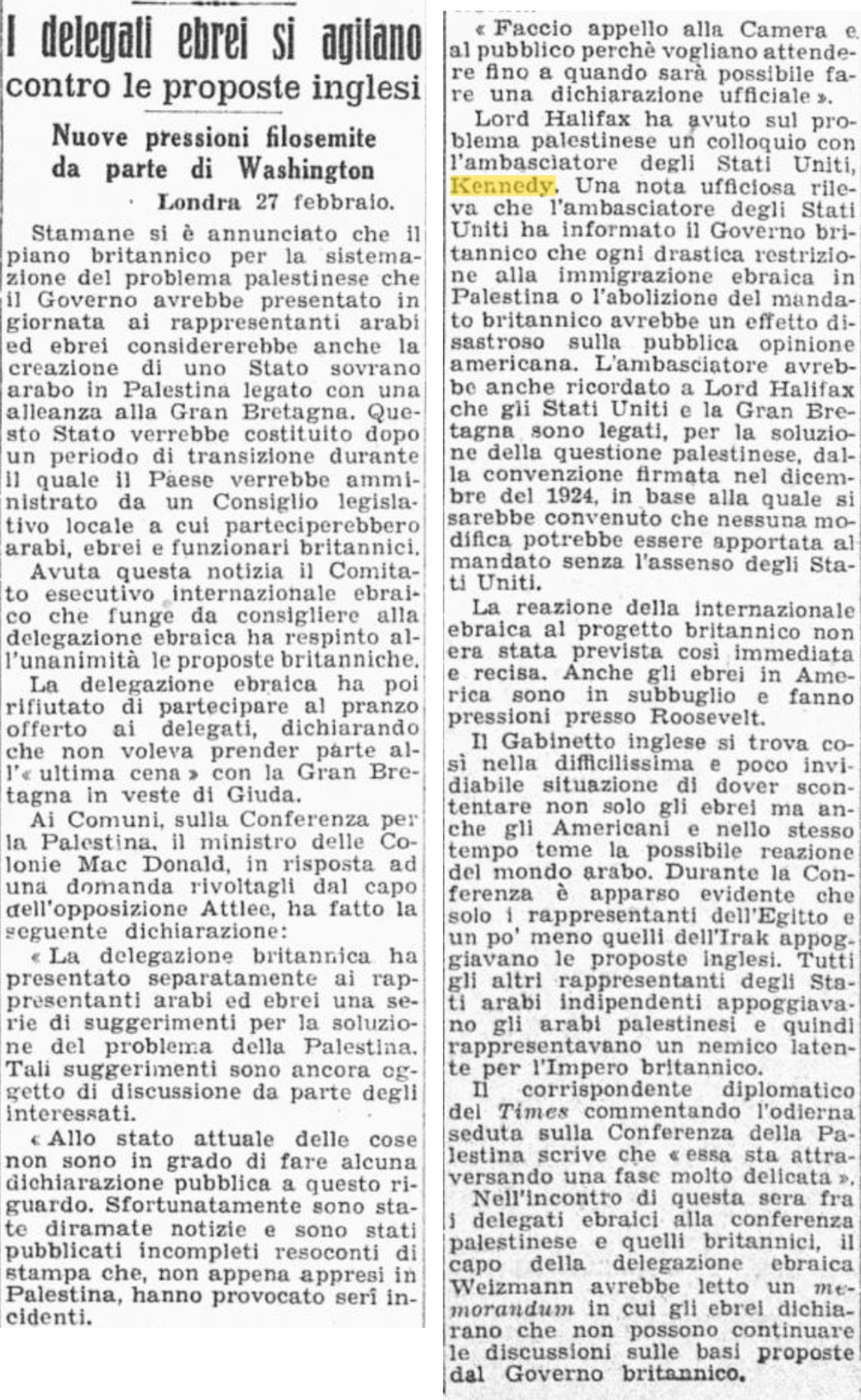
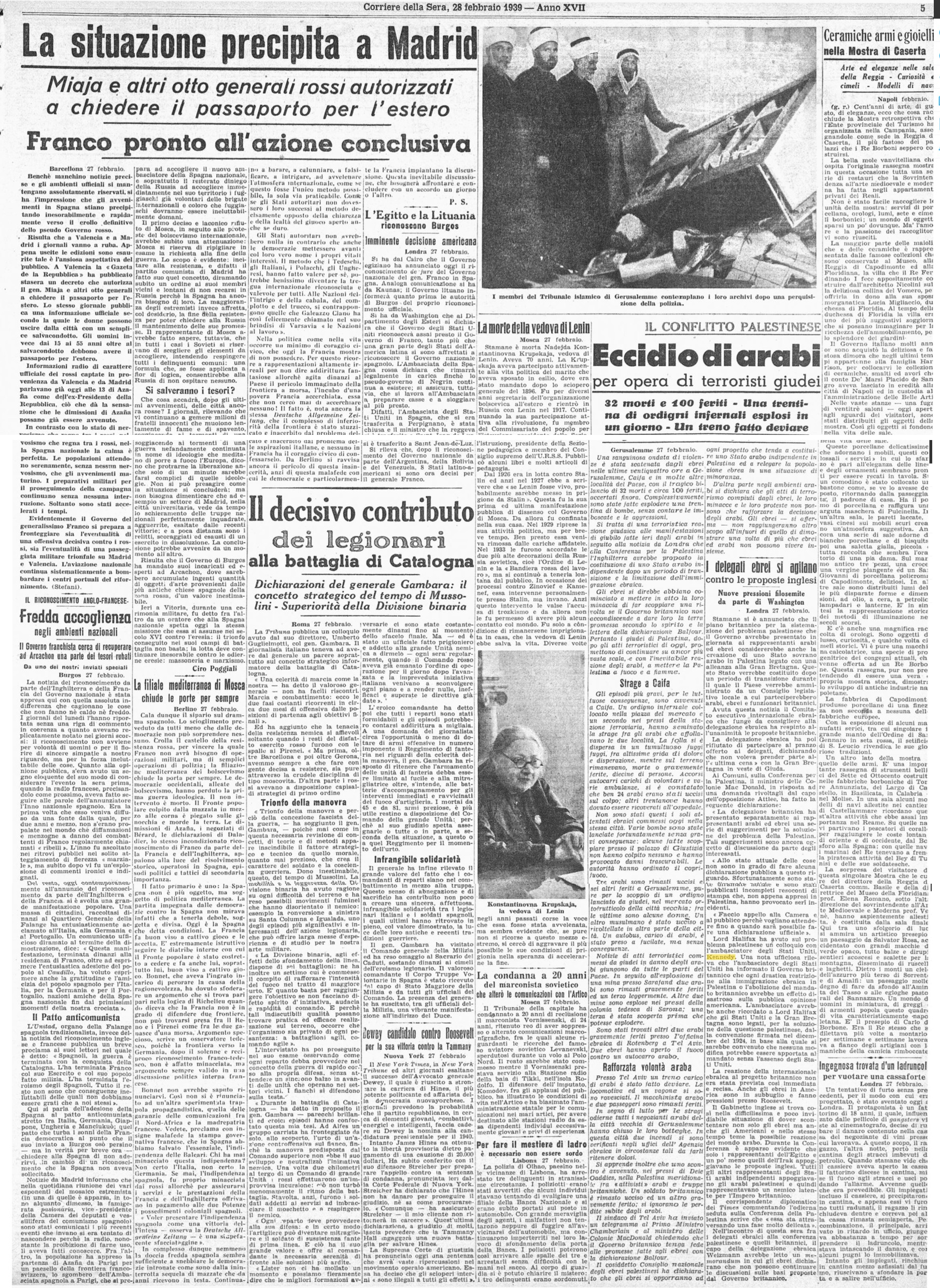
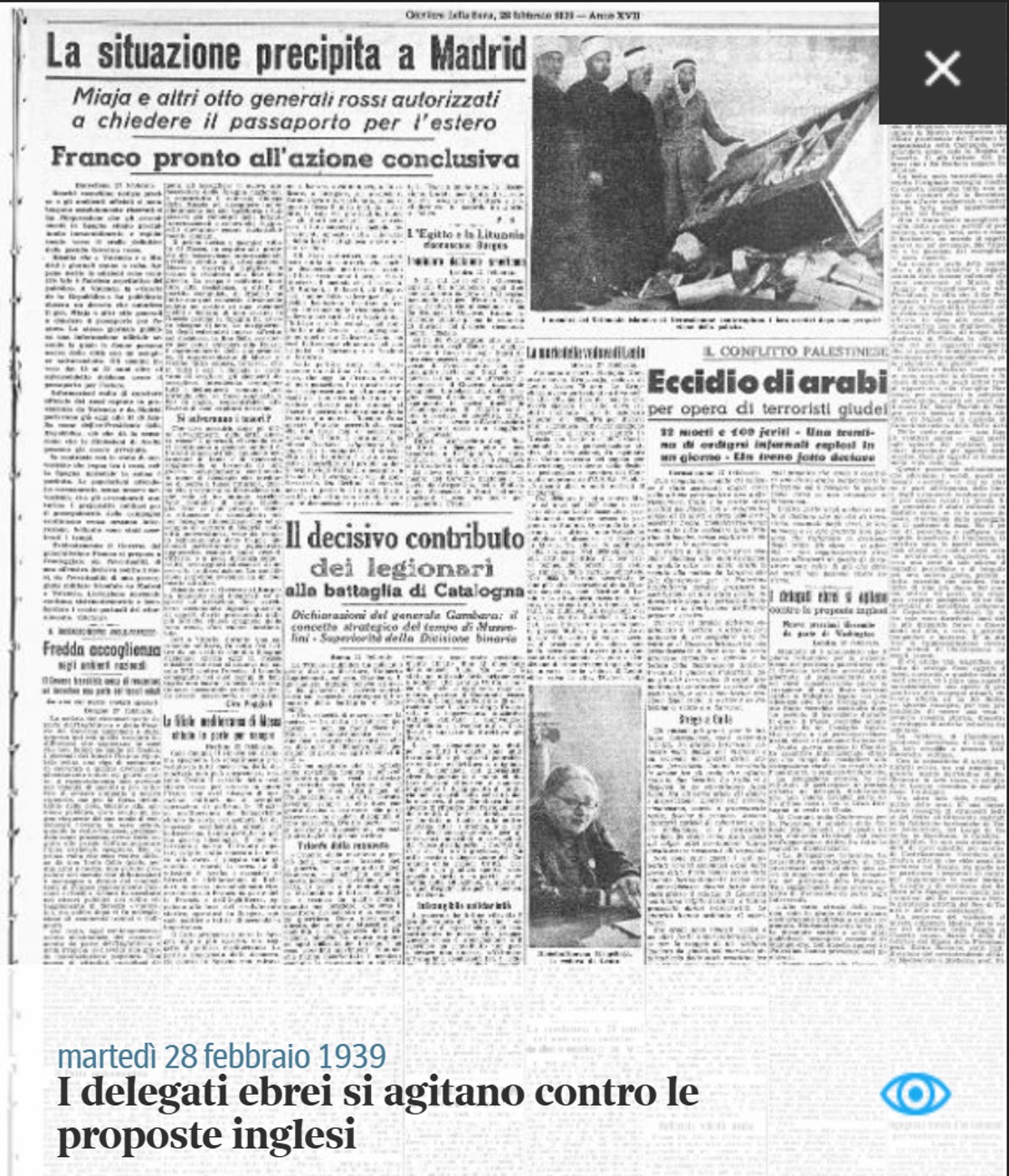
Copy of an article from
the Italian daily newspaper CORRIERE DELLA SERA, dated Tuesday, February
28, 1939. Article (from London, February 27): "Jewish delegates protest against British proposals." Here is a summary of the article: ° The British plan for Palestine: The British government intends to present Arab and Jewish representatives with a plan for the creation of a sovereign Arab state—linked to England by an alliance—following a transitional period under a local legislative council. ° Jewish protest and rejection: The International Jewish Executive Committee has unanimously rejected the British proposals. The Jewish delegation even refused to attend a luncheon hosted by the British delegates, describing it as "the last supper with Great Britain in the role of Judas." ° Intervention by Ambassador Joseph Kennedy and U.S. pressure: Lord Halifax held a specific discussion with American Ambassador Joseph Kennedy, who informed the British government that any drastic restriction on Jewish immigration to Palestine—or the abolition of the Mandate—would have a "disastrous" effect on American public opinion. Kennedy also pointed to the 1924 convention, which stipulates that no changes to the Mandate may be made without the consent of the United States. ° Statements in the House of Commons and a stalemate in negotiations: In the House of Commons, Colonial Secretary MacDonald sought to temper the situation by urging patience until official statements could be made. Nevertheless, the Jewish delegation, led by Weizmann, submitted a memorandum declaring it impossible to continue discussions based on the British proposals. |
|
1939, March 8 - Corriere della Sera |
||
|
|
|
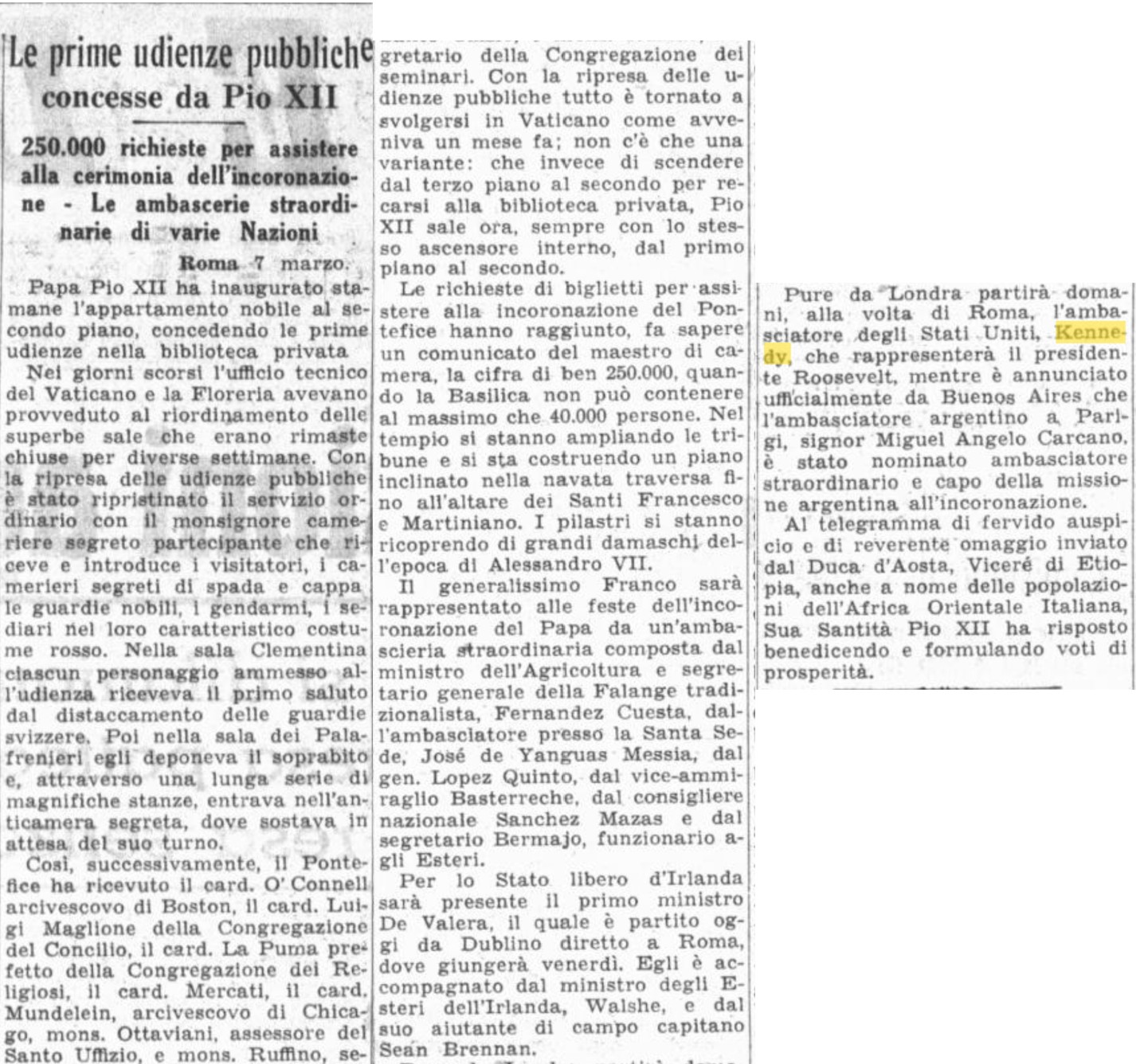
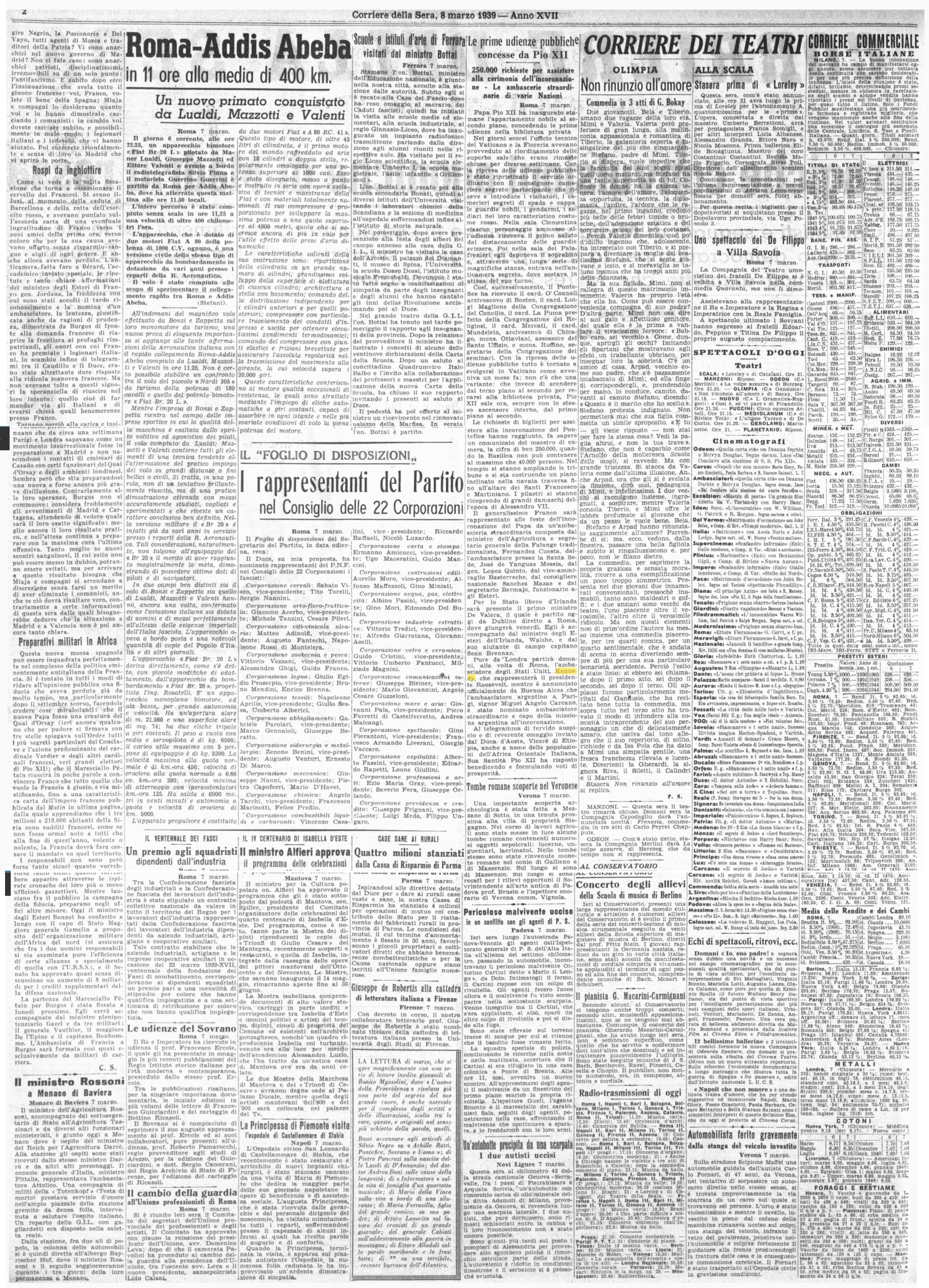
Copy of an article from
the Italian daily newspaper CORRIERE DELLA SERA, dated Wednesday, March 8,
1939. Article (from Rome, March 7): "The first public audiences granted by Pius XII." Here is a summary of the article: ° The first engagements and audiences of Pius XII: The newly elected Pope Pius XII has taken up residence in his apartment on the second floor of the Vatican, granting his first private audiences in the library—receiving, among others, Cardinal O'Connell, Archbishop of Boston, and Cardinal Mundelein of Chicago—and reinstating the standard ceremonial protocols and routine services. ° Preparations and attendance for the coronation: As many as 250,000 requests for tickets to attend the Pope’s coronation ceremony have been received. Since St. Peter’s Basilica can accommodate a maximum of 40,000 people, work is underway to set up and expand the interior viewing stands. ° The role of Ambassador Joseph Kennedy: The article announces that the United States Ambassador to London, Joseph Kennedy, will depart the following day for Rome to officially represent President Roosevelt at the new Pope’s coronation ceremonies. |
|
1939, March 8 - Corriere della Sera |
||
|
|
|
A copy of an article from
the Italian daily newspaper *Corriere della Sera*, dated Wednesday, March
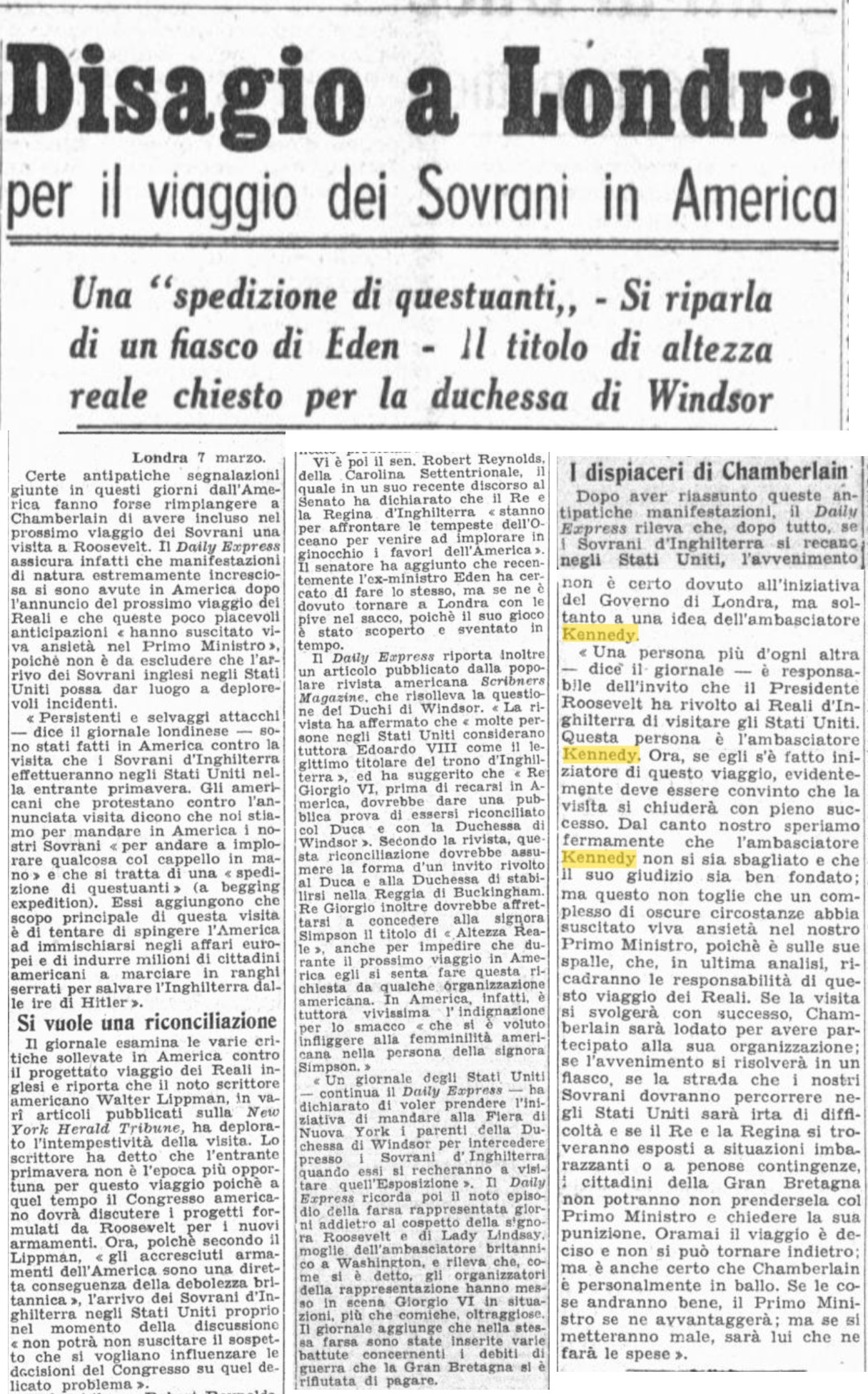
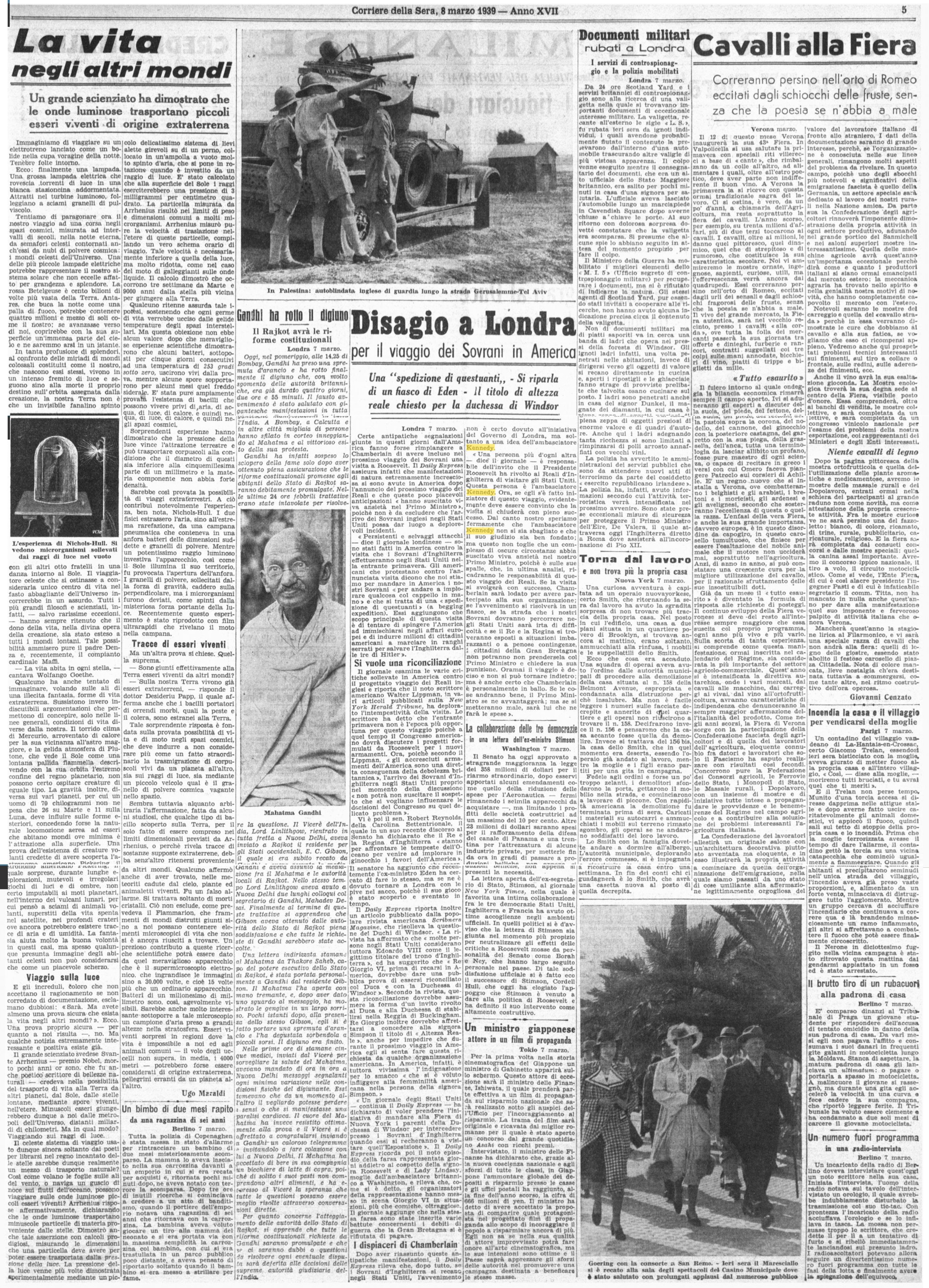
8, 1939. Article (from London, March 7): "Unease in London regarding the Sovereigns' trip to America." A summary of the article follows: ° Doubts in London concerning the Royal couple's trip: The announcement of the upcoming visit to America by King George VI and the Queen is causing significant anxiety for Prime Minister Chamberlain, due to the hostile reactions observed in the United States. ° Criticism and controversy in the USA: The American press and certain political figures (including Senator Reynolds) have attacked the visit, labeling it a "begging mission"—an attempt to plead for American aid and draw the USA into a potential conflict against Hitler. Journalist Walter Lippmann also deemed the timing of the trip ill-advised, as it coincides with congressional debates regarding American rearmament plans. ° The decisive role of Ambassador Joseph Kennedy: The article cites an analysis from the *Daily Express*, which suggests that the initiative for the trip did not originate with the London government, but was instead the brainchild of Ambassador Joseph Kennedy. Kennedy is identified as the individual responsible for the invitation extended by Roosevelt to the Sovereigns. ° Political risks for Chamberlain: Because the idea was promoted by Kennedy, Chamberlain finds himself in a difficult position: if the visit proves successful, the British Prime Minister will take the credit; however, should it turn into a diplomatic fiasco, he will be the one to pay the political price in the eyes of the British public. |
|
1939, March 9 - Corriere della Sera |
||
|
|
|
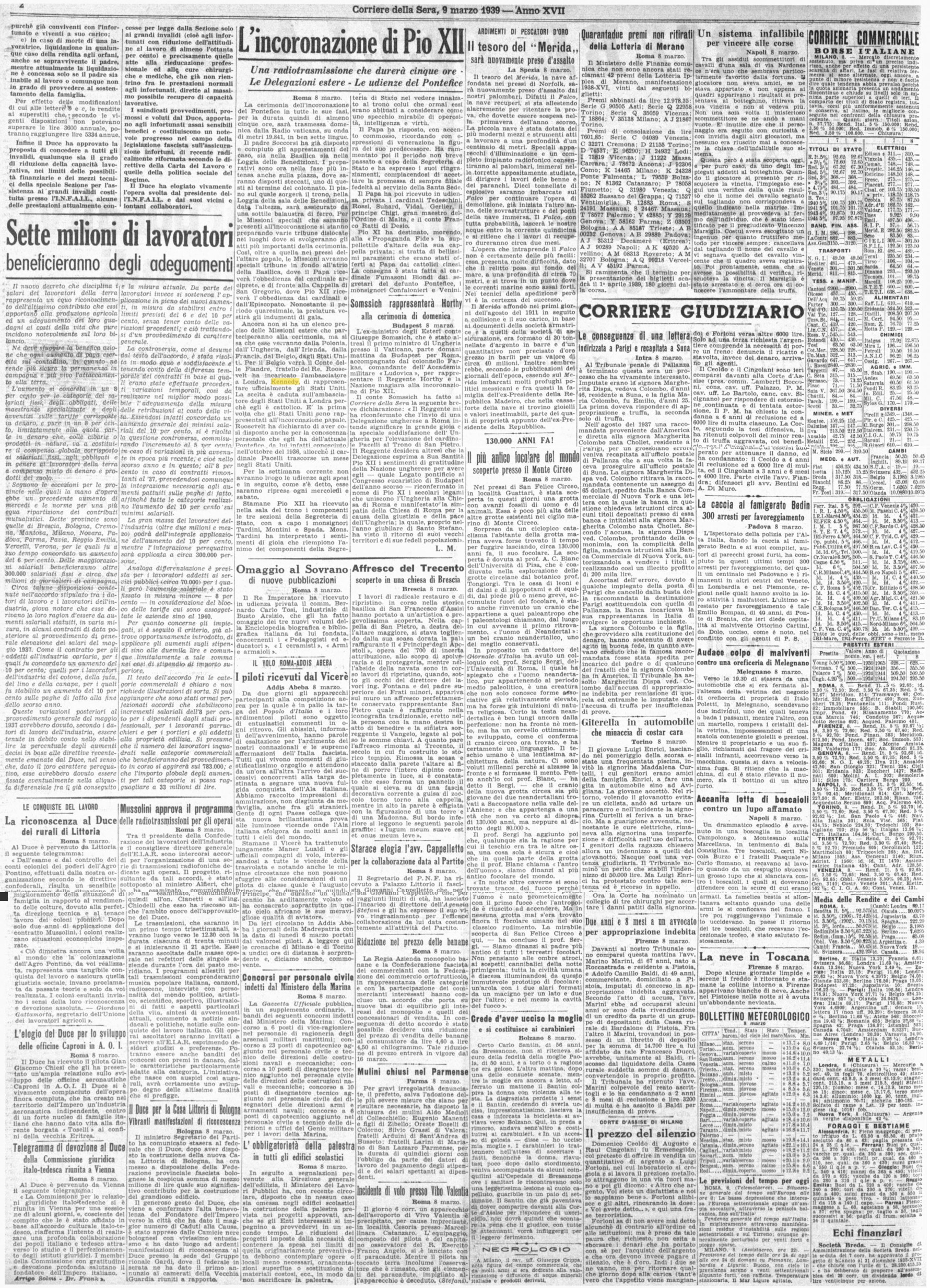
A copy of an article from
the Italian newspaper *Corriere della Sera*, dated Thursday, March 9,
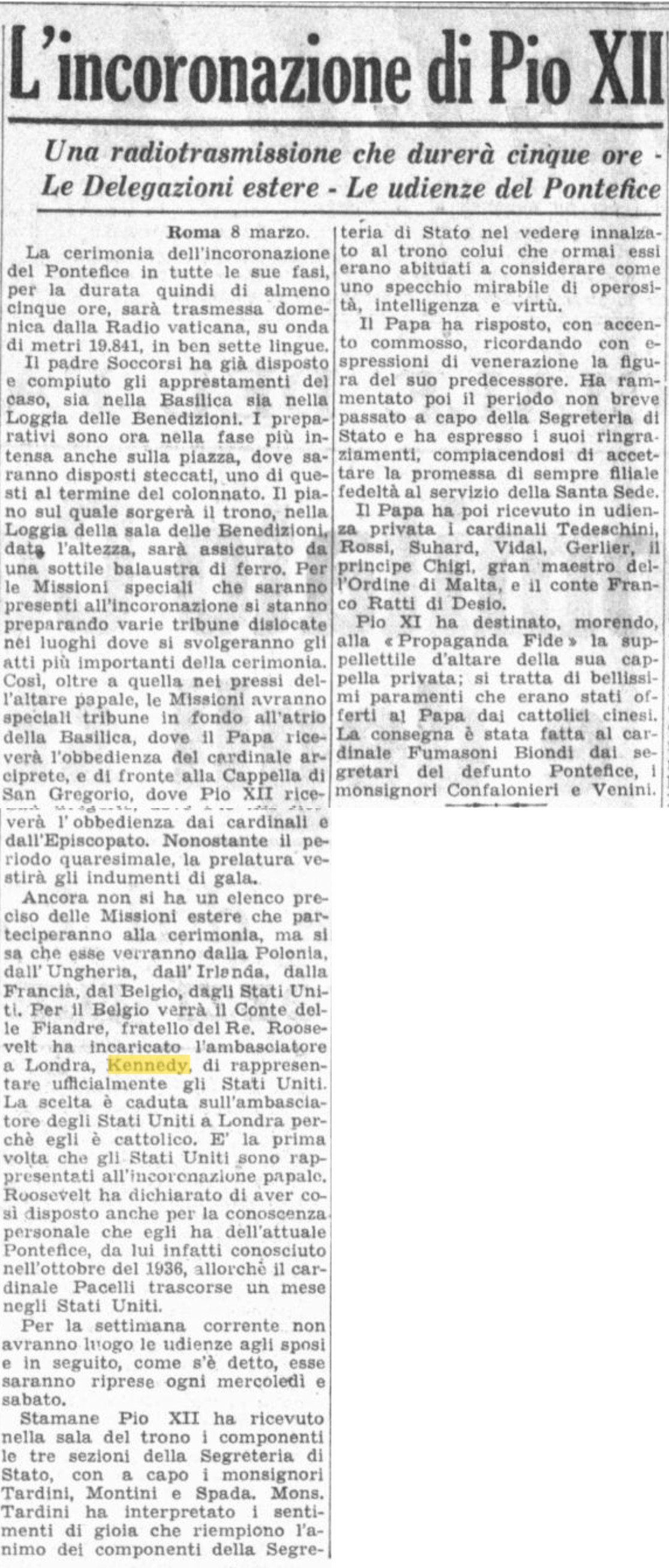
1939. Article (from Rome, March 8): "The Coronation of Pius XII." Here is a summary of the article: ° Organizational details and radio broadcast: The coronation ceremony of Pius XII will be broadcast by Vatican Radio in seven different languages, with a live transmission lasting at least five hours. The text describes the technical preparations taking place in the Basilica, the Loggia of the Blessings, and St. Peter’s Square, where special stands are being set up for foreign delegations. ° Foreign delegations and Roosevelt’s choice of Kennedy: Special missions from Poland, Hungary, Ireland, France, Belgium, and the United States are expected to attend. To officially represent the USA, President Roosevelt has appointed Joseph Kennedy, the U.S. Ambassador to London. ° The historical significance of Kennedy’s appointment: The article notes that this is the first time in history that the United States has been represented at a papal coronation. Kennedy was chosen because he serves as ambassador in London and is a practicing Catholic. Furthermore, Roosevelt stated that he made this decision in part due to the personal acquaintance Kennedy had already established with the new Pontiff during Cardinal Pacelli’s visit to the United States in October 1936. |
|
1939, March 18 - Corriere della Sera |
||
|
|
|
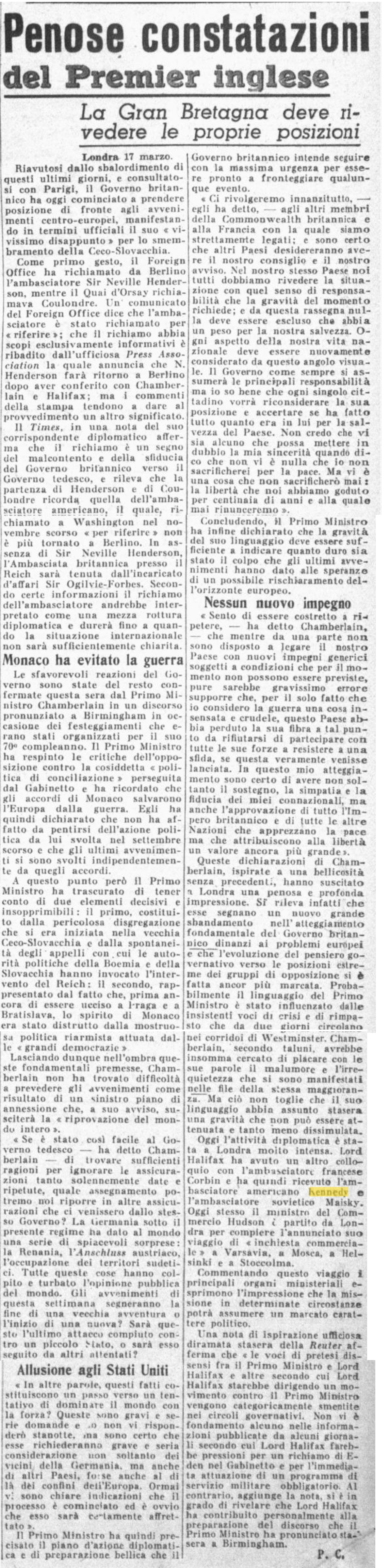
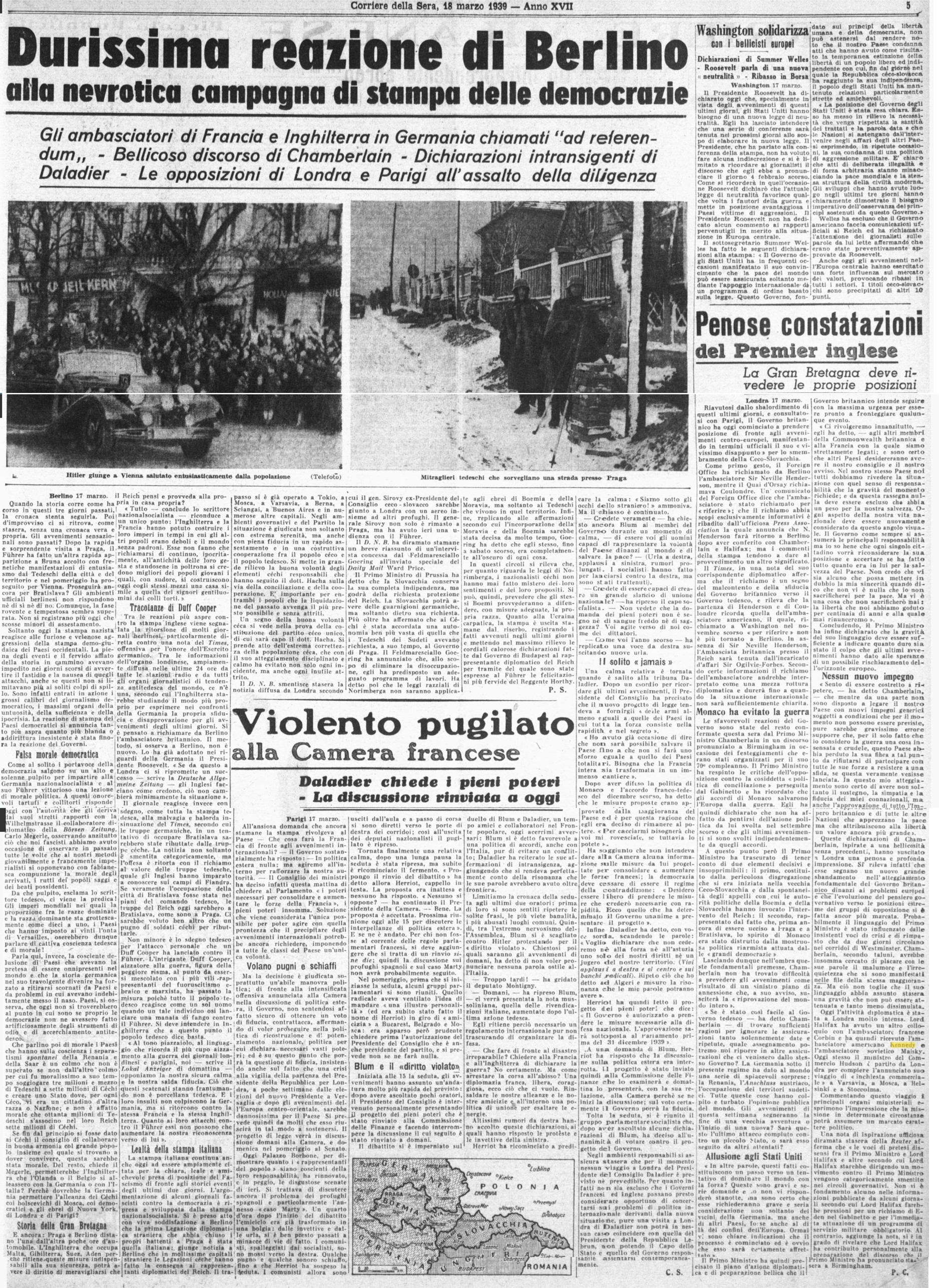
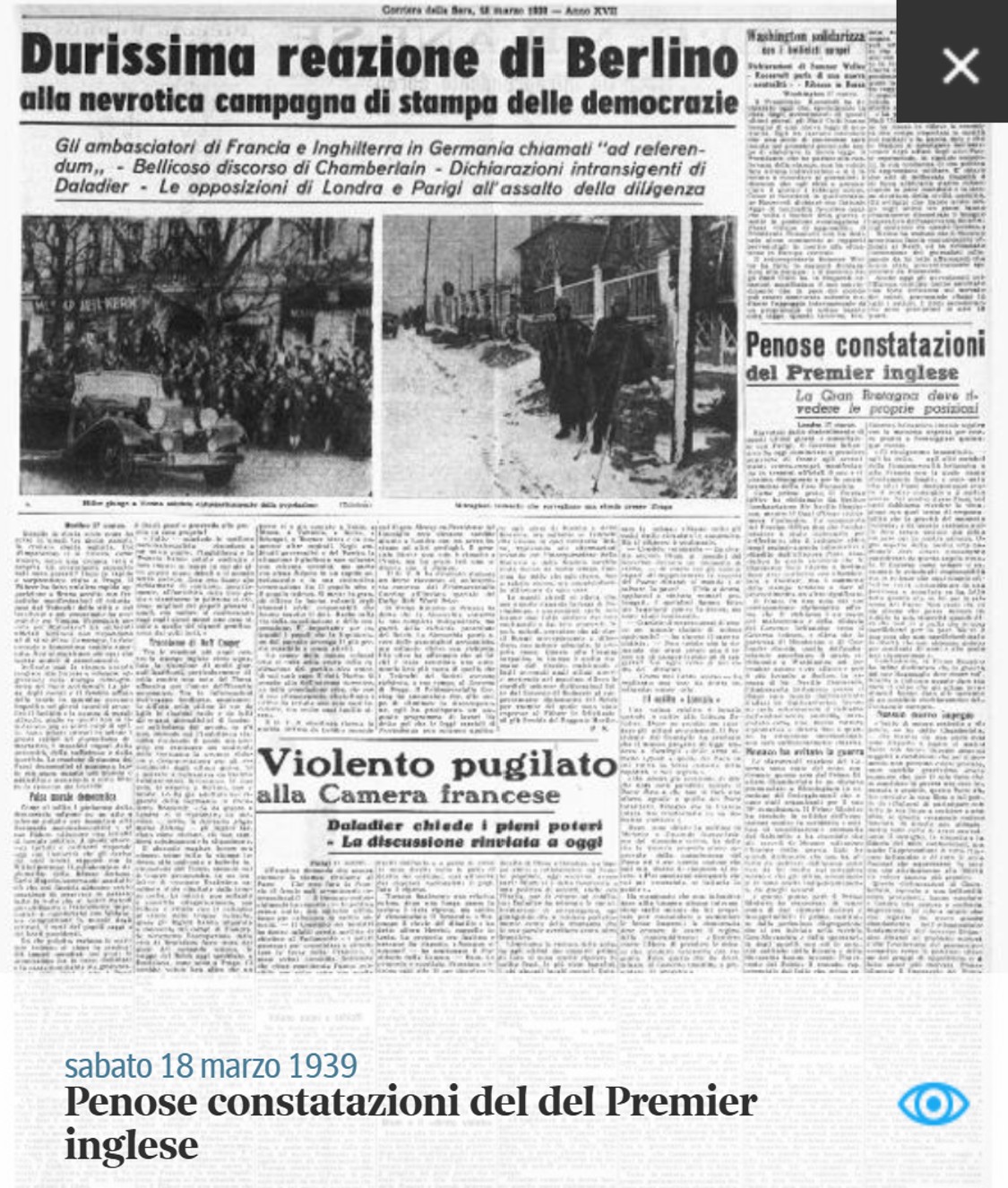
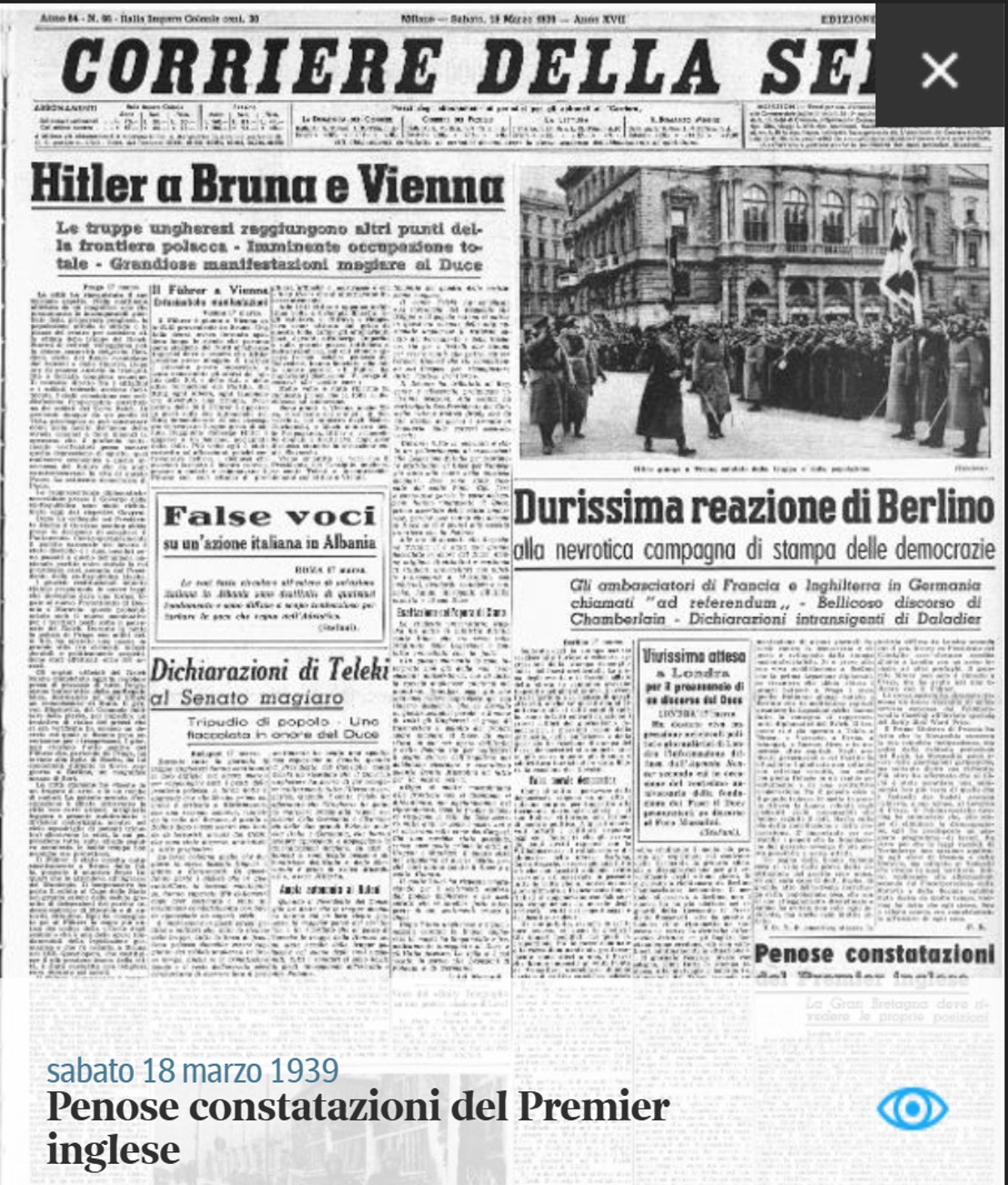
Copy of an article from
the Italian daily newspaper CORRIERE DELLA SERA, dated Saturday, March 18,
1939. Article (from London, March 17): "Distressing observations by the British Premier." Here is a summary of the article: ° The recall of ambassadors and the Czechoslovak crisis: Following the "dismemberment of Czechoslovakia" by Germany, the Foreign Office has recalled Ambassador Sir Nevile Henderson to London for consultations. The press notes that Henderson’s departure is reminiscent of the recall of the American ambassador to Washington—who never returned to Berlin. ° Chamberlain’s speech in Birmingham: Prime Minister Neville Chamberlain defended the Munich Agreement, asserting that it saved Europe from war; however, he expressed deep disappointment regarding Hitler’s conduct, noting that he had violated guarantees he had solemnly provided. He announced that Great Britain must re-evaluate its position and prepare, with the utmost urgency—alongside the Commonwealth and France—to confront any eventuality. ° Diplomatic activity by Lord Halifax and the involvement of Ambassador Kennedy: It was an exceptionally intense day of diplomacy in London. Foreign Secretary Lord Halifax held another lengthy discussion with American Ambassador Joseph Kennedy and subsequently met with the Soviet Ambassador, Maisky. |
|
1939, March 19 - Corriere della Sera |
||
|
|
|
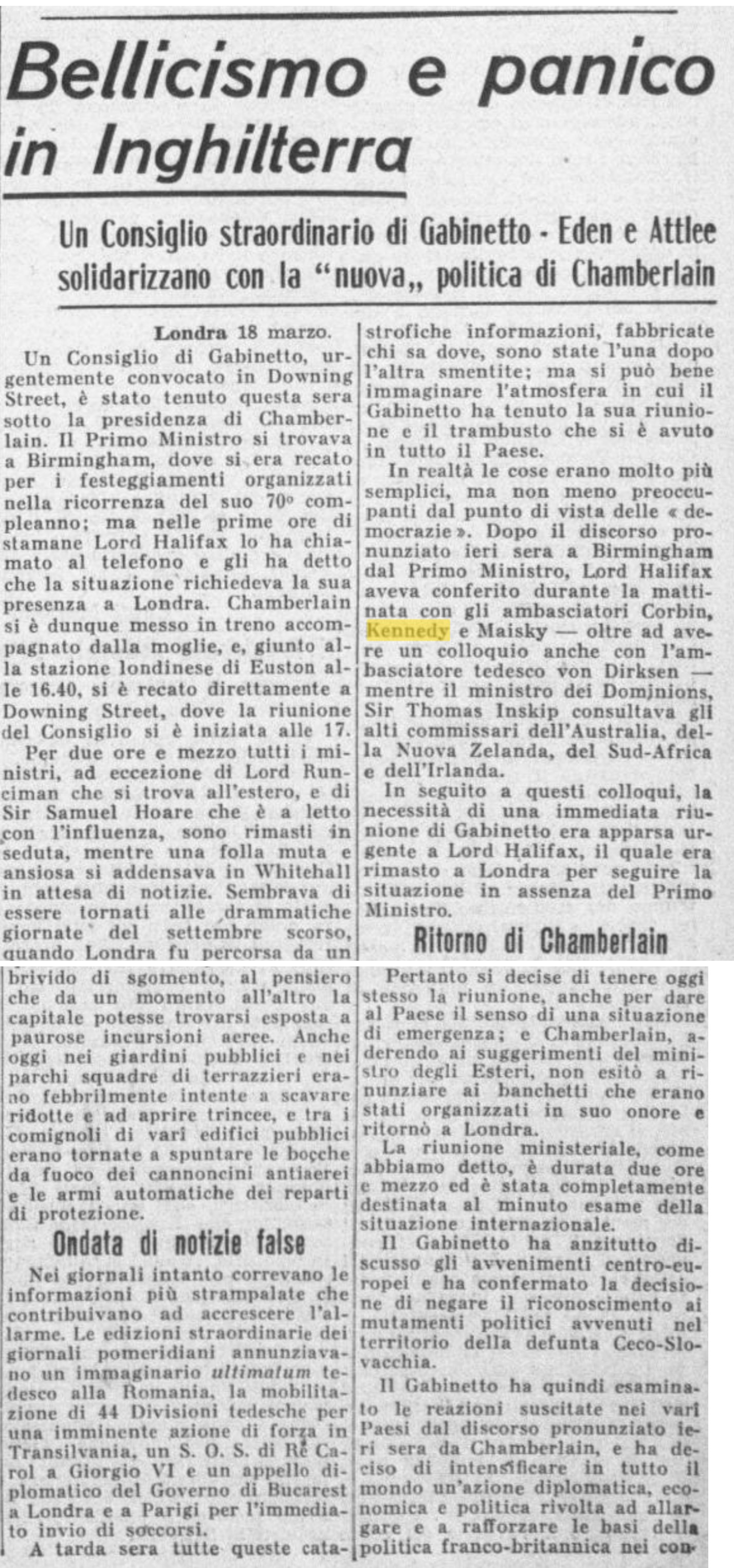
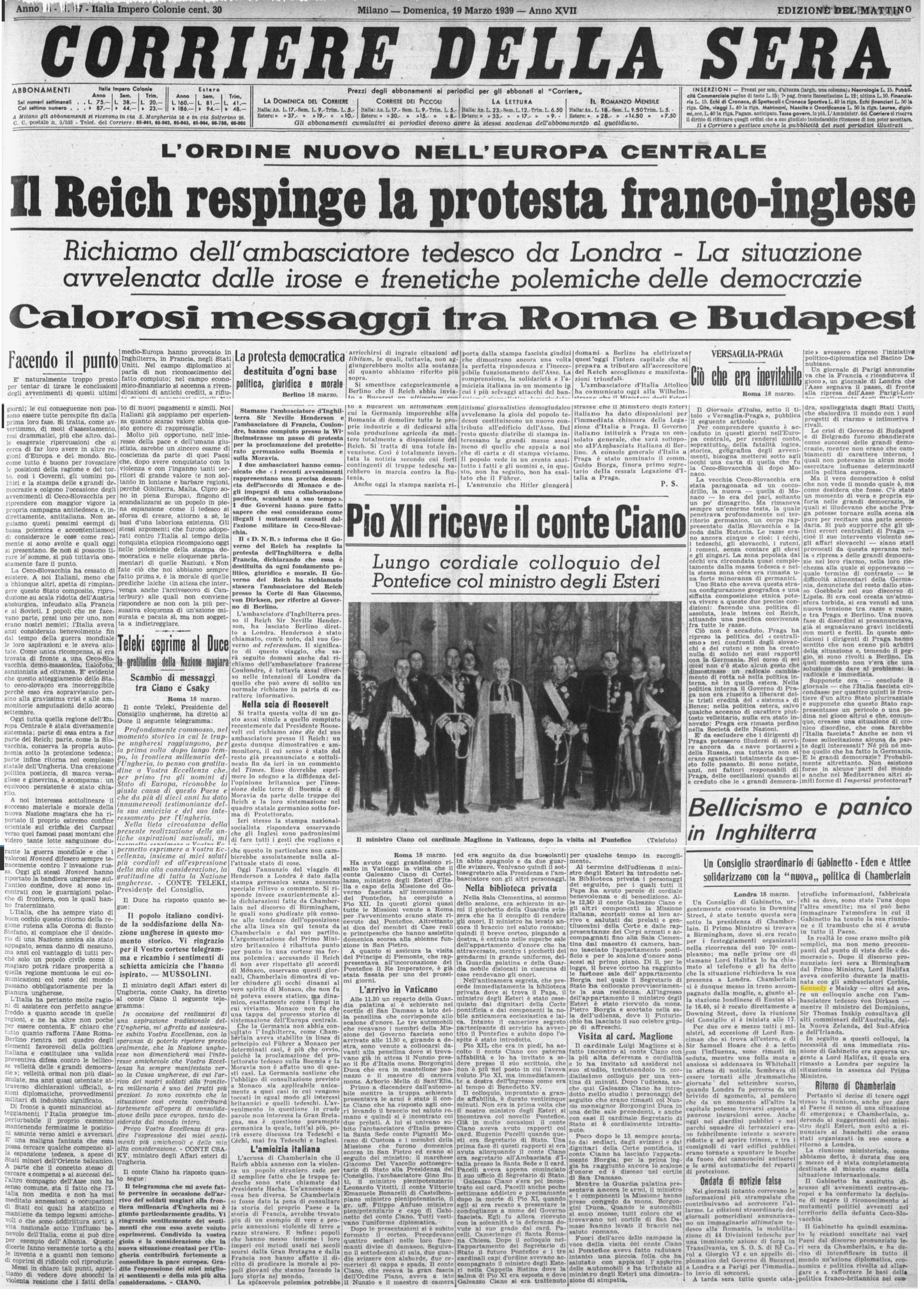
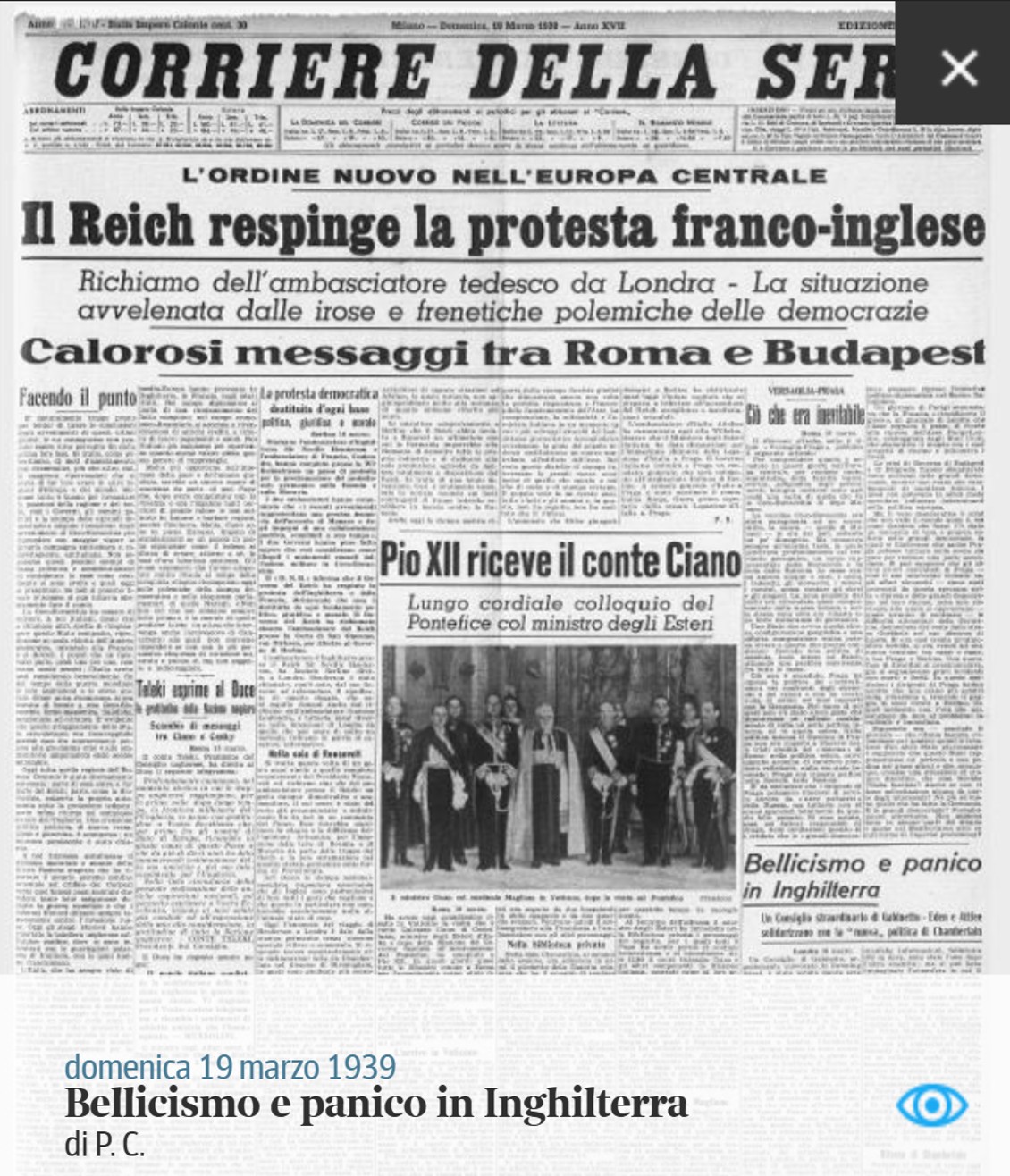
Copy of an article from
the Italian newspaper CORRIERE DELLA SERA, dated Sunday, March 19, 1939. Article (from London, March 18): "Warmongering and Panic in England." Here is a summary of the article: ° Extraordinary Cabinet meeting and an atmosphere of panic: Following the worsening situation in Central Europe, Lord Halifax urgently summoned Prime Minister Chamberlain back to London—interrupting his 70th birthday celebrations in Birmingham—to hold an emergency Cabinet meeting at Downing Street. A feverish sense of alarm hangs over the capital, reminiscent of the dramatic days of the previous September, with trenches being dug in public parks and anti-aircraft defenses being put into position. ° Intense diplomatic activity and a meeting with Kennedy: Before convening the Cabinet, Foreign Secretary Lord Halifax engaged in a series of intensive consultations in London. Throughout the morning, he held talks with American Ambassador Joseph Kennedy, French Ambassador Corbin, and Soviet Ambassador Maisky, in addition to a meeting with German Ambassador von Dirksen. ° Decisions of the British Government: The Cabinet confirmed its refusal to grant any formal recognition to the political changes that have taken place within the territory of the "defunct Czechoslovakia." Furthermore, it decided to step up diplomatic and economic efforts globally, aimed at expanding and strengthening the Anglo-French front. |
|
1939, March 21 - Corriere della Sera |
||
|
|
|
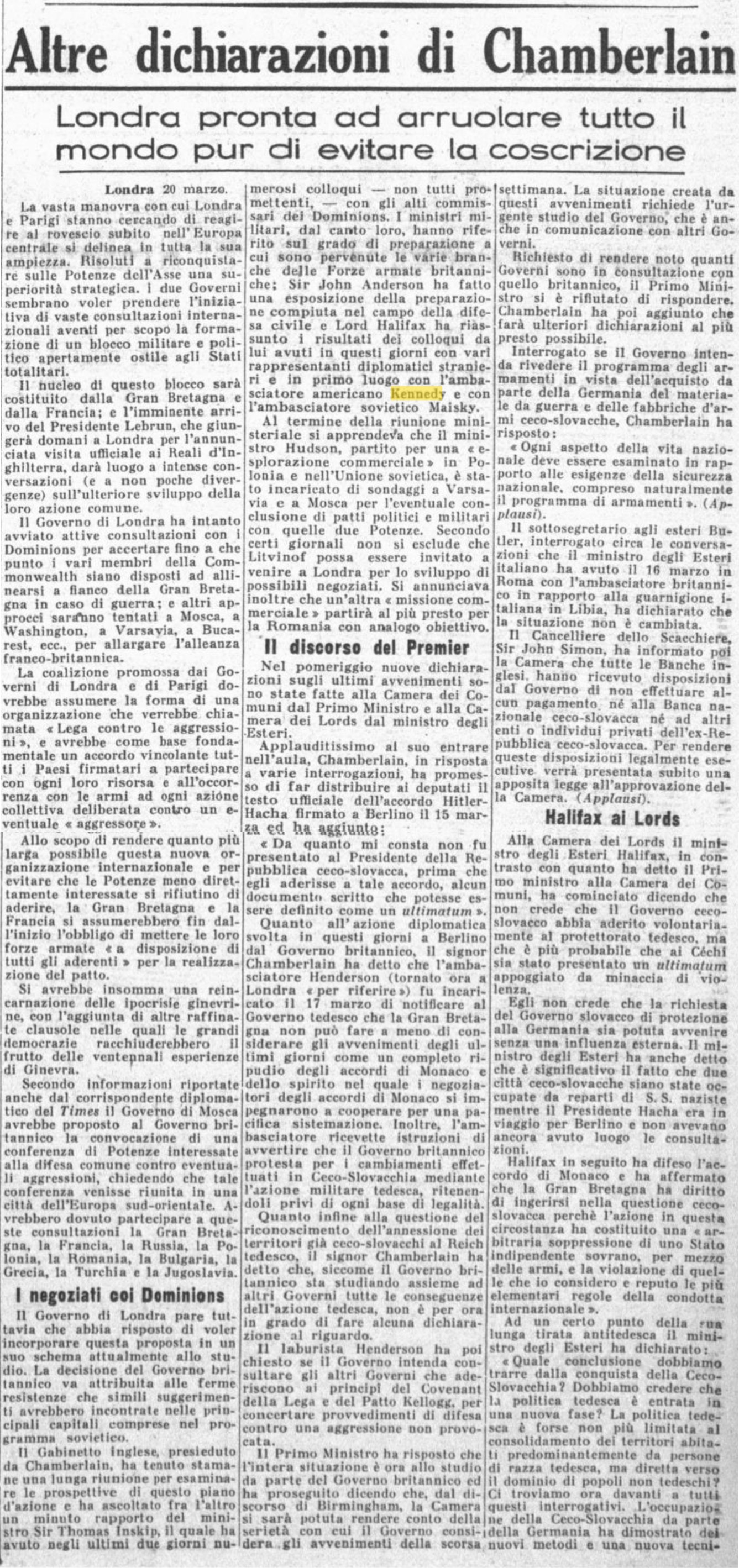
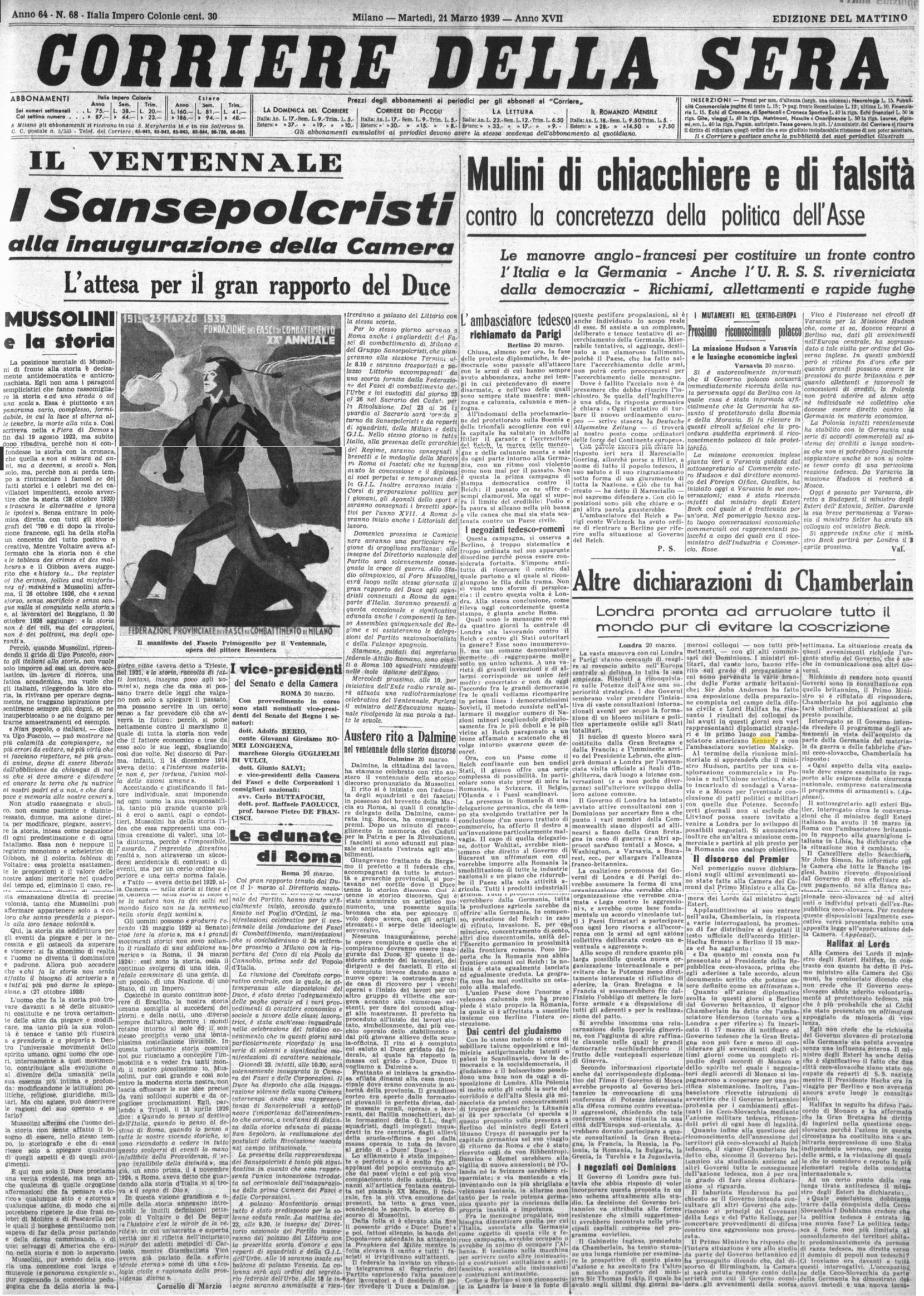
Copy of an
article from the Italian daily newspaper CORRIERE DELLA SERA, dated
Tuesday, March 21, 1939. Article (from London, March 20): "Further statements by Chamberlain – London prepared to enlist the whole world to thwart the conspiracy." Here is a summary of the article: ° The plan for an "anti-totalitarian military bloc": London and Paris have launched an intensive diplomatic offensive to create a broad coalition (also referred to as a "League against aggression") directed against the Axis Powers. The core of the alliance would consist of Great Britain and France, with the intention of extending it to the Dominions and other countries (such as Poland, Romania, Russia, Greece, Turkey, and Yugoslavia). ° Consultations and the role of Ambassador Kennedy: The British Cabinet held a lengthy meeting to examine the defense plan and the international outlook. Lord Halifax summarized the results of discussions held with various foreign diplomatic representatives—most notably with American Ambassador Joseph Kennedy and Soviet Ambassador Maisky. ° Chamberlain’s statements to the House: In response to questions from Members of Parliament, Prime Minister Chamberlain announced that an official note of protest had been sent to Germany, describing the events in Czechoslovakia as a "complete repudiation of the Munich Agreement," lacking any legal basis. He further confirmed that England is consulting with other governments regarding the countermeasures to be adopted. ° Lord Halifax’s statements in the House of Lords: In the House of Lords, Foreign Secretary Halifax delivered a sharp indictment of Germany, emphasizing that the occupation of Czechoslovakia demonstrates how German policy is now moving toward the “domination of non-German peoples” through new methods of aggression. |
|
1939, April 5 - Corriere della Sera |
||
|
|
|
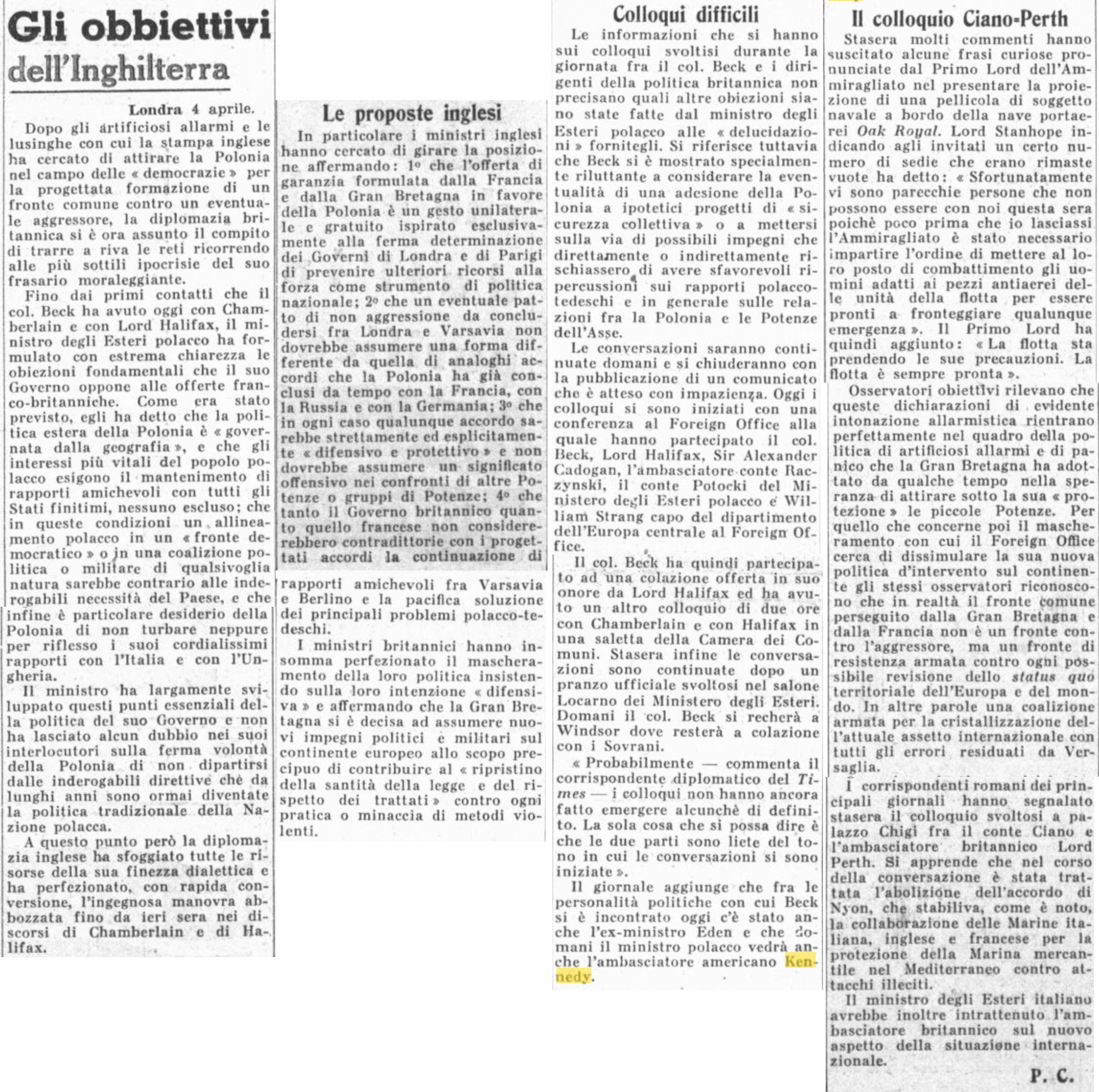
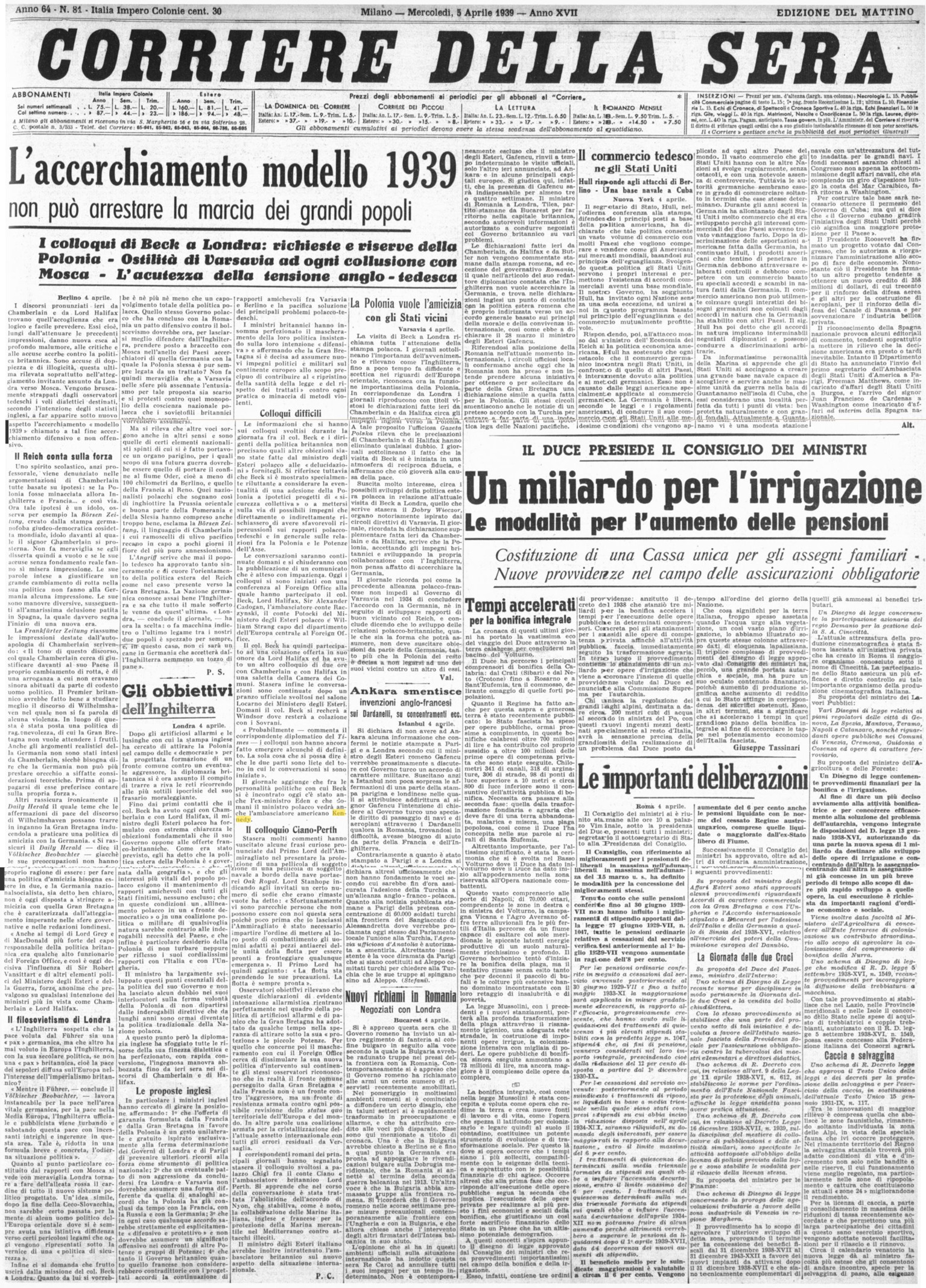
Copy of an
article from the Italian daily newspaper CORRIERE DELLA SERA, dated
Wednesday, April 5, 1939. Article (from London, April 4): "England's Objectives. Polish Minister Meets with Kennedy." Here is a summary of the article: ° Talks with Colonel Beck and Polish reservations: Polish Foreign Minister Colonel Józef Beck met with Chamberlain and Lord Halifax in London. Beck raised strong objections to Poland formally aligning itself with an anti-German "democratic front," emphasizing the need to preserve the independence of Polish foreign policy and to avoid compromising relations with Germany, Italy, or Hungary. ° British proposals and reassurances: British ministers sought to reassure Warsaw by explaining that the Franco-British guarantee is a unilateral act. They proposed a potential bilateral, defensive non-aggression pact that would not conflict with agreements already in place between Poland and Germany. ° Minister Beck’s packed schedule and his meeting with Kennedy: The article describes the series of meetings Beck held at the Foreign Office and the House of Commons. It notes that the Polish minister had already met with several political figures, including former minister Anthony Eden, and was scheduled to meet with American Ambassador Joseph Kennedy the following day. ° British alarmism and the Ciano-Perth discussion: The article highlights the "alarmist" stance taken by London. Finally, it notes the meeting that took place in Rome at Palazzo Chigi between Foreign Minister Galeazzo Ciano and the British ambassador, Lord Perth, which focused on the abolition of the Nyon Agreement in the Mediterranean. |
|
1939, April 9 - Corriere della Sera |
||
|
|
|
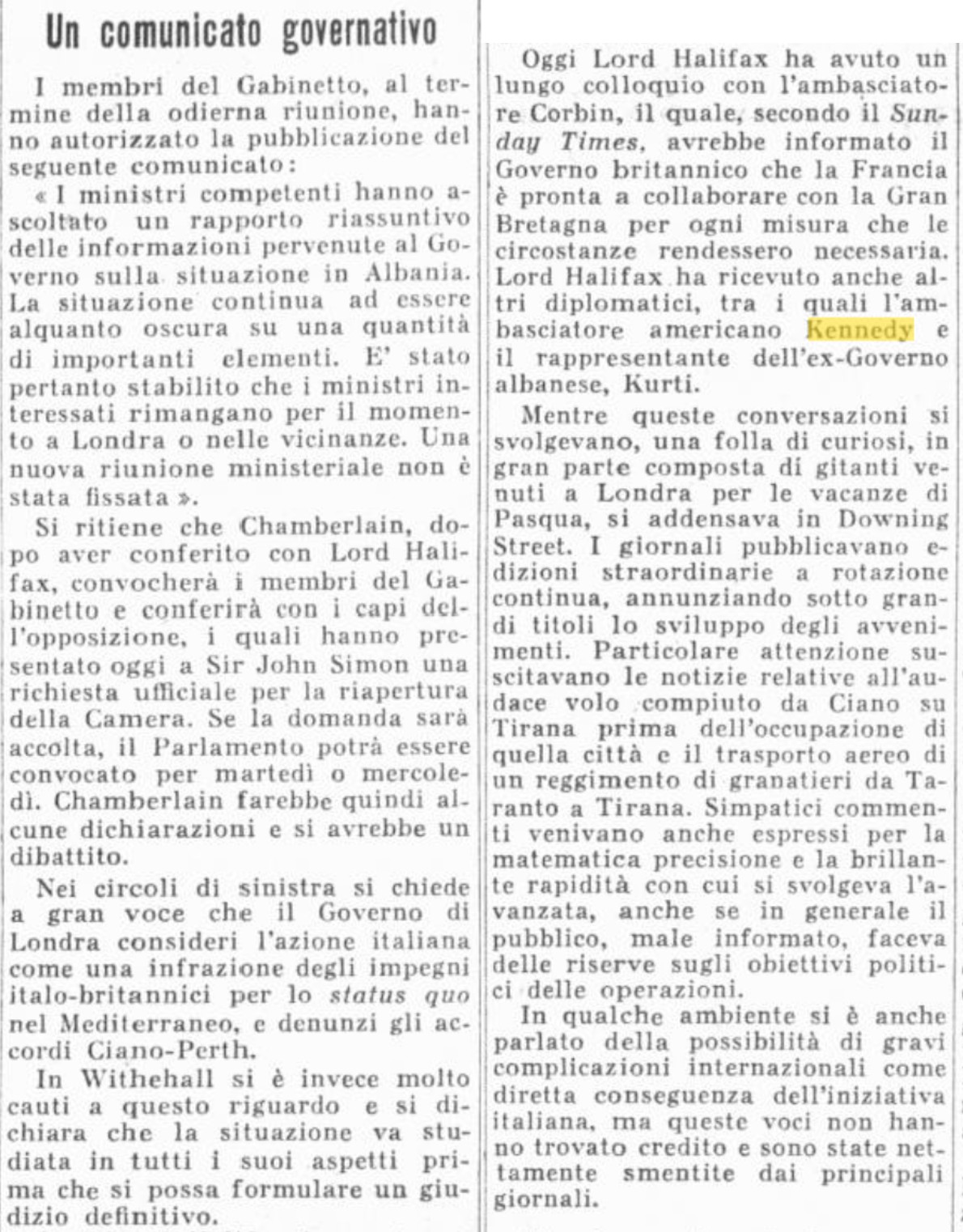
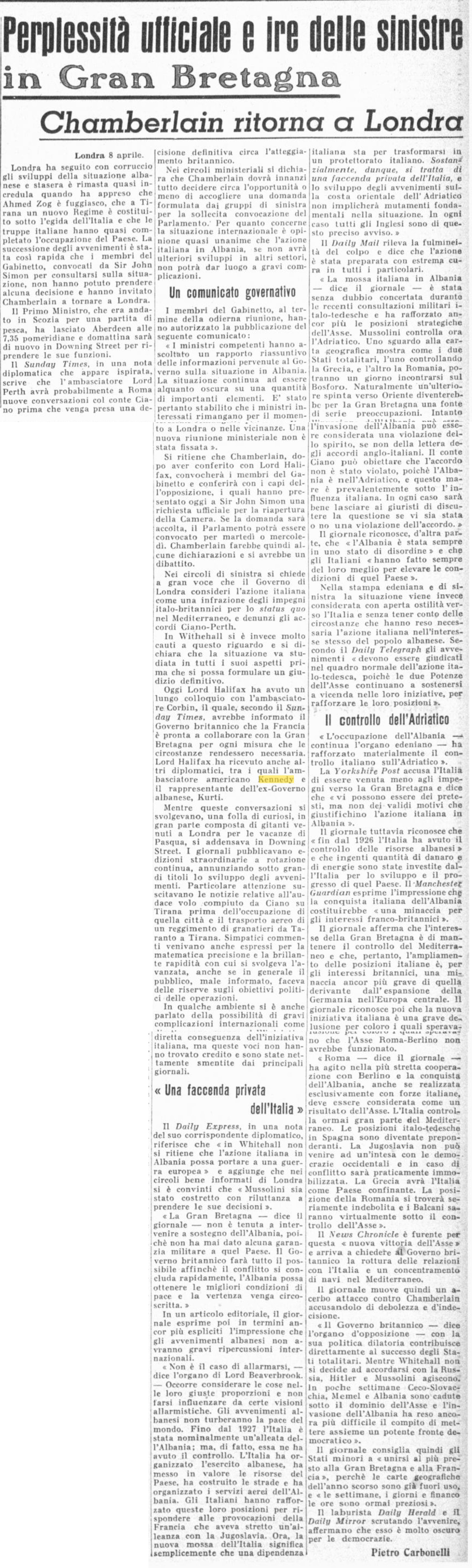
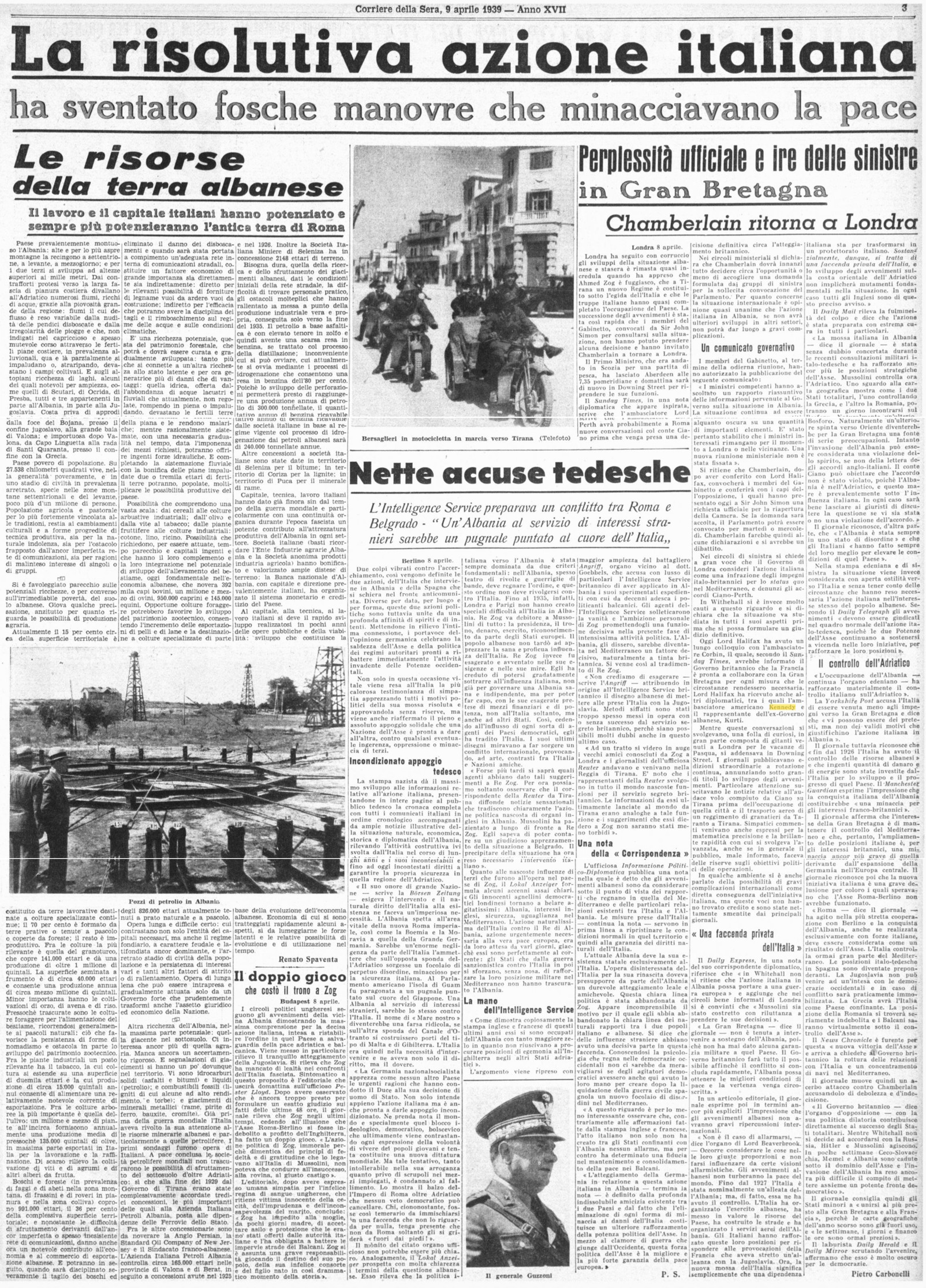
A
copy of an article from the Italian daily newspaper *Corriere della Sera*,
dated Sunday, April 9, 1939. Article (by Pietro Carbonelli, reporting from London): "Official perplexity and anger from the Left in Great Britain – Chamberlain returns to London." Below is a summary of the article: ° The British reaction to the Italian action in Albania: London has followed the Italian operation in Albania—the flight of King Zog and the rapid occupation of the country—with great perplexity. Prime Minister Chamberlain, who was in Scotland on a fishing trip, was urgently recalled to London to preside over government meetings. ° The government statement and the stance of the press: An official statement clarifies that government ministers are examining the situation, which is described as unlikely to lead to "serious complications." Several British newspapers (such as the *Daily Express* and the *Daily Mail*) characterize the Italian initiative as an "Italian private affair," noting that Albania had already been under Rome's economic and political influence for years. ° Discussions held by Lord Halifax and the involvement of Ambassador Kennedy: Foreign Secretary Lord Halifax has initiated an intensive series of diplomatic consultations. After conferring with the French ambassador, Corbin, Halifax met with other diplomats, including the American ambassador, Joseph Kennedy, and the representative of the Albanian government, Kurti. |
|
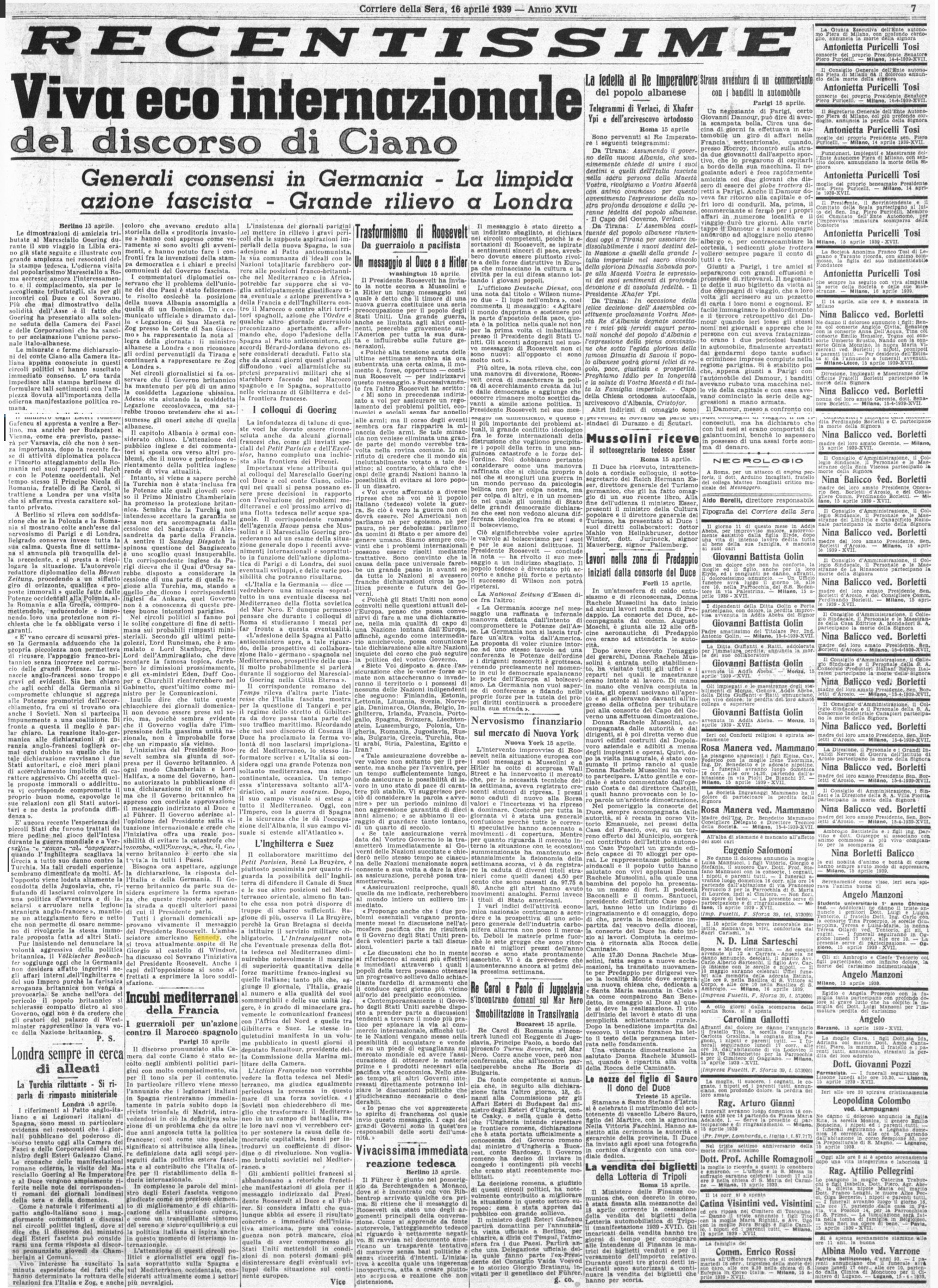
1939, April 16 - Corriere della Sera |
||
|
|
|
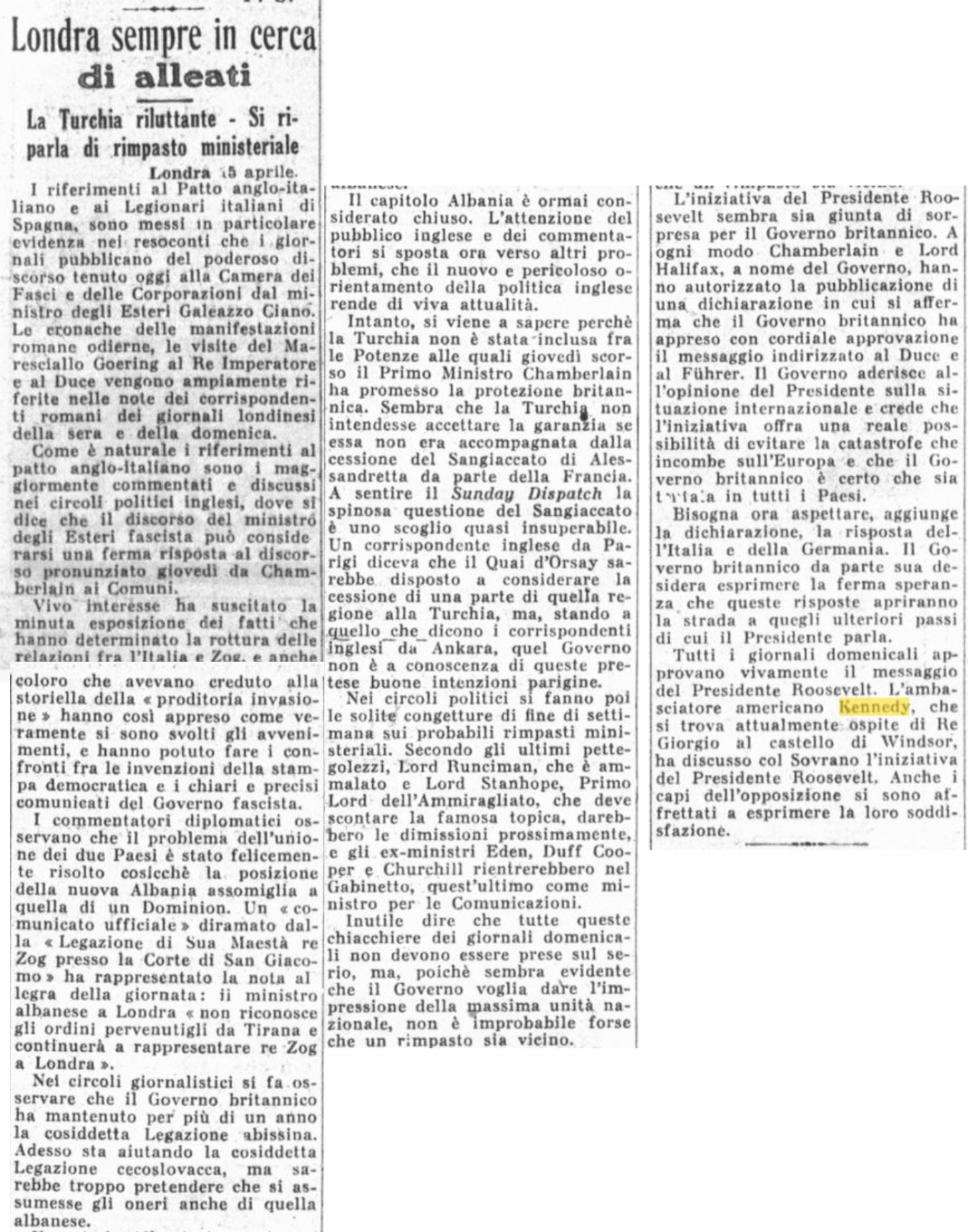
Copy
of an article from the Italian daily newspaper CORRIERE DELLA SERA, dated
Sunday, April 16, 1939. Article (from London, April 15): "London Still Seeking Allies" Here is a summary of the article: ° Roosevelt’s initiative and message: The British government has welcomed with warm approval the message sent by President Roosevelt to the Duce and the Führer, viewing it as a concrete opportunity to avert catastrophe in Europe and expressing hope for a favorable response from Rome and Berlin. ° Commentary and the role of Ambassador Kennedy: All the Sunday newspapers strongly endorse Roosevelt’s message. In this context, American Ambassador Joseph Kennedy—currently a guest of King George at Windsor Castle—discussed the U.S. President’s initiative with the Sovereign; the move was also met with satisfaction by the leaders of the opposition. |
|
1939, April 22 - Corriere della Sera |
||
|
|
|
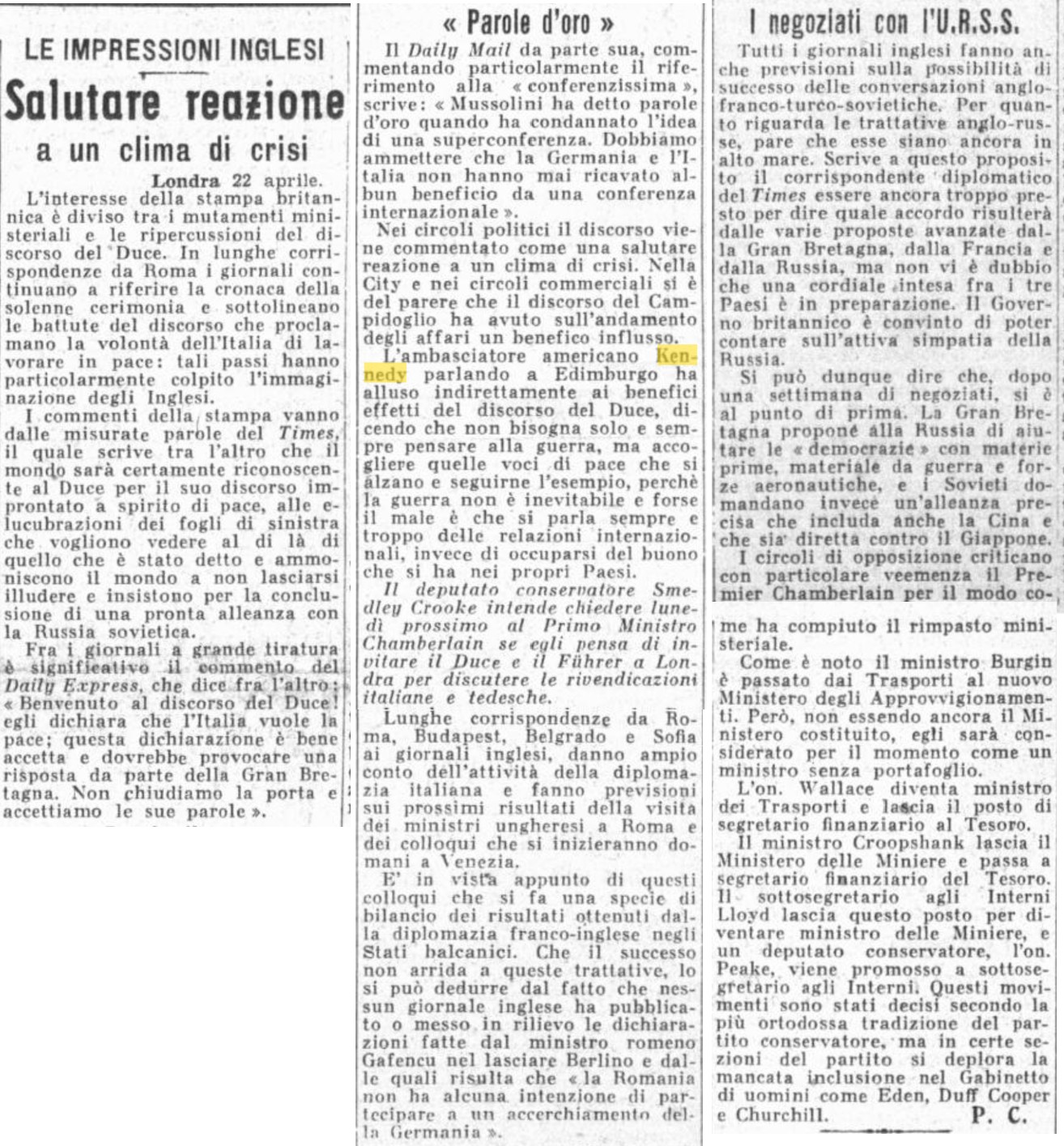
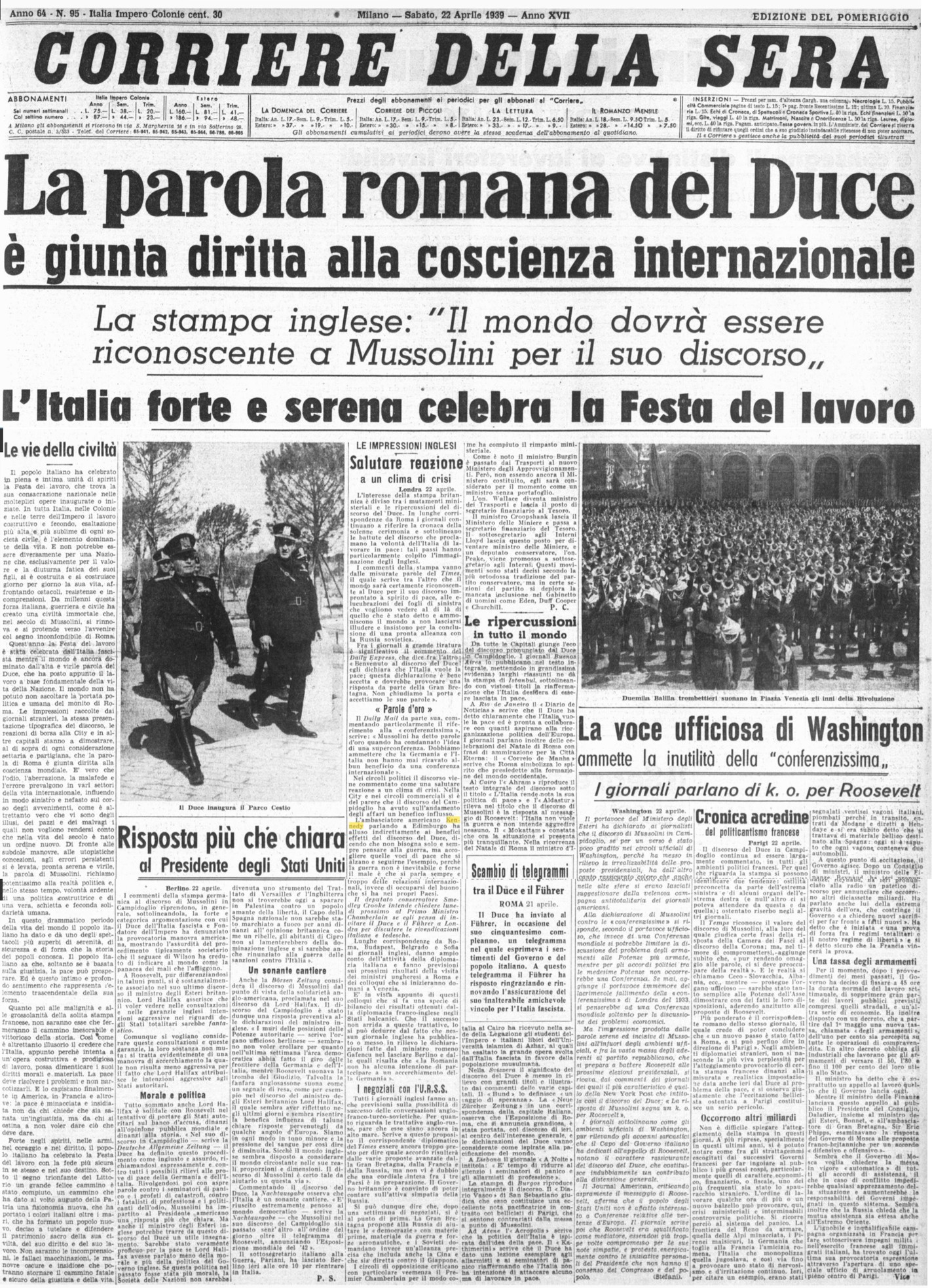
A
copy of an article from the Italian daily newspaper *Corriere della Sera*,
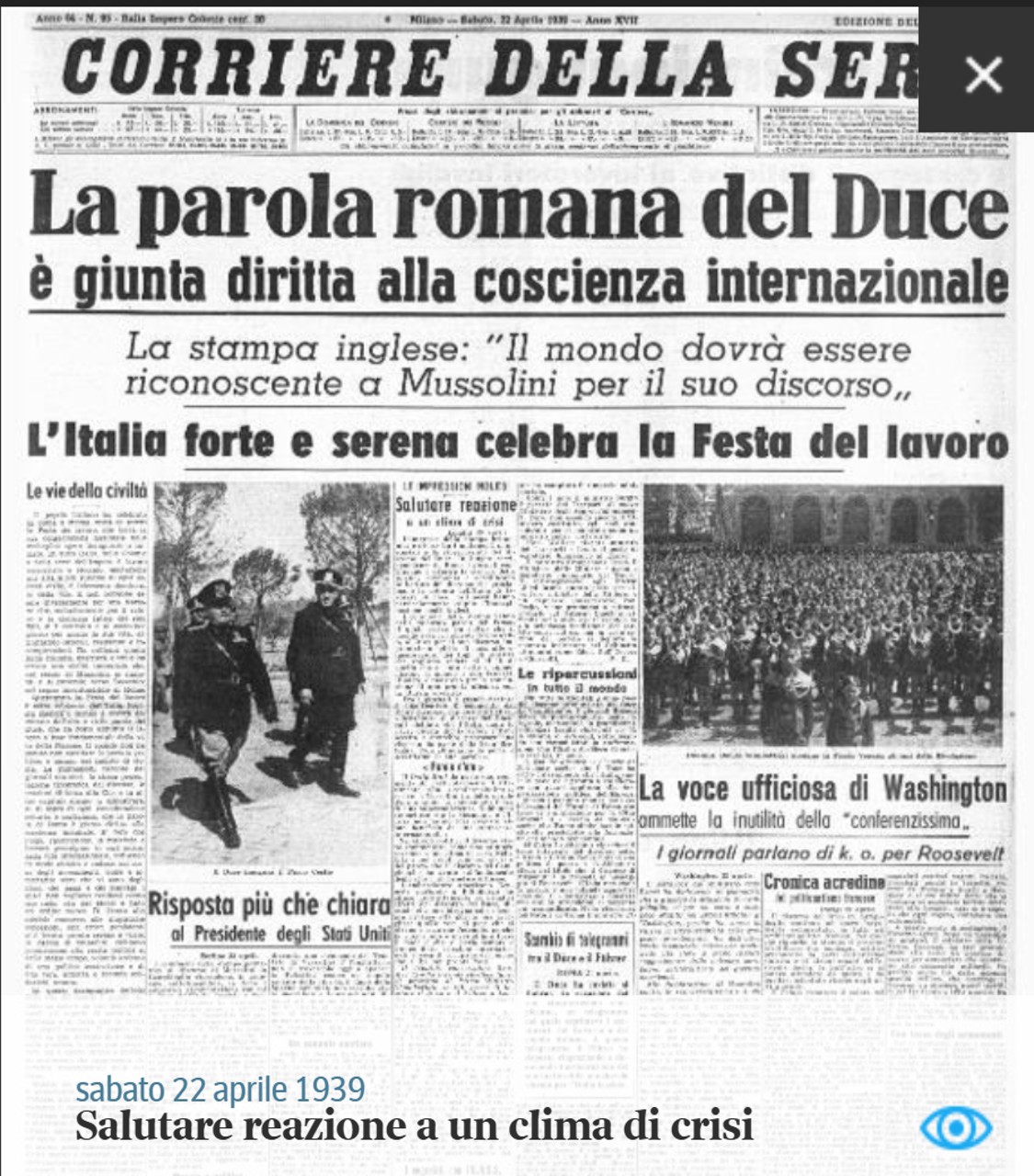
dated Saturday, April 22, 1939. Article by Pietro Carbonelli (from London, April 22): "British Impressions – A Welcome Reaction to a Climate of Crisis" Here is a summary of the article: ° Favorable reactions to Mussolini’s speech: The British press and political circles in London received the Duce’s speech at the Capitoline Hill with great interest, highlighting the passages in which he declares a desire to "work in peace." Newspapers such as *The Times* and the *Daily Express* underscored its peaceful spirit, while in the City of London, the event had a beneficial impact on business. The *Daily Mail* also expressed agreement with Mussolini’s criticism of international "super-conferences." ° The stance taken by Ambassador Joseph Kennedy: Speaking in Edinburgh, American Ambassador Joseph Kennedy alluded indirectly to the positive effects of the Duce’s speech, asserting that one should not think solely of war, but rather heed calls for peace and follow such an example. Kennedy reiterated that war is not inevitable and that the core problem lies in the constant focus on the "evils" within international relations, rather than on highlighting the positive aspects present in each nation. |
|
1939, May 24 - Corriere della Sera |
||
|
|
|
A copy of
an article from the Italian daily newspaper *Corriere della Sera*, dated
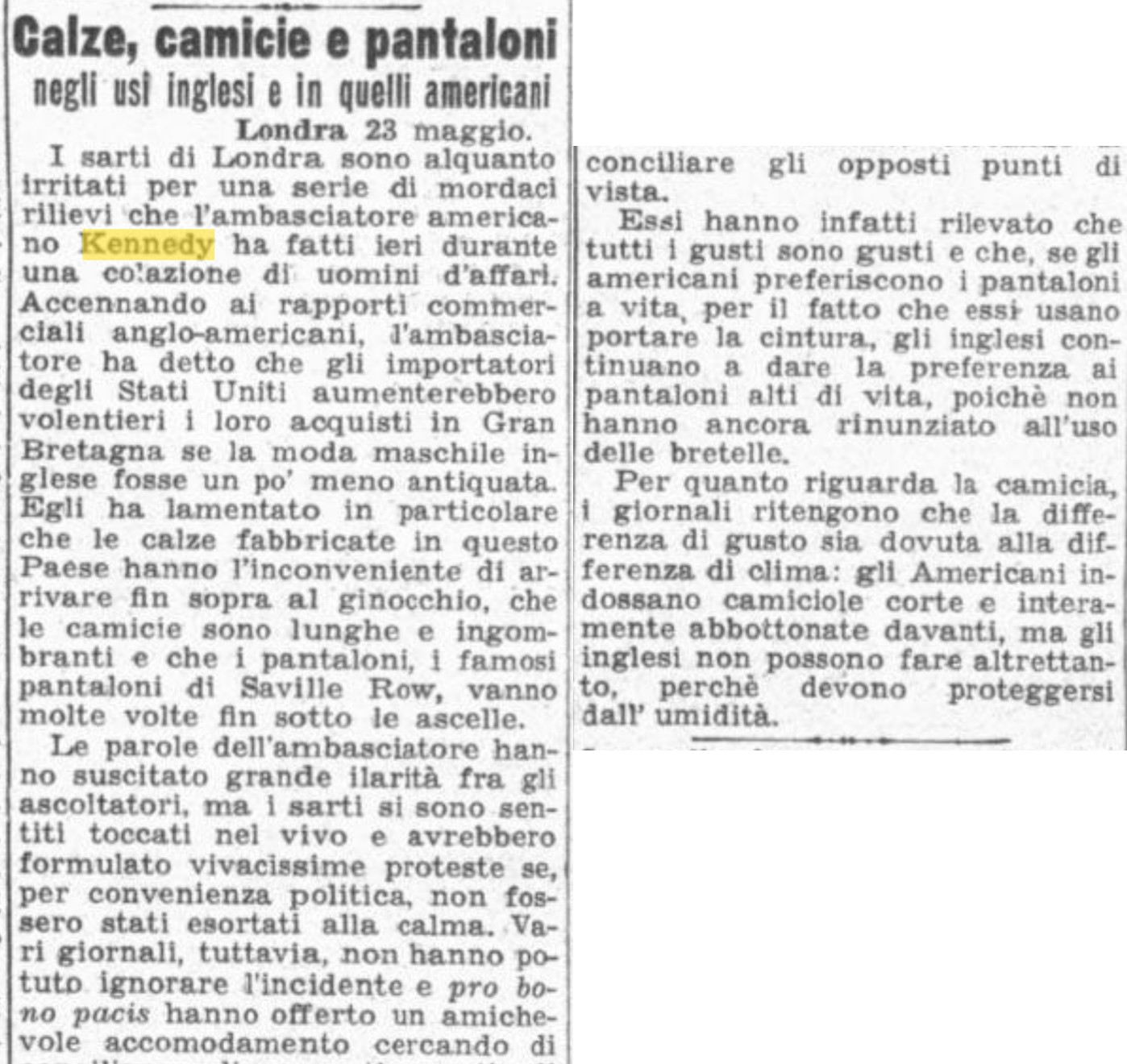
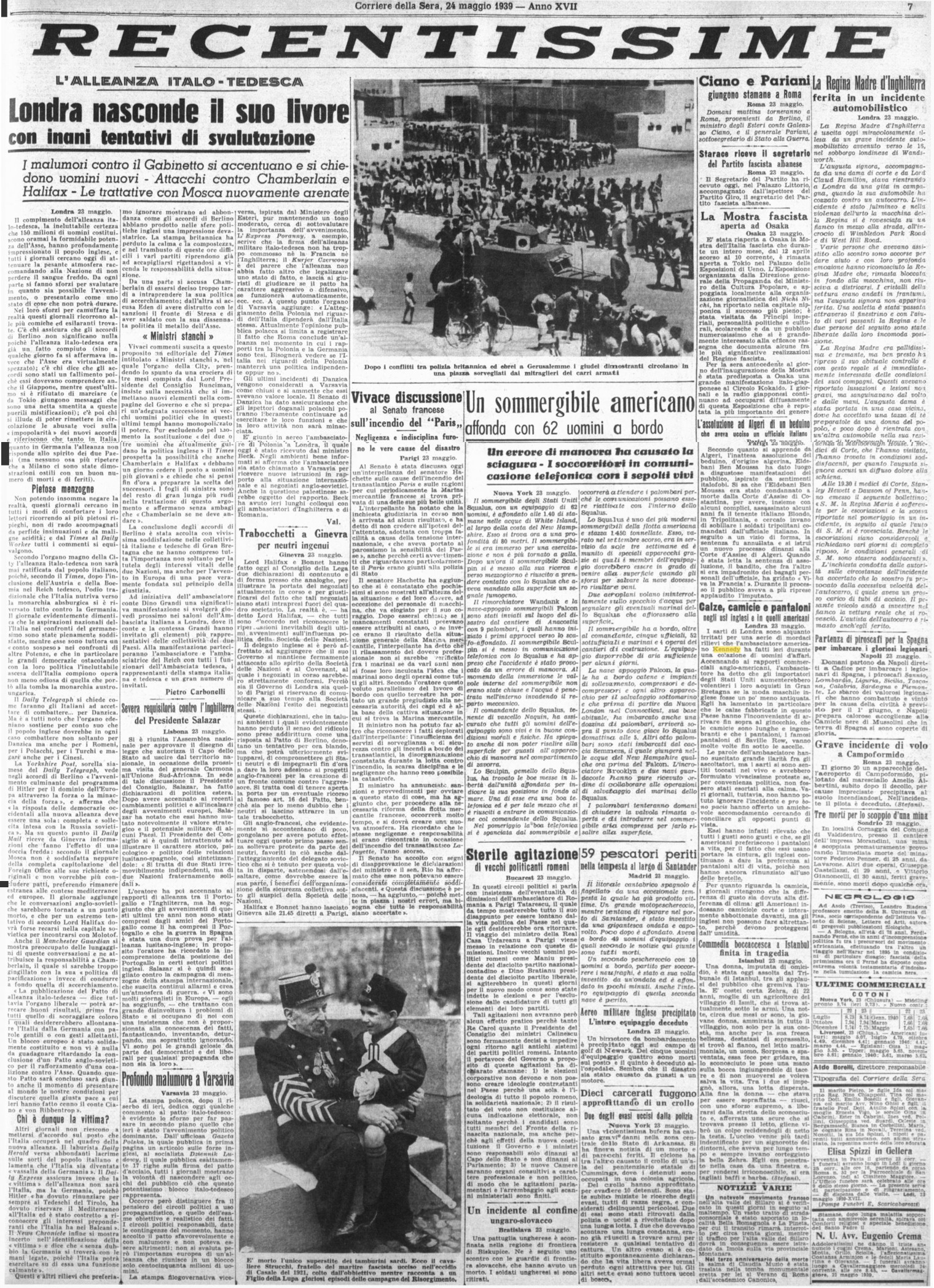
Wednesday, May 24, 1939. Article (from London, May 23): "Socks, Shirts, and Trousers: English vs. American Customs." Here is a summary of the article: ° Ambassador Kennedy’s critique of English men’s fashion: During a luncheon with businessmen, American Ambassador Joseph Kennedy took a jab at British tailors and manufacturers, stating that U.S. importers would gladly increase their purchases from Great Britain if English men’s fashion were less old-fashioned. Specifically, Kennedy criticized socks that reach above the knee, shirts that are overly long and bulky, and the famous Savile Row trousers—cut with such a high waist that they often reach "all the way up to the armpits." ° The reaction of London tailors: The Ambassador’s remarks drew great amusement from those present, but they irritated and struck a nerve among London’s tailors. The latter might have lodged vigorous formal protests had they not been urged to remain calm for the sake of political expediency. ° Newspaper defenses and a comparison of styles: Several daily newspapers weighed in on the debate, seeking an amicable middle ground: Trousers—in the U.S., low-waisted trousers worn with a belt are preferred, whereas in England, high-waisted trousers remain the standard due to the established practice of wearing suspenders. Shirts—Americans wear shorter, front-buttoning shirts, while the English require longer garments for protection against the damp climate. |
|
1939, August 25 - Corriere della Sera |
||
|
|
|
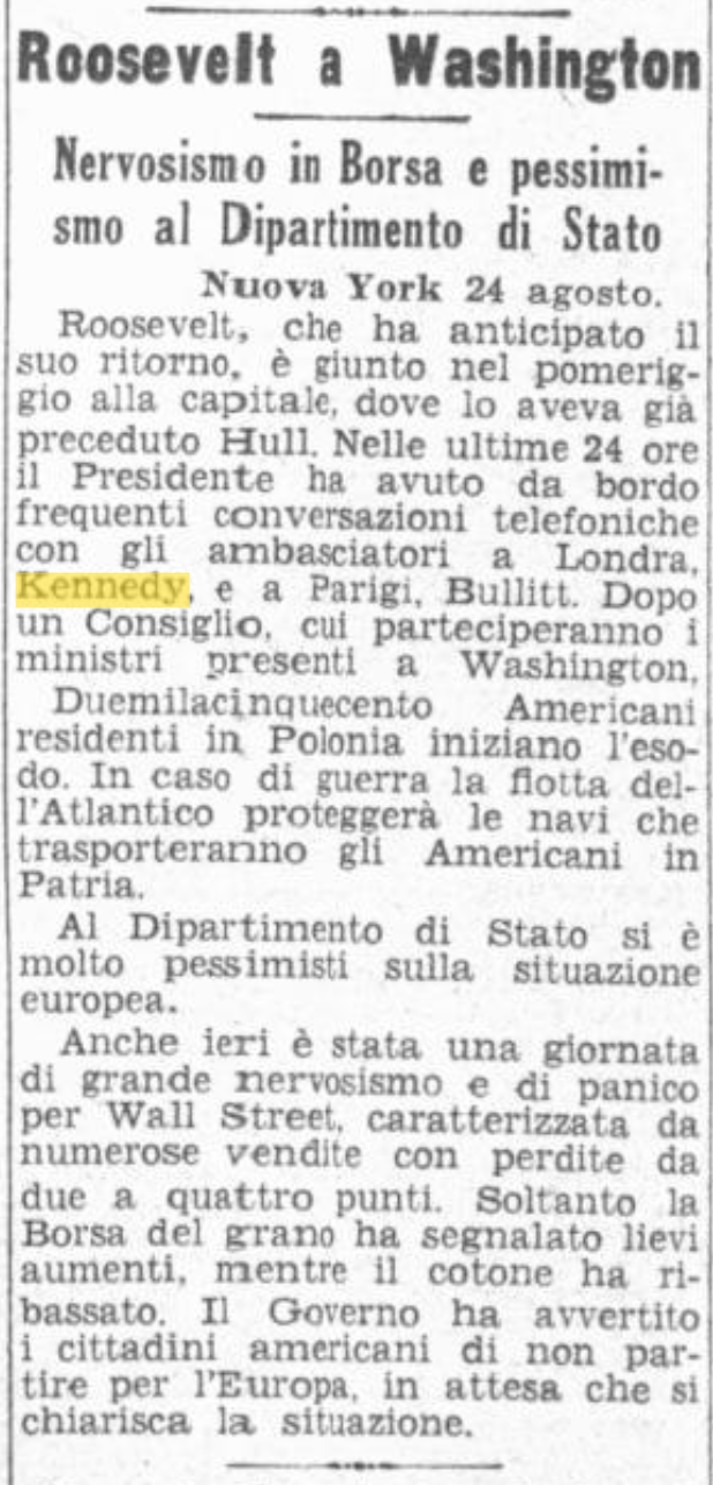
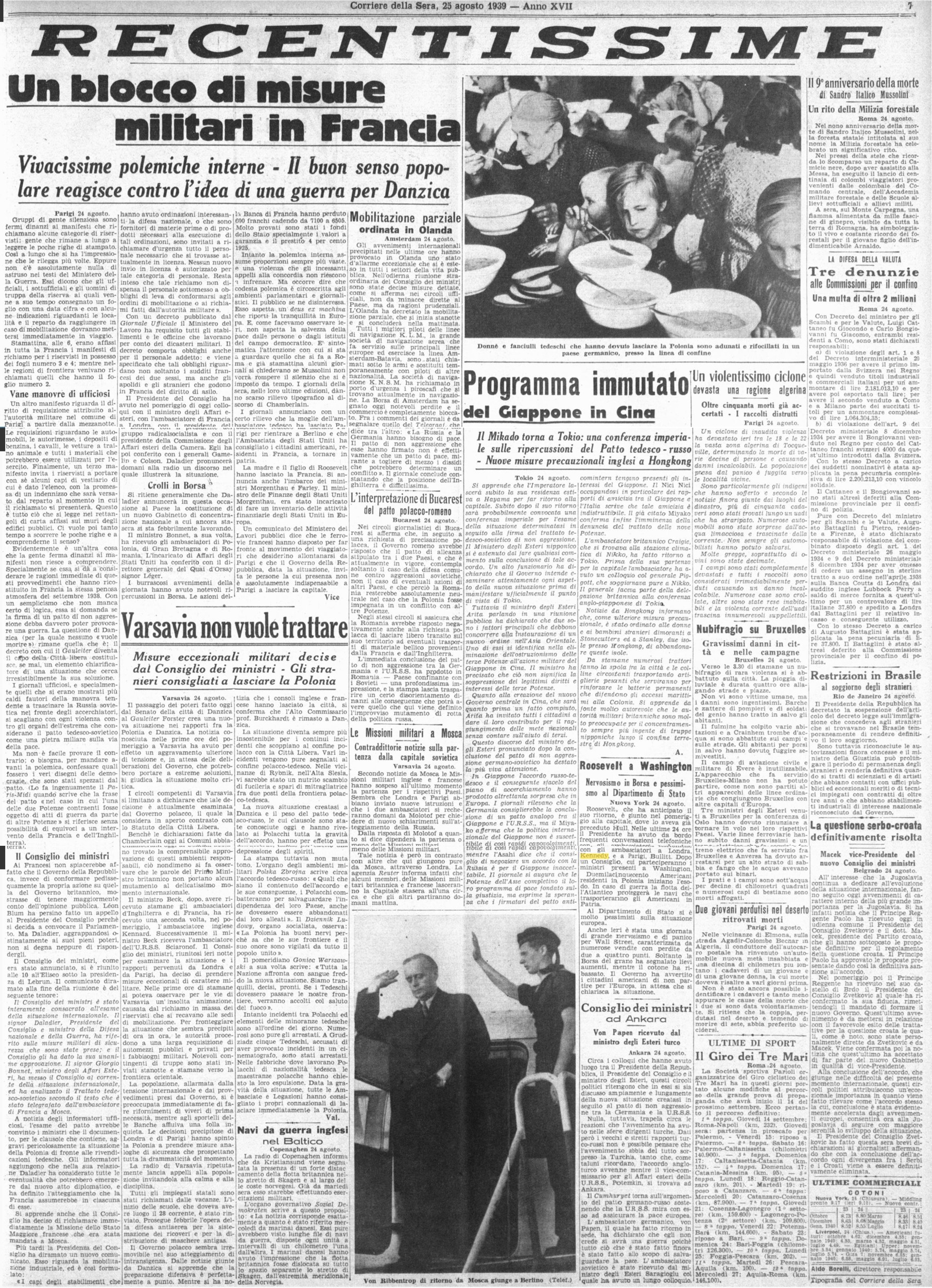
A
Copy of an article from the Italian newspaper CORRIERE DELLA SERA, dated
Friday, August 25, 1939. Article (from New York, May 24): "Roosevelt in Washington – Nervousness on the Stock Exchange and pessimism at the State Department." Here is a summary of the article: ° Roosevelt’s urgent return and contacts with Kennedy: President Roosevelt has returned to the capital earlier than planned, following the arrival of Secretary of State Cordell Hull. Over the last 24 hours, Roosevelt has maintained frequent, direct telephone contact—while traveling—with Ambassador Joseph Kennedy in London and Ambassador William Bullitt in Paris, in order to monitor the unfolding European crisis. ° The exodus of American citizens and protective measures: An exodus of 2,500 U.S. citizens residing in Poland has begun. In the event that war breaks out, the Atlantic Fleet will escort and protect the ships tasked with repatriating these Americans. Furthermore, the government has issued an official notice to its citizens, advising them against traveling to Europe. ° Pessimism in Washington and nervousness on Wall Street: At the State Department, there is a profound sense of pessimism regarding the prospects for peace in Europe. |
|
1939, August 26 - Corriere della Sera |
||
|
|
|
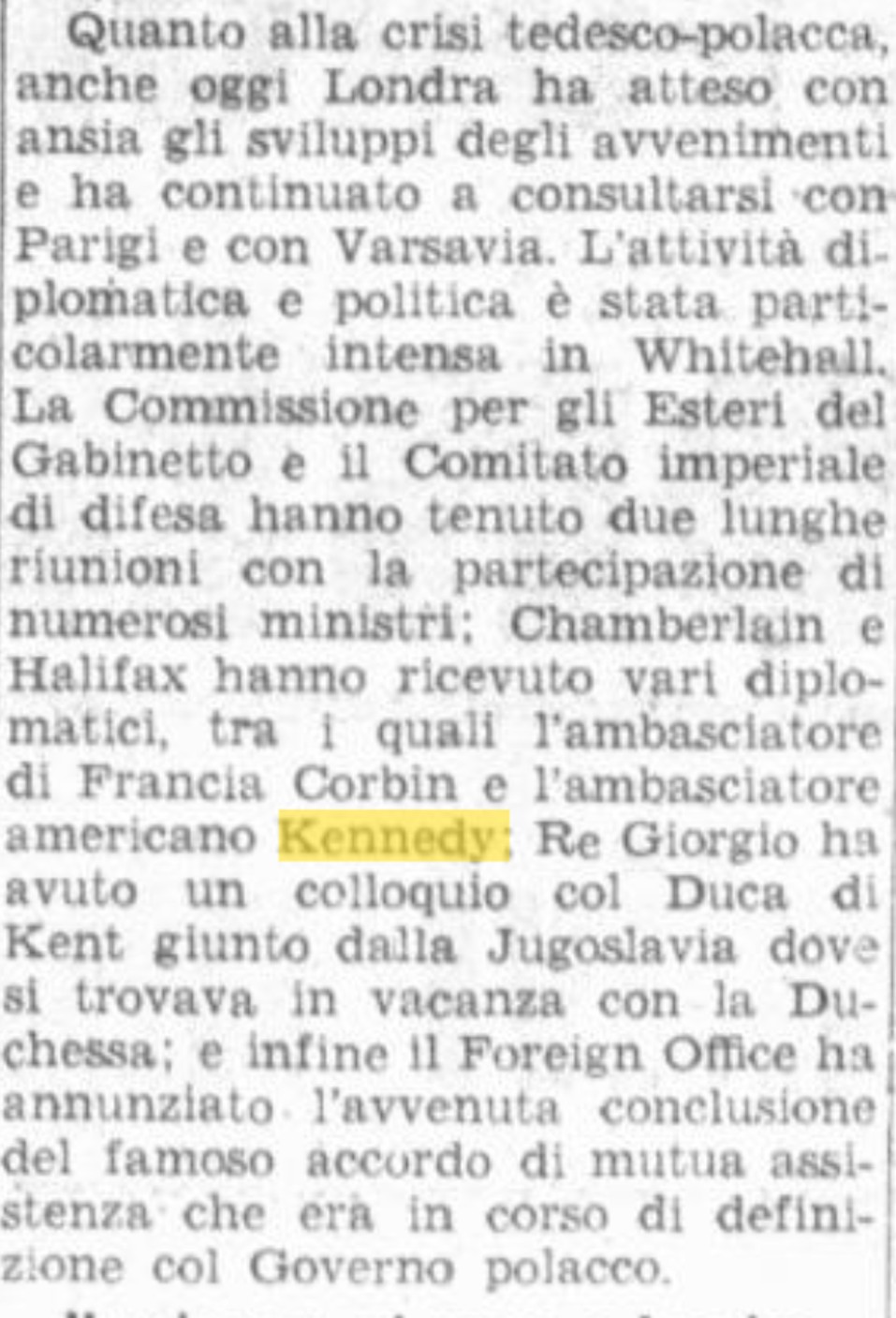
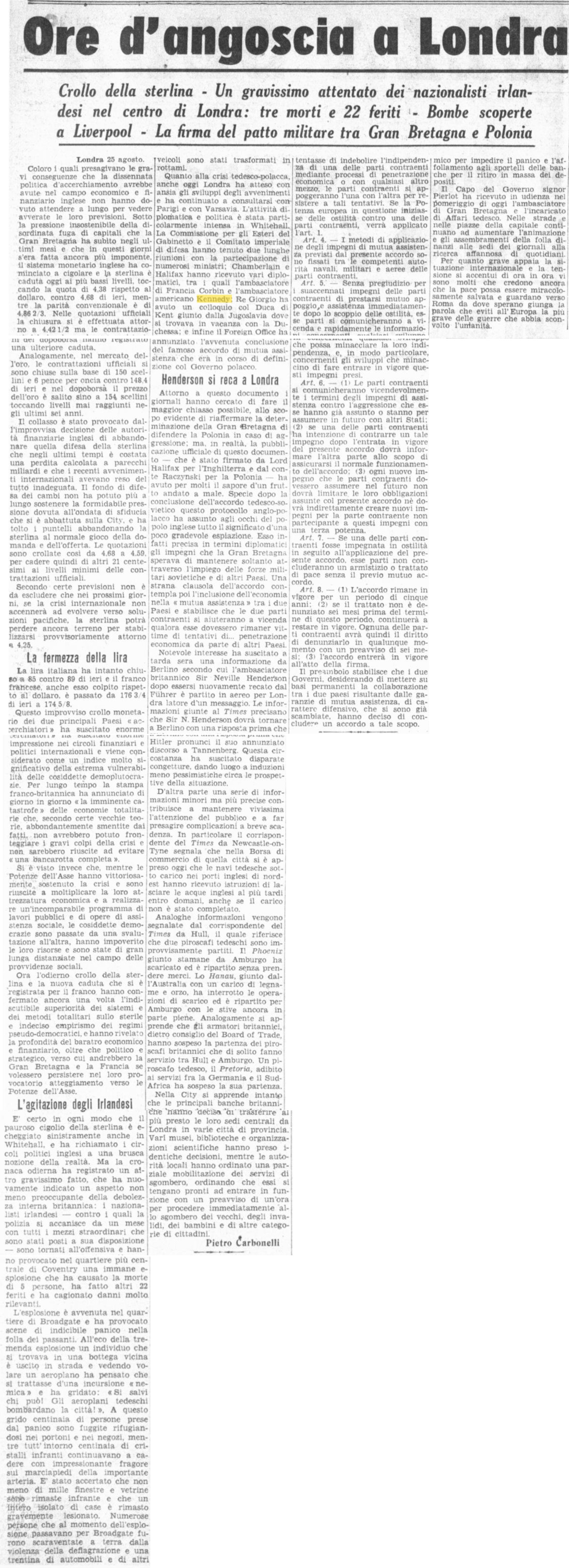
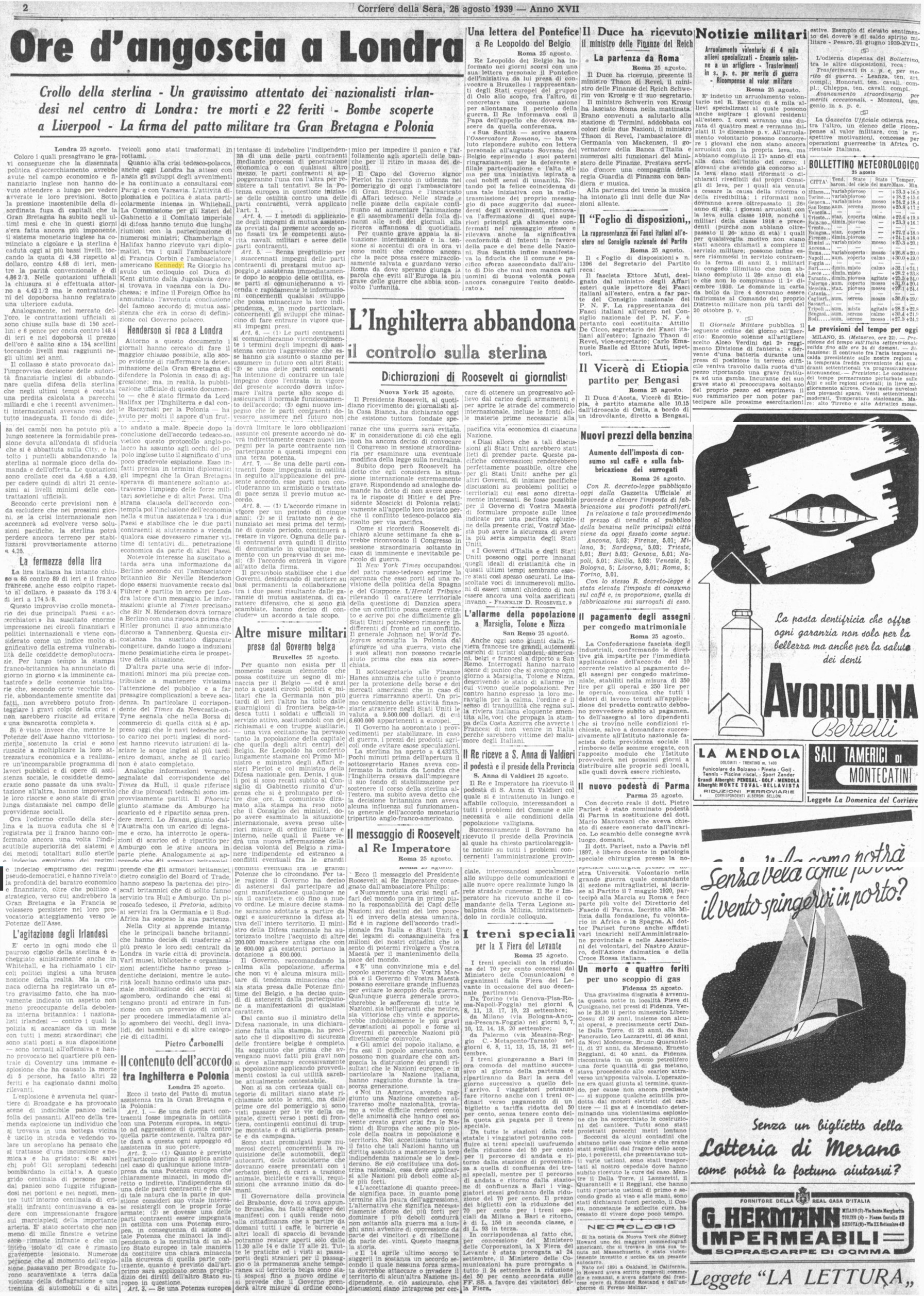
A copy of
an article from the Italian daily newspaper *Corriere della Sera*, dated
Friday, August 26, 1939. Article (by Pietro Carbonelli, reporting from London): "Hours of Anguish in London." Here is a summary of the article: ° The collapse of the pound sterling and financial panic: There is utter bewilderment in the London financial markets. The Bank of England’s decision to cease supporting the national currency has caused the pound to plummet against the US dollar (dropping rapidly from 4.68 to 4.40). The article contrasts this turmoil with the "steadfastness of the Italian lira." ° The signing of the Anglo-Polish military pact: The mutual assistance treaty between Great Britain and Poland—signed by Lord Halifax and Count Raczynski—has been made official. The agreement commits both nations to provide immediate support, using all available means, in the event of an act of aggression by any European power. ° Frenetic diplomatic activity and Ambassador Kennedy: Over the last 24 hours, Lord Halifax has held a series of continuous discussions with foreign diplomatic representatives. Notable among them is the American ambassador, Joseph Kennedy, alongside the French delegate Corbin, the Swedish minister Björnsson, and the Romanian minister Cesianu. Meanwhile, the return of the British ambassador, Sir Nevile Henderson, to Berlin is awaited following his decisive meeting with Hitler. ° The anguish of the population: The concluding remarks describe the somber atmosphere in the streets of London, where anxious crowds gather around newspaper vendors, hoping that peace might still be preserved. |
|
1939, September 17 - Corriere della Sera |
||
|
|
|
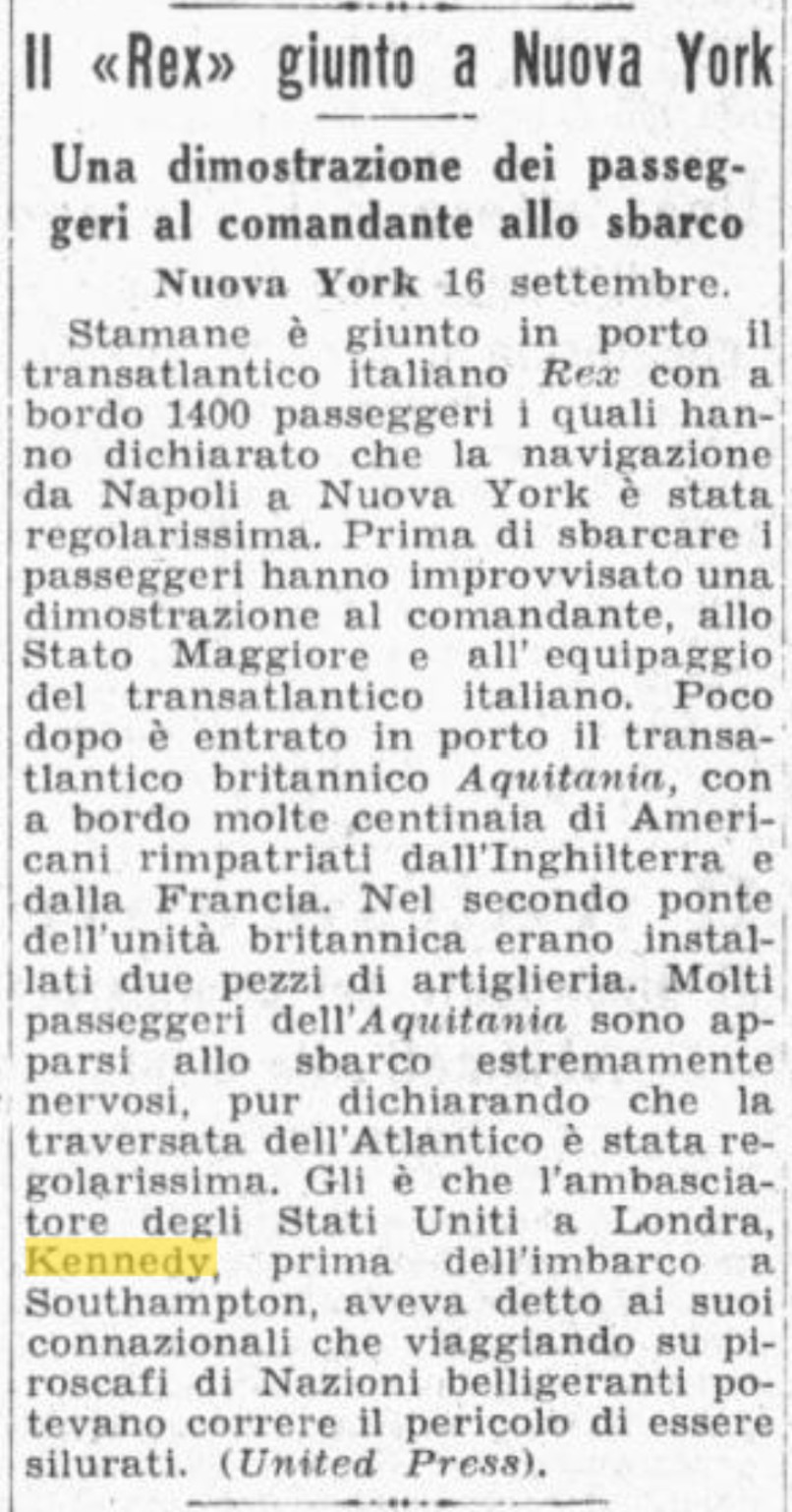
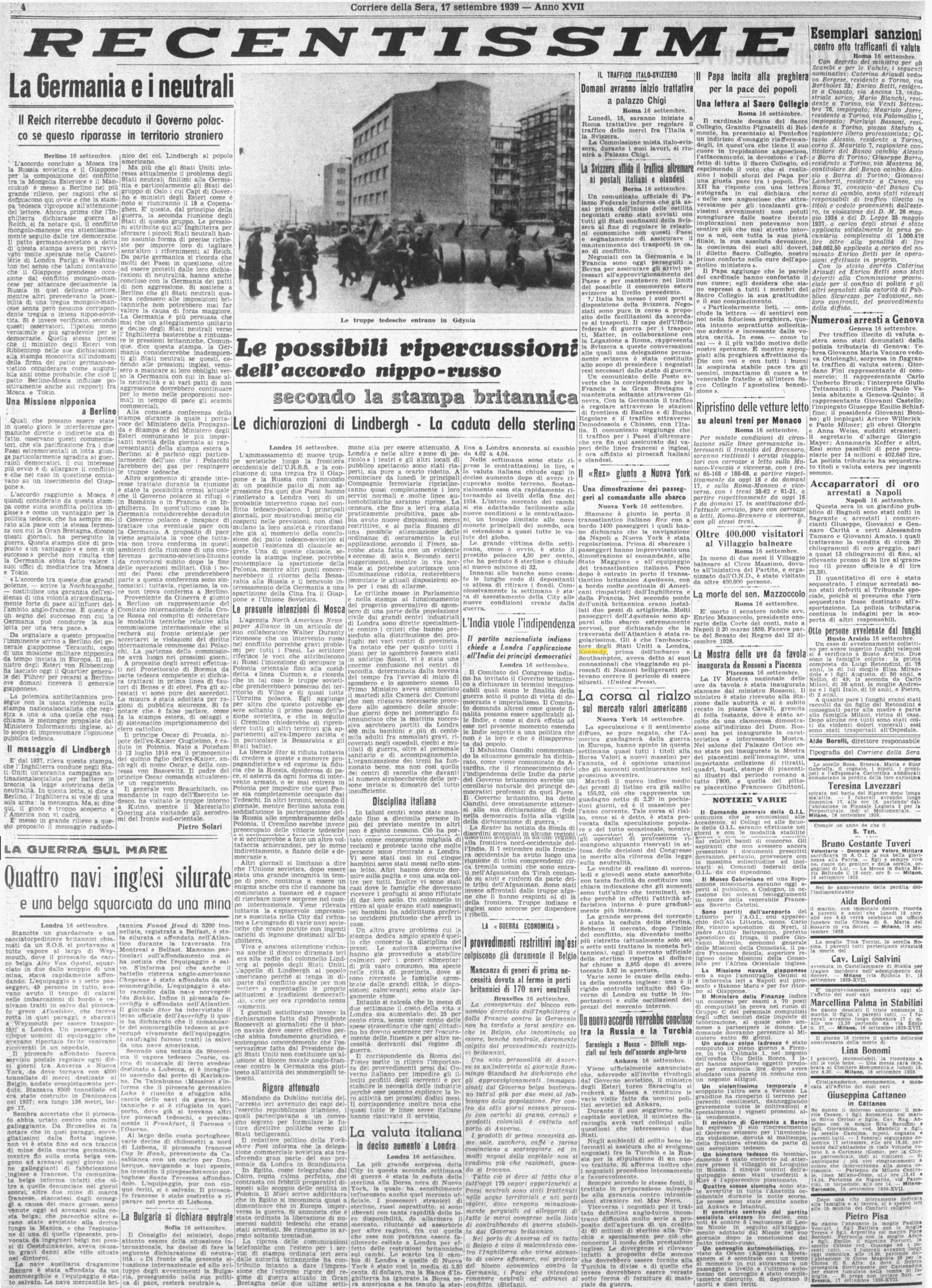
Copy of an
article from the *Corriere della Sera*, Sunday, September 17, 1939. Article (from New York, September 16): "The *Rex* arrives in New York – Passengers hold a demonstration for the captain upon disembarking": Here is a summary of the article: ° The arrival of the ocean liner *Rex* in New York: This morning, the Italian ocean liner *Rex* arrived in the port of New York with 1,400 passengers on board. The voyage from Naples to New York proceeded entirely without incident. Before disembarking, the passengers organized an impromptu, heartfelt expression of gratitude toward the captain, the senior officers, and the entire Italian crew. ° The arrival of the British ocean liner *Aquitania*: Shortly thereafter, the British steamship *Aquitania* also entered the port, carrying several hundred American citizens returning home from England and France. Two pieces of artillery had been installed on the second deck of the British vessel. ° Passenger anxiety and warnings from Ambassador Kennedy: Although the crossing was uneventful, many passengers on the *Aquitania* appeared extremely nervous upon disembarking. The reason for this apprehension lies in the fact that the United States Ambassador in London, Joseph Kennedy, had explicitly warned his fellow countrymen before they boarded in Southampton that, by traveling on steamships belonging to belligerent nations, they could face the serious danger of being torpedoed. |
|
1939, September 18 - Time |
||
|
|
|
Original.
Here is a summary of the article , titled "Angry Athenians": John Kennedy’s mission in Glasgow: Twenty-one-year-old John Kennedy—the second son of the American Ambassador to London, Joseph Kennedy—was sent by his father to Glasgow to interview and assist American survivors of the sinking of the British passenger ship S.S. *Athenia*, which had been torpedoed on September 3 west of the Hebrides. The passengers' anger and demands for a military escort: Young John Kennedy found himself facing furious protests from about a hundred American survivors gathered in the lounge of the Beresford Hotel in Glasgow. Still in shock from their harrowing experience at sea and fearful of setting sail again on an unprotected vessel, the passengers clamored for American destroyers and warships to escort them back to the United States, insisting that they could no longer trust the German navy or government. John Kennedy’s defense
and American neutrality: John Kennedy attempted to manage the
difficult situation by pointing out that the United States was bound by
neutrality laws and that President Franklin D. Roosevelt’s policy
precluded the use of American warships to escort refugees. The passengers
rejected his explanations, pointedly recalling instances where the U.S.
had mobilized entire fleets for other emergencies—such as the search for
Amelia Earhart in the Pacific—and firmly declared that they would refuse
to return home without a military escort. |
|
1939, November 23 - Corriere della Sera |
||
|
|
|
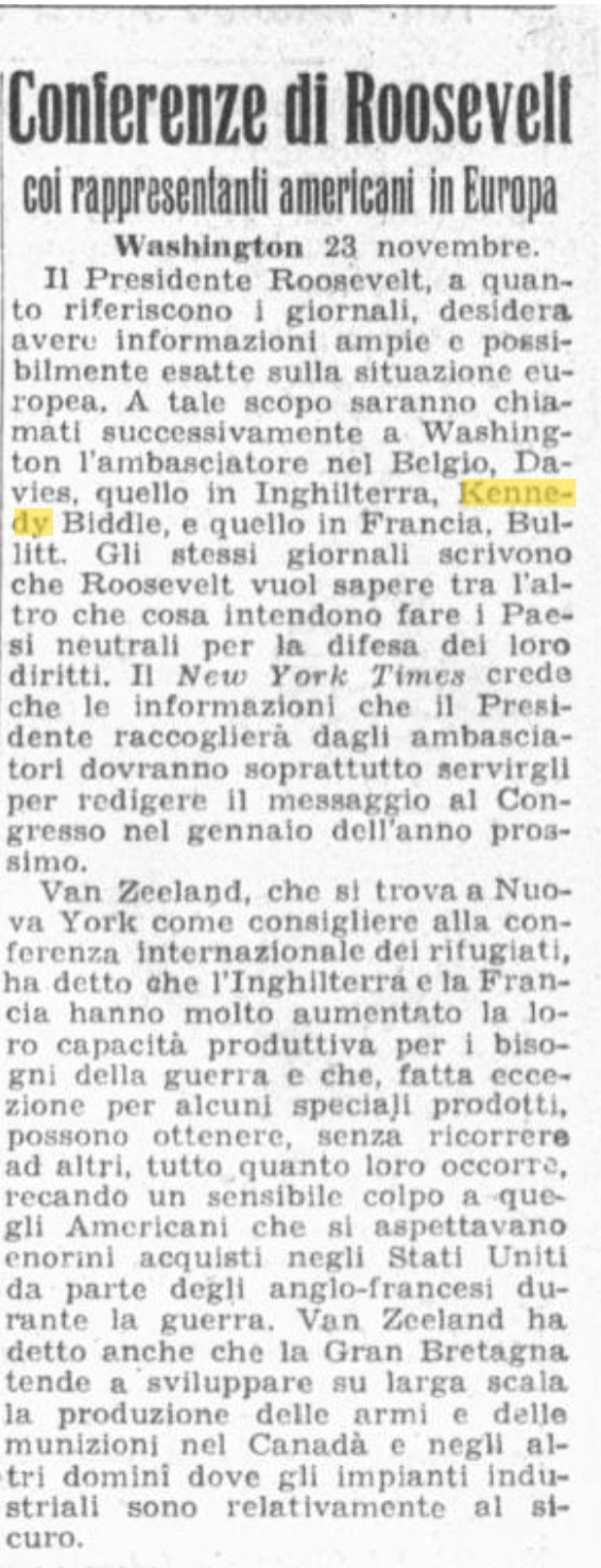
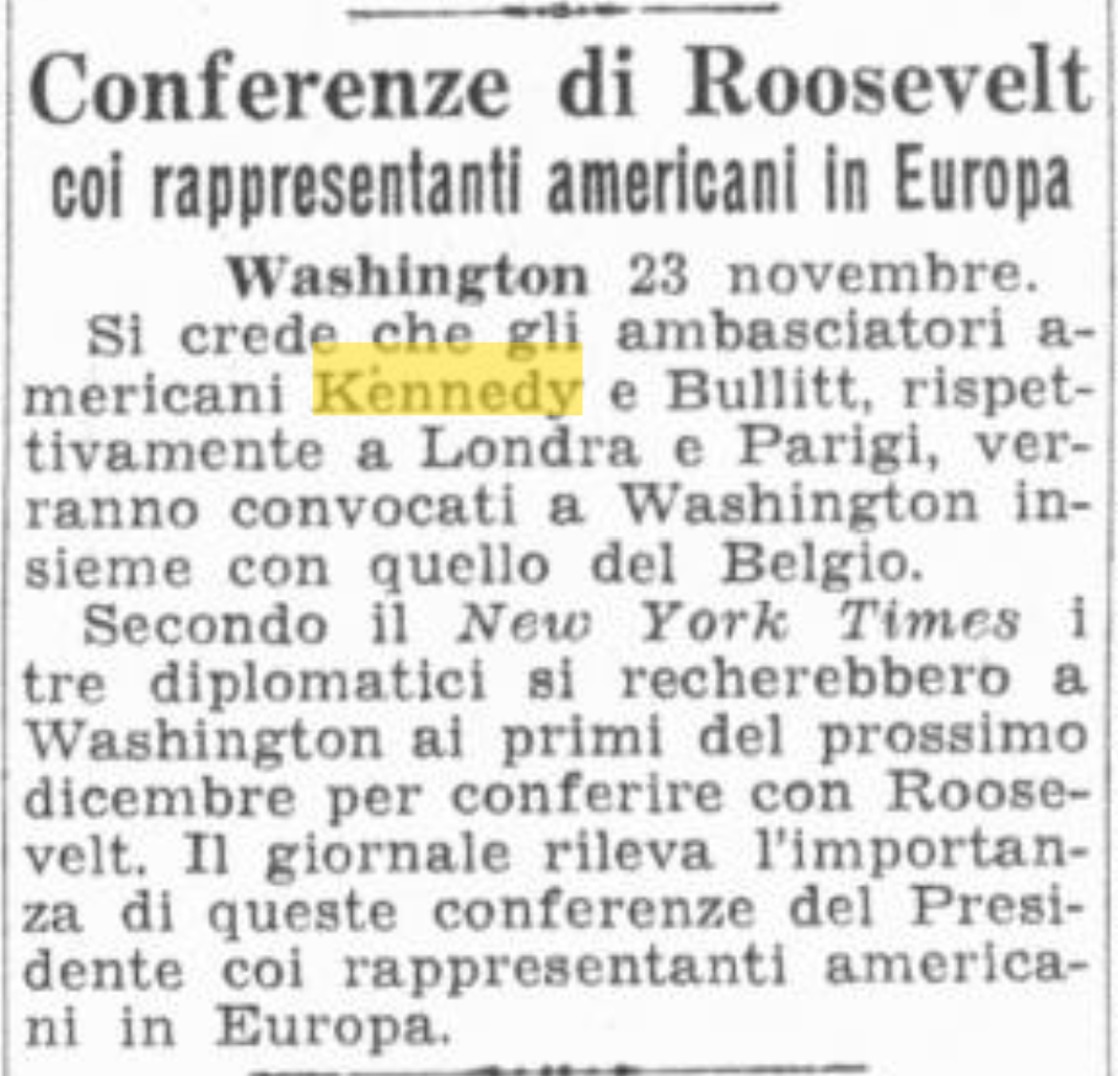
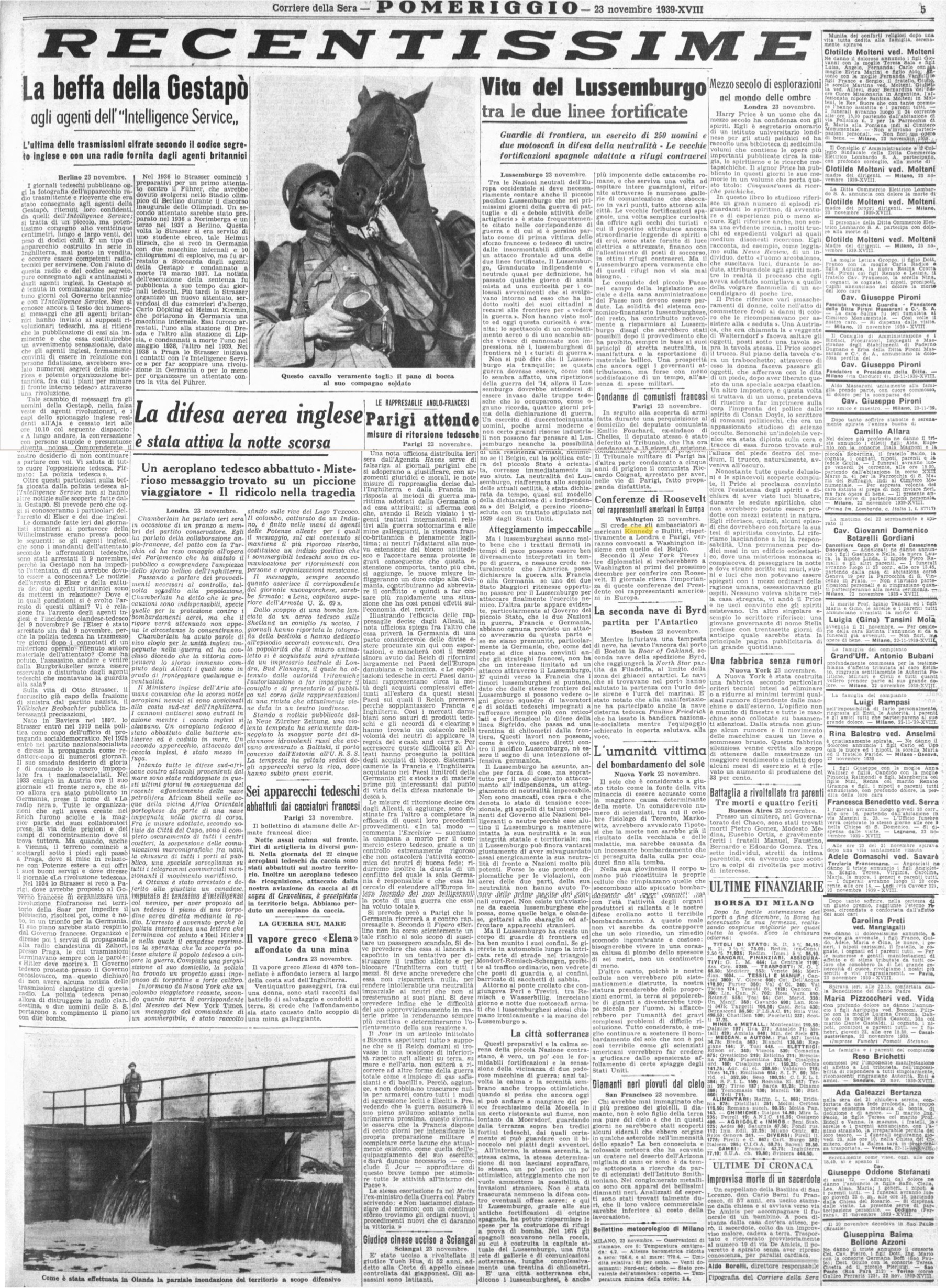
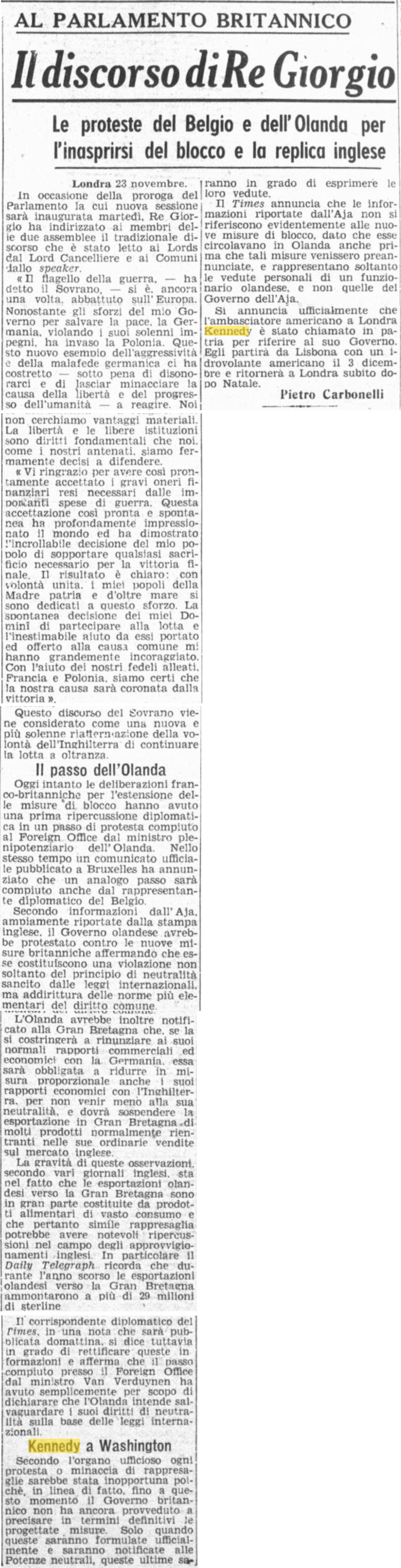
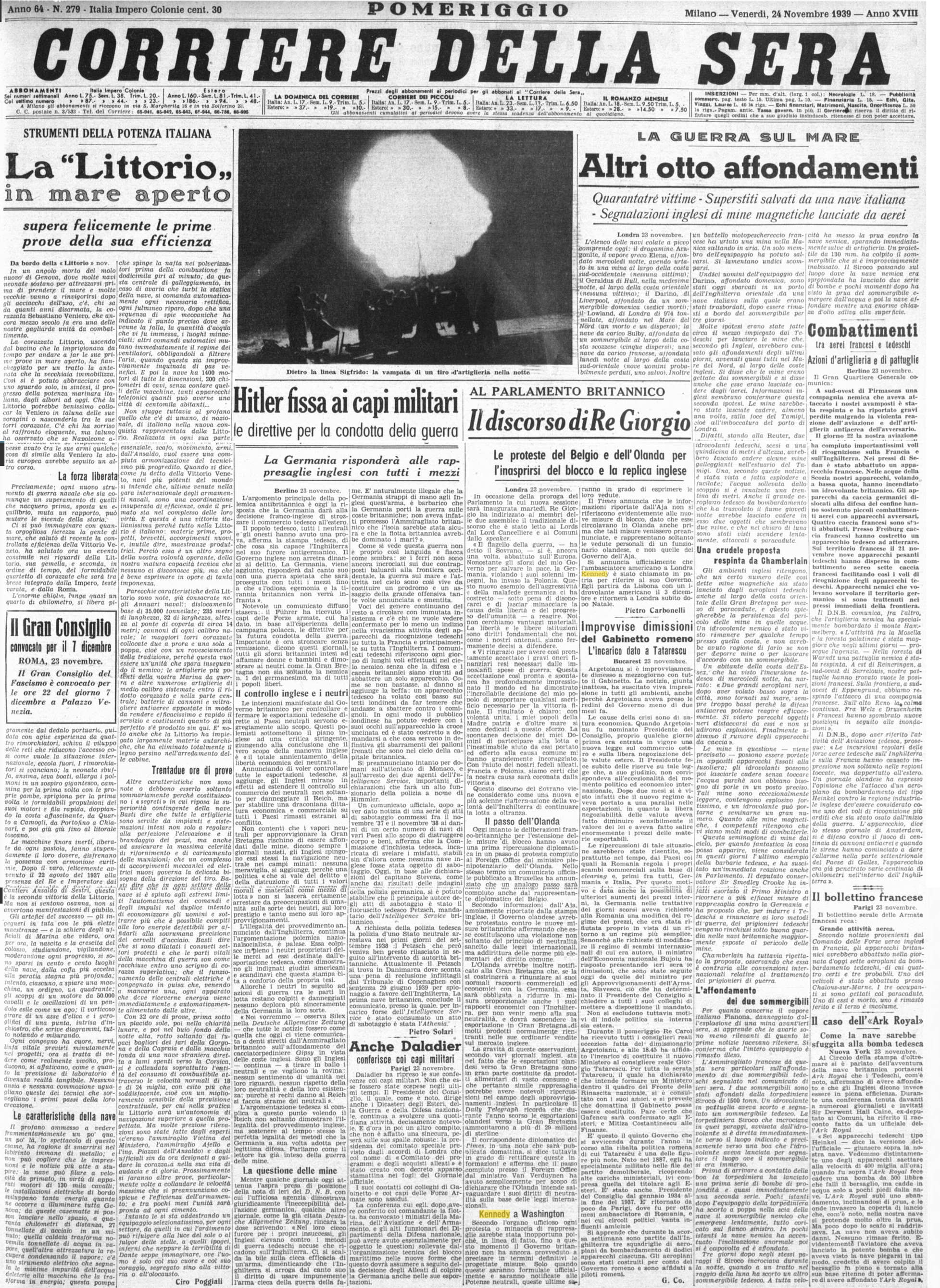
Copy of an
article from the *Corriere della Sera*, Thursday, November 23, 1939. Article (from Washington, November 23): "Roosevelt’s conferences with American representatives in Europe." Summary of the article: ° Roosevelt’s diplomatic summons and the position of Joseph Kennedy: President Roosevelt intends to obtain detailed and precise information regarding the situation in Europe. To this end, the ambassador to Belgium (Davies), the ambassador to England (Joseph Kennedy), the ambassador to the Polish government (Biddle), and the ambassador to France (Bullitt) are being summoned to Washington. ° Objectives of the consultations: Among other things, Roosevelt intends to ascertain what actions neutral countries plan to take to defend their rights. According to *The New York Times*, the information gathered by Kennedy and the other diplomats will assist the President in drafting his customary message to Congress, scheduled for the following January. ° Statements by Van Zeeland on wartime production: The article also mentions remarks by former Belgian Prime Minister Van Zeeland—who was in New York serving as an advisor for a conference on refugees—highlighting how England and France have significantly increased their own wartime production capacity. This reduces their reliance on supplies from the United States—disappointing the commercial expectations of many American industrialists—and shifts the production of arms and munitions to more secure facilities in Canada and other Dominions. |
|
1939, November 24 - Corriere della Sera |
||
|
|
|
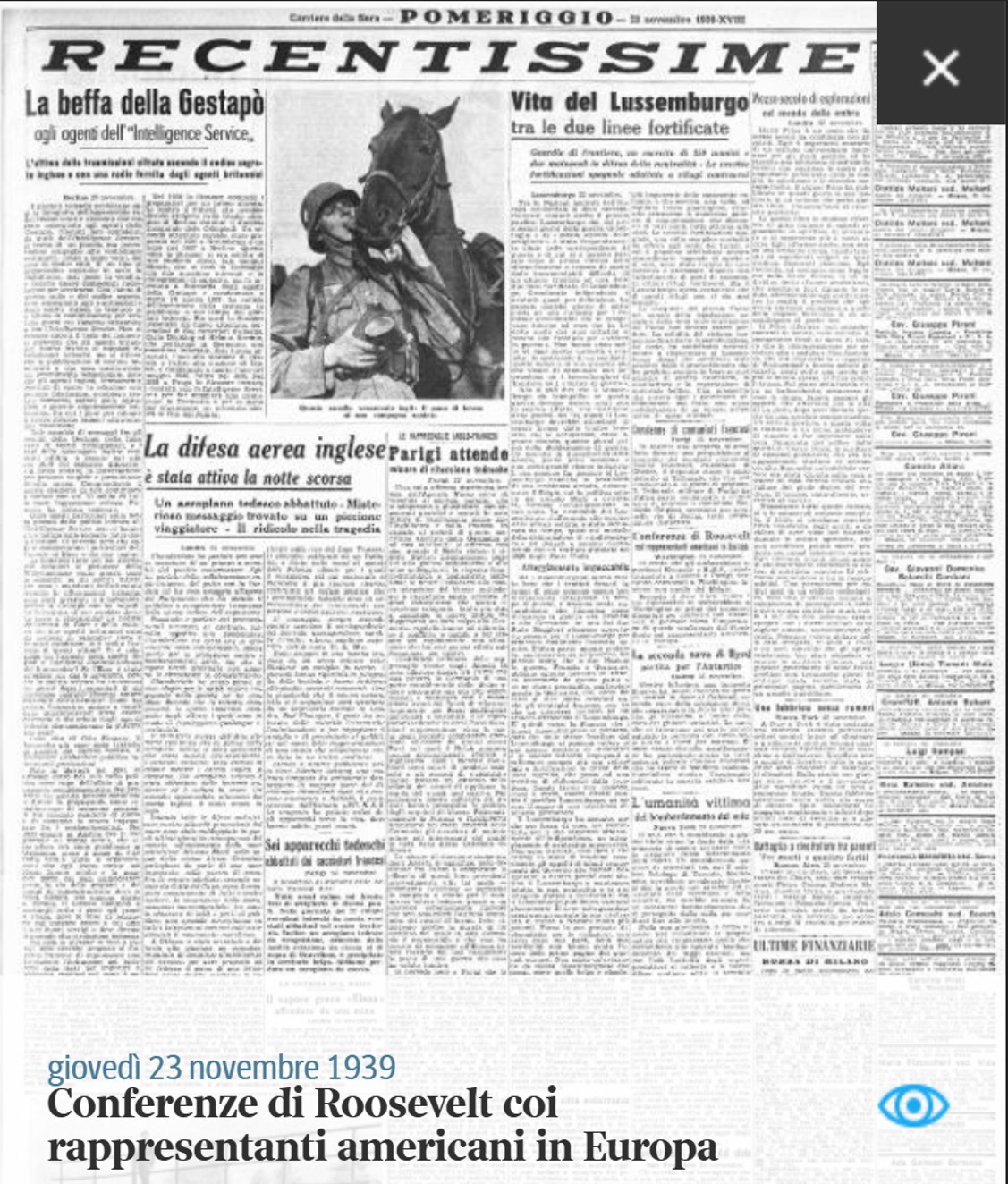
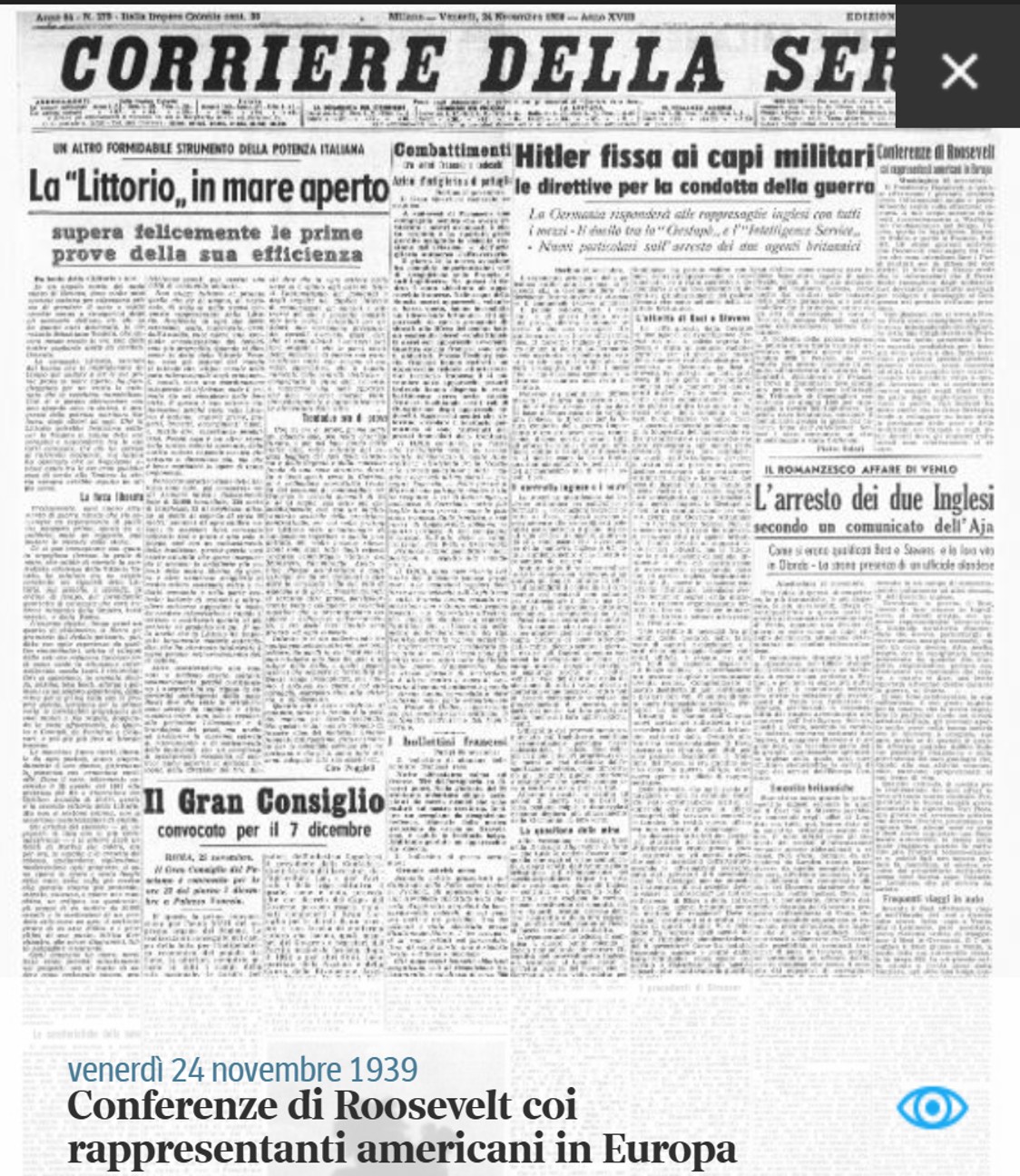
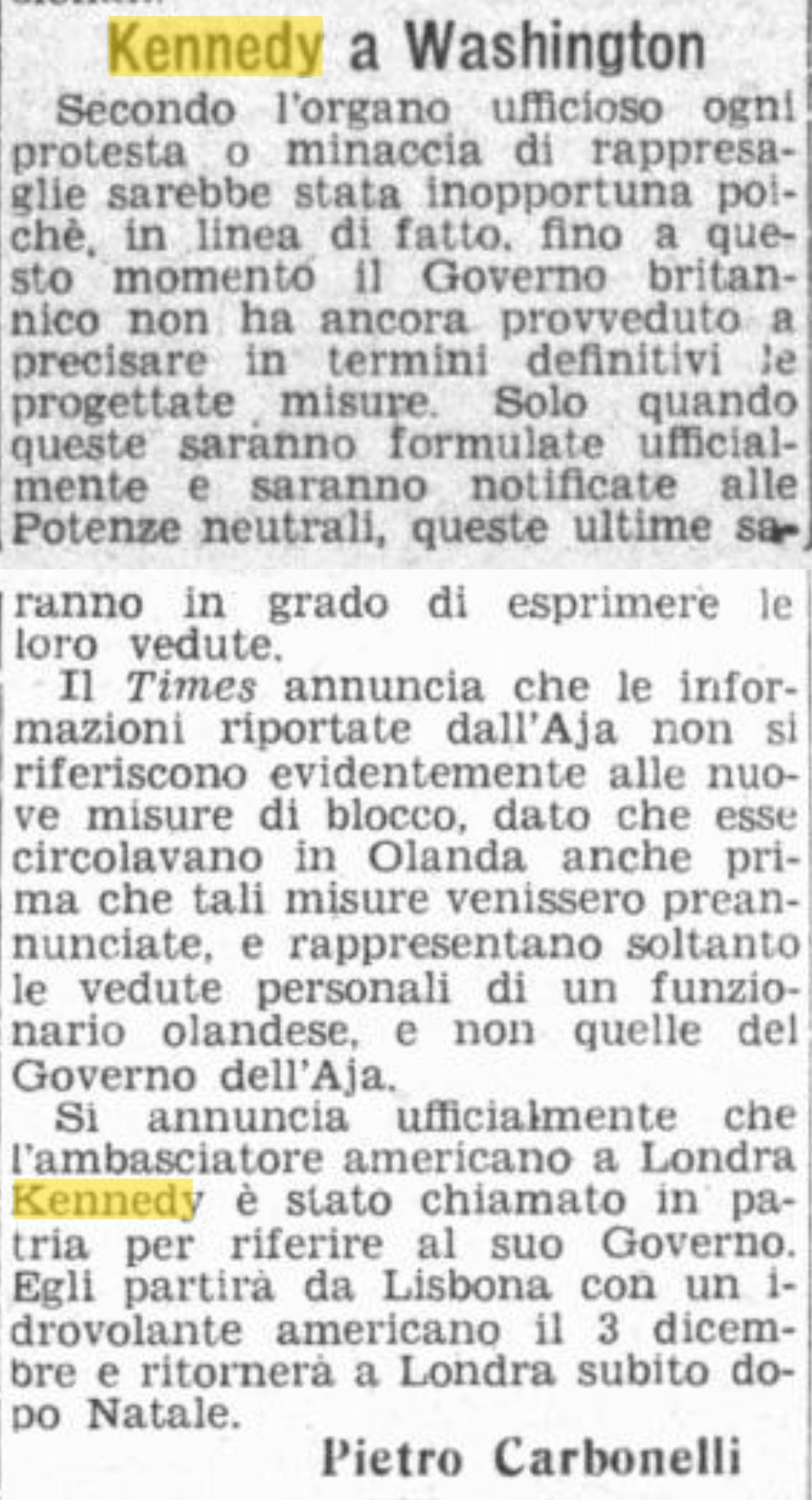
Copy of an
article from the *Corriere della Sera*, Friday, November 24, 1939. Article (correspondence from London by Pietro Carbonelli): "King George’s Speech – Kennedy in Washington." Summary of the article: ° King George VI’s speech to Parliament: On the occasion of the prorogation of Parliament, King George VI delivered a solemn address, declaring that—despite British efforts to preserve peace—"German bad faith" had unleashed war by invading Poland. The Sovereign reaffirmed the firm resolve of the British Empire and its allies (France and Poland) to continue the struggle to the bitter end in defense of freedom. ° Focus on Joseph Kennedy – Return to Washington: In a section titled "Kennedy in Washington," the official announcement is made regarding the recall of the American Ambassador to London: Joseph Kennedy has been summoned to Washington to report directly to the U.S. government on the situation in Europe. According to the travel arrangements, Kennedy is set to depart from Lisbon on December 3rd aboard an American seaplane. His stay in the United States will be temporary; Kennedy is expected to return to his diplomatic post in London immediately following the Christmas holidays.
|
|
1939, December 12 - Corriere della Sera |
||
|
|
|
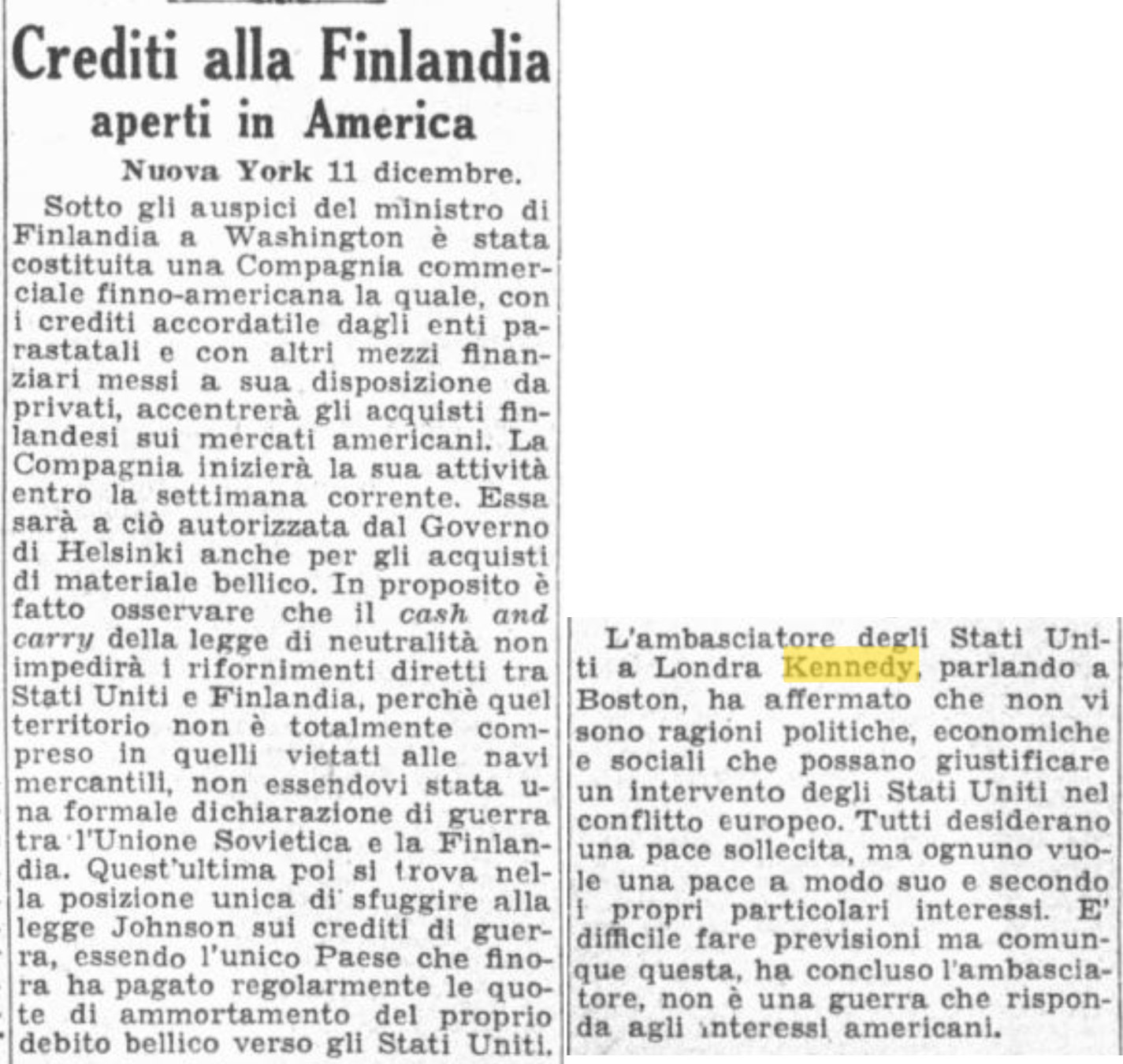
Copy of an
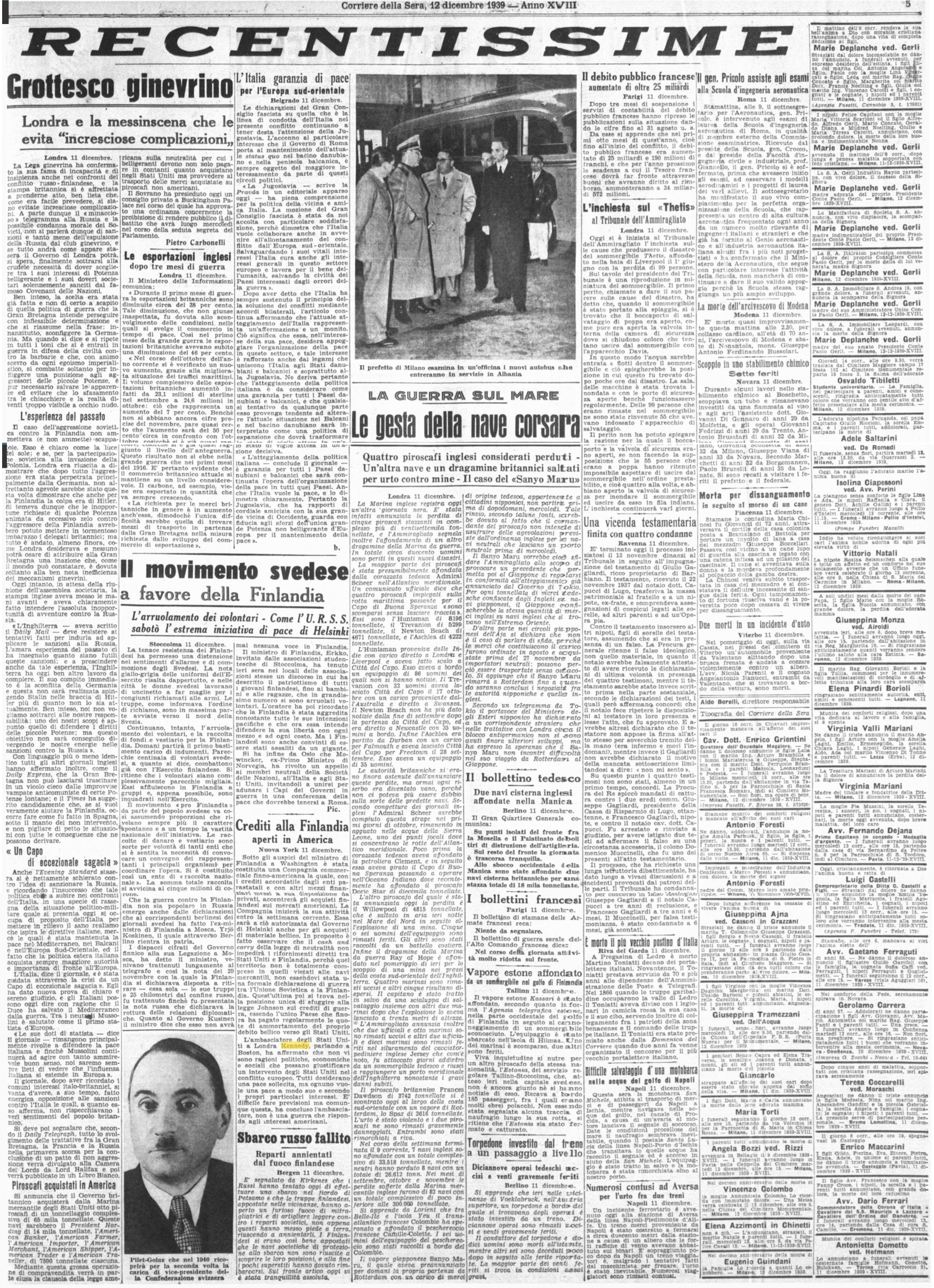
article from the *Corriere della Sera*, Tuesday, December 12, 1939. Article (from New York, December 11): "Credits for Finland Opened in America – Kennedy in Boston." Summary of the article: ° The Boston speech: In the section concerning a statement by the United States Ambassador to London—who had returned home for consultations with Roosevelt—Joseph Kennedy, speaking in Boston, firmly asserted that there is no political, economic, or social reason that could justify United States intervention in the European conflict. Kennedy noted that, while everyone desires a swift end to hostilities, each party conceives of peace "in its own way and according to its own particular interests." The ambassador concluded his isolationist stance by reiterating that the war currently underway in Europe "is not a war that serves American interests." |
|
1940, February 2 - Corriere della Sera |
||
|
|
|
Copy of an
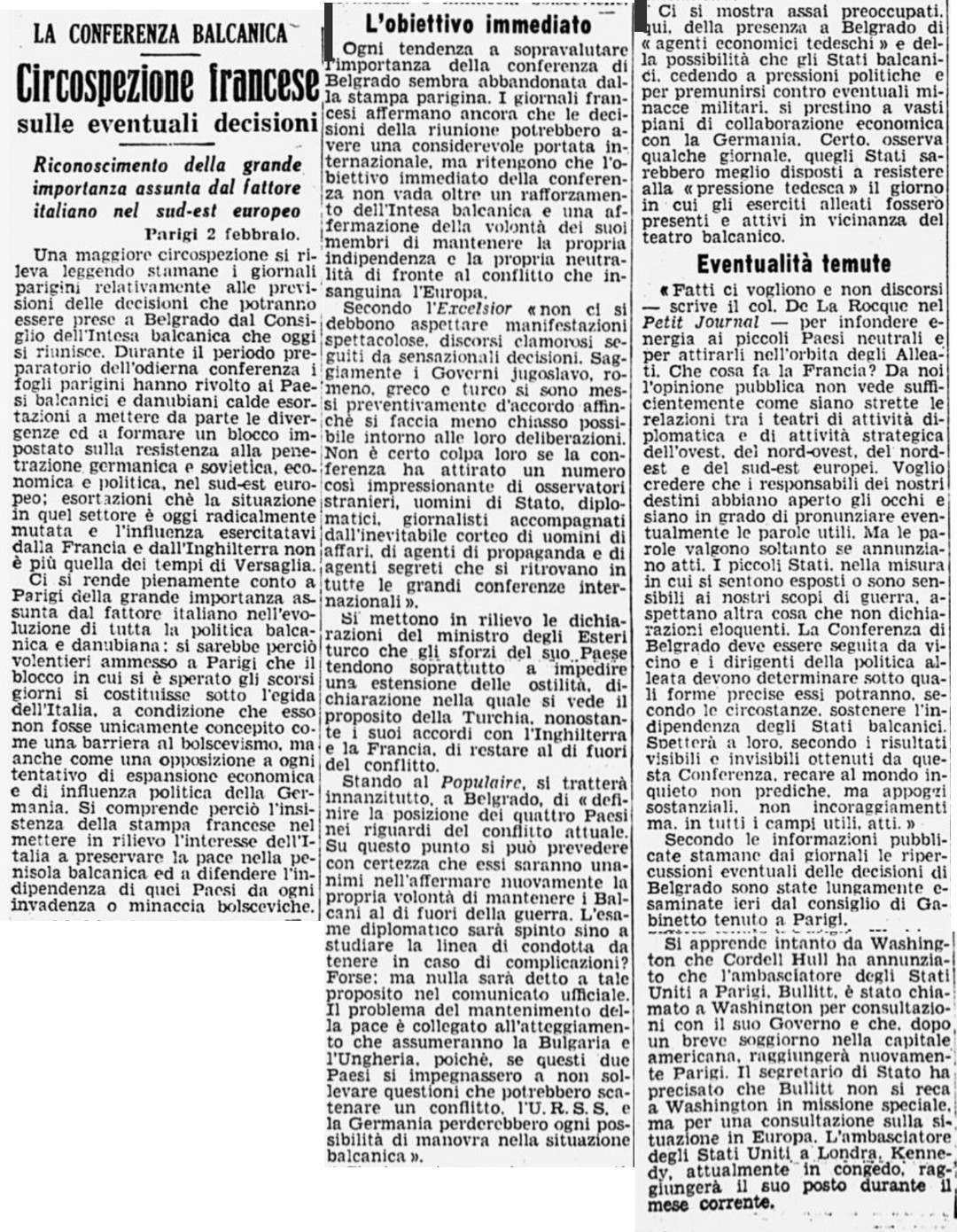
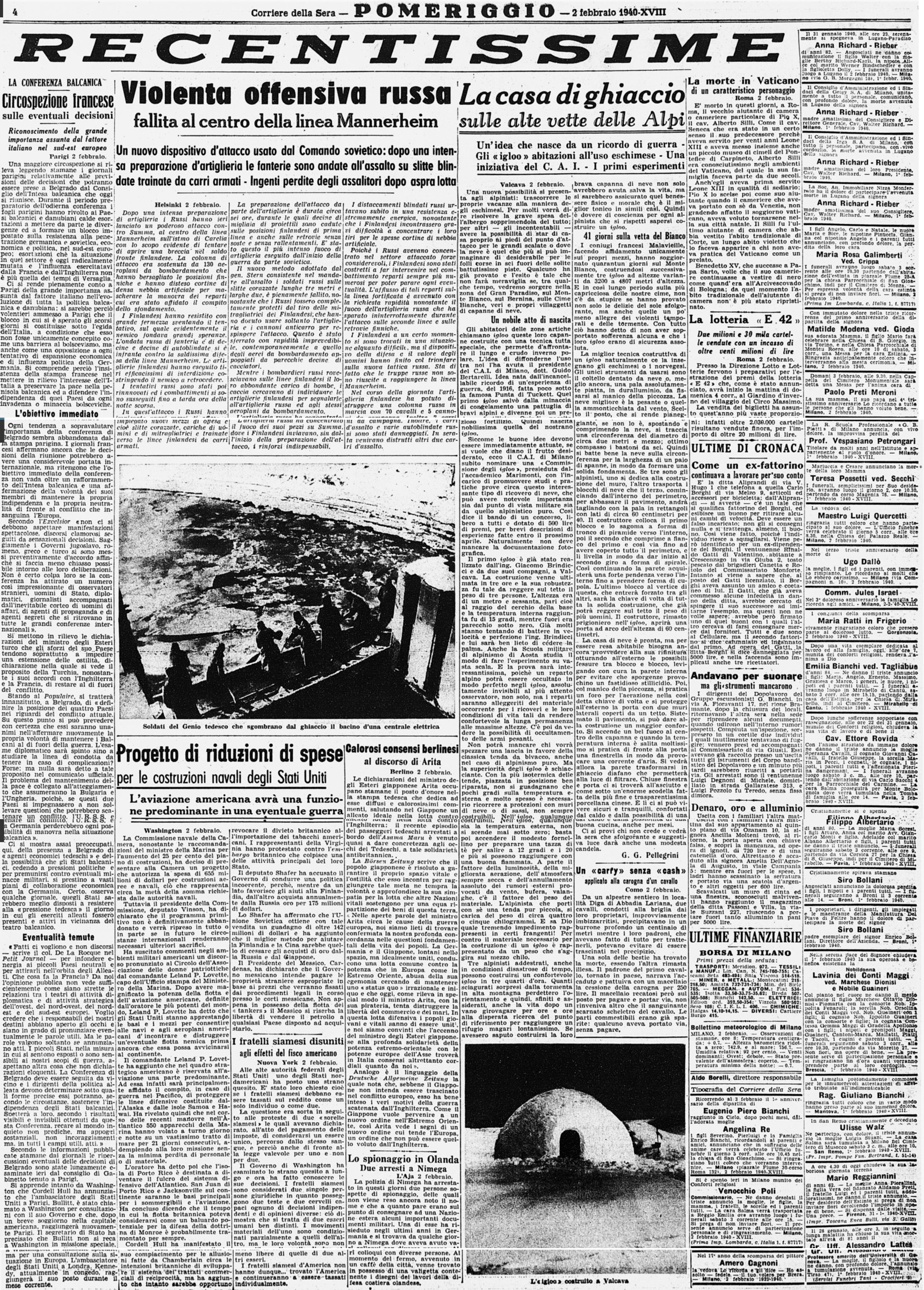
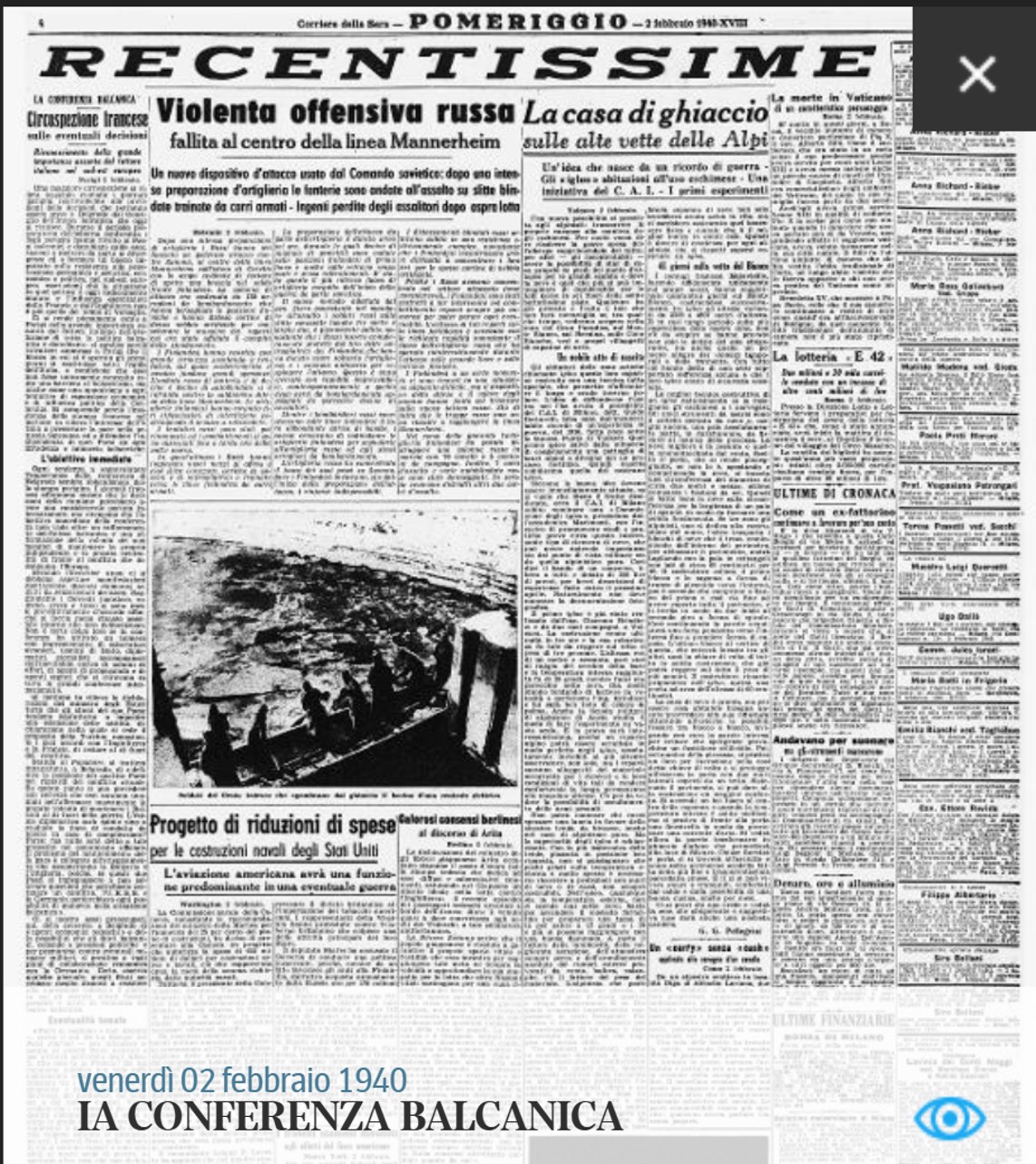
article from the *Corriere della Sera*, Friday, February 2, 1940. Article (from Paris, February 2): "The Balkan Conference." Summary of the article: ° The Balkan Conference in Belgrade and the French perspective: Parisian newspapers are observing the proceedings of the Balkan Entente Council in Belgrade with caution. The immediate objective of the member states (Yugoslavia, Romania, Greece, and Turkey) is to strengthen their neutrality and independence, while avoiding being drawn into the European conflict. ° Consultations in Washington and a focus on Joseph Kennedy: The final column of the article reports significant developments regarding U.S. diplomatic missions, as announced by Secretary of State Cordell Hull: The American ambassador to Paris, William Bullitt, has been urgently recalled to Washington for consultations on the European situation; he will return to France following a brief stay in the capital. Regarding Ambassador Joseph Kennedy—currently on leave in the United States (having returned there in December)—it is noted that he will resume his post in London sometime this month (February 1940). |
|
1940, February 13 - Corriere della Sera |
||
|
|
|
Copy of an
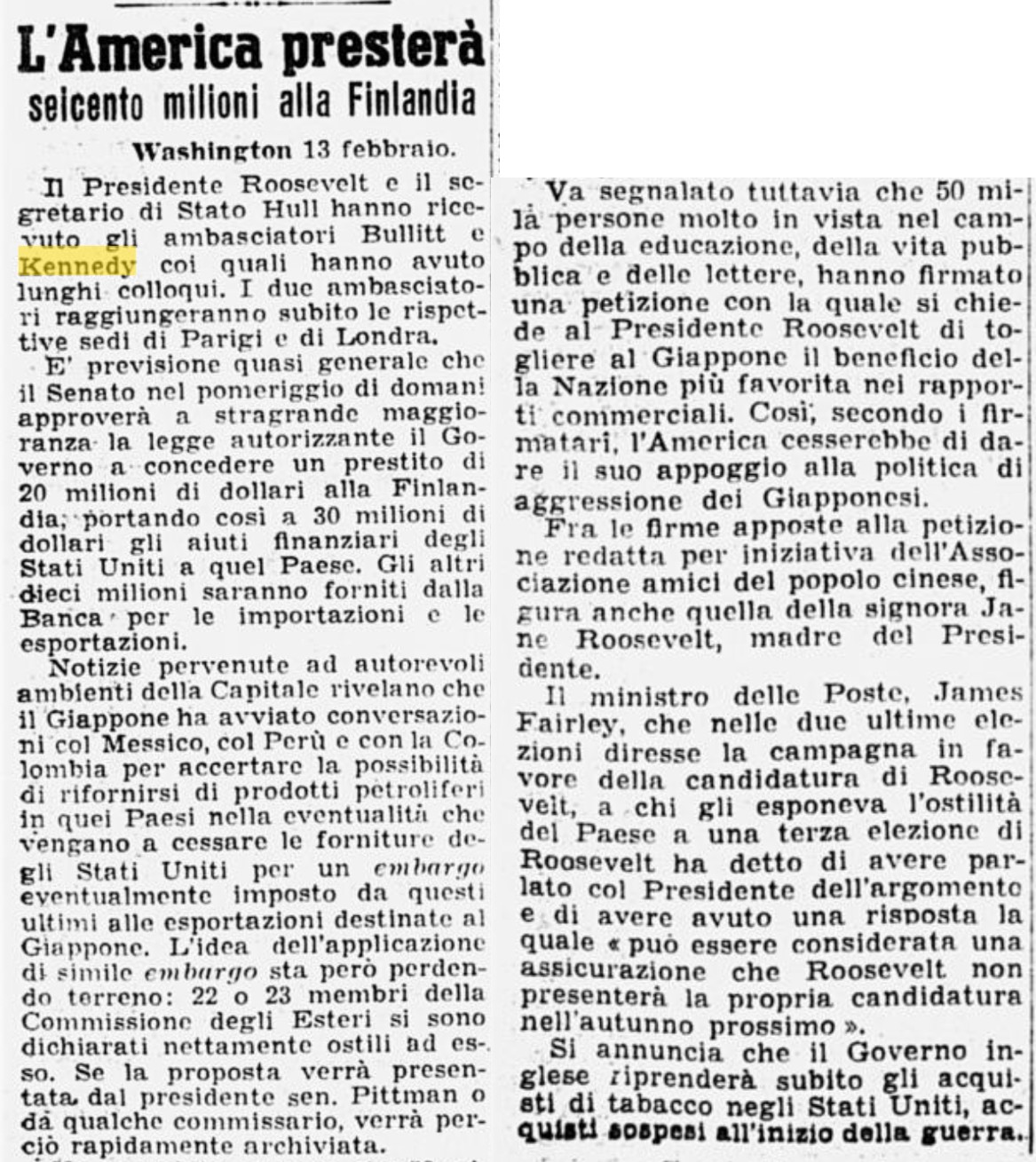
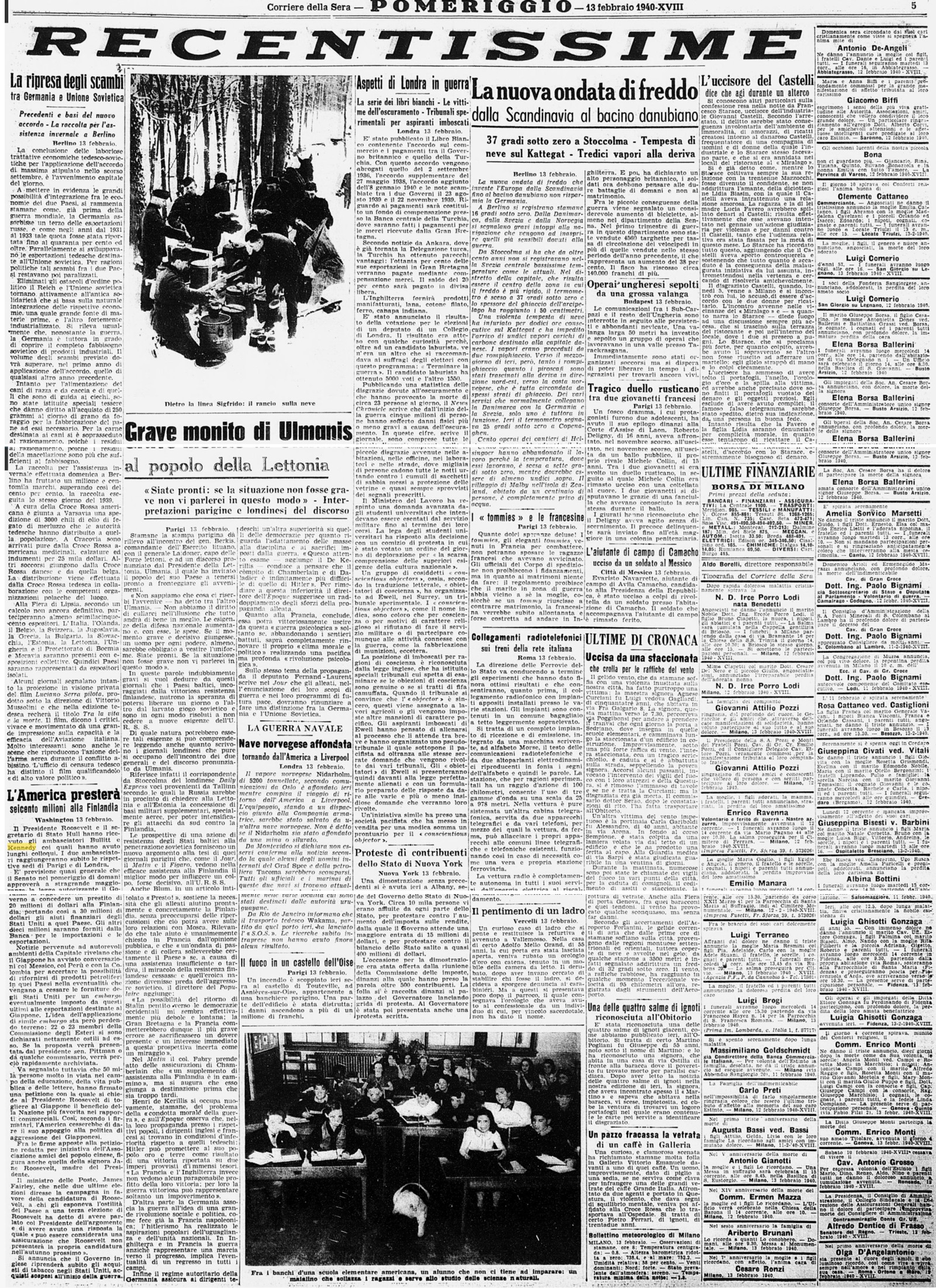
article from the *Corriere della Sera*, Tuesday, February 13, 1940. Article (from Washington, February 13): "America to lend 600 million to Finland." Below is a summary of the article, focusing on Joseph Kennedy: ° Meeting with Roosevelt and imminent return to London: President Roosevelt and Secretary of State Cordell Hull held lengthy, decisive discussions with Ambassador Joseph Kennedy and the Ambassador to France, William Bullitt, concluding their period of consultations in the United States. It has been confirmed that Kennedy and Bullitt will depart the United States immediately to return to their respective diplomatic posts in London and Paris. |
|
1940, March 8 - Corriere della Sera |
||
|
|
|
Copy of an
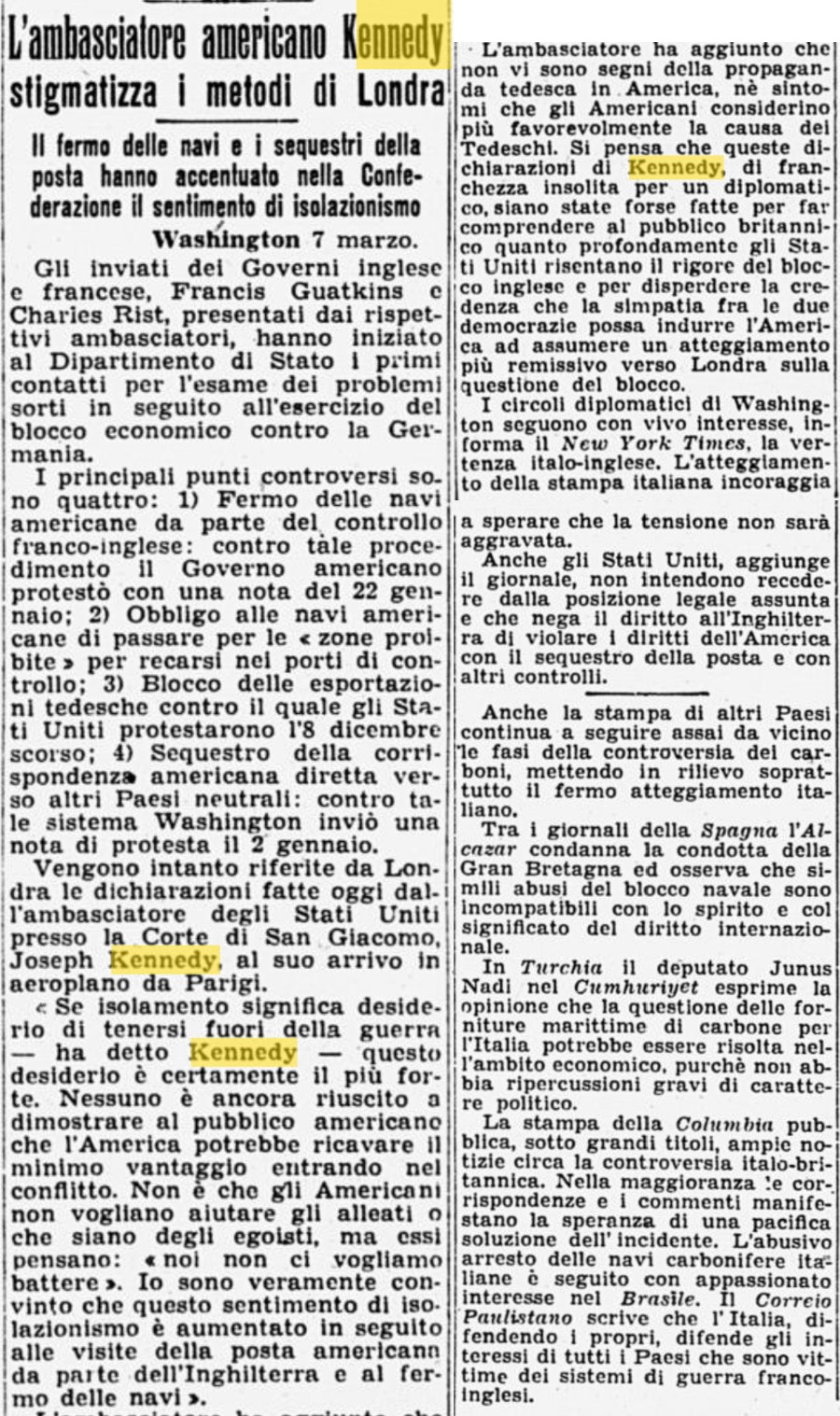
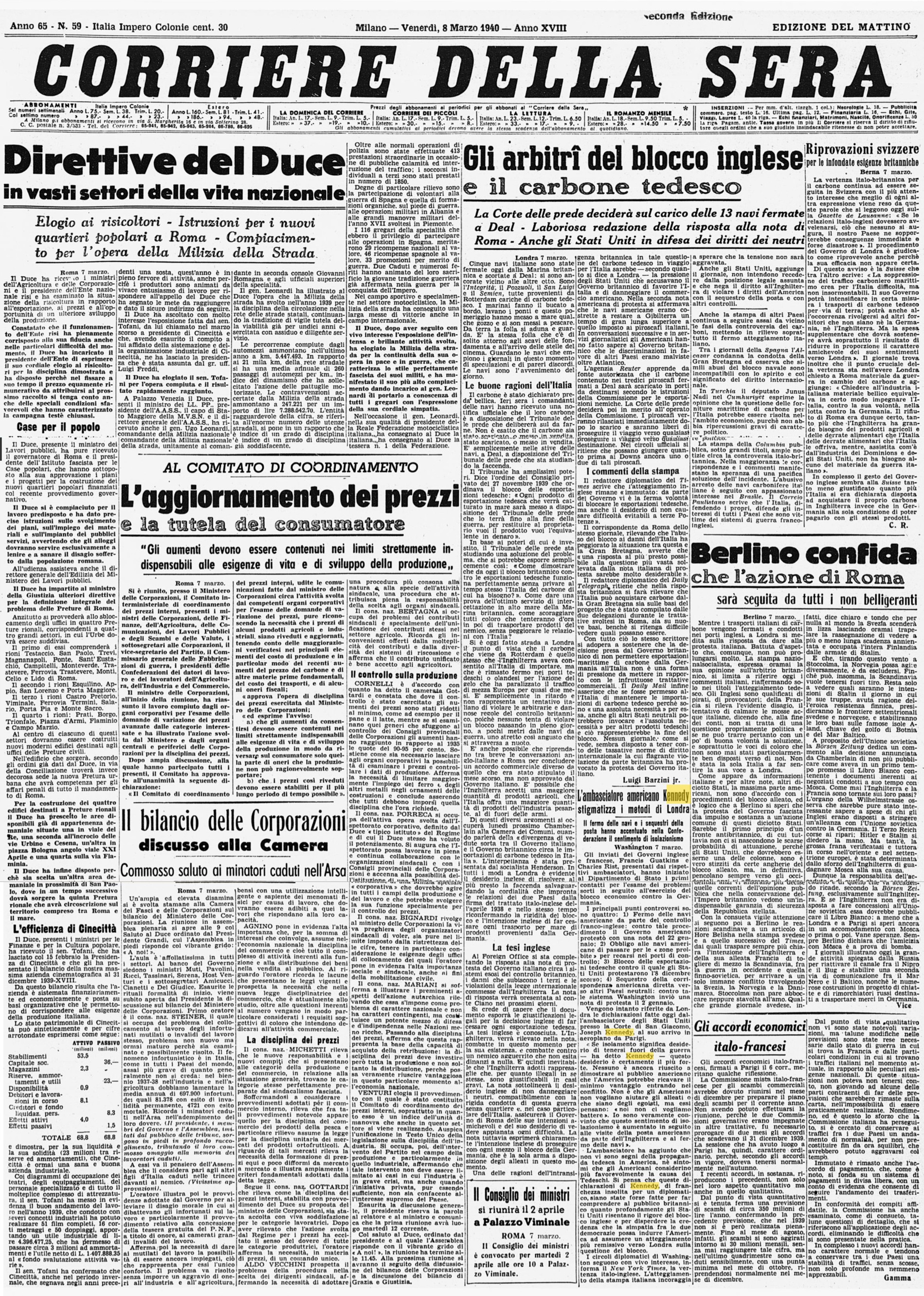
article from the *Corriere della Sera*, Friday, March 8, 1940. Article (from Washington, March 7): "American Ambassador Kennedy criticizes London's methods." Below is a summary of the article, focusing on Joseph Kennedy: ° Harsh statements in London: Upon returning from Paris by plane, American Ambassador Joseph Kennedy made remarkably frank remarks—considered unusual for a diplomat—regarding British restrictions. Kennedy stated that if isolationism means a desire to stay out of the war, "this desire is certainly the strongest one," and noted that no one has yet managed to demonstrate to the American public a single benefit that would come from entering the conflict. He further emphasized that isolationist sentiment in the U.S. has intensified significantly due to Britain’s inspection of American mail and the detention of merchant vessels. His stance serves to make it clear to London that sympathy for the democracies will not lead America to be submissive on the issue of the naval blockade. |
|
1940, March 12 - Corriere della Sera |
||
|
|
|
Copy of an
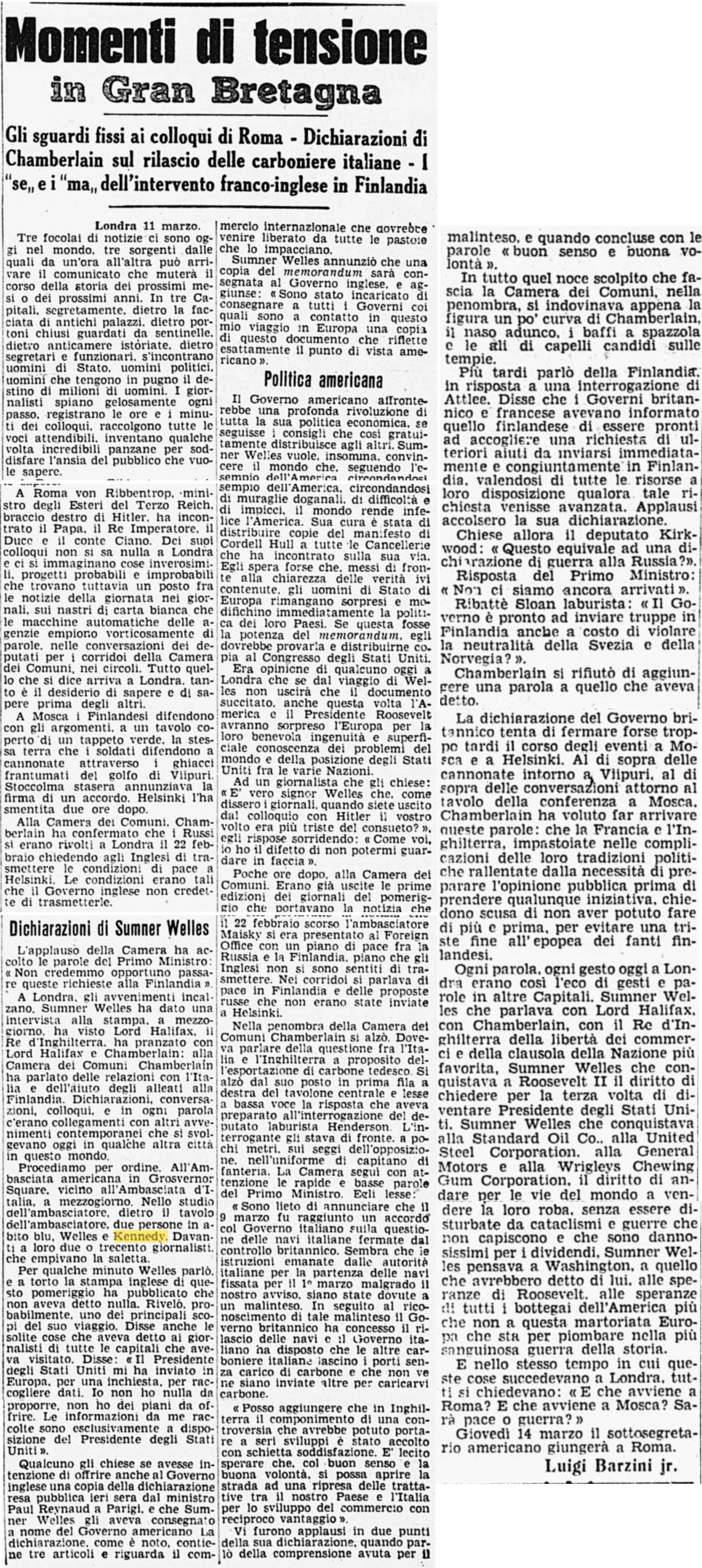
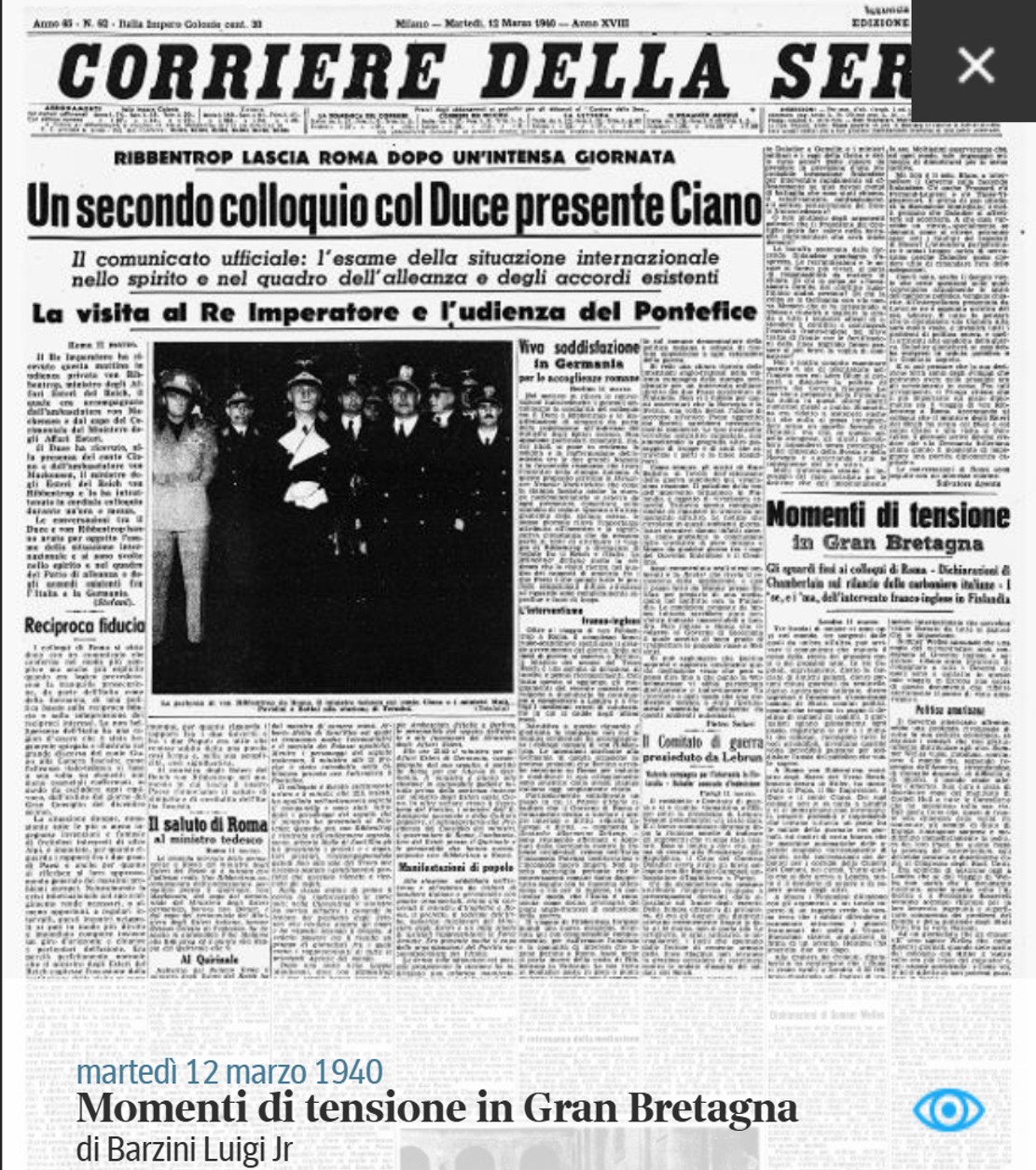
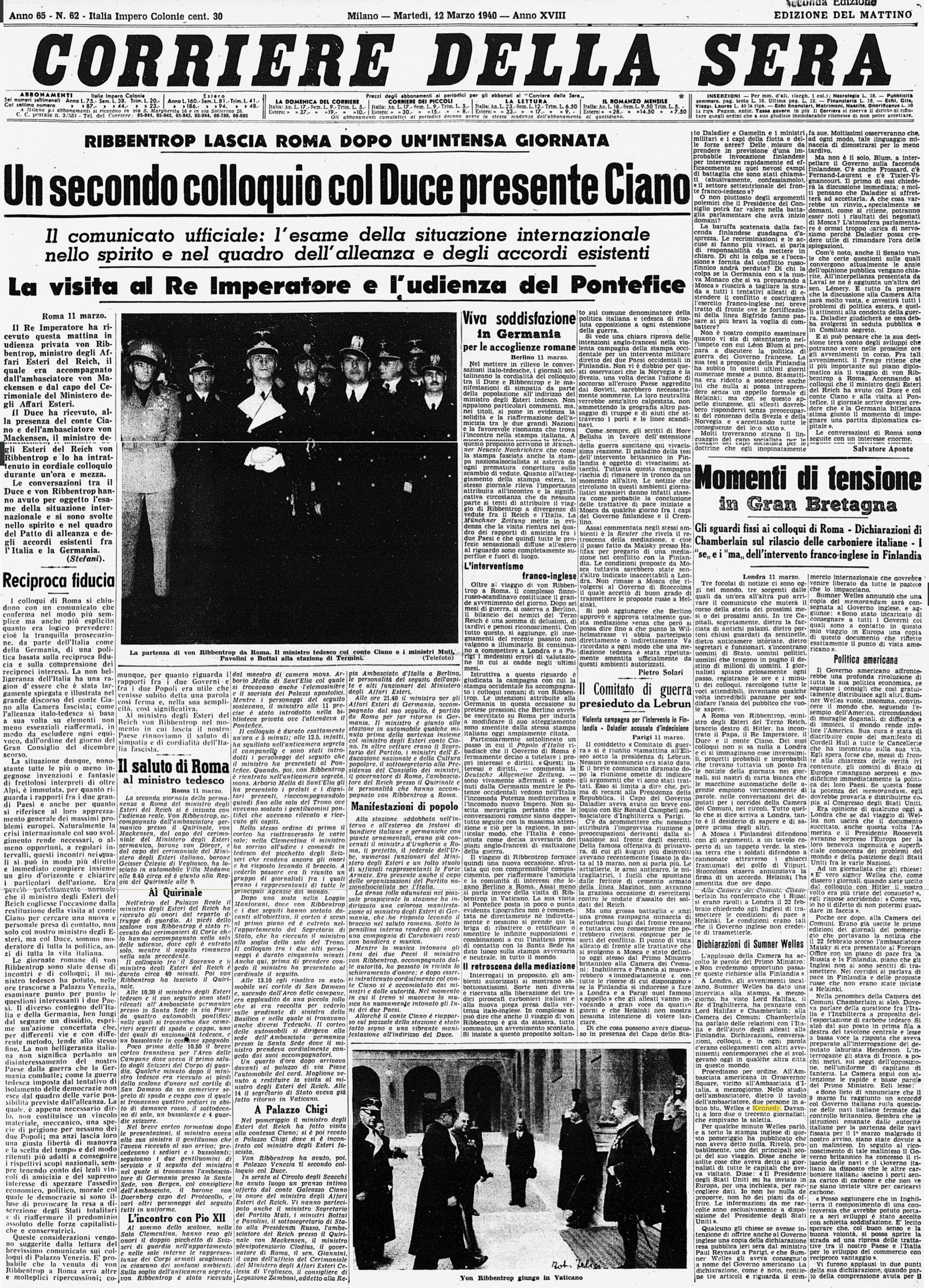
article from the *Corriere della Sera*, Tuesday, March 12, 1940. Article by Luigi Barzini Jr. (from London, March 11): "Moments of Tension in Great Britain." In 1940, Sumner Welles was the United States Under Secretary of State and one of President Franklin Delano Roosevelt’s closest and most influential foreign policy advisors. During the early months of that year (February–March 1940), Welles undertook a notable diplomatic mission to Europe on Roosevelt’s behalf: he visited Rome (meeting with Benito Mussolini), Berlin (meeting with Adolf Hitler), Paris, and London, in an attempt to gauge the possibility of a negotiated peace and contain the expansion of the Second World War. Here is a summary of the article: ° Sumner Welles’s diplomatic mission in London: U.S. Under Secretary of State Sumner Welles held a series of intensive discussions in the British capital, meeting with Lord Halifax—with whom he also shared a lunch, joined by Chamberlain—and holding a press conference at the American Embassy. Welles reiterated that his mission was one of inquiry on behalf of Roosevelt, with no specific plans to propose. ° Focus on Joseph Kennedy – The meeting and a portrait at Grosvenor Square: In describing Sumner Welles’s visit to the American Embassy in Grosvenor Square, the text provides an atmospheric detail featuring the ambassador: in the embassy office, behind the ambassador’s desk, two men sat side by side—Sumner Welles and Joseph Kennedy. A colorful, everyday detail is noted: Ambassador Kennedy is described assisting the Undersecretary while enjoying some candies, as Welles fields the persistent questions of the three hundred journalists present. |
|
1940, March 30 - Corriere della Sera |
||
|
|
|
A copy of
an article from the Italian daily newspaper *Corriere della Sera*, dated
Saturday, March 30, 1940. Article (correspondence from Berlin by Pietro Solari): "Berlin accuses France of being in tow to England." Here is a summary of the article: ° German accusations regarding Reynaud’s trip to London: Political circles in Berlin are commenting on the meeting between the new French Prime Minister, Paul Reynaud, and Neville Chamberlain, arguing that France has been reduced to a "most humble vassal" of England. The German press accuses Reynaud of intending to launch a fierce propaganda campaign aimed at enforcing the occupation of Germany and reducing the country to destitution. ° Publication of the White Book containing Polish documents: The German Foreign Ministry has released the first installment of a new "White Book," featuring 16 photographic copies of original documents seized from the archives of the Polish Foreign Ministry following the occupation of Warsaw. The texts include past dispatches (such as those concerning a 1935 conversation between Eden and Piłsudski), reports from military attachés, and diplomatic correspondence which, according to Berlin, prove the existence of Anglo-French maneuvers to encircle Germany. ° Focus on Joseph Kennedy – The Polish report on a conversation with the ambassador: In summarizing the contents of the sixteen seized diplomatic documents, the article makes direct reference to the American diplomat: The fifteenth document in the collection is a report sent to Warsaw by the Polish commercial attaché in London. This document details a private conversation that the commercial attaché had with the American ambassador, Joseph Kennedy. |
|
1940, March 31 - Corriere della Sera |
||
|
|
|
Copy of an
article from the Italian daily newspaper CORRIERE DELLA SERA, dated
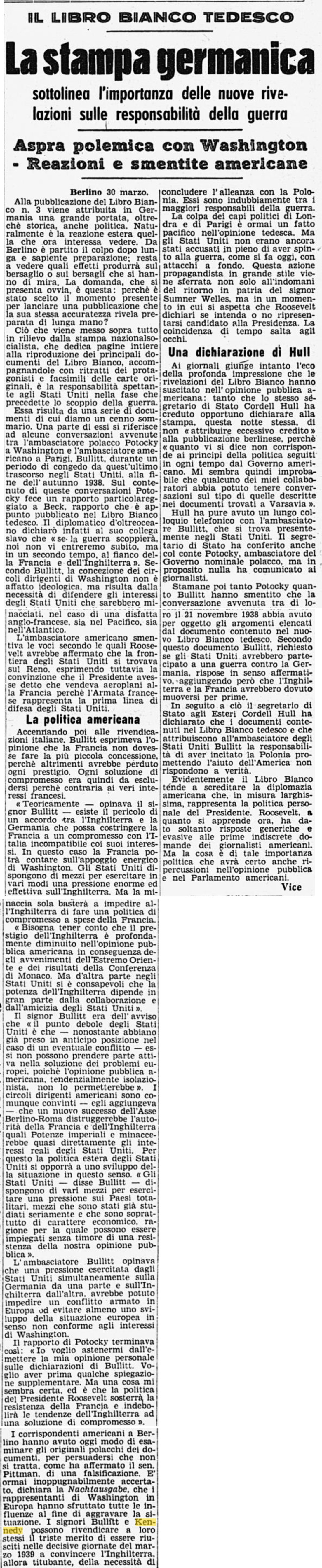
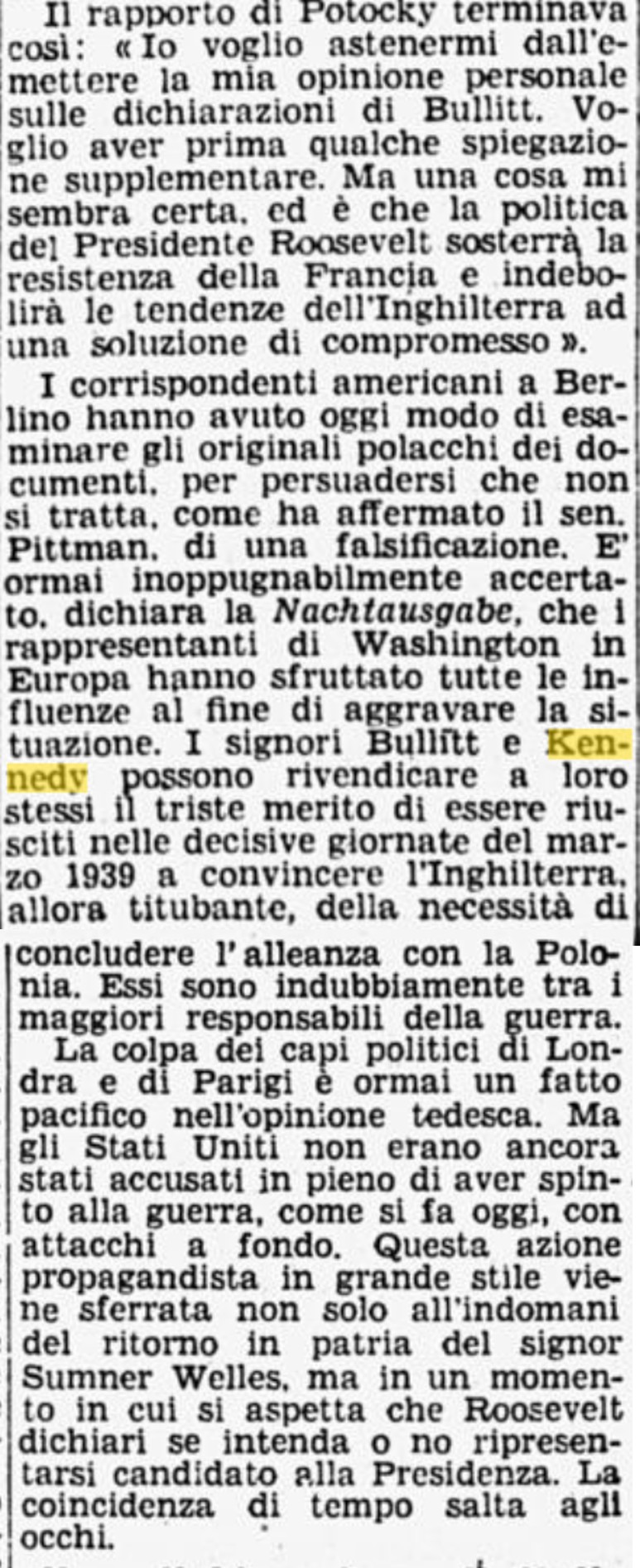
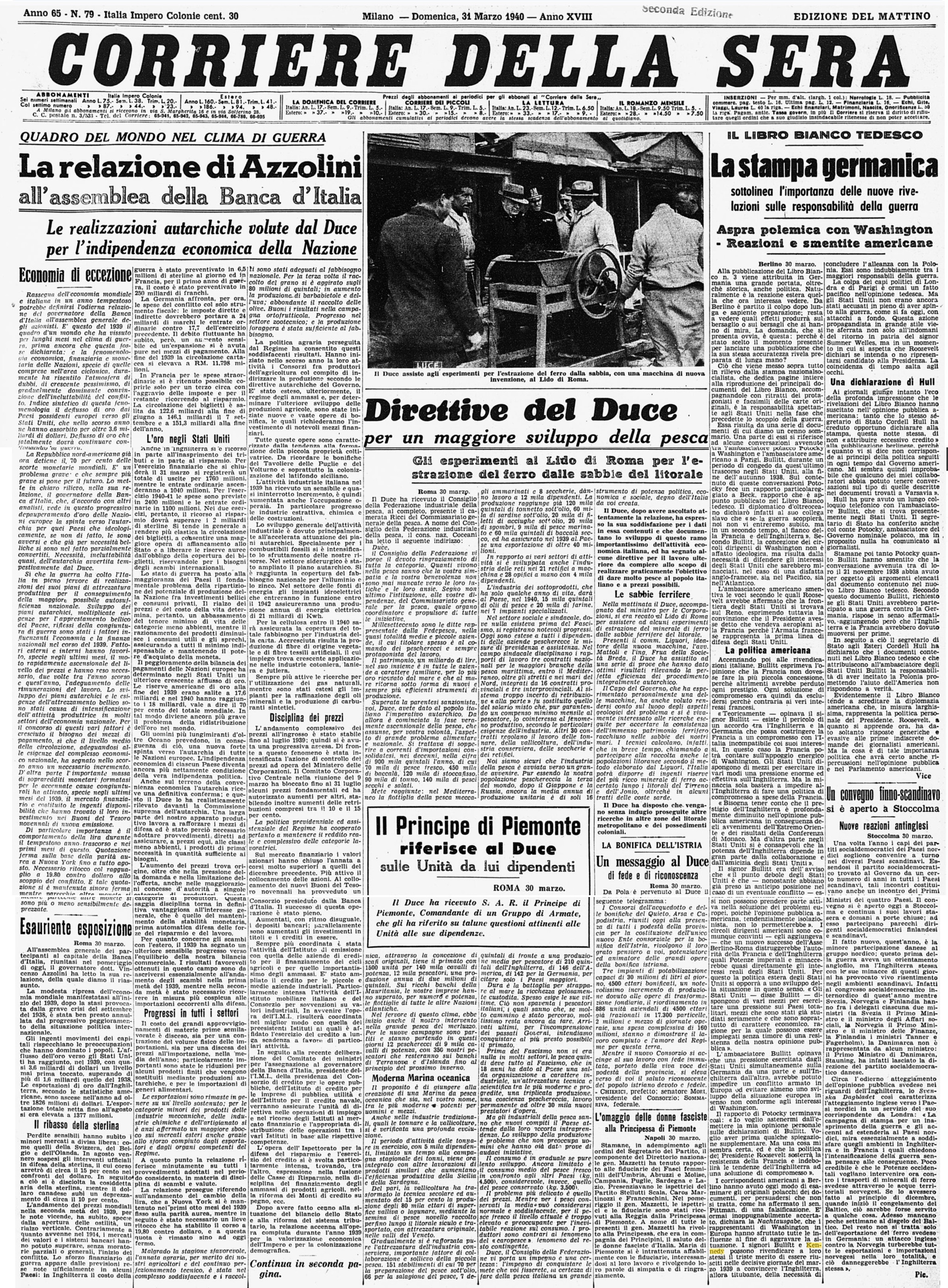
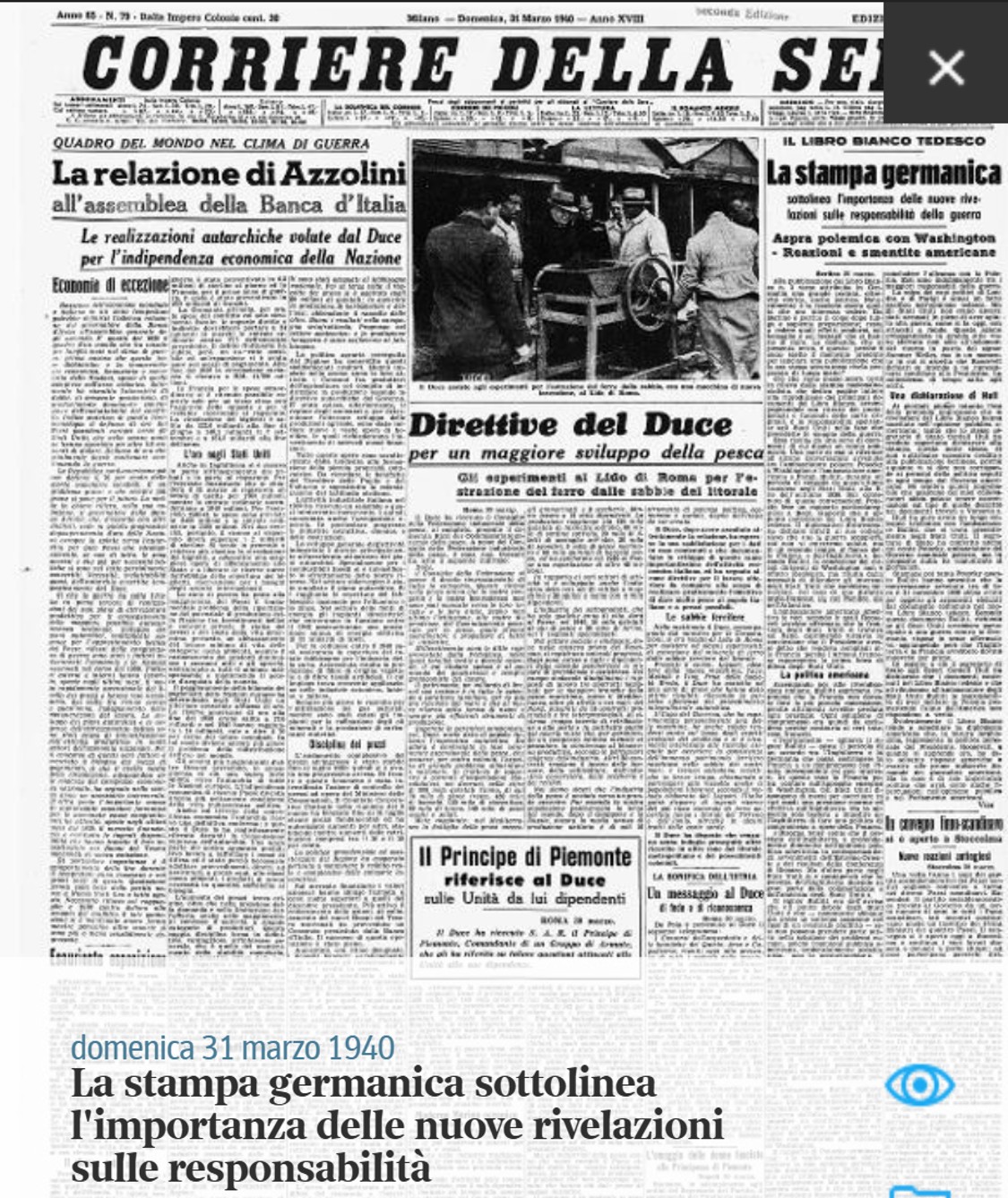
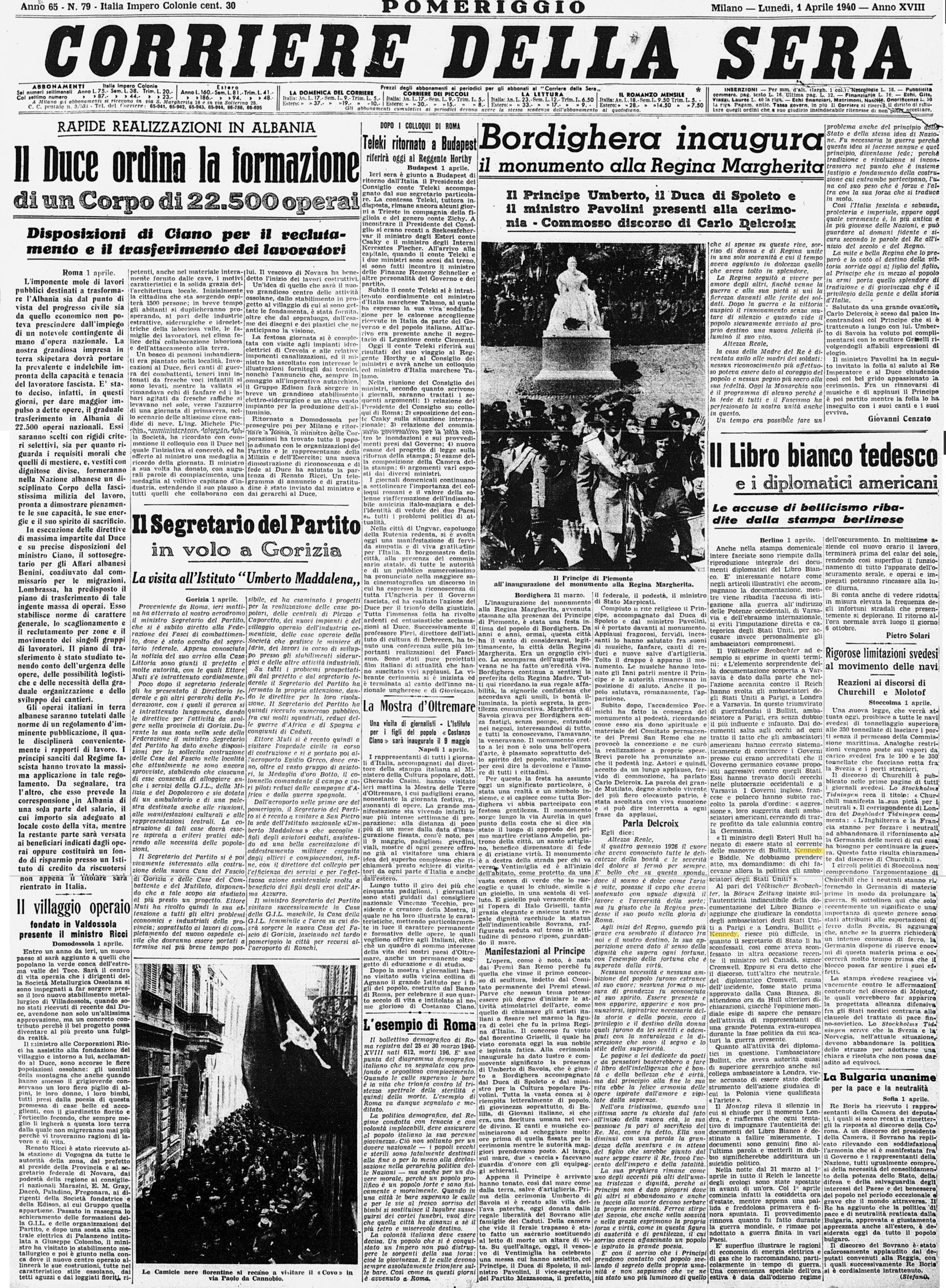
Sunday, March 31, 1940. Article (correspondence from Berlin): "The German White Book: The German press highlights the significance of new revelations regarding responsibility for the war — Sharp controversy with Washington — American reactions and denials." Summary of the article: ° The German press campaign regarding "White Book No. 3": In Berlin, great historical and political importance is being attributed to the publication of the new White Book, which contains seized Polish diplomatic documents. The National Socialist press openly accuses the United States of having pushed for war in 1938–1939, claiming that conversations held by American ambassadors influenced the decisions of the Western powers. ° Denials from Cordell Hull and Washington: Secretary of State Cordell Hull has issued an official statement downplaying the significance of the documents published in Berlin, asserting that they do not align with the principles of American policy and that U.S. diplomacy never encouraged war, nor did it promise military aid in violation of the nation's neutrality. ° Focus on Joseph Kennedy — Berlin’s accusations regarding the actions of Kennedy and Bullitt: In its commentary on the impact of these diplomatic documents, the Berlin press (specifically the *Nachtausgabe*) directly calls into question the conduct of the U.S. ambassador in London. According to the German argument, both Bullitt and Joseph Kennedy can "claim for themselves the dubious credit" for having succeeded—during the critical days of March 1939—in overcoming England's hesitations. |
|
1940, April 1 - Corriere della Sera |
||
|
|
|
Copy
of an article from the Italian daily newspaper *Corriere della Sera*,
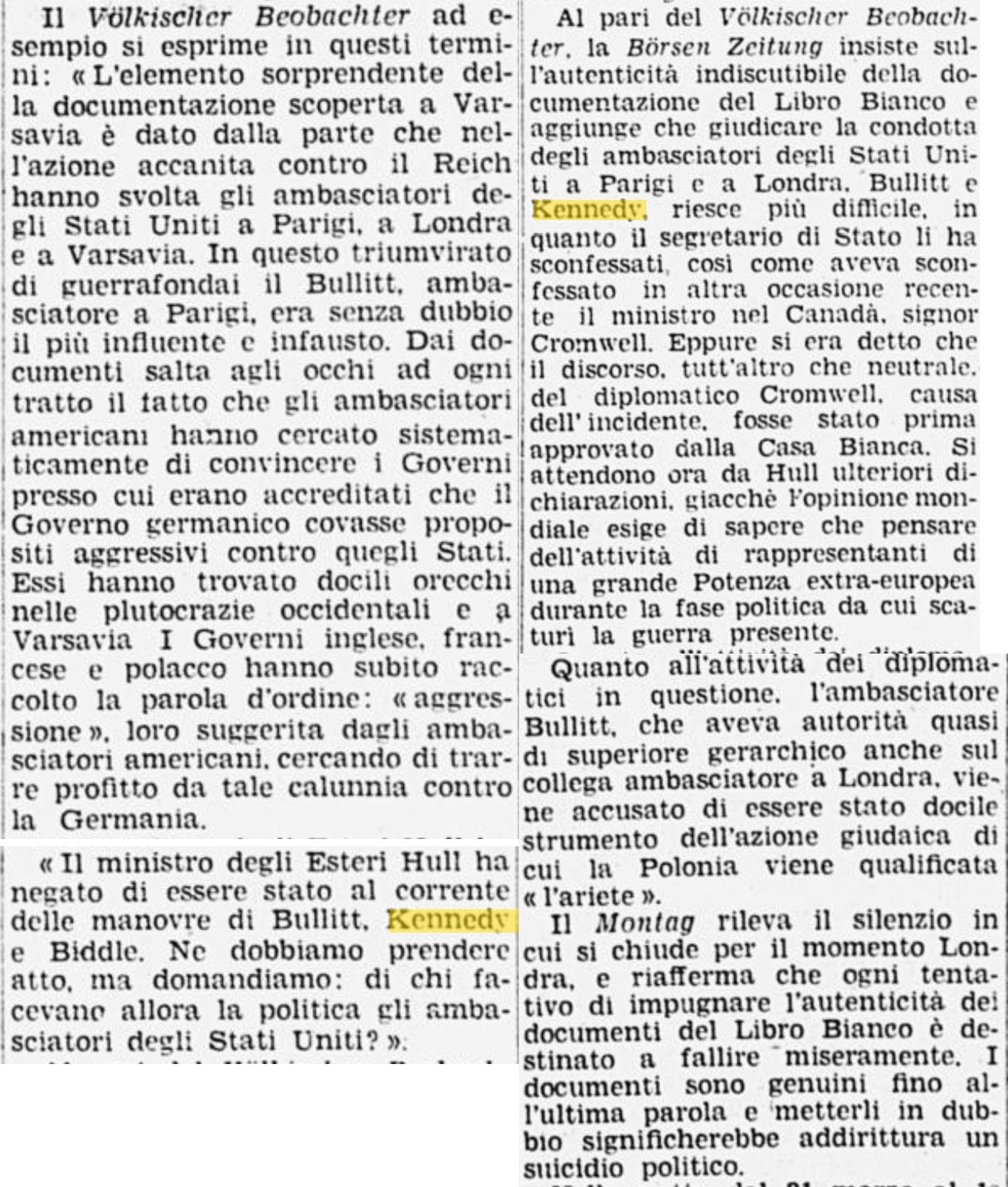
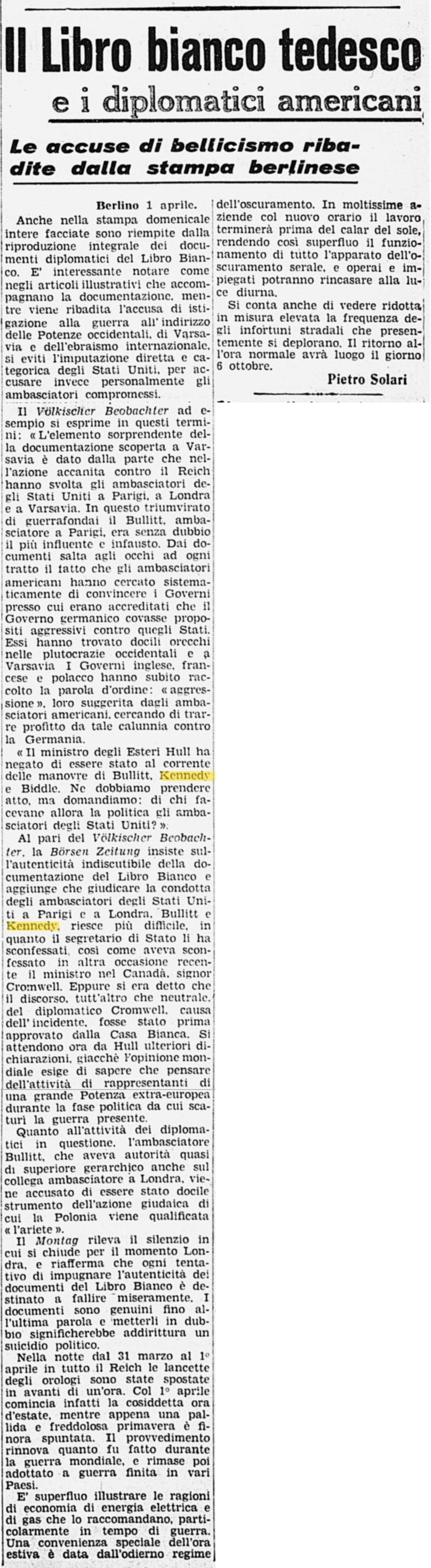
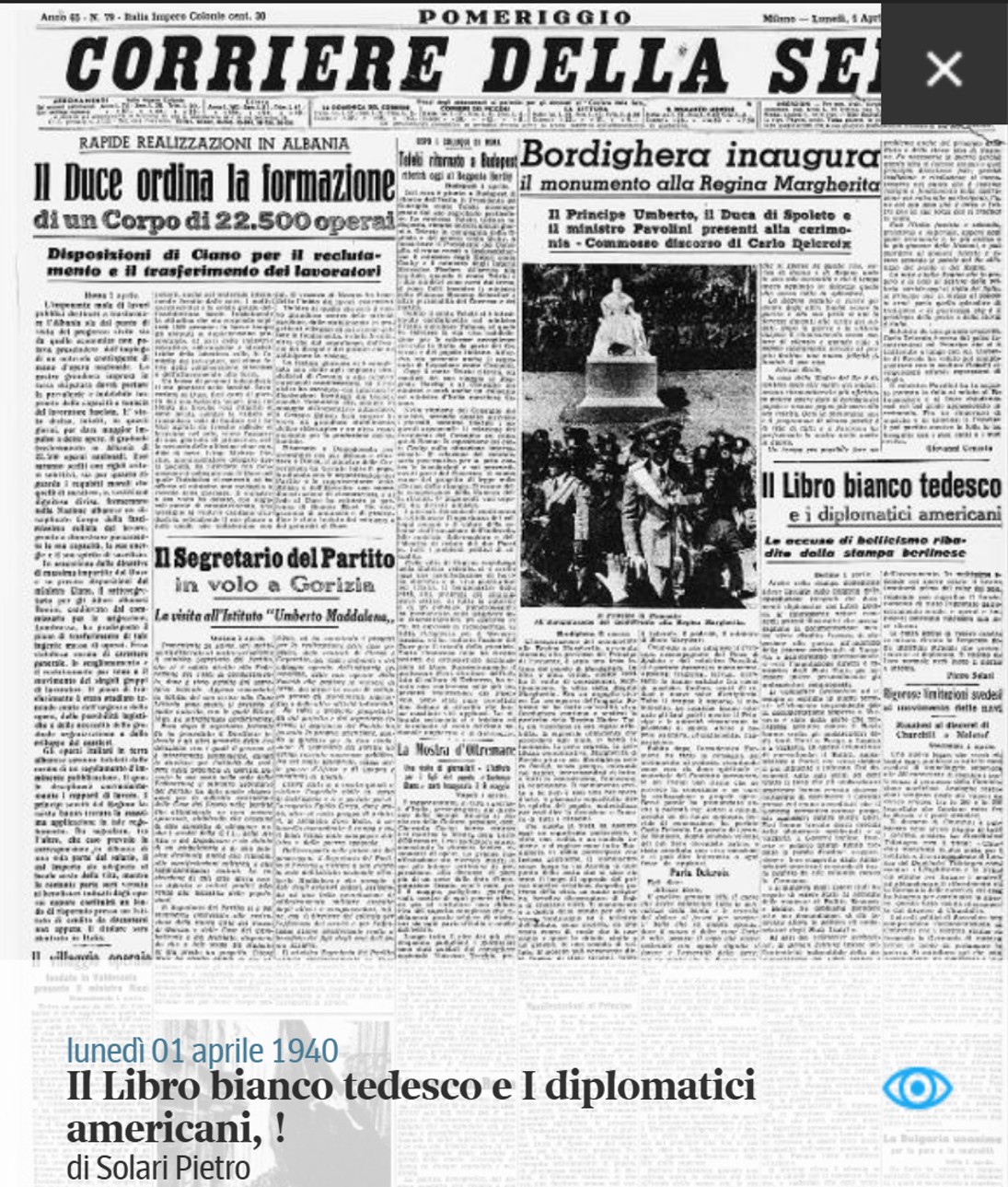
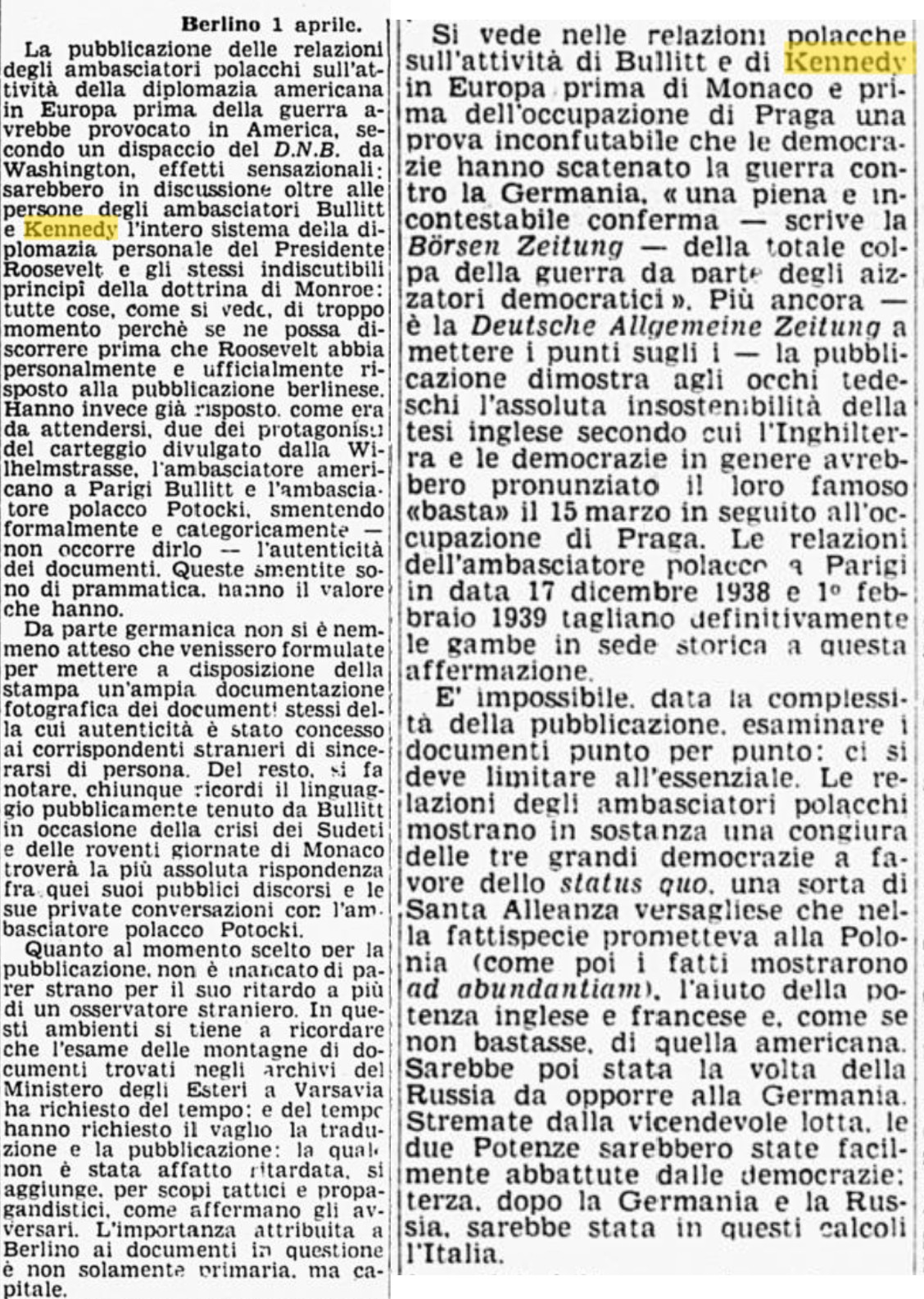
dated April 1, 1940. Article (correspondence from Berlin by Pietro Solari) titled: "The German White Book and the American Diplomats." Summary of the article: ° The ongoing press campaign in Berlin: The German Sunday press continues to give great prominence to the "White Book" published by the Third Reich, reproducing in full the Polish documents seized in Warsaw. The propaganda objective is to reiterate the accusation—leveled against the Western powers, Warsaw, and "international Jewry"—that they incited the war. ° Focus on Joseph Kennedy – The "war triumvirate" and the Nazi press offensive: The German press avoids making a direct, formal accusation against the United States government as a whole, choosing instead to focus its personal attacks on individual American ambassadors in Europe: The *Völkischer Beobachter* describes the American ambassadors in Paris (Bullitt), London (Joseph Kennedy), and Warsaw (Biddle) as a veritable "war triumvirate," alleging that they waged a relentless campaign against the Reich by pushing the governments to which they were accredited to adopt aggressive stances. In response to a denial by Secretary of State Cordell Hull—who claimed to have no knowledge of such maneuvers—the Nazi newspapers press the issue, provocatively asking who, then, was directing the policy of these American diplomats. The *Börsen Zeitung* asserts that it is impossible to justify the actions of the ambassadors in Paris and London—Bullitt and Kennedy—now that Hull himself has publicly disavowed them, much as he did in the case of the non-neutral statements made by the diplomat Cromwell in Canada. |
|
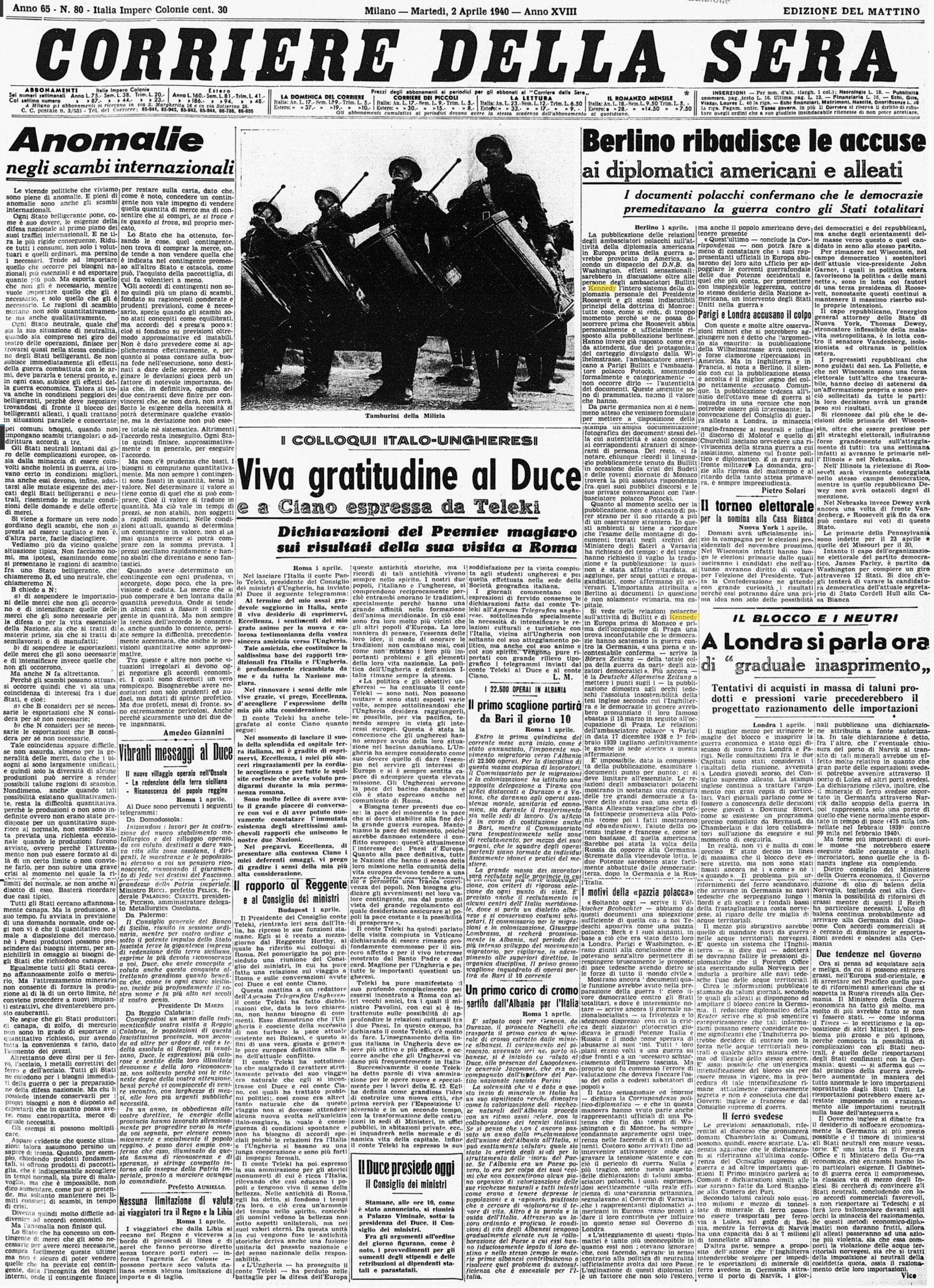
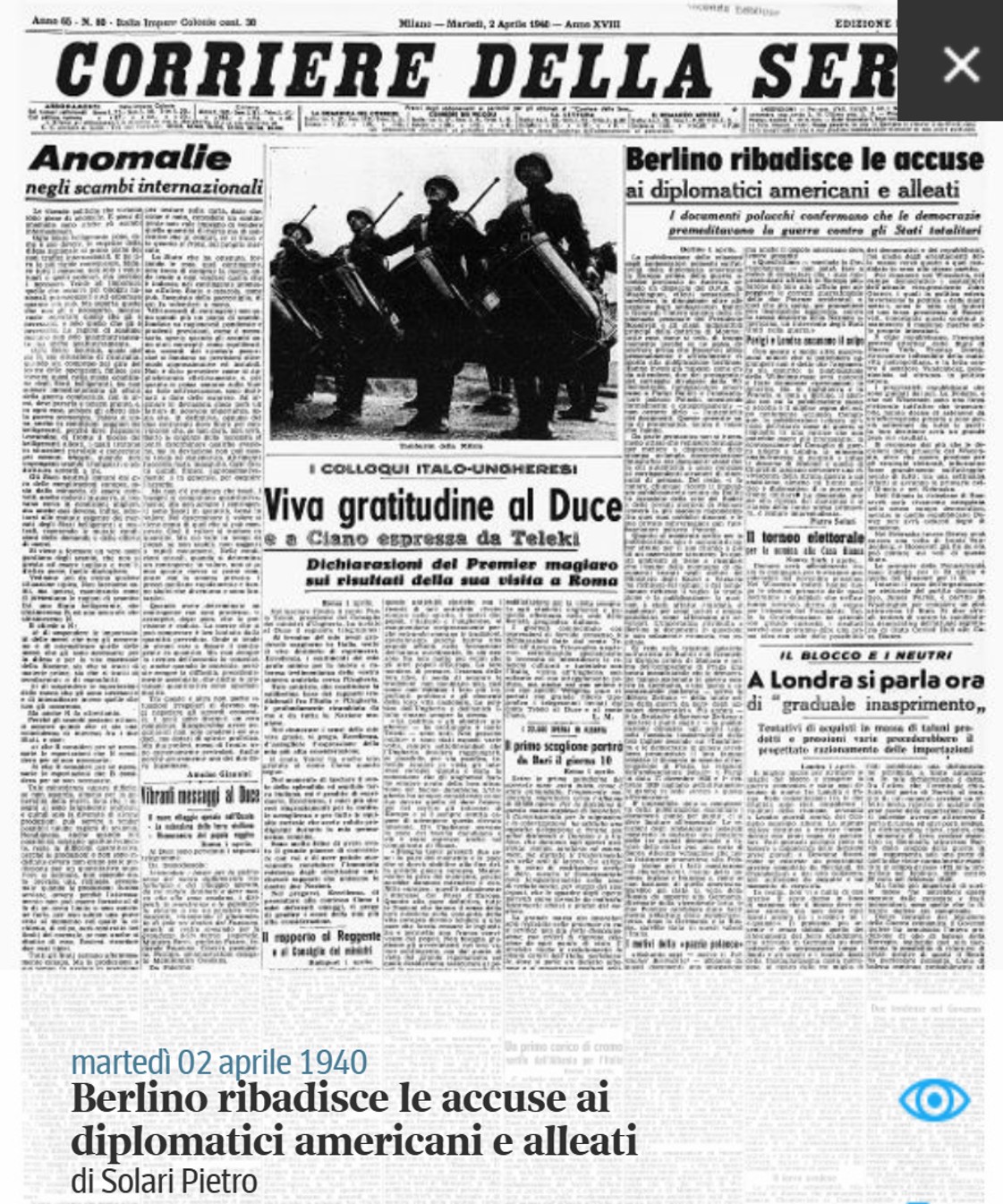
1940, April 2 - Corriere della Sera |
||
|
|
|
Copy
of an article from the Italian daily newspaper *Corriere della Sera*,
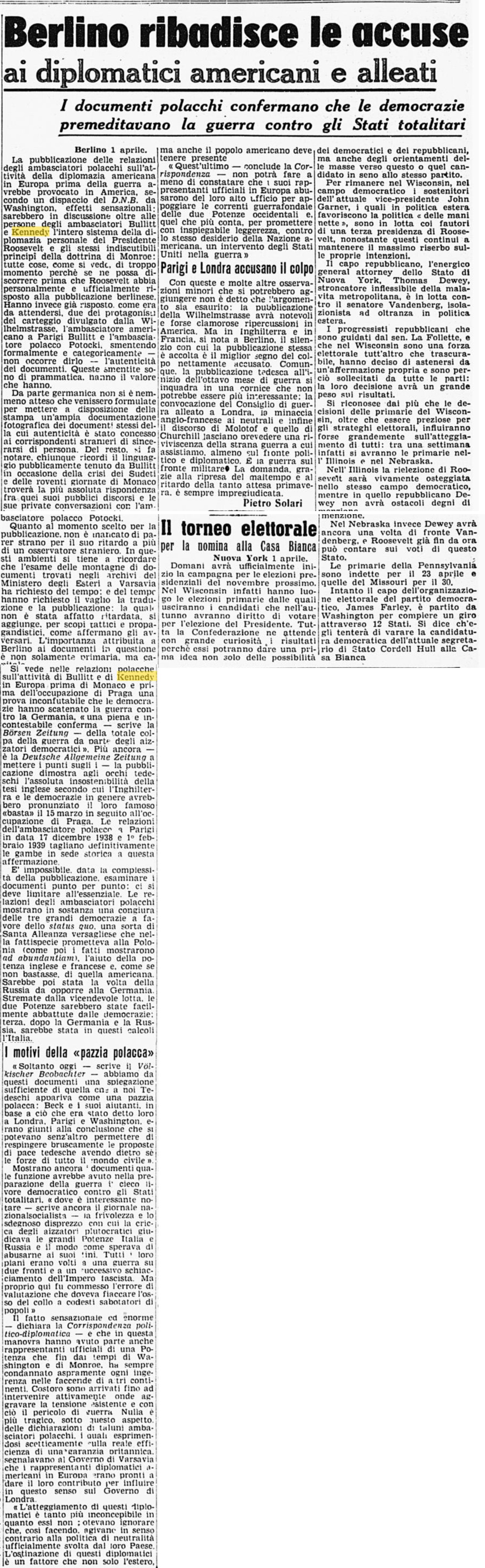
dated April 2, 1940. The article (a dispatch from Berlin by Pietro Solari) is titled: "Berlin Reaffirms Accusations Against American and Allied Diplomats – Polish Documents Confirm That the Democracies Premeditated War Against Totalitarian States." Summary of the article: ° Repercussions in the United States and denials: The publication of reports by Polish ambassadors regarding the actions of U.S. diplomats in Europe prior to the conflict has caused a major stir in the United States. According to German propaganda, this affair calls into question not only individual diplomatic representatives but also President Roosevelt’s entire personal diplomacy and the principles of the Monroe Doctrine. The article notes that the formal denials issued by Ambassador Bullitt and Polish Ambassador Potocki are dismissed in Berlin as mere perfunctory statements devoid of any real substance, given that the *Wilhelmstrasse* (the German Foreign Office) has made photographic reproductions of the original documents available to foreign correspondents. ° Focus on Joseph Kennedy – Evidence against American ambassadors: The correspondent highlights how the German press is using documents seized in Warsaw to directly target the actions of the U.S. Ambassador in London: Polish diplomatic reports concerning the activities of Bullitt and Joseph Kennedy in Europe—prior to the Munich Conference and the occupation of Prague—are presented by German newspapers (such as the *Börsen Zeitung*) as irrefutable proof that the democracies premeditated and unleashed the war against Germany. According to Berlin, these accounts regarding the actions of Bullitt and Kennedy definitively refute the British argument that England only changed its stance following the occupation of Prague in March 1939. ° The background to the "Polish madness" and the silence from London and Paris: The article cites commentary from the *Völkischer Beobachter*, which asserts that the Polish government—Beck and his associates—was encouraged to reject German proposals precisely because of assurances received from London, Paris, and Washington. Furthermore, the silence with which London and Paris have greeted this publication is interpreted in Berlin as a sign that the Allies have felt the impact of this propaganda blow at the start of the eighth month of the war. |
|
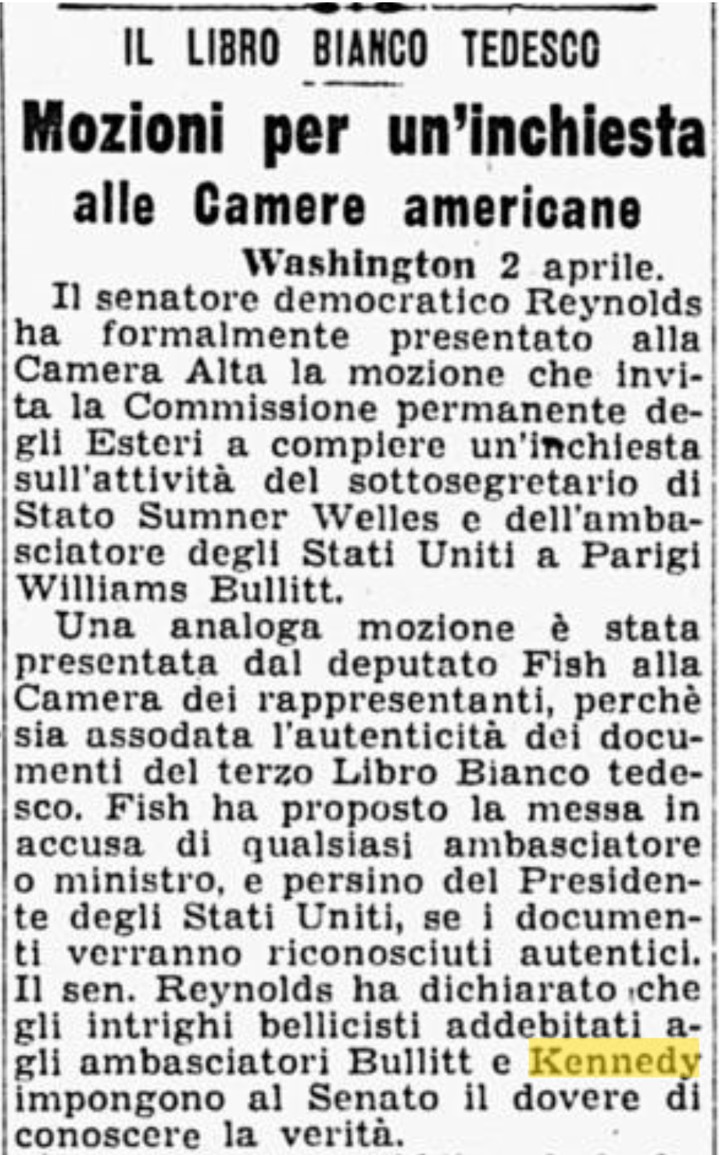
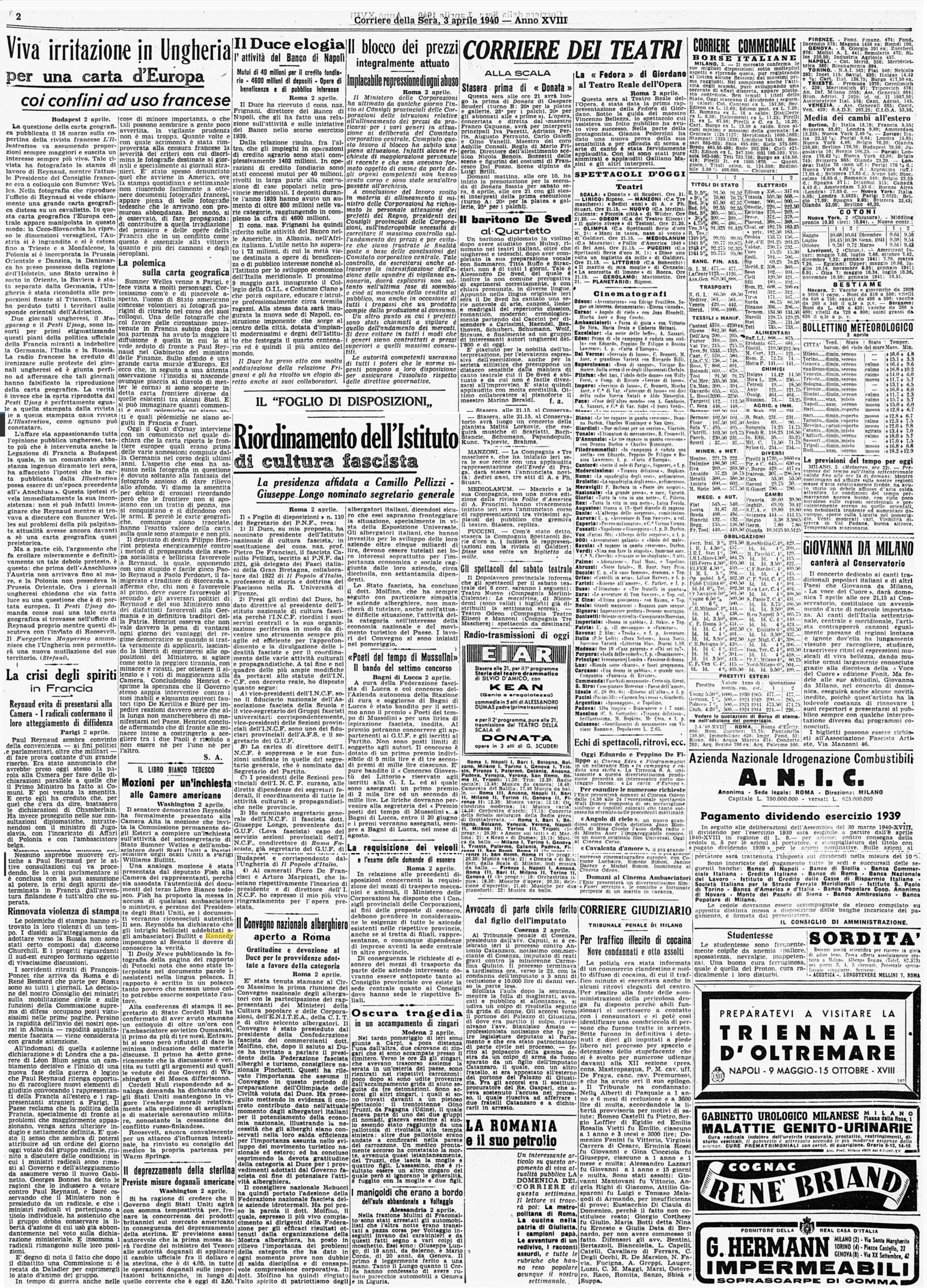
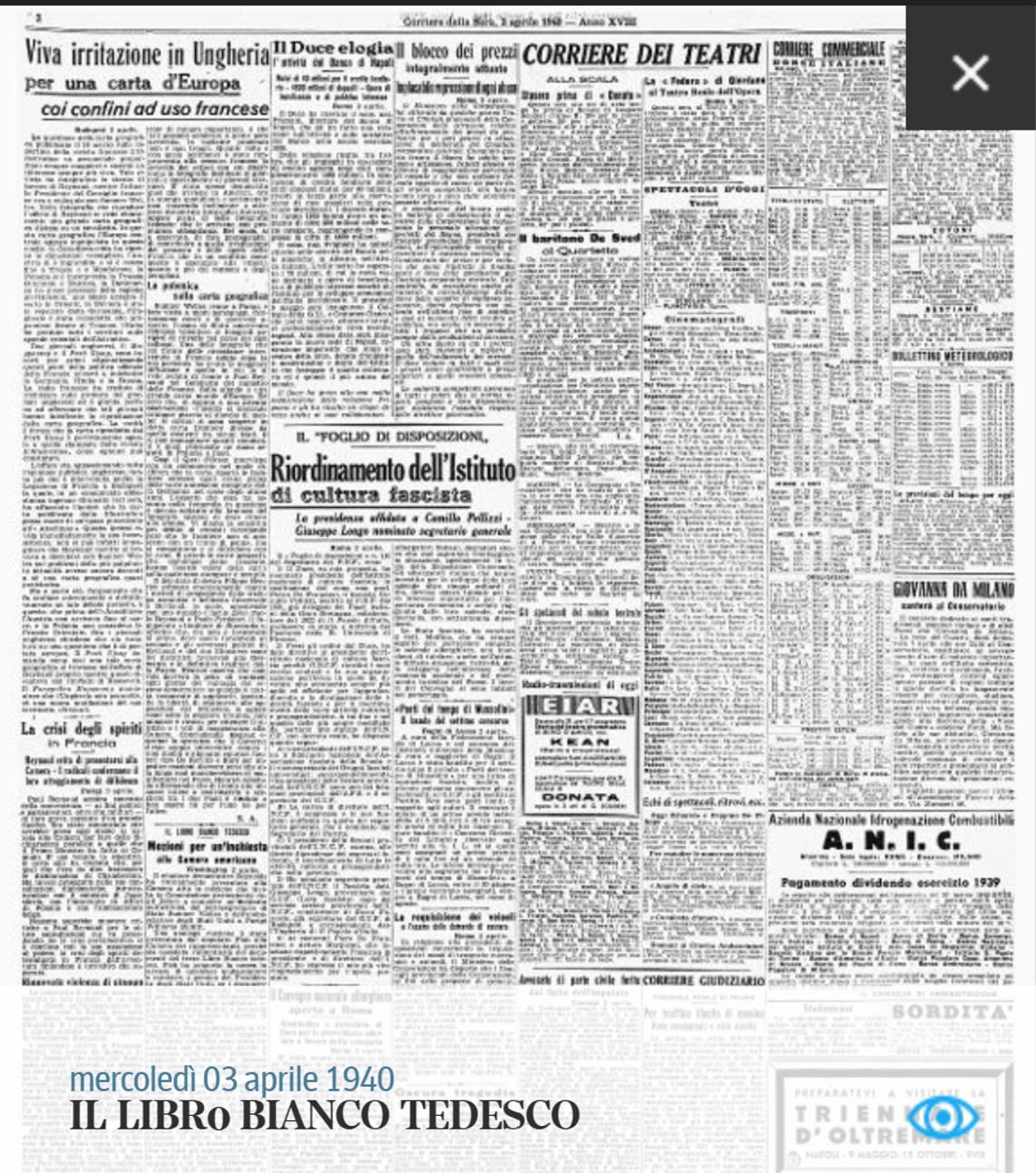
1940, April 3 - Corriere della Sera |
||
|
|
|
Copy
of an article from the Italian daily newspaper *Corriere della Sera*,
dated April 3, 1940. Article (correspondence from Washington, April 2) titled: "The German White Book – Motions for an Inquiry in the American Houses of Congress" Summary of the article: ° Motions for an inquiry in the U.S. Congress: Following the publication of the third German White Book, Democratic Senator Reynolds submitted a motion to the Senate calling for the Standing Committee on Foreign Relations to investigate the actions of Undersecretary Sumner Welles and the U.S. Ambassador to Paris, William Bullitt. In the House of Representatives, Congressman Fish filed a similar motion to verify the authenticity of the documents published in Berlin, going so far as to propose the impeachment of ambassadors, ministers, or even the President, should the texts prove to be genuine. Focus on Joseph Kennedy – The Senate’s duty to ascertain the truth: In justifying his parliamentary initiative, Senator Reynolds also directly implicated the U.S. Ambassador to London: Reynolds explicitly stated that the "warmongering intrigues" attributed to Ambassadors Bullitt and Joseph Kennedy impose a duty upon the American Senate to shed full light on the matter and uncover the truth. |
|
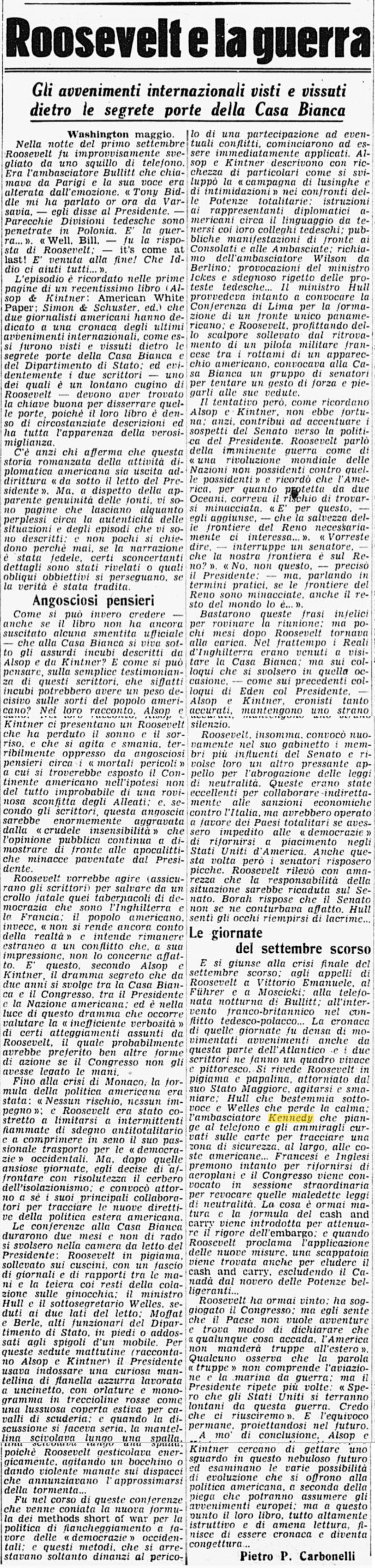
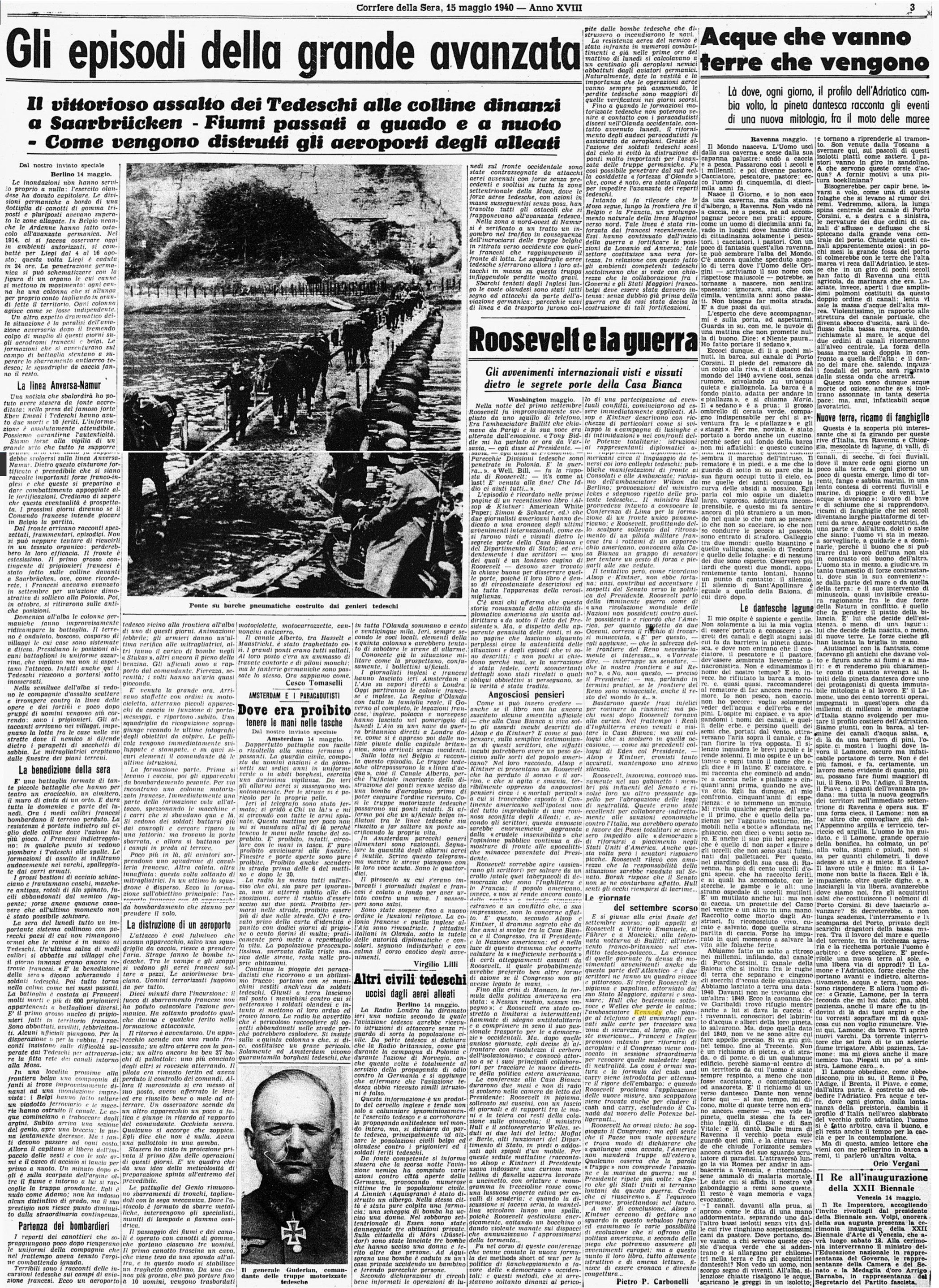
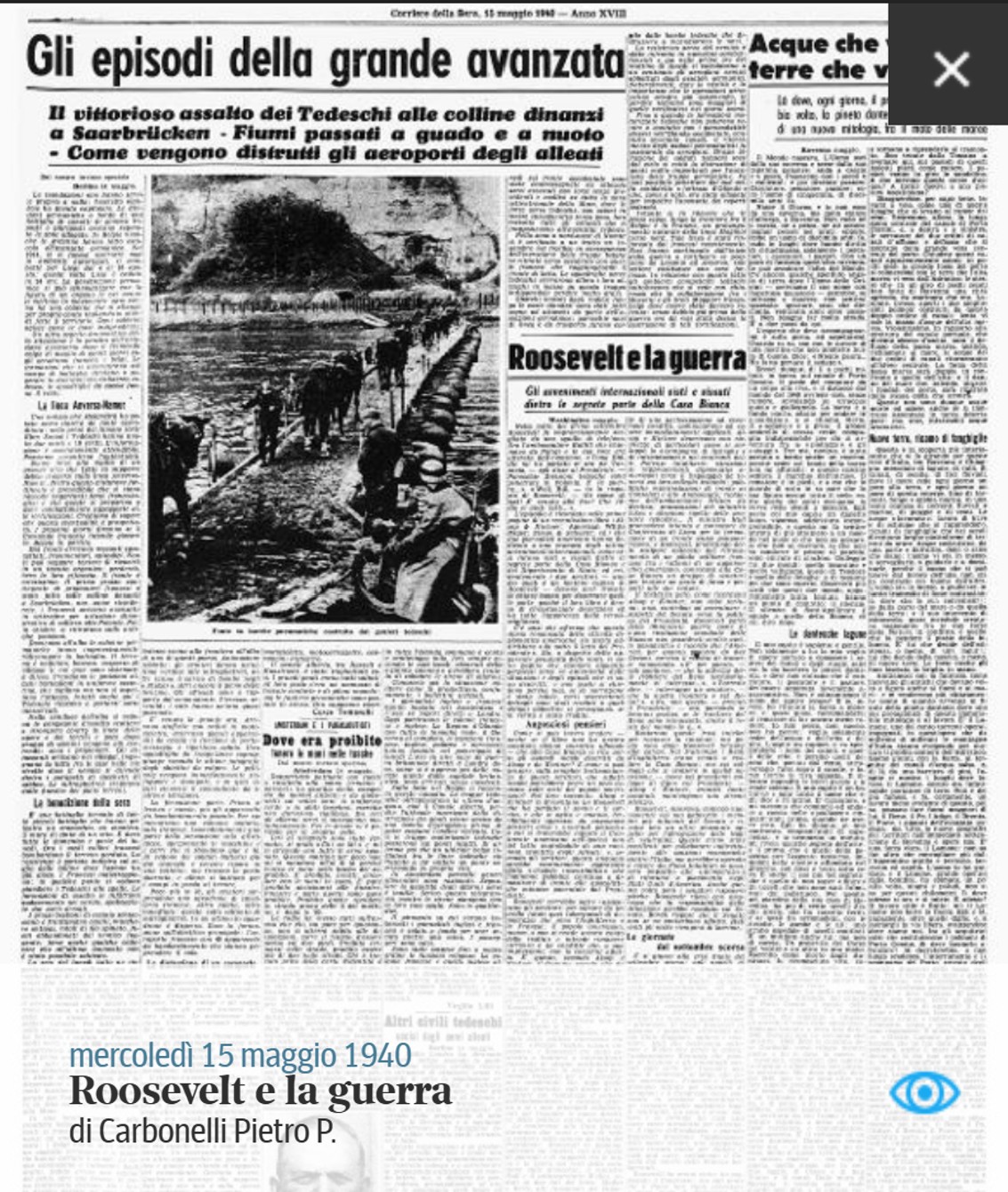
1940, May 15 - Corriere della Sera |
||
|
|
|
Copy
of an article from the Italian daily newspaper *Corriere della Sera*,
dated May 15, 1940. The article (a dispatch from Washington by Pietro P. Carbonelli) is titled: "Roosevelt and the War – International events as seen and experienced behind the closed doors of the White House." Summary of the article: Here is a summary of the article: ° The book *American White Paper* and the behind-the-scenes workings of the White House: The article examines a recent volume by journalists Joseph Alsop and Robert Kintner, titled *American White Paper*—a detailed chronicle, reportedly compiled under the supervision of the President himself, regarding American diplomatic maneuvers between the Munich crisis and the outbreak of war in September 1939. The text describes morning meetings held in Roosevelt’s bedroom (with the President in his pajamas and a skullcap) alongside his close aides, as they devised a strategy of "methods short of war" to support European democracies—a policy that encountered firm isolationist opposition from Congress and the Senate regarding the repeal of neutrality laws. ° Focus on Joseph Kennedy – The tense days of September 1939: In a section titled "The Days of Last September," the journalist recounts the vivid picture painted by the American authors regarding the most dramatic moments at the onset of the conflict: It describes the feverish atmosphere surrounding Roosevelt and his inner circle during the invasion of Poland and the subsequent intervention by France and Great Britain—noting, for instance, Cordell Hull muttering curses under his breath and Sumner Welles losing his characteristic composure. In this frantic scenario, Ambassador Joseph Kennedy enters the scene—depicted "gasping into the telephone" while on the line from London to update the White House on the unfolding crisis—as American admirals lean over maps to plot a security zone along the U.S. coastline. |
|
1940, May 18 - Corriere della Sera |
||
|
|
|
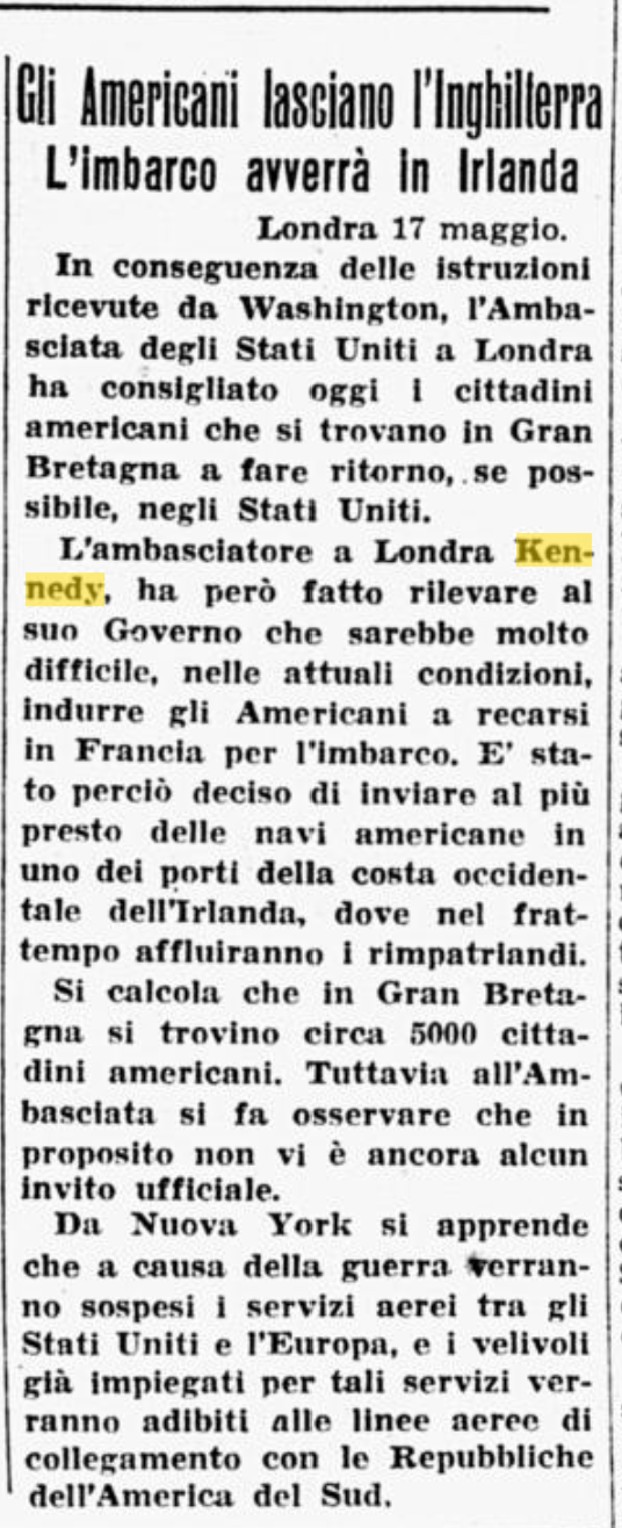
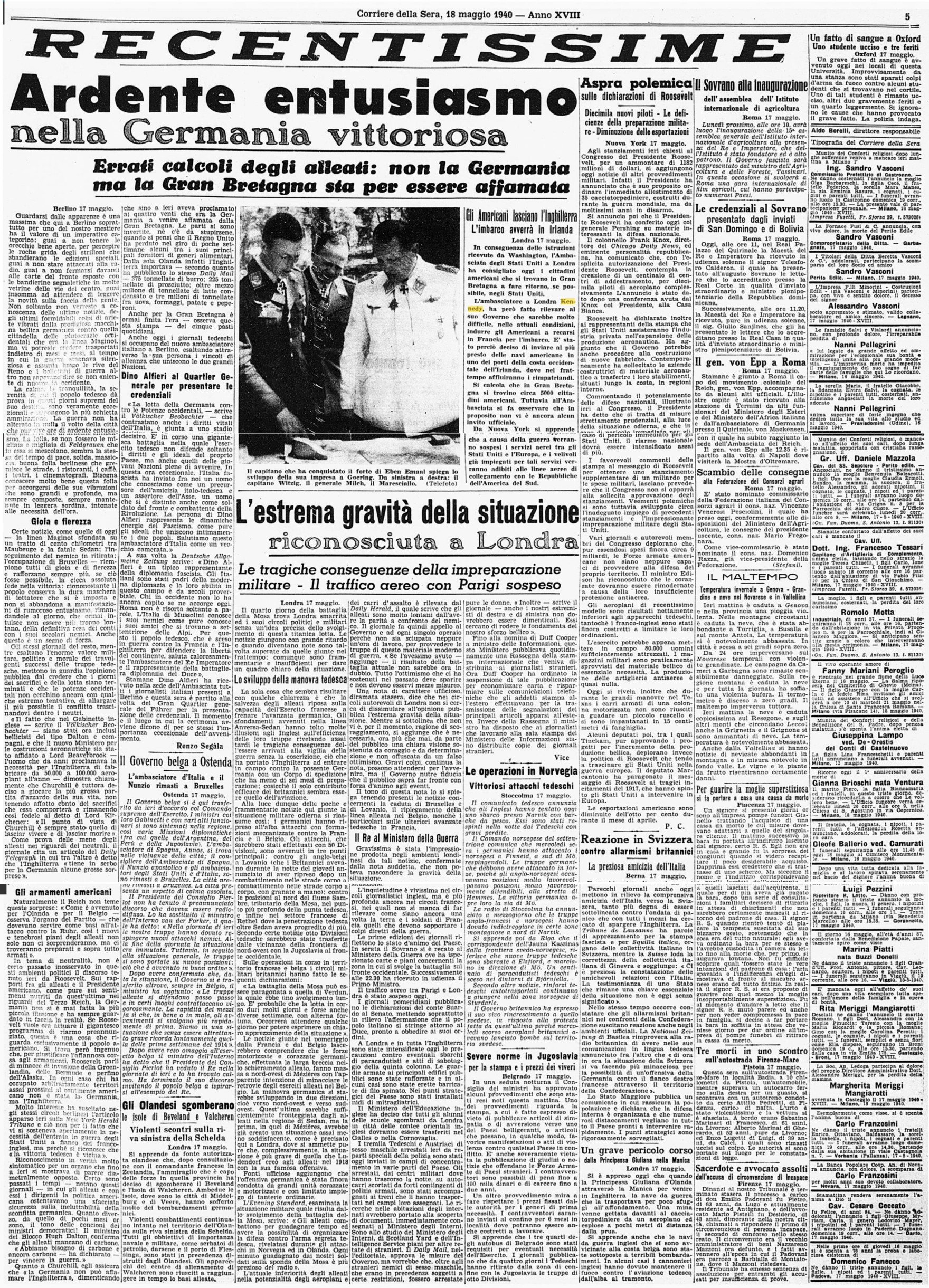
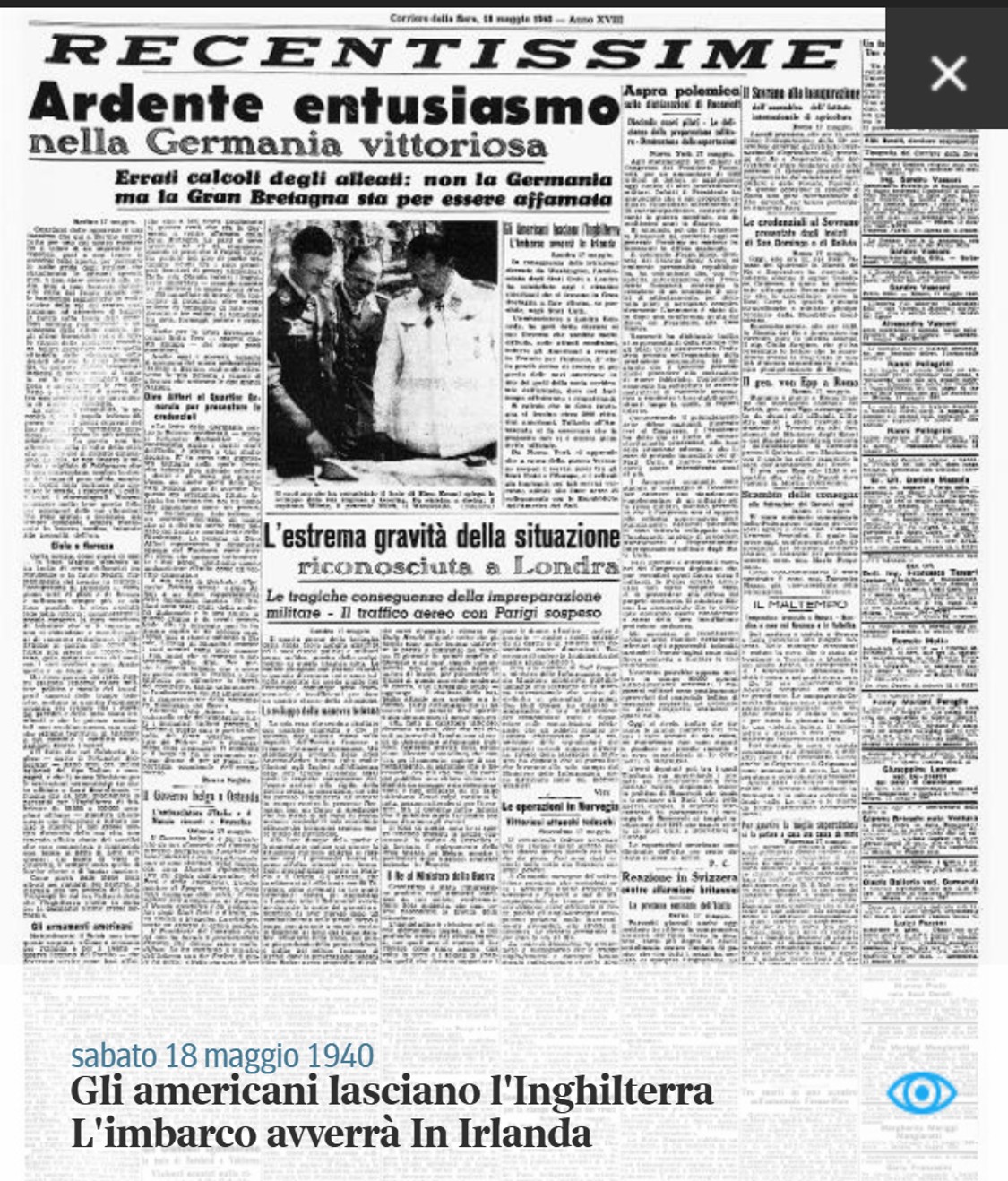
Copy
of an article from the Italian daily newspaper CORRIERE DELLA SERA, dated
Saturday, May 18, 1940. Article (from London, May 17) titled: "Americans Leaving England – Embarkation to Take Place in Ireland." Summary of the article: ° Call for U.S. citizens to return home: Acting on instructions from Washington, the United States Embassy in London has advised American citizens currently in Great Britain (estimated at approximately 5,000 individuals, though no formal summons has been issued) to return to the United States, if possible. ° Logistical solution—embarkation in Ireland: In light of the worsening war situation on the European continent, U.S. Ambassador to London Joseph Kennedy intervened directly regarding operational arrangements. Kennedy pointed out to his government that, given current wartime conditions, it would be extremely difficult to persuade American citizens to travel to France for embarkation. Accepting the Ambassador’s assessment, it was decided that American ships would be sent as soon as possible to a port on the west coast of Ireland, where those returning home would gather. |





Back to Top Back
to Biagio's J.F.Kennedy Home Page

Biagio Privitera's Home
Page. You can contact me at
biagio@biagioprivitera.it